




This story, “My Secret of Summertime Escape,” appeared in the June 1965 issue of Outdoor Life.
One bright June day several summers ago, my son Park and I tossed some camping gear into our 14-foot outboard boat and began an adventure on Utah’s Green River which neither of us will ever forget. Nor will Bill and Lee Howland, father and son, who are ranchers from Green River village. They accompanied us in another boat. For the next five days, the four of us explored Canyonlands, which only last year became our newest National Park.
The trip downstream carried us through 100 miles of awesome canyons and hidden river bottoms to the point where the Green pours into the Colorado River. At this junction, we turned northward up the Colorado for the 90-mile run to Moab, Utah, and the end of the trip. Along the way, we stopped to poke into long-forgotten gold mines, caught good strings of channel catfish, and scaled red-rock walls to see Indian pictographs which few other humans had ever seen before.
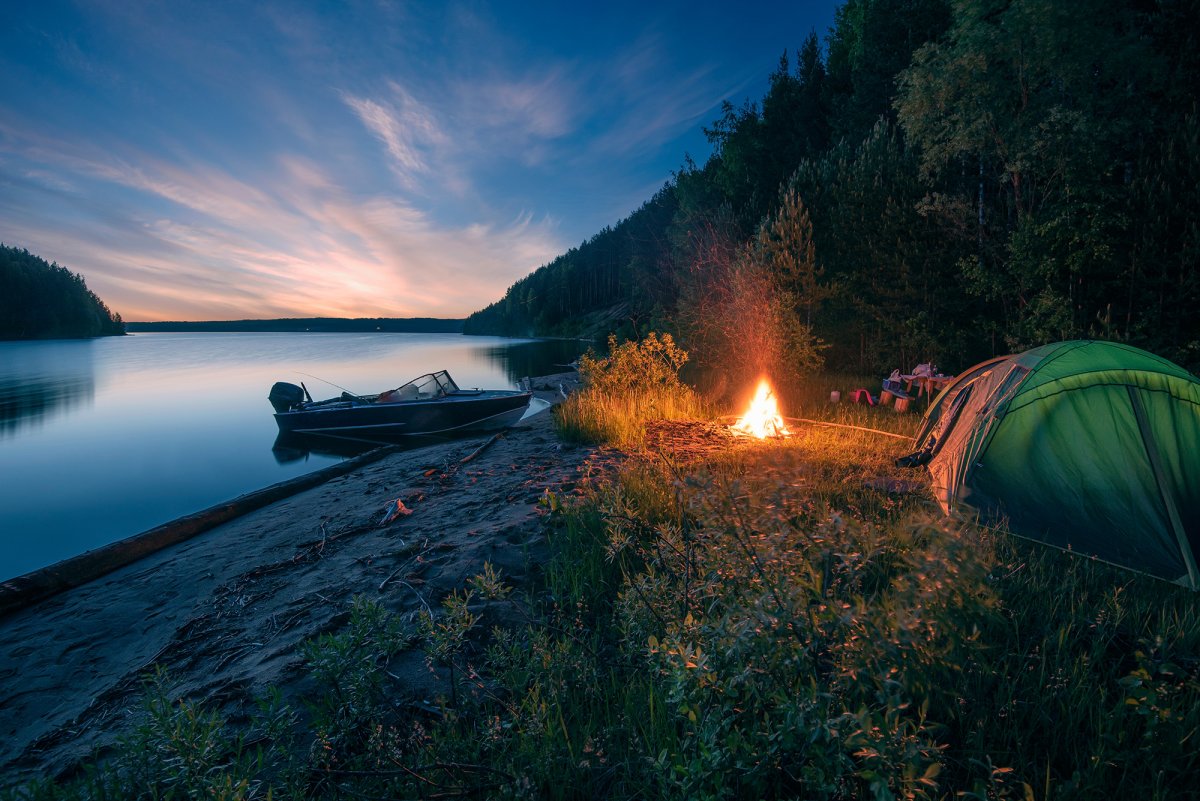
We also climbed to look into the ancient crumbling cliff houses of the Mokies, the small people who once inhabited the Green River country before the Indians but who mysteriously vanished many centuries ago. Our camps were the nearest level banks or sand bars when night began to fall. We brewed coffee over campfires of piñon and unrolled sleeping bags under the stars.
By carefully banking the fire at night, we always had enough embers by morning to start a breakfast fire. Even in that sun-bleached, desert land, summer mornings can be cold. Once fortified with food, we would reload our gear in the boats, start the outboards, and continue our trip through some of the most magnificent scenery on earth.
Sometimes the current was slow and gentle, other times it was fast and rough, especially at The Slide, the site of a collapsed canyon wall near the Green-Colorado junction. Some of the most striking scenes were the scarlet cliffs near Anderson Bottom and Dead Horse Point, where the vertical distance from the river’s edge to the rim of the canyon exceeds 1,000 feet. On the entire 190-mile trip, the only other travelers we saw were the many mule deer commuting daily between browse in the bottoms and bedding sites in the cliffs.
“We’ve found the secret of summertime escape,” Bill Howland remarked near the end of the trip.
We had indeed. By the simple technique of boat camping, we had escaped from all that is ordinary. We shared a great adventure, and we viewed a region of unusual natural beauty from a fresh angle. It was also a very inexpensive trip. To tell the truth, it was an adventure which anyone, or any family, with camping gear, a boat, and reasonable skill in boat handling could duplicate.
Since that trip, I’ve never missed any opportunities to go boat camping. I’ve boat-camped my way around the Bass Islands of Lake Erie, which is much nearer to my home in Columbus, Ohio, and I have traveled as far as Montana’s Missouri River and Fort Peck Reservoir to enjoy more of the same. Boat camping deserves to be discovered by more outdoor people.
There is no set formula to follow in taking a boat-camping holiday. For example, you may actually camp aboard your boat or on shore. This depends largely on the size of the boat, the number of persons in the party, and how easily a boat can be converted for overnighting.
Nowadays, there are numerous boats on the market which are ideal for camping. This is especially true of the many boats designed for fishing. They are fairly open models and have ample room for an angler to move around in. Once the tackle is stored, it’s no problem to raise a top on one of these boats, then unroll a couple of polyurethane foam mattresses and bedrolls right on the floor. These boats can be used for camping whether afloat or on a boat trailer. The latter is a good point to consider because it can save motel bills when trailering to a boat-camping destination.
Not much gear is needed to convert a roomy fishing boat into a camper for two or three persons. An overhead cover, which can be fabricated in a home workshop from aluminum tubing, C-clamps, and light canvas, is important if the boat is not a cabin model or does not have a collapsible top. However, this isn’t absolutely necessary in areas where the weather is predictably dry. But you will need a bedroll apiece, a small cook stove, cooking utensils, and dishes. It’s also convenient to have a small cooler (which might be built-in and sometimes serve as bait container), a lantern, and maybe mosquito netting.
Much valuable space can be saved by carefully selecting gear with your boat or boating always in mind. For example, a nesting set of utensils, pots, and pans will require less space than assorted unmatched pieces. Select a stove which will fit neatly into an odd area on the boat. Measure the odd areas and keep the measurements in mind as you shop. Nowadays, foam mattresses are available with roll bars which permit rolling them into tidy bundles.
Last winter, John Oney and I had a chance to check out a fishing boat as a camper. The place was the Naples Bay area of Florida, and actually our main interest was in fishing the Marco and Caxambas Pass area, but we found it was just as pleasant as it was easy to live aboard the boat. That way we also saved plenty of running time between lodgings on shore and good fishing areas. We just beached the boat somewhere each night and used the running time for more exploring or fishing.
This was almost an idyllic boat-camping adventure, except for a day or so of unseasonably cold weather. We did not have the greatest fishing, but we always had more fresh channel bass and sheepshead fillets than we could cook. One afternoon, on a very low tide, John and I walked the flats along a tidal basin and gathered enough oysters for a feast. We ate a couple of dozen raw and baked the rest over driftwood coals.
The success of any boat-camping venture rests on planning and a little research. Our Naples Bay trip might not have been so pleasant in midsummer when insects could have been a nuisance. But with enough netting and repellent, a party of campers might not be annoyed by them. One night some mosquitoes came buzzing around our bedrolls, so John and I just anchored the boat in open water where a steady breeze drove the critters away.
In the past few years, America’s growing band of campers has often complained about the lack of camping facilities and about the failure of governments to provide campsites. In some instances, they have been justified. Lately, many campgrounds have been crowded and in some cases overcrowded. Boat camping takes a person away from all the congestion.
About a year ago, in July, it seemed that my two sons and I had almost all of 100-mile-long Fort Peck Reservoir in Montana, plus another 100 miles of the Missouri River, entirely to ourselves. That may sound hard to believe, but it’s true.
We launched our outboard not far from Glasgow near Fort Peck Dam. About 50 or 60 boats were docked there and considerable cruising and water skiing was concentrated in the area. But once we pushed up the lake, we left everybody behind. That’s a shame, too, because on this lake a party can camp anywhere on any shore at anytime without formality. They can have vast areas, whole fjordlike bays, and lonely islands all to themselves.
We found two families camping together on an island midway up Fort Peck Lake. The children were as brown as roasted chestnuts from fishing, swimming, beachcombing, and rock-hounding for agates. The parents looked as if they had inherited the earth.
“My vacation is over tomorrow,” one of the parents told me, “but I don’t know how we’ll get the kids to go home.”
I knew what he meant. I had the same trouble last fall when it came time to end a camping cruise around the Bass Islands in Lake Erie with my youngest son, Bob. Sometimes I suspect that boy lives 10 days a week when he’s camping.
Mostly because a smaller boat can be used, most boat camping may be a case of setting up a waterfront camp on shore rather than living on the boat. As a random example, a family of four or five with a 16-foot runabout can carry enough gear for a week or even two weeks of comfortable camping. Except for also needing a tent, their requirements are similar to those who prefer to live aboard. But they probably have the luxury of being able to carry extra items to make the trip more comfortable.
Though many boat campers prefer just to set up a tent somewhere, then use it as a headquarters for fishing or other activities, it’s more adventuresome to choose a different campsite each night. This is easily possible everywhere, but it poses a few problems. Fuel is one of them.
First, it’s necessary to decide where to go. After you’ve done so, it is helpful to write for charts or maps. Most state conservation or watercraft departments have detailed boating maps of their inland lakes, free or at small cost. Topographic maps of any part of the United States are available from the U.S. Geological Survey, Washington 25, D.C. Charts of the Great Lakes are available from the U.S. Engineer Department, 630 Federal Building, Detroit 26, Michigan. Maps of coastal waters are available from the U.S. Coast and Geodetic Survey, Washington 25, D.C. Most large petroleum companies also have excellent boating and navigation maps available free in their service stations. These are often the best of all because they show locations of marinas, campgrounds, and similar recreation areas.
Once you have outlined your trip, you have to figure your fuel requirement, plus extra fuel as emergency. In many cases, it’s possible to obtain fuel along the way, as on the Great Lakes and most of the popular boating areas. If not, it’s a case of carrying extra fuel in spare cans or maybe of installing spare tanks right in your boat. Many boat campers prefer to do this as a space saver. If the boat is an outboard, use spare fuel tanks of the type ordinarily sold with your motor. These tanks have fuel lines which clamp directly to the motor, and no funnels or pouring is necessary.
Drinking water is a problem virtually everywhere, and a supply must be carried if the camping is to be away from designated campgrounds. In many areas, the lake or river water is safe enough for washing or perhaps even for cooking if vigorously boiled. But never take chances. Take drinking and cooking water along, or buy a portable water-purification outfit. Plastic bleach bottles, which are rugged, make excellent water carriers.
Food need never be a problem, thanks to all the fine canned, concentrated, dried, and freeze-dried products available today. It’s also possible to carry fresh foods if the cooler space and the coolant is readily available. But it never seemed worth that much bother to me. The prepared foods are far handier.
Considerable space can be saved aboard a boat by roughly planning and scheduling the trip’s menus in advance. Then buy groceries accordingly. Do not take too much. The more critical the space problem, the more you can depend on concentrated foods. These concentrated products are vastly more practical and tasty today than they were a few years ago. Most are delicious.
It’s not only practical but great fun to buy foods along the way. Most farmers will sell anything from fresh eggs and chickens to peaches and sweet corn. Make it a point to collect and use wild edibles when possible. Some good examples of these, frequently abundant, are wild berries, frogs, oysters, clams and crabs, watercress, dandelion and other wild greens, various nuts, crawfish, snapping turtles. On many occasions, just before retiring at night, Bob and I have set out bank lines for turtles, having turtle soup in mind. We’ve also been surprised how much fresh-water crawfish (very easy to catch, even by hand) taste like shrimp.
In many places, with emphasis on Western waters, boat camping can be on a pioneering basis. You can camp wherever you like and have the place to yourself. Elsewhere, with emphasis on the East and Southeast, it may be restricted to stopping at waterside public campgrounds or at private lands owned by persons who cater to boatmen. Such private facilities are becoming more numerous and widespread each season. Generally, if the land at the water’s edge is federally owned, leased, or controlled, a boatman has great freedom to camp as he pleases, keeping in mind the obligation not to litter or deface the area. Otherwise, a boatman should obtain permission before he camps.
If there is one single best inducement to go boat camping, it is the completely unlimited number of attractive places to do so. No sportsmen in the world have it so good nowadays as Americans who enjoy boating, camping, fishing, or any combination of the three.
Consider the TVA country in the mid-South, for example. You can launch somewhere in extreme eastern Tennessee, perhaps at Davy Crockett Lake, and spend the rest of the summer leisurely boat camping westward to giant Kentucky Lake near Paducah. On the way, you travel through no-closed-seasons fishing water, through beautiful changing scenery, and past more than 400 public-use areas, which include 13 state parks, 62 county parks and campgrounds, and many federal areas where unrestricted camping is permitted. Free boat passage is permitted through locks and dams of the various lakes that make up this vast chain.
Island areas are usually good places to go boat camping; Wisconsin’s Apostle Islands in Lake Superior is a good example. These islands are either uninhabited or only sparsely populated. But they’re exciting to visit, thanks to a rich historical background, and they are surrounded by good fishing. That also goes for the Cheneaux Islands of Michigan’s upper peninsula.
Virtually all of the giant reservoirs of the United States are splendid for boat camping. I’ve already mentioned Fort Peck. Some other good ones are Lake Mead on the Nevada-Arizona border; new Lake Powell formed by Glen Canyon Dam; Elephant Butte Reservoir in New Mexico; Lake Texoma in Texas; Missouri’s Lake of the Ozarks; Lake of the Woods in Ontario; Athapapuskow Lake and connecting water in Manitoba; Florida’s St. Johns River system; and Norfolk and Bull Shoals lakes on the Arkansas-Missouri border.
Boat campers seeking a place with great historical background and where nearby fishing is very productive might consider Gates of the Mountains on the Missouri River not far from Helena, Montana. One campground here, accessible only by boat and maintained by the U.S. Forest Service, is the exact site of a Lewis and Clark camp in 1806 during their journey to the Pacific. The giant palisades which loom above the campground once made the two explorers believe that they could go no farther, and they called it Gates of the Mountains.
The boat camper who wishes to visit wilderness, undeveloped places of haunting beauty, might consider a trip to Mexico and the Gulf of California. Here the rewards include extraordinarily bright weather, lonely islands, exquisite seascapes, abundant wildlife, sand beaches, perhaps the finest year-round fishing in the world, and complete escape. The Gulf is accessible either from the Mexico mainland or from the Baja California peninsula with launching at San Felipe. Campers will have no trouble trailering a boat into Mexico, but they must figure to be self-sufficient while cruising on the Gulf.
Read Next: I Was Floating One of the West’s Great Trout Rivers. Then the Governor Dropped in on His Helicopter
One last word of advice. If you are inexperienced at camping, or if you plan an ambitious boat-camping trip, it’s best to make a trial run first. Use a weekend for a shakedown cruise. Let the family get used to it and give yourself time to see about packing gear aboard the boat. It will be time and effort well spent.
Read the full article here
