




The snow-clad mountains ringing Lake Karluk looked down on the most surprised hunters south of the North Pole. It was only the third day of a trip that might last for weeks. And there in front of them was the writhing, twisting form of the biggest Alaska brown bear any of them had ever seen.
They hadn’t planned it that way. Actually, this was to have been sort of a reconnaissance trip for the three men from the Los Angeles County Museum. Melville N. Lincoln is chief curator of the museum; H.T. Beck, its taxidermist; and J. R. Sewell, its staff habitat-background artist. They were on Kodiak Island, Alaska, with a twofold purpose: first, to get suitable bear specimens for a habitat group in the museum, and second, to observe the country at first hand so that their display would be completely realistic.
Back in Los Angeles, Jean Delacour, director of the museum, and Keith Spaulding, of Pasadena, sponsor of the expedition, had obtained the co-operation of the U.S. Fish and Wildlife Service. And so the fourth member of the exploring party that afternoon was Roy Lindsley, of the Service. Stationed on Kodiak, he was thoroughly familiar with the terrain.
The men had made their way painfully through the rugged country of alder thickets and fantastic salmon runs. They were on foot; the use of horses was out of the question. From their base camp, the four of them crossed Lake Karluk each morning in an outboard-powered boat, then climbed into the mountains, wearing hip boots as protection against dampness and the stabbing brush.
They had timed their trip to catch the spawning run of salmon, since the museum group would depict a family of bears devouring the fish. But when they arrived at the lake on May 20, 1952, they found that the salmon run was late. So they decided to spend a few days making sketches of the country and looking over bear “prospects,” then go to the Pribilof Islands for seals. Later they’d return to Karluk when the salmon season was in full swing.
That was still their plan when they encountered the bear on the rugged, brush-covered mountainside. Lindsley, carrying a .30/06 rifle loaded with 180-grain bullets, was in the lead, and behind him walked Beck, toting a .405 elephant gun. Lincoln and Sewell brought up the rear.
None of the men were afraid of bears. Lindsley has seen so many Kodiak browns they are commonplace. He’s an expert rifleman, too, although he’d never shot one of the big bears. Lincoln and Beck had hunted grizzlies in Montana. Sewell, intent upon the landscape, was busy making sketches.
And then suddenly the giant bear was in front of them—perhaps 40 or 50 feet away. Its body was somewhat obscured by the willows and alders, so the men shouted at it in the hope it would stand up for “inspection.” They even whistled and yelled: “Sit up! Sit up!”
This particular bear, however, did not want to be inspected. Instead it put its head down and came at them with all the speed and purpose of an express train. Lindsley decided, in a split second, that he was either going to become a hunter forthwith or turn into a pelt himself. He whipped his .30/06 to his shoulder, got the sights on the charging brownie’s thick neck, and pulled the trigger.
Hit in the neck at 34 feet, the bear plowed forward and landed with a loud thud right in front of the hunters. Its spine had been shattered. But it was still alive, and both Lindsley and Beck poured additional bullets into it until it gave a final shudder and lay still.
The men sighed in relief. Only now did they realize what a close call they’d had. The sighting of the bear, the charge, the disabling shot by Lindsley —all had come in a matter of seconds, leaving the hunters no time to be alarmed.
“Most Kodiaks are wary of man and won’t attack him,” said Lincoln later. “But they don’t see any too well, and evidently we startled the big fellow when we came upon him so close. He just put his head toward the ground and came for us. It was a tough shot for Roy to make but he came through like a veteran.”
The fallen brownie looked as big as an igloo, and the men wondered in dismay how they were ever going to dismember it and get it back to camp. The rough, alder-thicketed mountainside was 1,000 yards from the lake, and even without a burden they’d found the going extremely rough. Moreover, it was now 8 p.m. Although the sun would continue to shine until nearly midnight, it was too late to start dressing out the carcass. So they threw a sweater over the bear-—its man scent would keep off scavengers—and went back to camp, stumbling over the treacherous ground and fighting their way through brush.
Next morning they returned to the kill, carrying accurate scales. As they dismembered the brownie they weighed each part. The job took all day. Total weight of the animal, thin after his long winter sleep, was 1,190 pounds. His summer weight would probably have run about 1,400. The hide alone weighed 157 pounds.
Getting the kill back to camp—skull and bones included—was the toughest part of the job. It was almost impossible to get a firm hold on the fatty, slippery hide, and a heartbreaking task to drag it through the clutching alder thickets. “When we reached camp,” Beck recalls, “we were so tired we decided our next expedition would be for chipmunks.”
But after a trip to the Pribilofs, the party returned to Karluk ready to continue their study of brown bears in the raw. They saw 53 in all, busily engaged in snaring and eating salmon in the Kodiak streams. One mother bear paraded proudly with four cubs, instead of the more usual three. The museum men, despite their scare by the big brownie, soon lost all fear of bears, which seemed determined to stay out of their way.
One evening Sewell decided to check on the intensity of light in the mountains, and the three other men accompanied him up one of the game trails near camp. Nobody carried a gun.
Then it happened again. At the intersection of two trails they ran abruptly into a male that had been invisible up to that moment in the high grass. This time the brownie stood up for “inspection.” Then he decided he didn’t like company, and started for the men.
Beck was in the lead. “All I could think about,” he said later, “was getting to a tree. I stalled running, hampered by hip boots, and I could hear the other fellows behind me. The only suitable tree was just to the right of the oncoming bear, so we actually ran toward him. I swarmed up the tree with Sewell right at my heels, but Lincoln fell down. If you’ve ever tried to climb a tree in hip boots you can imagine what we were up against. Anyway, Lincoln got to his feet and made a leap into the tree.
“The thing that saved us was the bear’s astonishment when we ran toward him. He stopped, took a look at the floundering mass of hip boots, and went off down the trail. I swear he was shaking his head.”
That ended the pleasant evening walks without guns. Two run-ins with antisocial bears cured the visitors.
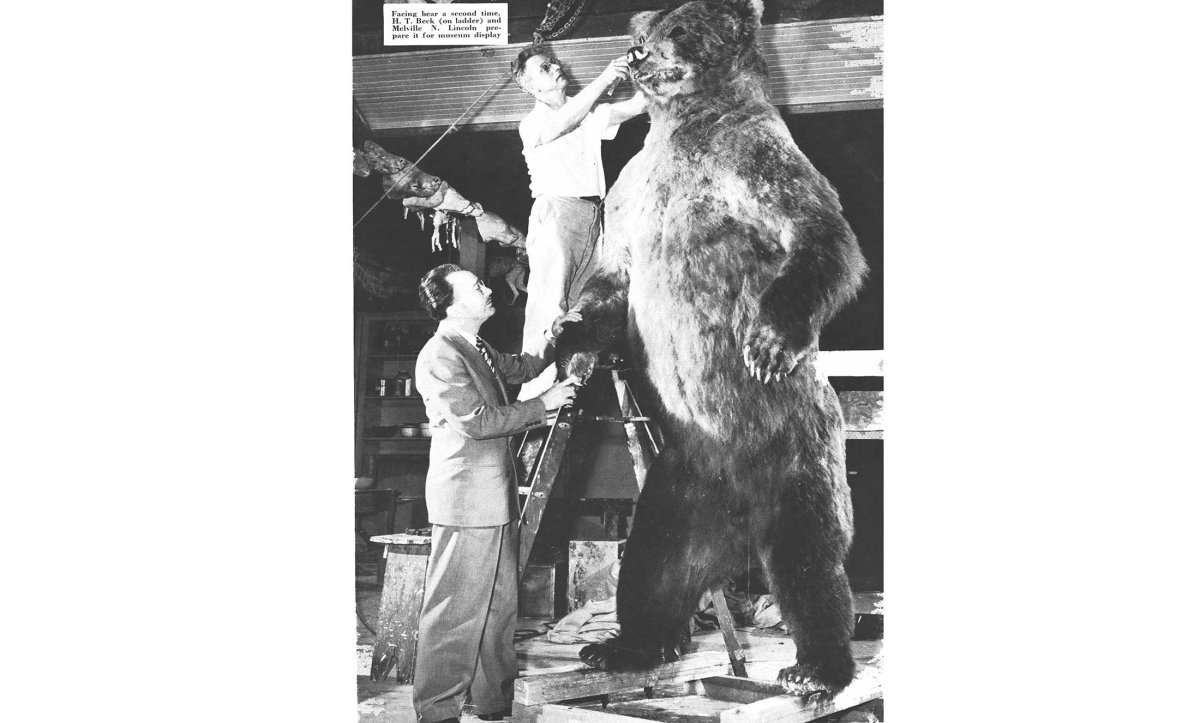
Back in Los Angeles with the trophy, Beck began his work of reconstructing the skeleton for the mounting, Sewell tackled a gigantic background canvas for the habitat group, while Lincoln started checking the bear’s size.
The curator soon realized that this was an extraordinarily large specimen. After making some preliminary measurements he got in touch with the Boone and Crockett Club in New York. Grancel Fitz, who is associated with the club committee that keeps the records of North American big game, flew to the West Coast to see the trophy. He took it back to New York, where he checked the measurements officially with Samuel B. Webb, the committee chairman.
In March of this year, Fitz notified Curator Lincoln that the Alaska brown bear was the biggest ever taken. Its skull length (measured, as usual, without the lower jaw) was 17 15/16 inches; its greatest width was 12 13/16 inches. Total score, under the club’s new rating method, was 30 12/16— which was 3/16 greater than the record holder now listed as tops in Records of North American Big Game, the so-called Wagner specimen at the University of California at Berkeley.
Meanwhile Beck finished assembling the skeleton, made a clay model over the bones, took a plaster cast, and from it, fashioned a burlap-and-plaster model on which he mounted the skin. Today the trophy, standing eight feet eight inches high, dominates a highly realistic habitat scene opened to the public a month ago in the Los Angeles County Museum.
When I saw the great bear I thought, “Gosh, it almost scares me, and I know it’s dead. Wonder how Lindsley felt when he faced it alive, roaring, and charging?
This story was originally published in Outdoor Life, July 1953
Read the full article here
