




These are very good times to be in the market for a rifle scope. Even better times if you’re on a limited budget. Brands are responding to softness in the consumer market and are offering deep discounts in their mid-tier product lines. These are generally those scopes that have the best combination of value and performance, are built around good glass and proprietary optical coatings, and offer a rich selection of reticles, magnifications, and add-ons like illumination or custom turrets.
Refreshingly, they’re not 34mm behemoths. These are scopes built on 1-inch and 30mm tubes with simple reticles, plenty of mounting geometry, and set-it-and-forget-it turrets that promote fast deployment in the field.
Some even ship with rings. Most include lifetime transferrable warranties. Whether you’re a hardwoods whitetail hunter, a small-game sniper, a backcountry Western hunter, or use a shotgun, straight-wall carbine, or AR, there’s a scope that’s right for your particular jam. The cheerful news is that it’s also priced right.
Here are the 10 best budget hunting-forward rifle scopes we’ve come across in the past year:
See It
Pros
- Choice of three reticle designs
- 15-yards-to-infinity side parallax correction
- At about $250, an excellent value
- Rezeroable turret dials
Cons
- Reticle references valid at highest mag
- Forgettable glass
Key Features
-
Capped turrets -
1-inch tube -
Many reticle designs have elevation and windage holds -
Available in illuminated version -
Fully transferable lifetime warranty
Like Nightforce, Zeiss, and Leupold, Vortex is completing the buildout of an entire rifle scope family. The Crossfire HD line, slowly replacing the Crossfire 2 line, has a scope for every hunter, from a handy LPVO to a big 6-18×50 model to this mid-mag optic that’s optimized for America’s deer hunters.
The 4-12×44 model comes in three distinct reticle types, all built on the second focal-plane arrangement and all with MOA-based aiming points. There’s the classic Dead-Hold BDC that’s a non-illuminated plex design with three bullet-drop references and windage hashed. Or you can opt for an illuminated version of that reticle, with a pin-point illuminated center dot for a $50 upcharge. Or you can go old-school and use the Widerange Plex, which is basically a German #4 duplex without illumination.
The hunter-centric BDC reticle has MOA-based hashes at 1.5, 4.5, and 7.5 MOA below the center aiming point. Those spacings conform to the drop of standard-velocity bullets zeroed at 100 yards or high-velocity and magnum calibers zeroed at 200 yards (Vortex ships a chart of zeroing recommendations with its scopes).
Users are encouraged to match their load ballistics with Vortex’s Long Range Ballistic Calculator to understand subtensions at various magnifications. That’s an important consideration, since published subtensions are only valid at the highest magnification of the second-plane reticle. When we plugged our specific ballistics into the Vortex calculator, we got magnification-adjusted holds out to 500 yards with center-fire ammo, and out to 145 yards with our 40-grain CCI Green Tag .22 Long Rifle load, which has become the go-to rimfire bullet for our annual Outdoor Life optics test because of its consistency and affordability.
It’s interesting to observe that the Crossfire HD scopes are only available in MOA configurations, and Vortex has leaned heavily into its Dead-Hold 2A BDC reticle. For shooters and hunters who want Vortex scopes with MIL references or first focal-plane systems, the Diamondback and Strike Eagle families have more options.
The glass in the Crossfire HD line is underwhelming, with a milky veil and some edge distortion. The eyebox in the 4-12x is pretty stingy, but the parallax correction helps keep both the reticle and the target in the same focal plane.
This isn’t a particularly sophisticated scope. The turret clicks are a little soft, but the adjustments tracked well. The magnification range is right in the sweet spot for whitetail hunters, whether you’re a grizzled veteran or a fresh-faced newcomer to the deer woods.
“Easy, simple, hunting budget workhorse,” noted Outdoor Life optics tester Todd Netto. “I think your average hunter would take this over the other $300 scopes in our test. It’s worth that price all day long.”
Vortex Crossfire HD 4-12×44
- Magnification: 4-12-power
- Objective Lens: 44mm
- Tube Diameter: 1-inch
- Light Transmission: Not provided
- Exit Pupil Diameter: 11mm to 3.7mm
- Twilight Factor: 13.3-23
- Field of View: 26.9-8.6 feet at 100 yards
- Reticle Plane: Second
- Reticle Type: Dead-Hold 2A BDC MOA (among others)
- Illumination: Yes, center dot. Some unilluminated models
- Turret Click Values: ¼ MOA
- Adjustment Per Revolution: 15 MOA
- Total Internal Adjustment – Elevation: 70 MOA
- Total Internal Adjustment – Windage: 70 MOA
- Parallax Correction: 15 yards to infinity
- Weight: 20.7 ounces
- Length: 13.4 inches
See It
Pros
- Familiar hunting configuration
- Distinctive red accents
- Simple set-it-and-forget-it operation
- At about $260, priced right
- Also available in Ballistic E3 and illuminated wind plex reticles
- Fully transferable lifetime warranty
Cons
- Limited adjustability
- Green coatings
Key Features
-
1-inch tube -
Available only in MOA adjustments -
Rezeroable turret dials -
Parallax correction fixed at 100 yards -
42mm objective enables low-profile mounting
The problem with many budget rifle scopes is that they distract from disappointing glass with whiz-bang features like tactical turrets and add-ons like cheap rings, power-changing levers, and illuminated reticles.
The Burris Fullfield 3-12×42 has none of those. Instead, it’s a throwback, build on a 1-inch tube with capped turrets and a second-plane duplex reticle. This is the scope that appeals to your buddy who wants to hand crank their pickup windows. By keeping things simple, Burris has produced a new classic that might be the perfect deer-hunting scope in our test of nearly 25 hunting scopes. That it’s able to sell the Fullfield 3-12×42 for under $300 made it the unanimous pick for the Great Buy award in this year’s rifle scope test.
The Burris had plenty of competition for the honor. Vortex’s 3-9×40 Crossfire HD has many of the same features, second-plane reticle, and fuss-free performance for a little less money. But we felt the build and tight handling of the Burris make it a longer-wearing optic, and we tested that hunch that by subjecting the scope to our inaugural drop test, which it passed with flying colors.
Don’t expect the Fullfield to engage steel targets way out there. And it’s not built for precision turret dialing. Instead, this is a straight-ahead hunting scope. Think straight-wall carbine, slug gun, rimfires, or just about any deer rifle on the market.
“It’s a set-it-and-forget-it scope,” notes tester Nate Ward. “Not a lot of moving parts to break or batteries to fail.”
Indeed, the Burris doesn’t have an illuminated reticle, and its parallax correction is set at 100 yards. The standard plex reticle is intended to be fast but not precise, since there are no reticle holds in the image plane. Hunters who want more reticle references should consider Burris’s excellent Ballistic E3 reticle, available in the 3-12×42 platform. If you’d rather have illumination, the Wind Ret reticle is available for another $100.
The standard-issue Fullfield has some nice features, including distinctive red accents on the power-changing ring and turret dials and rezeroable turrets powered by what Burris calls its Knob Synergy erector system. But we also noted some misses. It has a distracting greenish coating that’s especially noticeable in low-light conditions. Its turret indexing is so tiny that it’s hard to confirm when you’re zeroed. And some testers struggled to get both the target and reticle sharp in the same focus plane beyond 500 yards.
But for a good image, simple and repeatable controls, and abundant versatility, the Burris Fullfield 3-12×42 checks nearly every box for a hunting scope. By doing it for under $300, it is the very definition of a Great Buy.
Burris 3-12×42 Specs
- Magnification: 3-12
- Objective Lens: 42mm
- Tube Diameter: 1-inch
- Light Transmission: Not provided
- Exit Pupil Diameter: 14-4.7mm
- Twilight Factor: 11.2-19.4
- Field of View: 36-9.25 feet at 100 yards
- Reticle Plane: Second
- Reticle Type: Plex
- Turret Click Values: ¼ MOA
- Adjustment Per Revolution: 25 MOA
- Total Internal Adjustment – Elevation: 72 MOA
- Total Internal Adjustment – Windage: 72 MOA
- Parallax Correction: Fixed at 100 yards
- Weight: 14.7 ounces
- Length: 11.1 inches
See It
Pros
- Familiar hunting configuration
- Distinctive Gold Ring accent
- Simple operation
- At just under $400, priced right
- Also available with muzzleloader, straight-wall, and rimfire reticles
- Fully transferable lifetime warranty
Cons
- Limited adjustability
- Stingy eyebox
Key Features
-
1-inch tube -
Available only in MOA adjustments -
Familiar duplex reticle -
Parallax correction fixed at 150 yards -
40mm objective enables low-profile mounting
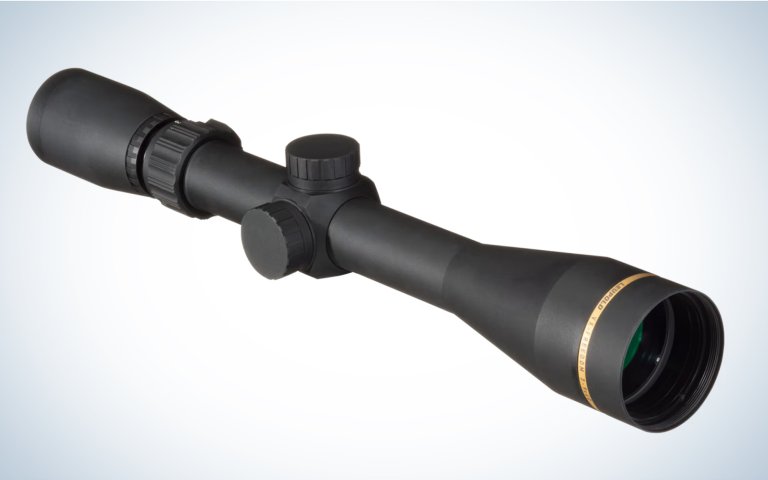
Old-timers can think of the VX-Freedom scope as this generation’s version of Leupold’s VX-2. It’s not an exact comparison but it’s close. This is a simple, no-fuss hunting scope, with capped turrets, fixed parallax, fast and intuitive second-plane reticles, and decent glass and controls. There’s a ton of variation within the theme, with models of the FX-Freedom configured for muzzleloaders, rimfire hunters, and hunters using caliber-specific straight-wall carbines.
Unifying the product line is smart and simple controls and the classy styling that Leupold is known for delivering. It’s so light, just over 12 ounces, that mountain hunters are smart to consider the VX-Freedom for their ultralight rifle builds.
The best part of this product line is the price. The basic VX-Freedom runs just under $400. In short, it’s a fair price for an honest scope that will dress up any rifle it’s mounted on and give you years of fuss-free performance.
Leupold VX-Freedom 3-9×40 Hunt-Plex Specs
- Magnification: 3-9-power
- Objective Lens: 40mm
- Tube Diameter: 1-inch
- Light Transmission: Not provided
- Exit Pupil Diameter: 13.3-4.4mm
- Twilight Factor: 10.6-19
- Field of View: 33.1-13.6 feet at 100 yards
- Reticle Plane: Second
- Reticle Type: Plex
- Turret Click Values: ¼ MOA
- Adjustment Per Revolution: 15 MOA
- Total Internal Adjustment – Elevation: 60 MOA
- Total Internal Adjustment – Windage: 60 MOA
- Parallax Correction: Fixed at 150 yards
- Weight: 12.2 ounces
- Length: 12.5 inches
See It
Pros
- Brand new design
- Exposed elevation turret with ballistic stop
- Hash-style
- Smart Hunting Reticle
- Optional precise center-dot 10-step illumination
- Impressive internal adjustment range
- Also available in capped turrets and plex reticle
Cons
- Reticle references are crowded
- Exposed elevation turret turns too easily
Key Features
-
Parallax correction fixed at 150 yards -
Premium glass and coatings -
5-turn revolution indicators -
Two-screw adjustment for ballistic stop -
Transferable limited lifetime warranty
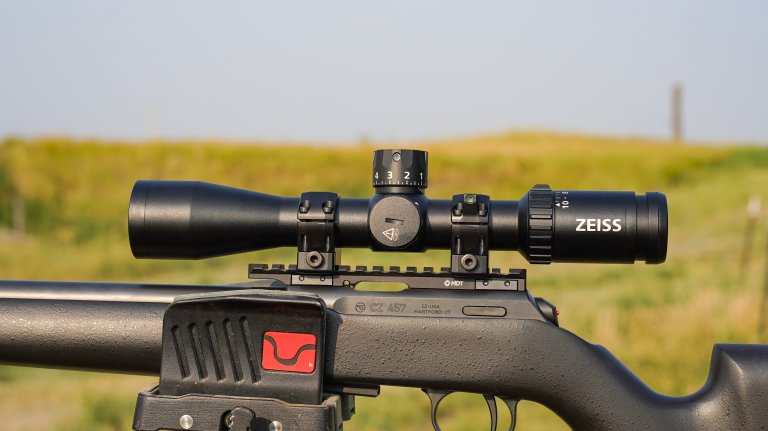
We struggled with picking the version of the V3 that we wanted to highlight in this roundup, but price and versatility led us to the 3.5-10×42. But we could just as easily have featured the 4.5-14×44 or even the compact 2.5-8×35. Because this is a group defined by price, we went with the Goldilocks of the trio, the do-everything 3.5-10x.
It’s just slightly higher in price than its peers, but for $450, you get an immense amount of features and performance. The new V3 is offered in three versions of its second-plane reticle build, a non-illuminated No. 6 plex and both non-illuminated and center-dot illuminated versions of the SHR (it stands for Smart Hunting Reticle) hash-style design with MOA-based holdover and windage references. The illuminated version has a crisp center dot that shines with a red illumination.
The big news is that these premium Zeiss scopes are no longer made in Europe. They’re sourced in Asia, but if that suggests a decline in optical performance or brand integrity, relax. These are excellent scopes, sourced with premium components and curated with American hunters in mind. That’s an important inflection; previous Zeiss rifle scopes were almost maddeningly European, with metric controls that often turned the wrong way.
Zeiss describes the 3.5-10×42 as its “all-around” hunting scope, and that’s a hard description to contest. This is a scope that will do yeoman’s work on just about any deer rifle, can handle longer-range shots in pronghorn country, and is a good choice for a straight-wall-cartridge carbine or a muzzleloader. Non-illuminated versions of this configuration, built on a 30mm tube, should retail for under $450.
Our optics testers appreciated the tactility and ease of adjusting the exposed elevation turret, which is intended for hunters who want to dial to a distant aiming solution. It’s a nice addition to this scope, but for most hunting purposes of this mid-magnification build, we’d probably advise the capped elevation turret to ensure your zero doesn’t slip in real-world field conditions. Our only other gripe was the crowded appearance of the SHR reticle. With its 1 MOA hashes clustered on both the horizontal and vertical stadia and no numeric references, we found ourselves counting aloud the holdover and holdoff references. We like the granular aiming points, but a couple fewer references would make this a faster and more intuitive aiming system.
There’s plenty that we did like about this new V3 family. The center-dot illumination is sharp and bright, and enhances reticle visibility in the SHR configuration. The glass is excellent, with edge clarity and nice contrast and color fidelity. We like the light weight of all the models. The 3.5-10×42 weighs less than a pound, even with the overlarge exposed elevation turret. We like the controls, which turn with confidence. Lastly, we really like the huge internal adjustment range of the V3. Some models feature twice the reticle adjustment of their peers.
The 3.5-10×42 is a welcome addition to the crowded field of all-rounder hunting scopes, but between its very good glass, responsive controls, and field-ready reticles of this V3, Zeiss is well-positioned to take over the American deer-hunting market.
Zeiss V3 3.5-10×42 Specs
- Magnification: 3.5-10-power
- Objective Lens: 42mm
- Tube Diameter: 30mm
- Light Transmission: 90 percent
- Exit Pupil Diameter: 11.7mm to 4.2mm
- Twilight Factor: 12-20.5
- Field of View: 34-11.8 feet at 100 yards
- Reticle Plane: Second
- Reticle Type: Illuminated SHR #87
- Illumination: yes, 10-step intensities
- Turret Click Values: ¼ MOA
- Adjustment Per Revolution: 10 MOA
- Total Internal Adjustment – Elevation: 100 MOA
- Total Internal Adjustment – Windage: 80 MOA
- Parallax Correction: Fixed at 150 yards
- Weight: 15.3 ounces w/ Ballistic Stop
- Length: 12.4 inches
See It
Pros
- Excellent crossover hunt/target scope
- Modified hash-style first focal-plane reticle
- AZS Zero Stop system
- At about $300, a screaming deal
- Also available in precision MIL reticle styles
Cons
- Limited windage adjustment range
Key Features
-
Solid mechanical zero stop -
High exposed tactical-style elevation turret -
Capped and rezeroable windage dial -
Ships with sunshade -
Fully transferable lifetime warranty
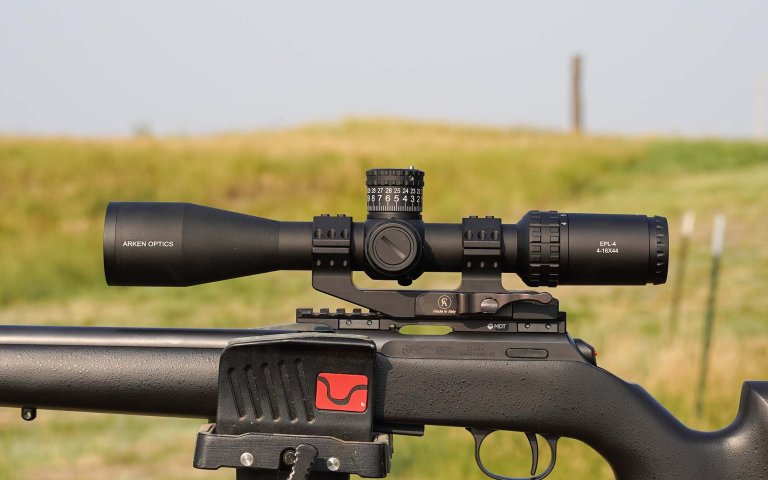
We’ve seen this astonishingly affordable, capable scope from Arken in the past, but the new version has the first focal-plane VHR reticle, a less busy design compared to the VPR tree-style reticle of the first-gen EPL-4. If you’re looking for a high-performing first-plane scope for a hunting optic that can pull double duty as a competition scope, this is a very good choice.
The Arken is a remarkable scope at twice the price of $299, which is the real-world street price. The glass is bright and decent enough, though we detected some edge distortion and flaring in full sun. The turret adjustment turn with positive authority, and we confirmed excellent tracking except on the very end of the adjustment range. The reticle is visible at its lowest magnification. The configuration lands right in the sweet spot for hunters who are looking for a scope to ring steel, and for target shooters who want to hunt.
The exposed elevation turret, which contains a redesigned zero stop, is a little too proud for some testers, and others wanted a reticle with a few more windage references in the elevation field. But for hunters, the relatively spare reticle is a very good option for quick shots using reticle references or slow-fire precision work dialing the turrets.
At a little over 24 ounces, this is a heavy build for a walk-about hunting rifle, but given the versatility of the first-plane build, it’s a great choice for a Western hunter who might have to take shots on game beyond 400 yards in tricky conditions. The price is just as appealing as the Arken’s versatility.
Arken EPL-4 4-16×44 Specs
- Magnification: 4-16-power
- Objective Lens: 44mm
- Tube Diameter: 30mm
- Light Transmission: Not provided
- Exit Pupil Diameter: 11mm to 2.75mm
- Twilight Factor: 7.3-26.5
- Field of View: 30-7.5 feet at 100 yards
- Reticle Plane: First
- Reticle Type: Illuminated VHR MOA
- Illumination: yes, 6-step intensities
- Turret Click Values: ¼ MOA
- Adjustment Per Revolution: 20 MOA
- Total Internal Adjustment – Elevation: 68 MOA
- Total Internal Adjustment – Windage: 41 MOA
- Parallax Correction: 10 yards to infinity
- Weight: 24.1 ounces
- Length: 13.2 inches

See It
Pros
- Useful second-plane bullet-drop reticle
- Fine floating illuminated center aiming dot
- At under $500, a good value
- Locking exposed turrets
- Excellent field of view
Cons
- Reticle references valid at highest mag
Key Features
-
Multi-position magnification throw lever -
Liberal mounting dimensions -
Rezeroable turrets -
Red and green illumination -
Abundant internal reticle adjustment
Another in a long line of solid, bright Hawke scopes. This sub-$450 Vantage 30 is an upscale sibling to the Vortex Crossfire HD 6-18×50, and should earn a long look from Western hunters who may face situations where they need to make 500-yard shots on game. Both the Hawke and Vortex sport useful second focal-plane BDC reticles with center-dot illumination. But the Hawke brings a little more sophistication to its controls, with exposed pull-to-turn turrets, immersive field of view, and a floating center-dot aiming point that lights up in either green or red.
Optics are good but not great. The illumination is good but we wish it was more intense to boost visibility in bright sunlight. And turret tracking started to slip a bit at the very end of its elevation travel.
But the Hawke impressed us with its smooth, tactile controls, and the BDC reticle is fast, with MOA-based references that correspond to the drop of standard center-fire loads. With a 50-yard zero with our standard 40-grain CCI .22 LR ammunition, we easily stretched the reticle to 300 yards by dialing 35 MOA of elevation and holding another 10 MOA. That’s impressive range for the scope-and-rimfire combo.
“It’s a simple, straightforward hunting scope that’s priced about right,” says Outdoor Life optics tester Dale Manning. Enough said.
Hawke Vantage 30 4-16×50 Specs
- Magnification: 4-16-power
- Objective Lens: 50mm
- Tube Diameter: 30mm
- Light Transmission: Not provided
- Exit Pupil Diameter: 12.5mm to 3.125mm
- Twilight Factor: 14.1-28.3
- Field of View: 28.8-7.8 feet at 100 yards
- Reticle Plane: Second
- Reticle Type: LR2 Dot
- Illumination: Red and green center dot
- Turret Click Values: ¼ MOA
- Adjustment Per Revolution: 15 MOA
- Total Internal Adjustment – Elevation: 95 MOA
- Total Internal Adjustment – Windage: 95 MOA
- Parallax Correction: 10 yards to infinity
- Weight: 26.1 ounces
- Length: 13.7 inches

See It
Pros
- At just over 14 ounces, extremely light
- Basic, simple operation
- Useful simplified holdover reticle
- Very good glass
- At $425, priced right
Cons
- Limited utility
- Holdover references trued to highest magnification
Key Features
-
Excellent C-Series Japanese glass -
Liberal mounting dimensions -
Very good field of view -
Enables low-profile mounting
This is a throwback rifle scope in all the best ways. It’s hardy, and built to handle the harshest punishments of the field. It’s simple, with relatively few moving parts to fuss with or to fail. It’s light, to enable hard hunts in steep country. And it’s reliable.
Shooters interested in the latest MIL-based first focal-plane reticles and turrets with just-so tactility to dial by feel may find the Maven CRS.1 lacking in sophistication, but for hard hunters interested in fail-proof scopes for sheep country, that’s precisely the point. The fewer moving parts, the better. The Maven brings a second focal-plane MOA-based reticle with just enough references to provide bullet-drop navigation without being busy. In short, this is a pure hunting scope, for better and for worse.
The heart of the scope is the wire-frame CSHR-W reticle, which provides 20 MOA of windage references on the horizontal stadia at 10x, along with 20 MOA of elevation holdover. The three holdover hashes are intended to make fast and close-enough distance-adjusted shots, but students of the long-range game will use the reticle design to make magnification- and distance-informed dope cards that transform this simple 1-inch scope into a decent long-range rig.
At $425, the Maven is priced in the sweet spot of this roundup. Interestingly, Maven has held the price on the CRS-1 in the years since the Wyoming company introduced it to the world. Meanwhile, Maven has added a more sophisticated reticle to the scope, which has assisted hunters on first hunts, last hunts, mountain hunts, and back-field hunts, performing its tasks with quiet sophistication.
Maven CRS.1 3-12×40 Specs
- Magnification: 3-12-power
- Objective Lens: 40mm
- Tube Diameter: 1-inch
- Light Transmission: 88 percent
- Exit Pupil Diameter: 13.3mm to 3.3mm
- Twilight Factor: 10.95-20.91
- Field of View: 34-8.5 feet at 100 yards
- Reticle Plane: Second
- Reticle Type: CSHR-W
- Illumination: N/A
- Turret Click Values: ¼ MOA
- Adjustment Per Revolution: 18 MOA
- Total Internal Adjustment – Elevation: 50 MOA
- Total Internal Adjustment – Windage: 50 MOA
- Parallax Correction: Fixed at 100 yards
- Weight: 14.2 ounces
- Length: 12.4 inches
See It
Pros
- At around $250, extremely affordable
- Useful BDC-style reticle
- Versatile magnification range
Key Features
-
Capped turrets -
10-yards-to-infinity parallax correction -
Distance-informed windage holds
For a price-point scope, Bushnell’s R5 has some surprisingly sophisticated features. The most useful is its second focal-plane DOA-LRH800 reticle, which in the right hands might be capable of placing bullets out to 800 yards. For most of us, though, the reticle is a useful tool to make distance- and wind-informed hits out to 300 yards with rimfires and to 600 yards with most center-fire cartridges.
The modified tree-style reticle is extremely tunable, meaning that for shooters and hunters willing to invest the time, the Bushnell Ballistics app can produce customized drop tables for your specific load and magnification setting. Not too shabby for a $250 scope.
The R5 doesn’t have quite the smooth and confident controls of its big sibling, the R7 introduced earlier this year, but it’s a more responsive and precise build than most scopes in its price range. You might consider the 3-9×40 or 3-9×50 for more or less reach and low-light performance, but for a center-of-mass hunting scope, it’s hard to beat Bushnell’s do-everything R5 in 4-12×40.
Bushnell R5 4-12×40 Specs
- Magnification: 4-12-power
- Objective Lens: 40mm
- Tube Diameter: 1-inch
- Light Transmission: 88 percent
- Exit Pupil Diameter: 10mm to 3.3mm
- Twilight Factor: 12.6-21.9
- Field of View: 27-9 feet at 100 yards
- Reticle Plane: Second
- Reticle Type: DOA-LRH800
- Illumination: Yes
- Turret Click Values: ¼ MOA
- Adjustment Per Revolution: 15 MOA
- Total Internal Adjustment – Elevation: 70 MOA
- Total Internal Adjustment – Windage: 70 MOA
- Parallax Correction: 10 yards to infinity
- Weight: 19.6 ounces
- Length: 12.4 inches
See It
Pros
- At around $250, extremely affordable
- Useful BDC-style reticle
- Versatile magnification range
Key Features
-
Exposed turrets -
50-yards-to-infinity parallax correction -
Distance-informed windage holds
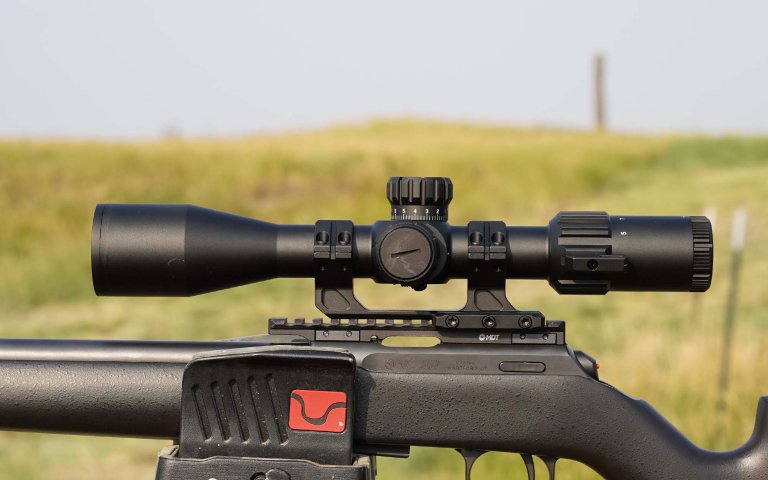
This do-everything, fuss-free scope was the consensus pick for our 2025 Great Buy award, and by bringing so much performance for so little money, it also nearly won the Editor’s Choice award as the top scope of the year.
For the price of premium scope rings, you get a non-illuminated scope with exposed turrets that turn with more tactility and precision than we expected, a useful hash-style second-plane reticle, and side parallax adjustment that turns from 50 yards to infinity. You get handy lay-flat caps that stay out of the way when you’re not shooting but are ready to protect your glass when you’re not. You get Sig’s excellent lifetime transferable warranty. You even get a serviceable cantilevered 30mm unimount as part of the bargain.
Of course, for $200 there are things you don’t get. There’s no illumination. The TANGO-SPR has dark and glinty Chinese glass, and the field of view is extremely narrow. The turrets move with sharp, abrupt clicks.
But those turrets track just fine. We mounted our test sample on a 6mm Creedmoor chassis rifle and ran a PRS-style steel course from 100 yards out to 800 yards both by dialing elevation and windage dope and holding in the reticle. Both turret and reticle references are true to MOA values. How many $200 scopes can make one- or two-shot hits at that range, then come back to 100 yards and hold their zero? The TANGO-SPR even has a zero stop, virtually unheard of at this price.
“This scope was very easy to zero, and having parallax adjustment on a $200 scope is nice,” noted tester Todd Netto. “It even comes with a rail-mount. It’s solid for the price. You won’t confuse its image or its handling with a $2,000 scope, but impressive performance for a price-point rifle scope.”
We’d rather have a capped or locking elevation turret for hunting purposes, but the turrets, tuned to ¼ MOA click values, have clear indexing and aren’t prone to turning easily. We did experience what we’ve come to call a “stingy” eyebox, meaning that shooters have to keep both their eye relief and their head aligned with the narrow exit pupil in order to see the entire field of view. Move your head, even a little bit, and the scope blacks out. And the amount of internal reticle adjustment — only 30 MOA — is by far the lowest in the field and will limit the effective distance of this scope.
But those are relatively minor quibbles in the face of what is an almost incomprehensible value. How Sig can manage to deliver such a serviceable, competent, and durable scope for $200, covered by its full warranty, is remarkable, and reframes the value proposition of a price-point scope.
Sig Sauer TANGO-SPR 4-16×44 Specs
- Magnification: 4-16-power
- Objective Lens: 44mm
- Tube Diameter: 30mm
- Light Transmission: Not available
- Exit Pupil Diameter: 11mm to 2.75mm
- Twilight Factor: 13.3-26.5
- Field of View: 105-6.1 feet at 100 yards
- Reticle Plane: Second
- Reticle Type: MOA BDC-1
- Illumination: No
- Turret Click Values: ¼ MOA
- Adjustment Per Revolution: 25 MOA
- Total Internal Adjustment – Elevation: 30 MOA
- Total Internal Adjustment – Windage: 30 MOA
- Parallax Correction: 50 yards to infinity
- Weight: 29.6 ounces (with mount)
- Length: 14.7 inches
See It
Pros
- Priced at just over $100, an insane value
- Ships with cantilever mount
- Fiber-optic illumination creates bright aiming point
- Push-to-turn locking turrets
Cons
- Reticle adjustments are mushy
- Stingy eyebox
Key Features
-
Rezeroable turret dials -
Second-plane reticle -
Hash-style reticle tuned to MOA references -
Fully transferable lifetime warranty
How does Monstrum do it – produce a decent precision optic for a few bucks over $100, include a cantilever mount and bright illuminated reticle and ships it for free, and stay in business?
We’re not sure how the accounting works, but one answer is by producing optics with inexpensive components. While the entirety of the new Monstrum Beast 3-15×44 works together to place bullets on targets, each constituent part of the scope is problematic. The turrets are mushy and track poorly at the outer ends of their adjustment range. The eyebox is so narrow that it’s easy to lose sight of your target. And the image blurs on the edge of the woozy glass.
But did I mention this full-size, high-performance, second focal-plane scope costs less than the average monthly cell phone bill?
The inexpensive build raised a question among testers: Is it worth the money?
“This scope works, but it feels cheap,” notes tester Nate Ward. “The stingy eyebox really impacts shootability for me. I just can’t keep the target in range unless my eye alignment is absolutely centered.”
But the scope, and the company that makes it, serve an important service as an on-ramp to shooters and hunters. Maybe you can’t afford a $300 scope just now. This $100 unit will get you on the range and into the field. That more expensive and higher-performing optic can wait.
Monstrum Beast 3-15×44 Specs
- Magnification: 3-15-power
- Objective Lens: 44mm
- Tube Diameter: 30mm
- Light Transmission: Not provided
- Exit Pupil Diameter: 14.7mm to 2.9mm
- Twilight Factor: 11.5-25.7
- Field of View: 34-7 feet at 100 yards
- Reticle Plane: Second
- Reticle Type: Hash style MOA
- Illumination: Yes, fiber optic dot
- Turret Click Values: ¼ MOA
- Adjustment Per Revolution: 15 MOA
- Total Internal Adjustment – Elevation: 74 MOA
- Total Internal Adjustment – Windage: 80 MOA
- Parallax Correction: 10 yards to infinity
- Weight: 29 ounces with mount
- Length: 13.2 inches
Read the full article here
