




This story, “Bear Nightmare,” appeared in the March 1965 issue of Outdoor Life.
There were six of us in the tent, three couples, snug in our sacks and sleeping like people drugged. We had turned in the night before, completely worn out, and at 8 o’clock in the morning, long after daylight, nobody had opened an eye.
We had no warning. There was a sudden, loud thump, and Bernie Watermolen brought us awake with a yell that was enough to raise the dead. Then he started to pound on the tent wall, shouting at the top of his voice, and I saw a gaping cut in the tent and blood streaming down Bernie’s left hand. “Get out!” he screamed. “Get out of here, you so and so!”
We scrambled out of our bags and rushed outside. Looking us over at the edge of the brush only 30 away was a big black bear. He seemed unafraid and in no hurry to leave. Somebody grabbed the ax, and the three men ran at him, yelling and waving their arms. He turned and walked over a low ridge behind the camp, stopping two or three times to look back.
When things quieted down a little, we put the story together. The bear had raked a paw down the back of the tent, ripping it wide open. Bernie was sleeping next to the wall, and two claws had caught him on the hand, gashing his thumb and tearing through the web of flesh between thumb and forefinger. He had been lying on his back with his hands outside his bag, one on either side of his head. Had the bear reached in another three or four inches, it would have torn half his face away.
That was the beginning of a four-day nightmare so dreadful that even now, months afterward, the six of us find it difficult to believe we went through it.
Bernie and Peg Watermolen, Vic and June Piontek, and my husband, Don, and I made up the party. We all live in Green Bay, Wisconsin. Bernie’s an engineer with the Highway Commission, Vic manages a supermarket bakery, and Don is a foreman at the Green Bay Packaging Corporation. The three went to school together, and their friendship has lasted. We’re all between 28 and 30, and we have growing families. Don and I have four children, the Watermolens five, and the Pionteks three. We’re all fond of the outdoors and like fishing and camping. Bernie and Peg have had more experience at it than the rest of us, but none of us are novices.
When the summer of 1964 rolled around, we decided on a wilderness camping trip for our vacation project. This would mean a lot, especially to Don and me. It had been six or seven years since we’d had a vacation of more than a long weekend. Don was going to school at the University of Wisconsin when we were married, and then we had the four babies, and there never seemed to be enough time or money for us to get away by ourselves. So we agreed we’d make the 1964 trip one to remember. It turned out to be all of that, but not for the reasons we’d anticipated.
Bernie’s dad had been flying to remote lakes in Ontario for several years and had come home with glowing reports of the trout fishing. The past two years, he had gone to Robb Lake, in the Algoma bush 60 miles east of Sault Ste. Marie, flying in from Blind River on the north shore of Lake Huron. There were lake trout and rainbows in Robb, he told us, rainbows and brook trout in the nearby streams, and plenty of brookies in the beaver ponds. Bernie, Don, and Vic are ardent trout fishermen, so we decided on Robb Lake and left the arrangements to Bernie.
He made them with the late Leo LaMothe’s Huronian Air Service at Blind River. LaMothe died of a heart attack last October while paddling his plane out from the shore of a lake in the Ontario bush, preparatory to flying out a party of four moose hunters.
We were to be flown in for a week of fishing. The outfitter would furnish a tent, two boats, camp stoves, gas lanterns, ax, and dishes. We’d bring the rest of the outfit, including a five-horsepower outboard, sleeping bags, and provisions.
We left Green Bay on Friday evening, June 19, in Bernie’s car, towing a trailer. Our rig was crammed with people and gear. Bernie was so excited about the trip that he drove all the way, not wanting relief. We drove all night, reached Sault Ste. Marie before daylight, and were at LaMothe’s base on Lauzon Lake at 6 o’clock Saturday morning.
We ate a hurried breakfast, bought our nonresident licenses, and loaded our outfit into two planes, a Cessna and a Beaver. The flight took only 35 minutes, and, a little more than 12 hours after leaving home, we landed in front of our campsite on Robb Lake, back in the roadless bush.
Our two boats were there, a pair of 12-footers, one wood, the other aluminum. There was also a supply of gas cached at the campsite. Those boats were to play a strange role in the days to come.
While we were loading the planes back at Lauzon Lake, LaMothe had mentioned that he was taking a tent in for us. “Bears tore up the one we had there,” he said.
I saw Peg’s and June’s eyes widen and knew mine were doing the same. “Bears?” we asked with one voice.
“You’ll be in bear country,” the outfitter replied, “but don’t let that worry you. They’re more afraid of you than you are of them, and, as long as there are humans around, they won’t molest anything.”
We have been asked since why we didn’t take along a hunting rifle for dealing with mischief-bent bears. After the thing was all over, we learned we could have done that legally. Fishing or camping parties going into the Ontario bush when hunting seasons are closed are permitted to carry firearms for purposes of self-protection and survival.
We watched the two planes vanish above timber. We were on our own for a week, every link with the outside world severed, no way to get word out, no matter what happened. This was exactly what we had talked and dreamed of for months.
Canadian Customs will admit shotguns or rifles (but no sidearms) under these conditions. And, so long as they are not used to hunt out of season, the Ontario Department of Lands and Forests permits their possession and use in self-defense or to secure food in remote country if necessary.
But we knew nothing of these regulations at the time we planned our trip, and we assumed that possession of a gun in closed season was prohibited. Also, when the question of taking a rifle along came up, we decided it would just be excess baggage in our already overloaded car. It never occurred to us that there would be any real reason for carrying a gun on a fishing trip.
We were to have six days of fishing. “See you next Friday,” LaMothe said when he was ready to leave. “If we’re over the area, we’ll check on you, but you’ll be O.K.”
We watched the two planes vanish above timber. We were on our own for a week, every link with the outside world severed, no way to get word out, no matter what happened. This was exactly what we had talked and dreamed of for months. Nevertheless, it was a lonely feeling, and I couldn’t quite shake off a few misgivings. I suspected that June and Peg shared them, too. A small voice at the back of my mind kept asking, “What if something goes wrong?”
The last party that had camped there had left rubbish strewn all over. While the men put up the tent, the wives undertook to make the place fit to occupy.
The country around Robb Lake was logged over about 1918, and our campsite had once been a logging camp. We found old sleigh runners and other odds and ends, and even a rusted cross-cut saw that we used to cut tent poles. A big fire had gone through the area in 1948, but young timber and brush have grown back, and it’s green and thick enough now to be an ideal place for bears.
There was a platform for the tent, a pole table, and a tumbledown lean-to that the outfitter had told us we could use for storing supplies. But the roof leaked, and we made no use of it.
Instead, we kept our supplies piled under the table. There was room for only the six of us and our bags in the tent, and we had been warned not to keep food there because of the bears. I’d like to emphasize that at no time during the horrible ordeal that followed was there a scrap of food in the tent. Long before we finished cleaning up the place and making camp, we realized we had made one serious error in calculations. We all knew that June is the peak of black-fly season in the Canadian bush and that we’d have to reckon with them. But we had plenty of insect dope along and felt sure we could lick that problem. We could hardly have been more wrong.
I have never seen anything like the swarms of black flies that attacked us the minute we stepped ashore. Our dope seemed to have no effect on them. They covered our hands, faces, ears, and necks, got inside our clothing, up our arms and legs, and around our collars. During the day they bit us until we bled, and at night the swollen bites itched and burned unbearably.
I have never seen anything like the swarms of black flies that attacked us the minute we stepped ashore. Our dope seemed to have no effect on them. They covered our hands, faces, ears, and necks, got inside our clothing, up our arms and legs, and around our collars. The torment was almost too great to endure. During the day they bit us until we bled, and at night the swollen bites itched and burned unbearably. Some of us will carry the scars of those bites as long as we live. The mosquitoes were not nearly as bad. They swarmed out of the brush for a short time at dusk, but our dope pretty well took care of them, and, as soon as the night turned cool, they quieted down.
Once the camp chores were done, we ate sandwiches and then went fishing. But, either because of weather conditions or because we were totally unfamiliar with the water, we fished for four hours without getting a strike. We finally gave up and went back to camp for a nap. Nobody had slept much in the car the night before, and we were six really shot-down people. We tried the fishing again in the evening, and Bernie and Peg came in with two lake trout about 18 inches long.
The fishing picked up on Sunday. Bernie took a 20-inch rainbow on a night crawler, and, late in the afternoon, he and Peg walked up the inlet of the lake for half an hour and came back with another good rainbow and two brook trout. While they were gone, Vic and June caught a couple of lakers.
It was on Peg’s and Bernie’s hike that afternoon that we got our first hint of bear trouble. They found a swampy place around a beaver pond that was laced with bear trails and strewn with dung, more than 50 piles of it. The signs were fresh, and Bernie knew enough about the woods to realize that they had walked into a highly unusual situation. On the way back to camp, they encountered a big bear face to face. Bernie had come across black bears four or five times before on fishing trips in northern Wisconsin, but, without exception, they had cleared out the instant they saw him. This one didn’t. He stood his ground, watching without the slightest show of fear, until Bernie led Peg across the creek to get around him.
“I can’t get that bear out of my mind,” Bernie told us as we sat by the fire that evening. “I’ve never seen one act like that before.” For the first time, we began to worry seriously about bears, and our worst fears were borne out the next morning when one walked into camp, tore the tent, and laid Bernie’s hand open.
We dressed his cuts, ate breakfast, mended the tent as best we could, and went fishing. When we came back in the middle of the afternoon, our camp had been ransacked. Bears had torn the back of the tent apart, turned things topsy-turvy inside, smashed cartons and baskets, and eaten all the food they could find. Luckily, most of our meat and butter and some other supplies were stored in two stout, home-made iceboxes that had not been molested. We still had enough food to see us through if we lost no more, but even this raid would mean skimpy meals, and now we were really scared wondering what might happen next.
We found a big square of orange plastic left by an earlier party, and we hung it out as a distress flag on a pole near the lake shore, hoping one of LaMothe’s planes would fly over and realize we were in trouble.
Sick with fear, we started to make the few preparations we could for what darkness seemed sure to bring.
We had trout for supper but were too worried to enjoy it.
While the wives did the dishes, the men strung tin cans on a line around the tent and piled up scraps of rusty iron so the bears could not approach without alerting us. We thought if we heard them coming, maybe we could yell and drive them off.
We took a chance on going fishing again after supper but left the tent flaps tied open. If those bears were determined to get in, we’d fix it so they wouldn’t have to tear the tent up to do so.
We came back before dark. As we neared shore, we saw a medium-size bear — the men thought he’d weigh 200 to 250 pounds — come out of the tent, and a second, which looked twice as big, walk around the side of it. We began to realize just how bold they were when they came down almost to the water to look us over. Finally, they turned off on a trail and went out of sight. Coupled with what had happened before, the whole thing made our hair stand up.
We hurried up to the tent. Not much damage had been done this time, but our dwindling supply of food under the table had been pawed over again, and a few more packages were broken open.
Sick with fear, we started to make the few preparations we could for what darkness seemed sure to bring. We gathered plenty of dry wood and got a roaring fire going, lighted three small smudge pots and our two gas lanterns. While we worked, we discussed the things we could do to protect ourselves if the bears came back. None of us had much doubt on that score now. We agreed to stand watch, one couple sleeping for three hours while the other two stayed on guard, and to keep a big fire burning. But the ax and a hunting knife were our only weapons, and we knew if those two black brutes were really looking for trouble we’d be all but defenseless. June summed it up for all of us when she said, “There’s another thing we’re going to do. If a plane comes in tomorrow, we’ll break camp and get out of here!”
The bears gave us no time to carry out our plans. While we were collecting firewood, we heard brush break, first on one side of camp, then on the other, only a few yards from the tent. They were prowling there, and our dread mounted. Dusk deepened, and our fire threw shadows that made every stump look like a bear. Then, while there was still enough light to see them plainly, the two came stalking out of the brush, growling and muttering.
We yelled, and the men ran at them, but they paid no attention except to answer our shouts with low, moaning growls and loud popping of their teeth, a noise that sounded like dead sticks breaking. They inched to within 20 feet of the fire, and it seemed, as Don said later, that they were looking right down our throats. We tried everything we dared to drive them off, but none of it did any good. They either sat and looked at us or paced back and forth, swinging their heads from side to side, sniffing, growling, grunting like pigs. They were determined to get at our stuff and never retreated a step. We took it for 15 or 20 minutes. Then one of the men said, “They mean business. We’ve got to get out of here.”
It was still dark when we beached the boats. We could hear nothing, but the walk up the path took all the courage we had. We found the tent badly torn, our outfit raked over, and everything soaking wet. That was the most miserable morning I had ever known.
There was only one safe place to go — out on the lake. We grabbed up air mattresses, sleeping bags, a basket of food, warm clothing, and the ax and knife, threw everything into the two boats, and shoved off. We had improvised an anchor rope by tying short lengths of line together. But it was short, and, to reach bottom, we had to anchor only 50 feet offshore. We tied the two boats together and settled down for a wretched night, with three people crowded into each of the 12-foot boats.
We spread the mattresses and bags in the bottom. One person curled up in the bow and two on the flooring of each boat, our feet crammed under the seats. Both boats leaked, and our bags were soaked through in a short time. The night was windless and warm, so the wetness didn’t matter too much. But, cramped in our bags, we were driven almost mad by our black-fly bites. Tired as we were, we slept very little, and all the while we could see and hear the bears walking around and pawing through our gear.
We have been asked many times since whether we really needed to take to the boats or whether we could have stayed on shore and faced the bears down. In other words, did we chicken out? All we can say is that only those who were there can ever understand the menacing behavior of that pair of bears. We had never been so scared in our lives, and, if we were to do it over again, we’d do exactly the same, only sooner, as Peg said afterward. And people who know bears well agree that it was fortunate we didn’t crowd those two any harder. We had proof of that the next night.
About an hour before daylight, lightning began to flash along the horizon, and we could hear the roll and mutter of distant thunder. The storm came up very fast. A sudden, cold wind blew across the lake, then rain fell in a slashing downpour. When the storm passed, we were drenched and shaking with cold. We’d have to go ashore and get a fire going, bears or no bears.
It was still dark when we beached the boats. We could hear nothing, but the walk up the path took all the courage we had. We found the tent badly torn, our outfit raked over, and everything soaking wet. That was the most miserable morning I had ever known.
Gray daylight began to break while we were starting the fire, and, in the first light of that wet dawn, we saw our two tormentors watching us only a few yards away, one behind the tent, the other off at the edge of the brush. The big one backed up to a tree, scratched his back, and then lay down as if he had no intention of ever leaving. They stuck around for 45 minutes, but came no closer and did not growl or threaten us. At full daylight, they finally went walking back into the woods.
We had no heart for fishing that day. We sat by the fire, exhausted and discouraged, or took turns getting brief snatches of sleep, and prayed for a plane to come over. But it rained off and on most of the day, with clouds down on the treetops, so we resigned ourselves to another night of fear and misery. We were thankful for one thing. Bernie’s torn hand was showing no sign of infection. We had all worried about that.
The weather cleared in late afternoon, and we were able to dry our bags fairly well, but a chill wind came up, whipping whitecaps across the lake. If it continued to blow, we’d have a cold night out on the water, and none of us doubted that that was where we’d be. The bears came back just before dark, growling and grunting as they approached. We had lighted two big fires, but they paid no attention. There were a few firecrackers and cherry bombs in our gear, which we lighted and threw, one at a time, but they had no effect either. Finally we tossed a cherry bomb into the fire. It went off with a shower of sparks and flame almost in the face of the smaller bear. He backed off about 10 feet, but then came in 20.
It didn’t take us long to realize that this smaller bear was in a far uglier mood than he had been the night before. He crowded closer, snorted and growled, and popped his teeth without letup. It was plain that he was working himself into a dangerous rage. The bigger one showed no sign of fear, but he was less quarrelsome.
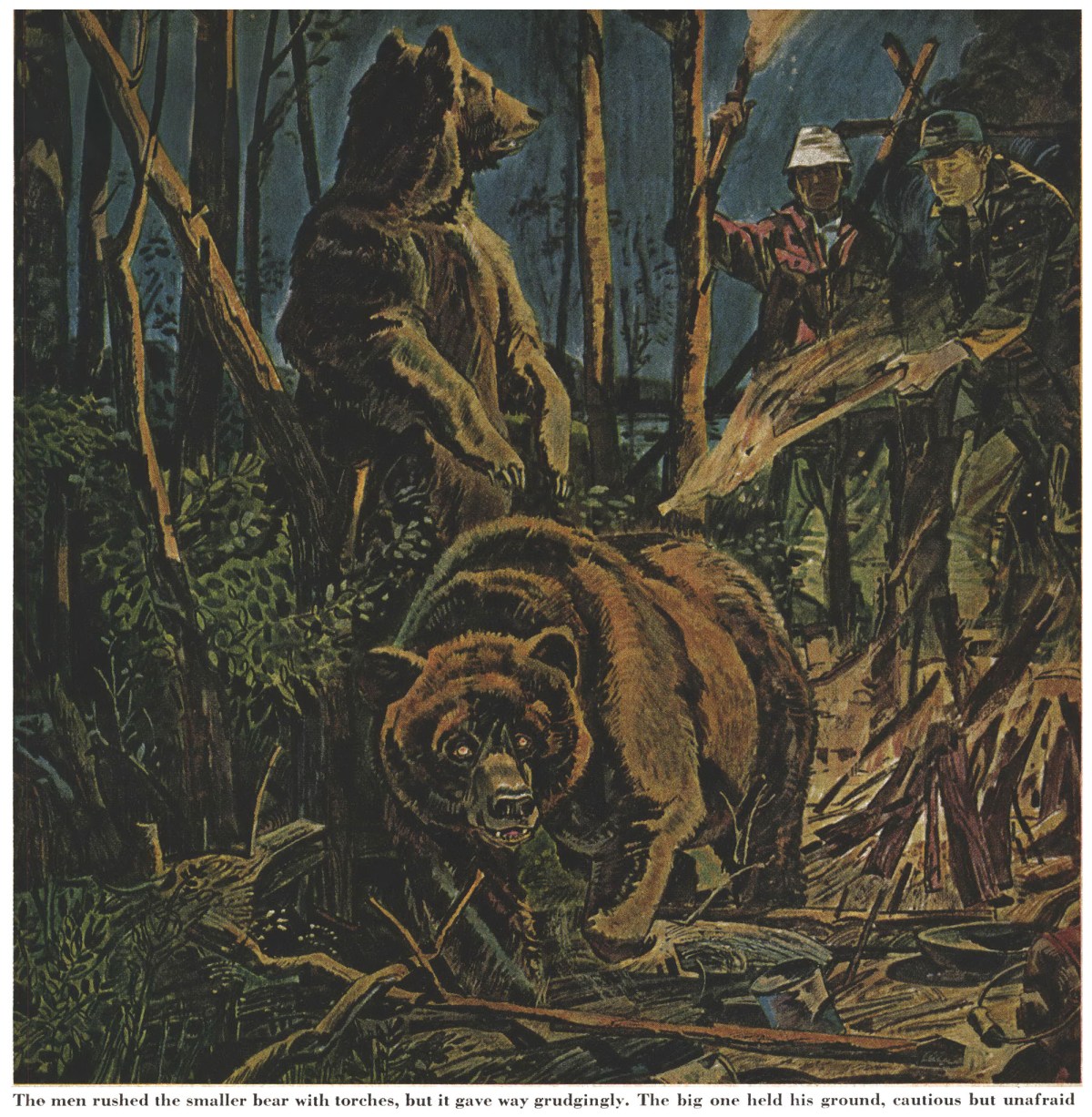
I don’t remember who proposed trying gasoline flares. But once the suggestion was made, Vic, Bernie, and Don hurriedly made two of them by fastening rags around the end of poles, soaking them with gas, and lighting them. They burned with a big, smoky flame. The instant the torches were ignited, the three men went after the smaller bear. He backed away a step at a time, but would not turn and run. He ducked back and forth, never more than 10 feet from them, shaking his head, snarling, grunting, and clawing at brush and grass like a baited bur paws the ground. The men rushed him with the torches repeatedly but could not drive him farther than the edge of the thick brush. Each time they came back to the fire, he followed, mumbling and fighting mad. To this day, we are agreed that we pushed that bear to the very brink of an attack. And, all the while, the bigger one kept edging in a few feet at a time, cautious, but not afraid, retreating when the men rushed him with their flares, but always circling back toward the tent.
In desperation, a last-resort weapon was made ready. We filled a kettle with gasoline, and the men debated throwing it onto the smaller bear and setting him afire with one of the torches. But, in the end, we didn’t dare try it. It would cause him terrible agony, and it seemed that, in his pain and rage, he’d be as likely to attack as to run off.
The men used up six flares before we admitted defeat at the end of a terrifying hour. The thought of another night on the lake was hard to take, but we had no choice. The men held the bear off while the wives loaded the boats.
We had no more than left shore when those two black devils began their onslaught on the camp. They weren’t after food now. They smashed our equipment in blind fury. We had left three smudge pots, one lantern, and two of our flares burning. In five minutes, the pots and flares had been knocked over and put out. The tent seemed to be the main target.
We could hear the bears slash it with a noise that sounded like heavy sheets ripping apart. The lantern, hung on the A-frame, swung like a pendulum.
The bears went berserk now. They knocked the camp stoves off the table and broke the table itself, bringing pots, pans, and dishes crashing down. There was hardly a dish left unbroken. That attack on our camp was a horrible thing to listen to. “The most sickening sound I have ever heard,” Peg says. But, almost unbelievably, three cartons of eggs piled under the table were not broken, and a glass jar of jam and another of sirup escaped untouched.
We slept in shifts the rest of the night, two staying awake in each boat while the third got what rest he could, all of us fearful that the bears would end their rampage by swimming out to attack us.
It rained again before morning. We went ashore right after daybreak, lighted a fire, and sized up the wreckage. The destruction was close to complete. The shredded tent lay almost as flat as a rug on its platform, entirely ruined. The bears had torn and slashed our suitcases and had even bitten into our soap and toothpaste. We had one small consolation — there was little more they could do.
Our food supply was getting low, though we still had two canned hams stored under water at the edge of the lake. To play it safe, however, in the event that the plane failed to come for us on Friday, we decided to cut down to one hot meal a day. Nobody minded much, for by that time we were so ill from weariness, loss of sleep, insect bites, terror, and worry that all appetite was gone.
The wind blew hard all day Wednesday, and visibility was so bad that we had little hope of seeing a plane. We ate a good meal at noon and then covered our demolished tent with green branches so that if one of LaMothe’s pilots should fly over he’d see no tent and know something was wrong. The rest of the time we played cards to break the monotony, or just waited and prayed.
We had talked about going across the lake to set up a makeshift camp with no tent. But just before we came ashore that morning, we had seen a big black bear walk out on the beach on that side and stand, sniffing and looking across at us. So, if we moved camp, we’d only be jumping from the frying pan into the fire.
We didn’t wait for the wreckers Wednesday night. We took to the boats early and headed for a little cove where we’d have some shelter from the cold wind. Just before dark, I tried to bring my diary up to date, but the entry is only one line long and in a shaky hand. “We’re freezing,” it reads. “Can’t hold the pen to write.” The bears came back to camp again that night, but there was nothing left for them to destroy.
I tried to bring my diary up to date, but the entry is only one line long and in a shaky hand. “We’re freezing,” it reads. “Can’t hold the pen to write.”
Thursday was a repetition of the day before. We used the last of our pancake flour and bacon for supper and wound up with ham and eggs. Then we got into the boats once more and moved across to the cove where we had anchored the previous night. We thought our troubles had to be about over, but this night was to rate only an iota better than our Tuesday-night o-deal.
The bears invaded our deserted camp again before dark. There was no wind, and, though we were a quarter of a mile away, we could hear them mutter and grumble as they pawed through the leavings. They kept it up most of the night, and, after darkness fell, we could hear brush break as one or more heavy animals moved through the thick stuff along the shore of our little cove. We were sure other bears had got our scent and were waiting for us there. Our prayers that night were for 12 more hours of calm, clear weather until the plane came, but they went unanswered. At 4 a.m., a storm of close to tornado force came flailing out of the darkness. Lightning made the sky as bright as day, the thunder was a continuous crash, and torrents of rain poured down. It made the other storms we had endured seem like gentle showers. We were soaked to the skin in minutes, and the wind raged with such fury that we had to get off the lake to save the boats from capsizing.
/
We ran ashore, found a splintered pine stump, poured gas on it, got it burning, and then scrounged enough wood for a big fire. The storm died away at daybreak, and as soon as we were partly dry we headed across to camp. The bears were gone. Apparently the storm had been too much even for them.
Just before noon, we heard a plane coming, and LaMothe’s Cessna slanted down and taxied in to shore. We had never seen a more beautiful sight. The outfitter shook his head in honest disbelief when he heard our story. Nothing like it had ever happened anywhere in that part of Canada, he told us.
Read Next: A Polar Bear Tried to Eat My Neighbor — and Other Close Calls With Nanuq in Alaska’s High Arctic
The plane flew June, Peg, and me out and then went back for our husbands. At Blind River, we rented a roomy cottage and spent the next 24 hours taking hot baths, treating our black-fly bites, eating, and catching up on sleep. At noon on Saturday, we headed for home.
We’ve been asked a few times whether we’ll ever go back. No one has found a better answer than June.
“Sure,” she told one questioner, “but before I do, I want to spend a vacation in each of the 50 states.”
“One a year?” she was asked.
“No, one every two years,” she replied. The other two wives, at least, feel exactly the same way.
Read the full article here
