



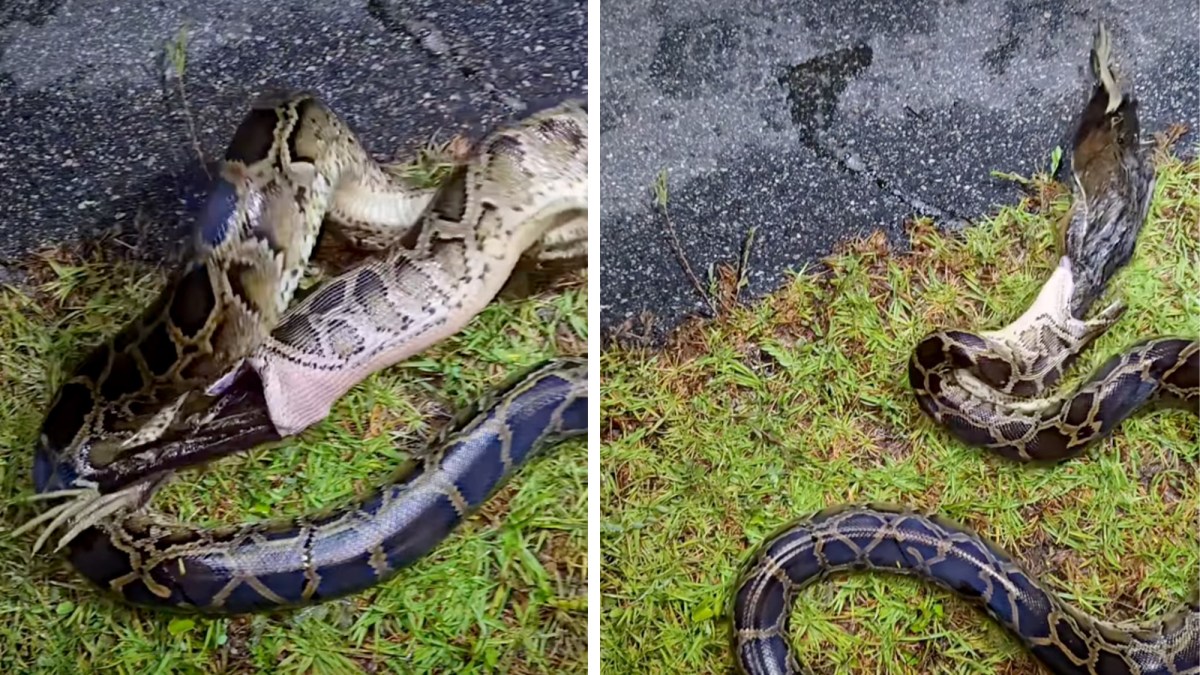

A professional python hunter in South Florida was recently reminded — in a nauseating way — of why exactly he and others spend so much time and effort finding and removing the giant, invasive snakes from the Everglades. In a video he shared to Instagram, Kev Pav gave viewers an up-close look at a Burmese python regurgitating a native bird. The giant snake, writhing on the ground, opens its flexible mouth and jawbones to spit out the dead bird in one piece, feathers and all.
“The ONLY reason that I am involved in python removal is to save native wildlife,” Pav, who goes by the handle snakeaholic, wrote in the post. “This video is a prefect [sic] example of the impact that pythons have on native wildlife.”
These impacts have been widely studied over the years by researchers, who’ve found evidence of Burmese pythons eating their way through the food web of the Greater Everglades ecosystem. The snakes primarily target smaller mammals like marsh rabbits, and in some places, studies have shown, they’ve reduced rabbit populations by more than 75 percent.
Read Next: Watch: Researchers Find a Whole Alligator Inside an 18-Foot-Long Burmese Python
Burmese pythons can also swallow much bigger prey, due to their ability to open their flexible jaws even wider than their bodies. This includes larger mammals — such as raccoons, bobcats, and even full-sized whitetail deer — along with other reptiles and all kinds of birds.
Researchers in the Everglades have found the remains of at least 58 different bird species in the digestive tracts of pythons. The giant snakes will also seek out nests to consume the eggs. One study by the National Audubon Society found that birds (along with their eggs) make up roughly a quarter of a typical Burmese python’s diet in South Florida.
Pav did not respond immediately to a request for comment from Outdoor Life, and it’s not clear from the video what kind of bird was regurgitated. It’s also unclear what caused the snake to spit up its last meal. Some python trackers and biologists will often palpate — or tap on — a snake’s stomach to force regurgitation.
Read Next: What It’s Like to Get Dragged Through a Florida Swamp by a 200-Pound Python
“This is a native species. This is what’s supposed to be here,” Pav says, holding up the dead bird in one hand and the invasive snake in the other. “And these, these [snakes] are from Asia … And every single one of these [apex predators] that we remove saves the lives of our native wildlife animals.”
Read the full article here
