



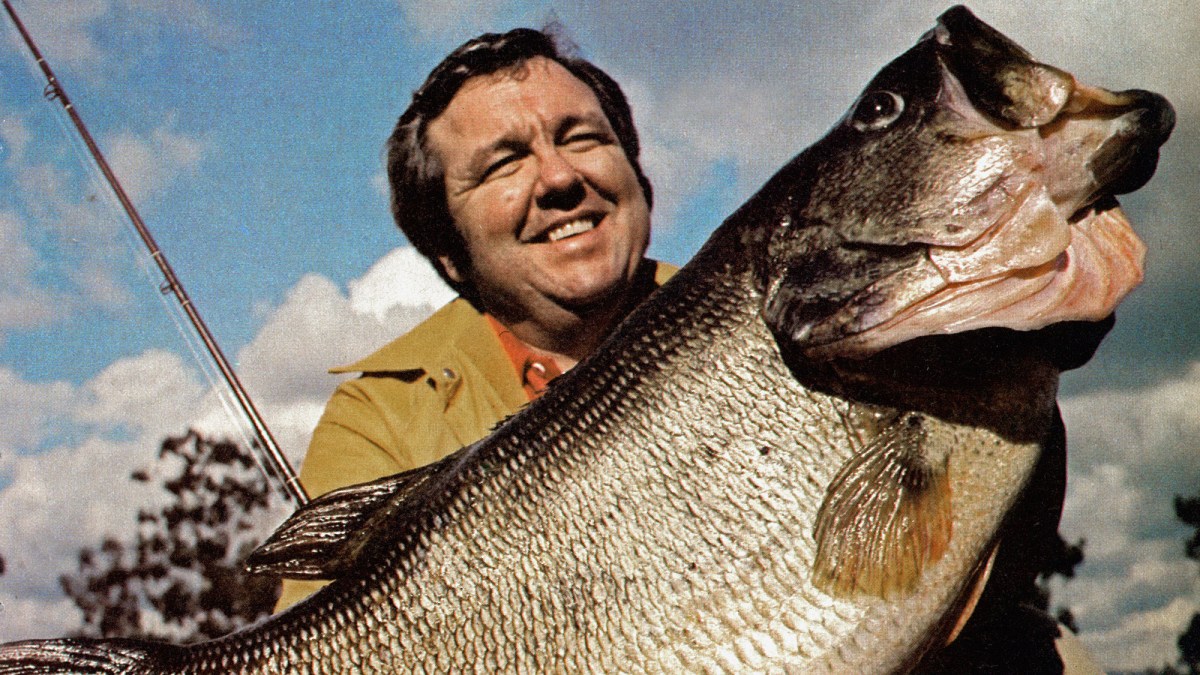

This story, “Biggest Bass in 48 Years,” appeared in the June 1980 issue of Outdoor Life. Easley’s bass remains the fourth largest ever caught, and he still holds the world-record for 8-pound test according to IGFA.
On March 4, 1980, Ray Easley of Fullerton, California, turned to his two fishing buddies and teased, “I’ll bet there’s a big one lying right over there.”
His joking prediction turned out to be one of the greatest understatements ever uttered by a largemouth bass fisherman.
Easley, 38, a Fullerton fireman, was the first to pitch a live crawdad “over there,” to the right side of his marker buoy after he, John Pierson of Mission Viejo, and Leo Smallwood of Fullerton had made casts to the left side of the float. The trio was at Lake Casitas, in southern California’s Ventura County, and it was about 4:30 in the afternoon.
Easley was showing Pierson how to fish with live crawdads and, after making a cast, he let the bait settle to the bottom in 15 to 20 feet of water. A twitch along the line told Easley a bass had picked up the crawdad. As the belly started to move out of the line, Easley calmly explained to Pierson how a bass swallows such a bait as it swims off.
“See that?” he said to Pierson. “He’s got it good now, and in a few more feet I’ll set the hook.”
It was a history-making fishing lesson.
Easley drove the barb of the size 4 bait holder into the mouth of the biggest bass landed anywhere in the world in the past 48 years.
His 21-pound, 3 1/5-ounce Florida-strain largemouth set a new California record for the species, established a new Lake Casitas record, became the largest bass ever photographed (no photos exist of the world record bass) and fell only 1 pound, 4/5 ounce short of the world’s largest bass catch — 22 pounds, 4 ounces — in 1932 at Montgomery Lake, Georgia, by George W. Perry.
When the huge bass struck. Easley was using 8-pound-test Stren line, a Fenwick Lunker Stik rod and a Garcia 5500C baitcasting reel. He was fishing in the Deep Cat area of the lake where, a few weeks before, he had noted some brush sticking above the surface of the water. Because of a heavy runoff, the stickups were well under water when he caught his giant fish.
Measurements of the fish, taken by California Department of Fish and Game fishery biologist Ken Sasaki, were impressive: 27 5/8-inch length, 25 ¾-inch girth, and 26 ¼-inch from the tip of the nose to the fork of the tail. On a certified, digital-readout scale at the Corner Market, a mile and a half south of Lake Casitas, the fish weighed 21 pounds, 3 1/5 ounces.
What happens when an average fisherman, one of millions across the country, catches such a gargantuan bass?
On Tuesday, March 4, few anglers outside Easley’s circle of friends knew who he was. By Thursday, March 6, Easley was being interviewed and photographed; he was the celebrity (along with his fish) at the annual Western Fishing Tackle and Fishing Boat Show in Long Beach, California; he was the star of a radio talk show, the object of cash and merchandise offers by tackle firms, and his phone was ringing incessantly.
Through it all, Easley, ingrained with a Southern gentleness during his childhood in Fayetteville, Arkansas, remained quiet, soft-spoken and unassuming.
“More than anything else,” he says, considering his overnight rise to fame, “I’m just happy I caught the fish.”
Easley can thank the California Department of Fish and Game for making his celebrated catch possible. As part of an experiment to enhance the trophy bass potential of the 2500-acre lake, California DFG biologists in 1968 planted 200 Florida bass, taken from Upper Otay Reservoir in San Diego County, into Lake Casitas. Another 950 Florida bass from Lake Hodges in San Diego County were transported to Lake Casitas in 1970.
Read Next: The Best Bass Lures: The Ultimate Guide to Every Type of Bass Bait
Larry Bottroff, a California DFG biologist in the San Diego area, collected the original group of Florida bass for the 1968 stocking.
“Those 200 fish were actually stunted adult Floridas,” Bottroff says. “They weighed from about 3/4 pound to 2 1/2 pounds and were 2 to 4 years old when stocked in Casitas. Unfortunately, they weren’t fin-clipped (for later identification, as the Floridas stocked in Casitas in 1970 were) but you can be reasonably certain of identifying one of those 1968 fish when it’s caught, by considering its size and the number of scales found along its lateral line.”
Bottroff says a northern bass typically has 58 to 68 scales along its lateral line, and an average of about 63; a Florida bass usually has 66 to 77 lateral-line scales, and an average of about 70. While examining Easley’s giant bass, biologist Sasaki counted 71 scales, indicating the 21 pound, 3 1/5-ounce trophy was a Florida strain.
The 20-pound, 15-ounce former California record bass which Easley’s catch surpassed had been estimated to be 12 years old when it was caught in 1973. Bottroff said Easley’s fish was — probably 14 to 15 years old, considering the ages of the Floridas first planted in Casitas.
While the weight of Easley’s fish made a dramatic impact on the nation’s bass fishing fraternity, several circumstances surrounding his catch were nearly as unique as the bass he caught.
Easley had been fishing within 50 feet of the same spot on Feb. 28, 1979, with his cousin, Cliff Alderson of Fullerton (who has since moved to Fayetteville, Arkansas), when Alderson caught a lake record bass — 16 pounds, 14 ounces. Alderson’s catch toppled a short-lived lake record of 15 pounds, 8 ounces, taken only three days earlier by Bob Cherepko of Yorba Linda. California. Alderson’s lake record stood until Jan. 15 of this year, when Bill Beckum of South Gate, California, landed an 18-pound, 11-ounce giant in Casitas waters.
In all, five lake record bass (including one state record) have been caught at the prolific giant-bass factory in the past four years.
One of Easley’s fishing buddies, Leo Smallwood, was in the same boat when both Alderson and Easley caught their huge bass. In fact, Smallwood netted both fish.
“I was kidding Leo and said it must be depressing to be in the boat twice and see two giant fish landed, but not on his line,” Easley joked. “I was only fishing about 10 feet from Leo’s line when I caught the 21-3 1/5. I said, ‘Now, I wonder why that big ol’ bass picked up my crawdad?’.”
Says Smallwood: “I’ve got to be the next one. If I get a record fish, I’m not settling for anything less than a world record. And I want a better net before I catch mine.”
When Smallwood netted Easley’s monster bass, he had to scoop up the head of the fish, “because you don’t get all of a big fish like that inside a net.” Smallwood says he used both hands to hold on to the rim of the net to keep the handle from bending.
The electronic scale at the Corner Market had been recertified by a Ventura County Department of Weights and Measures official only a few hours before Easley arrived there with the largest bass caught in nearly half a century. Game warden Richard E. Clack, who also examined Easley’s bass, said the scales were recertified at about 2 p.m., and Easley’s weigh-in took place about 6 p.m.
Easley had two witnesses in his boat, lake personnel saw the fish alive, several people witnessed the weighing at Corner Market, and two DFG men examined the catch. All this should eliminate the controversy that often develops after an ultra-large bass is caught in southern California.
Easley described the actual fight with his nearly world record bass this way:
“When I set the hook I didn’t know right away it was a big fish. I thought at first it might have been a catfish because it was sort of swimming right toward the boat, and then the line got heavier and I thought the fish had gotten into some brush. When it got close to the boat it turned away and started to really fight, taking line against the drag, before coming out of the water. ” Pierson, who moments before was receiving Easley’s instructions about crawdad fishing, started to laugh.
“I couldn’t help myself,” he says. “We had talked about catching a giant bass all the way up to the lake in Ray’s motor home. We were talking about his cousin’s big fish, and Ray said there was a bigger fish than that in Casitas and that a world record bass would come out of the lake. I thought it was funny, me getting a fishing lesson and Ray hooking that fish.”
Easley’s belief about a world record bass living in Ventura County — to the surprise of some who have noted the giant bass caught in the 1970s in San Diego County’s bass lakes — isn’t at all far-fetched.
“We expect to see a world record bass here,” says Randy King, manager of Casitas Boat Rental. “We’re only 1 pound and 4/5 ounce away now, and I wouldn’t be surprised to see it this year.”
DFG biologist Sasaki notes: “After having Florida bass for a dozen years, Casitas is now producing fish comparable to those in Lower Otay and San Vicente lakes in San Diego. It’s quite logical, considering the sizes of the last two Lake Casitas records, that a world record bass is in there right now.”
Some fishermen think a “world record” bass has already been caught at Casitas, or, at least, a lean bass with a world-record frame. Bill Beckum’s 18-pound, 11-ounce lake record, which stood just 49 days before being toppled by Easley’s fish, had a length of 29⅛ inches, but a girth of only 25 inches, according to the Department of Fish and Game. Beckum’s bass was 1½ inches longer than Easley’s, but was caught earlier in the spawning season.
Charley Detzel, general manager of Phenix Rods in Anaheim, California, and an avid Lake Casitas bass fisherman, says, “If Bill Beckum had caught his fish a month later, when the eggs were fully developed and the fish had grown more supporting tissue and taken on more body water, it would most probably have been a new world record.”
Although he prefers to catch bass on artificial lures, Easley says a live crawdad is one of his favorite baits for trophy bass. He offers these tips for crawdad fishing:
- Use a green-shell crawdad — not a red one — about 3½ inches long, and if the crawdad doesn’t kick and right itself immediately in the water, reel in and replace it.
- Use a No. 4 hook pinned into the center of the fantail of the bait. (Long and short-shank hooks work equally well.)
- When fishing in less than 20 feet of water, and when there’s very little wind, don’t use split shot on the line; if the water is deeper than 20 feet, or if a breeze is up. use barely enough split shot to keep the crawdad on the bottom. The split shot should be at least 36 inches up the line from the hook.
- Cast, let the bait settle to the bottom, then crawl it slowly back toward the boat, twitching the rod tip.
- After a strike, let the bass run a few feet before you set the hook. The running distance should be shortened when fishing next to heavy brush.
Prior to his history-making fish, a 9-pound, 2-ounce bass was Easley’s largest catch. He’s been fishing Lake Casitas for 15 years but has been bass fishing since he was 5 years old.
“When I was a kid back in Fayetteville,” he says, “I used to put my feet in the back pockets of my dad’s pants and hold on to his neck while he was wading the rivers there. He’d hook the bass and I’d bring some of them in …
Lake Casitas lies about 78 miles north of Los Angeles and 12 miles north of Ventura. Facilities include two launch ramps, a marina, boat rentals, campgrounds, store-tackle shop and fish cleaning tables. The mail address is Lake Casitas, 11311 Santa Ana Road, Ventura, CA 93001 (805-649-2233). To reach the lake from the Los Angeles area, take U.S. Highway 101 through Ventura, turn north on Highway 33, continue to Highway 150, then turn left to the lake.
Read Next: The Biggest Bass Ever Caught
According to rental-fleet manager Randy King, most of the largest bass are caught from mid-January through March. Three of the last six lake records have been caught on artificials (Rebel plug, Cordell Spot and a Super-Float plastic worn,), and three have been taken on natural baits.
And anyone traveling to Lake Casitas might do well to take along a positive attitude.
Remember?
Easley looked to the right of his marker buoy, wound up to make a cast and optimistically said, “I’ll bet there’s a big one lying right over there.”
Tell you what. You and I will hire Easley as our guide; we”ll pay his cousin, Cliff, to run the boat; we’ll offer fishing lessons; and we’ll borrow Leo Smallwoocd’s net — the one that’s now landed more than 38 pounds of bass in two swipes.
The world record bass should be a cinch.
Read the full article here
