



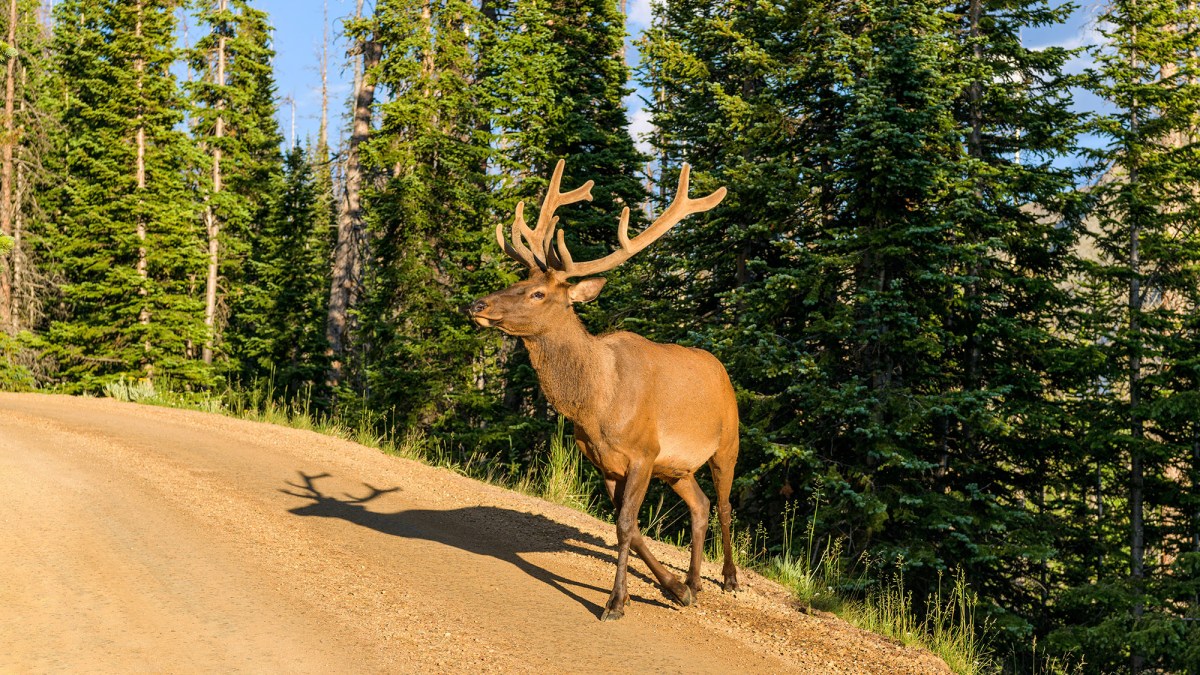

The U.S. Forest Service has drafted a forest management plan for some 4.9 million acres of public land in Oregon and Washington that doesn’t address motorized vehicle access. Conservation groups and state agencies say this lack of off-highway vehicle and road regulation in the Blue Mountains will continue to force elk off public forests and onto private ground.
By omitting motorized vehicle access from the 356-page draft Environmental Impact Statement and skipping any supplementary travel management plans, USFS appears to be taking sides in an entrenched local debate over vehicles and OHVs in the Malheur and Wallowa-Whitman national forests. Along with the Umatilla National Forest, which does have a travel management plan in place, these are already among the most roaded forests in America. It’s also part of a wider push by the second Trump administration to develop previously designated Roadless areas to increase logging, and to open previously closed federal public lands to off-roading.
Overall the Blue Mountains plan has plenty of promise, say wildlife managers and conservationists. After years of conservative timber harvest, wildfire fuel is piling up and dense canopies have crowded out forage for elk. It’s high time to start logging, many argue.
But the key obstacle in this region — how to balance multiple uses with motorized access — is being largely dismissed as a problem to solve. Instead, the USFS is ushering in an uncertain future on how roads will and should be regulated. Research from the USFS in the Blues and across the West shows that when motor-vehicle use increases on public lands, elk relocate. In Oregon, they’re already pushing onto private land.
“We’re on this trajectory of, basically, if you can get it there [in a vehicle], you can go there,” says Nick Myatt, the east region manager for Oregon Department of Fish and Wildlife. “I worry that a lot of the elk hunters who hunt these national forests have no idea what’s coming.”
The draft forest plan is currently open for public comment through Sept. 30.
Road Rage in the Blues
The Blue Mountains are long overdue for an updated management plan. The previous iteration was adopted in 1990, and while it’s been amended many times, a new forest management plan has failed to garner approval. Myatt has spent the last two decades of his career working toward a revised plan. Most recently he served as a member of the Blue Mountains Intergovernmental Council, or BIC, which formed after the last planning process “melted down” in 2019.
Myatt was feeling “very comfortable” about the essential conditions for the Blue Mountains he helped develop alongside his fellow BIC members, who included county commissioners, state agencies, federal agencies like the U.S. Fish and Wildlife Service, and four tribes. A key concern for everyone was ensuring elk security on public land.
“But there was a chain of events where the Forest Service has moved past that. They basically felt like motorized access and elk were the reason the plans had not successfully made it to the finish line in the past. So they’re not going to have that as part of this planning process. They’ve really adopted many of BIC recs in the alternatives out for public review, but that one they’ve largely ignored.”
The USFS also issued several memos that signaled a departure from previous management. USFS forest supervisors notified the BIC that there would be no Travel Management Plan on the Wallowa-Whitman and Malheur national forests. Then came the memo that USFS line officers would no longer have the authority to make on-the-ground road closures.
“When you start looking at all of that as a whole,” says Myatt, “it starts to paint a troubling picture of what our forests could look like in the future for hunters and public users that really depend on elk on their public land.”
In its memos, the USFS frames travel management as something that would “decrease public access.” This is consistent with messaging by some OHV users who have framed any road closures as denying the public access to its public lands, rather than managing motorized use on public lands that they are still free to recreate on. The pro-off-roading group Forest Access for All is one such group.
“As travel management plans start to become more of a talking point across our forests, BLM, and Congress, we can’t allow the conversation to devolve into a pro ‘access’ fight which implies that access in many forms does not already exist. It does,” says Ryan Callaghan, a former Western hunting guide and president & CEO of Backcountry Hunters and Anglers. “We cannot allow this to become a deregulation conversation either. It is … literally the regulations that allow for multiple high value opportunities to exist on our public lands.”
The USFS memos and current federal guidance conflict with existing law and operating procedure, and it’s causing confusion. This is true on the ground for USFS employees in the Blues. Some foresters in the Blues are choosing to stall planned closures per USFS interim guidance, which may technically be a violation of the current forest plan.
It also makes trying to understand what exactly will happen to Roadless areas or current closed roads in the Blues confusing for conservation groups, elk hunters, and other public-land users who rely on the area. In other words, certainty on motorized use or future road building is anything but resolved with this draft EIS.
The USFS did not provide comment by press time on its decisions to exclude motorized access management.
The agency’s own research is clear, however: Elk are sensitive to disturbance from roads. They don’t particularly like horses, hikers, bikers, and other human interference, either, but elk are most affected by motorized vehicles.
In fact, some of the leading science on how elk respond to motorized vehicles was conducted by the USFS in the Blue Mountains, at the Starkey Experimental Forest near La Grande, Oregon. That research has shaped motorized vehicle management all over the West. The takeaway is that elk need both active timber management for healthy forage and secure habitat. If they’re too close to open roads with vehicle use, they’ll leave.
Related: Roadless Areas Provide 10 Times Better Elk Hunting and Support the Best Trout Streams in the West, Study Shows
“The research coming out of Starkey has been telling us for decades,” says Tristan Henry, a sixth-generation Oregonian and the Oregon field representative for the Theodore Roosevelt Conservation Partnership. “Once you get much past a mile of open road per square mile, elk start looking for somewhere quieter to be.”
When open-road density creeps to roughly 2 miles of road per square mile of habitat, there’s a 55 to 80 percent loss of elk in that area. That’s staggering when you consider that Wallowa-Whitman and Malheur national forests already have more than 11,000 combined miles of existing roads open to the public.
The exact figures vary based on different reports from over the years (several of which have been removed from the USFS website), but here’s a snapshot of existing roads and road densities for the Malheur and Wallowa-Whitman. Under increased logging and unregulated motor-vehicle access outlined in the management plan, these figures could expand substantially.
| Road Density forest-wide (mile of road per square mile of habitat) | Greatest road density within the forest (mile of road per square mile of habitat) | Existing Open Roads | Existing Closed Roads | Total inventoried roads | |
| Malheur National Forest | 1.5 to 3.2 miles, varies by habitat | 4.23 (excludes current roadless wilderness) | 7,033 miles | 2,637 miles | 9,670 miles |
| Wallowa- Whitman National Forest |
2.4 to 2.5 | n/a | 4,633 | 4,486 | 9,119 miles |
Note: The Umatilla National Forest, which has road densities estimated between 2.5 and 3.1 miles/square miles, currently has a travel management plan in place.
Elk herds in the Blues are relatively healthy and numbers are robust, says Myatt. The problem has increasingly been their distribution.
“Over the last few decades we’ve just been in this situation where elk populations are getting more and more on private land,” says Myatt. “A lot of that has to do with this lack of active management and [resulting] habitat conditions on public land.”
It’s tough for state agencies to compete with irrigated agriculture or private forests that are actively logged and, as a result, have plenty of browse. If more roads are built, existing road closures aren’t enforced, and OHVs are permitted anywhere, the problem will intensify.
“If you’re going to have high public use,” says Myatt, “you have to provide areas where there’s distance from roads, these security areas where elk aren’t getting run around all the time and chased off public land.”
What Hunters Want to See
Not only do elk rely on the millions of acres of public ground in the Blue Mountains, but so do generations of hunters and the economies of the local towns. Elk have been adopted as the mascots of everyone from school sports teams to resident hotshot crews, and they are one of the primary economic drivers in the region.
The most relevant study on the economic impact of elk hunting in the Blue Mountains is dated, but still widely cited among state and federal officials. In the 1990s, researchers calculated the value of elk season in the Blues between $17 to $20 million per year. Adjusting for inflation, the best estimate puts the value between $40 and $47 million last elk season.
“Elk hunting is in the fabric of our culture in these local communities,” says Myatt. “People eat, sleep, and breathe elk hunting.”
Now 49, Justin Moore has hunted elk with his family in the Murderers Creek unit in the Blues since he was six. Tags have gotten harder to draw and feral horses have begun to run unchecked in the area, but mostly he’s been able to enjoy the same traditional camp with multiple generations of family members. Often they drive their trucks straight to camp and hunt where open country meets timber. Moore used to draw a tag every year until his 20s; now they draw as a group every three to five seasons.
“That’s the cool thing about the whole Blue Mountain Area,” says Moore. “You have that vast meadow and really steep, rugged timber.”
Moore, who comes from a family of loggers and cattle grazers, says the area desperately needs logging to clear the thick timber and wildfire management to reduce ladder fuels.
“There are tons of road closures for the hunting seasons where we hunt. Which, to be honest, I’d say 90 percent of the hunters are pretty happy about. Because it does keep people [from driving everywhere],” says Moore. “There are quite a few other hunters around. Just like anywhere, the further you get away from the road, the fewer people you’ll see.”
Some elk hunters see both sides of the access debate, but remain skeptical of full road deregulation — particularly those who enjoy hoofing it into more remote and rugged areas on foot or horseback.
As sheriff of Grant County, Oregon, which is 54 percent USFS land, Todd McKinley knows residents are “highly dependent” on public forest and its renewable resources for their livelihoods and way of life. He has served as sheriff for six years and worked in the county for nearly 26. He’s also a diehard elk hunter.
“I love to public-land hunt myself and go deep, dark in places. I don’t like to see people and I love to go places no one else wants to walk and absolutely enjoy it.”
He understands the usefulness of road access for hunters who aren’t as physically capable, but he doesn’t relish the idea of roads everywhere.
“Do I think [other hunters] should be able to access a bunch of that? Sure. Do I want them driving down remote wilderness trails? No. There’s wilderness for a reason and that’s for those who can get in there,” says McKinley. “[Some hunters] look at us and are like ‘Oh man I’d love to go in there but I’d have to ride a wheeler in there.’ And I’m like, ‘Well that’s why you’re not there.’ And they’re almost like, ‘Well that isn’t fair, I want to go in because there’re big bulls in there.’ Well, yeah. Start walking. Get in shape. It’s almost everybody-gets-a-participation-trophy garbage. They want to be able to [go into the backcountry] and not put the effort in.”
In his professional capacity, McKinley grapples with every facet of road access on those public lands. During search and rescue operation, he and his crews can enter locked access gates — but often dead-end on old logging roads that are physically obstructed by berms and boulders. On the flip side, he gets plenty of complaints from backcountry hunters clashing with OHV users who are ignoring road closures.
“They have Travel Management Areas in our area for hunting season. And I get it, it’s to keep people from just driving everywhere and chasing game around with vehicles. To me that’s not fair hunting. So do we get a lot of calls? Absolutely,” says McKinley.
“Because you’ll get a camp set up on the end of one of those closed roads next to the traveled road, and in the middle of the night five rigs go down that road and drive way into where these guys are hiking … and observing this closure and putting the effort in. And of course, they’re fired up because all this machinery goes way in and dumps off hunters. So then the fight is on.”
McKinley did his fair share of logging in the 1990s. Currently he’s coordinating wildfire evacuations and fire-response teams in his jurisdiction. Like many of his peers, he sees an urgent need for timber management and wildfire fuel reductions.
On Friday the Hagen Fire was headed toward Summerville, where Blue Mountain Adventures outfitter Bob Staples is based. He attributes Oregon’s current wildfires to years of forest mismanagement. While he relies on public-land elk to make a living, his most pressing concern is expediting whatever forest plan will allow more active timber management.
“If you look at a wildfire map, we are losing our forests rapidly,” says Staples, who has outfitted in the area for 22 years. “There’s one unit right now, in the last three years has burned sixty percent of the hunting unit up. If they had logged it, had put roads in to log it, and then put gates in later, and then done a travel management plan, I think that would be my opinion for the best on both sides.”
As a big-game outfitter, Staples often relies on horses and mules to access backcountry with his elk hunting clients. He also operates out of a lodge and sometimes uses helicopters for remote access. While he’d previously attended stakeholder meetings on the Blue Mountains plan, Staples says officials kept changing the plans and he couldn’t keep up. Now, he’s only vaguely familiar with what the plan might mean for motorized access, but it’s less of a priority these days.
“You’ve got the wilderness people like myself who love wilderness and getting into the backcountry. But if we don’t have any forests to go into because it’s all burned up, that kind of defeats the point.”
A Desperate Need for Management — and Consensus
In trying to finally drag a management plan across the finish line, however, the USFS could be setting itself up for another time-honored tradition in the Pacific Northwest: environmental lawsuits.
Because the draft forest management plan exists in an odd gray area of conflicting federal law and executive orders to undo them, it may not be legally defensible. This might represent a temporary win for those elk hunters and conservation groups who are concerned about road density, but it will ultimately delay the active forest management that most people have agreed they want. That includes responsible timber harvest, fire fuel mitigation, and increased vegetation for elk browse, among other priorities.
The Rocky Mountain Elk Foundation has a long history of habitat work, research, and financial investment in the Blue Mountains. However, RMEF declined to provide comment to Outdoor Life on the current proposal and has not yet submitted comments on the USFS draft proposal.
Instead, the organization points to its guidance from 2025 on forest management in the area, where the organization has worked for decades. RMEF’s stated priorities include fuels reduction and “active forest management treatments” but do not address motorized access.
Still, other hunting and conservation groups like TRCP and BHA are urging elk hunters to weigh in on the current Blue Mountains Forest Plan Revision. One overlooked point, says Devin O’Dea, the Western policy and conservation manager for Backcountry Hunters and Anglers, is the risk of throwing out elk habitat and research investments made over the last 35 years. That includes projects done through the Blue Mountains Elk Initiative.
“If we’re not mindful of the density of roads and routes that are open or closed, we’re just going to see that investment go to waste,” says O’Dea. “We’ll see elk move more onto private land, there’s going to be more costs to the agricultural community, there’s going to be more conflict. It ends up wasting taxpayer dollars, it wastes time in legislature debating issues related to wildlife. We need to just be good stewards of that [habitat] investment and understand the value of the hunting economy … and continuing that really calculated science-based management that keeps us away from the polls. The loudest voices in the room are the ones saying ‘opening it all’ or ‘close it all.’ And it’s never going to get us to a solution.”
The public can submit comments on the proposal through Sept. 30.
“The linchpin here is that motorized access management needs to be balanced with the other things this plan seeks to secure,” says Henry of TRCP. “Timber harvest is not problematic from our perspective. It can and should be very helpful in most of these forests. But … managing timber without also managing road density is a recipe for poor elk distribution, conflict, and reduced opportunity.”
Read the full article here
