



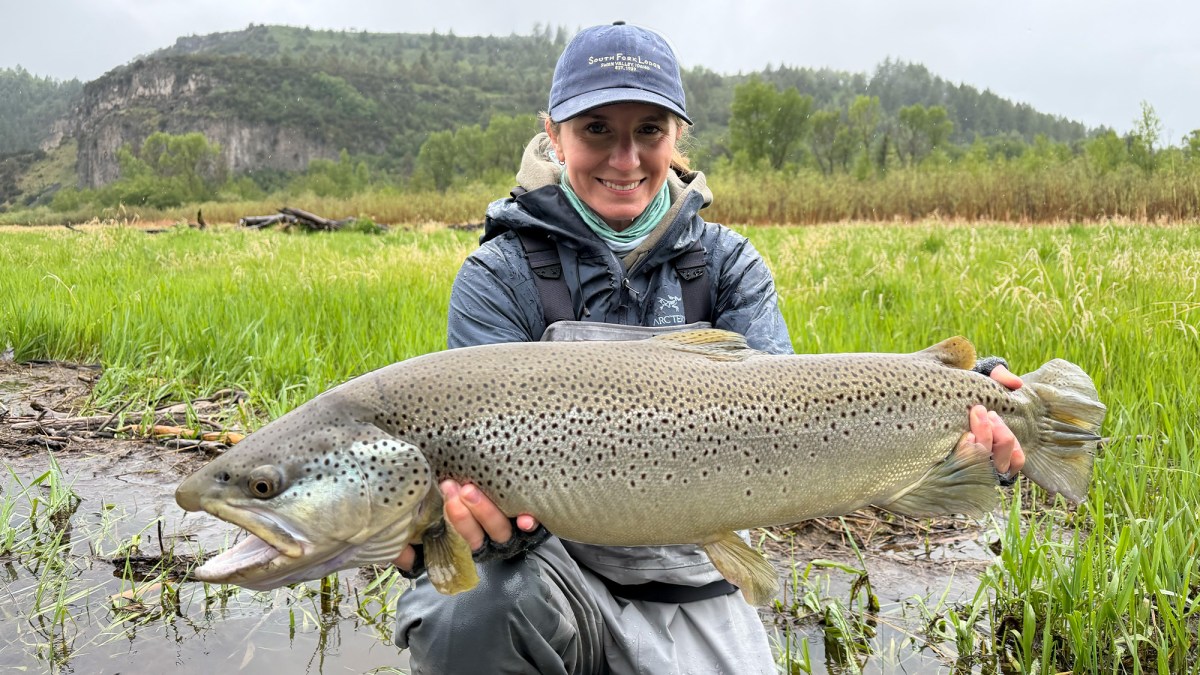

The South Fork of the Snake River in Idaho holds some truly giant fish. Most of these trout, what veteran guide Ed Emory calls the “megalodons,” are rarely hooked. When they are, the odds are usually stacked in their favor. But occasionally everything aligns and a fish that rewrites the record books is lifted out of the water.
“A blessing from God is honestly what I amount it to,” says Caroline Langdale, the Georgia angler who caught and released a pending Idaho record brown trout while fishing with Emory on May 30. The fish, which they released back into the South Fork, measured 30.5 inches long.
A Pivot in the Turkey Woods and a Runaway Fly
Hailing from Georgia, Langdale is one of many Southern hunters with a growing addiction to turkey hunting. So, when she planned her trip out West for this May, her main focus was chasing gobblers in northeast Wyoming with Seven J Outfitters, run by Jeff and Deb Smith. She also booked a couple days of guided fishing through the South Fork Lodge in eastern Idaho, and her plan was to head there right after her three-day hunt.
They found plenty of birds in Wyoming. And while it was late in the spring season, Langdale says most of the toms they saw were still henned up.
“They were hot and heavy, strutting and gobbling like crazy, but that made them really hard to hunt,” Langdale tells Outdoor Life. “I think it was the second afternoon when I realized this might not be wrapped up in time for me to make my first day of fishing on the South Fork.”
That evening, Langdale called the lodge to push her guided trip back from May 29 to May 30. The next morning, on May 28, she and Jeff sealed the deal in a “picture-perfect” hunt. With time now on her side, Langdale canceled the flight she’d booked from Rapid City, South Dakota, to Jackson, Wyoming. She rented a car instead and spent May 29 driving west.
This meant that Emory, who’s now in his 36th season guiding on the South Fork, had an open boat. Not one to miss a day on the water, he took out two lodge employees, the dining room manager and a younger guide. The three of them were having a great day catching trout on nymphs when the dining room manager lost her entire rig to a fish that Emory thinks was at least 25 inches long.
“That fish was so powerful it was literally pulling her over the edge of the boat,” Emory recalls. “So she does this Vulcan death grip on the fly rod, the indicator breaks off, and the whole rig’s gone … We sat there for probably half an hour going back and forth, running the same areas and looking for it.”
Amazingly, after rowing down about a mile of river, Emory spotted the same indicator scooting across the surface with a fish still clearly attached to one of the flies below. The younger guide was able to hook and haul in the rig, which now had a small whitefish hooked on the rubberlegs stonefly nymph. Emory kept the two-fly rig near his rower’s seat, knowing it would come in handy soon.
Revenge of the Rubberlegs
By the time May 30 rolled around, Langdale was itching to hit the river. It would be her first time floating the legendary South Fork, although she’d fished the Snake River near Jackson awhile back. The morning conditions were cold, wet, and nasty — great for trout fishing, but not exactly welcoming for a Georgia girl.
“But I’m thinking, you know, she’s tough enough to turkey hunt,” Emory says. “So she probably has the fortitude to tough this out.”
Langdale proved him right quickly enough, when she hooked a 21-inch cutbow on her second or third drift of the morning. They were still within sight of the boat ramp.
“There’s something to be said about somebody who has that much experience, and I just got so fortunate that [Ed] is who I got put with,” Langdale says. “I was so tickled with that first fish alone, my whole day would have been made.”
As it turns out, the two were just getting started. Emory’s go-to rig for this time of year, a double nymph setup with a stonefly imitation and an egg pattern, was doing work. By mid-morning, Langdale had landed around 15 nice trout. Then she hooked a much bigger fish that rolled around the leader and broke her off.
“We’re kind of disappointed because we knew — I knew — that was a big one. And I pointed out to her: That’s how you know it’s a nice, big fish, when you see it rolling like that,” Emory explains. “Those really big fish, they don’t run … They don’t get big by running away with your fly in their mouth and expending all that energy. They literally tumble and twirl, and do whatever they can to wrap that line.”
It was a little before noon when they got another shot at brown trout glory. By that point, Emory had tied on the rubberlegs fly they’d lost and retrieved the day before. They were drifting toward a big, 30- to 40-foot hole where Emory had found nice fish in the past, and Langdale’s indicator dipped down right as her nymphs dropped off a shelf and into the massive hole. She came tight to what felt like a snag.
“I really felt like I had the bottom. I was even saying that to Ed, ‘Did he come off? Am I hooked on bottom?’”
Emory assured her the fish was still hooked as he watched it rolling down deep. Then he pulled anchor as quickly as he could. He knew there was a big tree at the bottom of the hole, one that has helped break more than one client’s heart over the last 20 years. (By his count, Emory has rowed around 68,000 river miles on the South Fork over the course of his career.) Of course the fish headed straight for the wood.
Read Next: Trout Fishing Tips: A Quick Guide for Catching More Trout
With Emory pulling on the oars and Langdale leaning into her rod, they were able to get the trout away from the sunken tree and back into the main current. As the fish came out into the channel, Emory watched the indicator pop three times slowly under the water — a sure sign that the fish had unrolled itself from the 2X (12-pound-test) leader.
After pulling the boat into faster water and then back into a deep eddy, Emory coached Langdale, whose rod was bent into a U shape. After nearly 10 minutes of this, she was finally able to coax the big brown to the surface. Emory rowed back into a shallow riffle, pulled out his long-handled net and scooped the fish. The trusty rubberlegs nymph was pinned in the corner of its mouth.
“Then we gently made our way to shore to give the salutations and thankfulness that fish really deserved,” Emory says.
On any other day, Emory says, he would have taken the obligatory grip-and-grin and then let the fish go. But because of a conversation he’d had with a younger guide in the fly shop earlier that morning, he was thinking about the standing Idaho catch-and-release record, a 30-inch brown trout caught from the Snake River in 2016. (Emory thinks that brown was also a South Fork fish, but he isn’t positive.) So he put a tape on Langdale’s fish, which measured 30.5 inches long.
“This young guide, he’s just full of testosterone. And he was yakking about the record that morning, saying ‘I want to get the record. It’s only 30 inches and I think we can beat 30.’ I was thinking, ‘Dude, just relax,’” Emory says. “But that’s the only reason I taped the fish, because he had just put that in my mind.
“It was also to kind of put that young kid back in his place,” Emory jokes.
Langdale says she’s already heard back from officials with the Idaho Department of Fish and Game, and she expects to hear back on state-record certification within the month. She isn’t too worried about it, though.
“I’m just so thankful for the memory,” Langdale says. “I really believe that the Lord worked the timing out perfectly … I was meant to be there on May 30th at 11:30 a.m. on that exact stretch, with Ed Emory in the boat.”
As a reminder of that divine providence, Langdale kept Emory’s lucky fly with his permission.
“I have a little bowl on my kitchen counter with some of my turkey spurs. It also has an alligator scute, and the fly I caught my first redfish on,” Langdale says. “Now I’ve got my rubberlegs fly. So that’s gonna stay in a safe place for a long time.”
Read the full article here
