



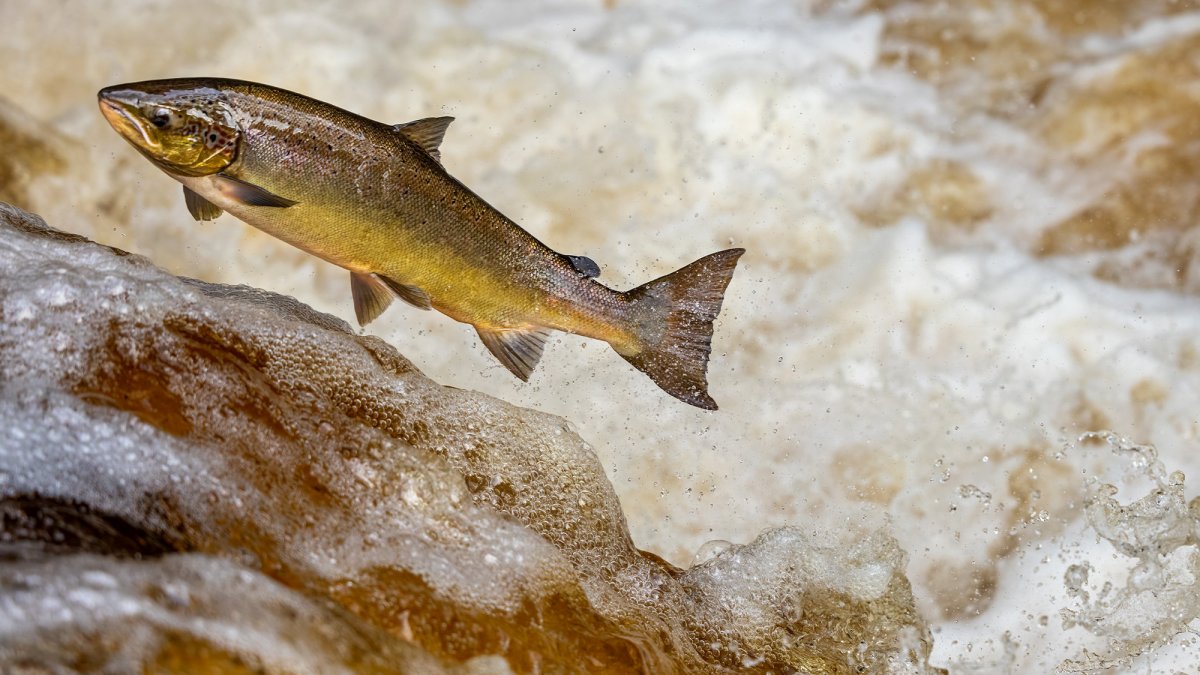

Atlantic salmon are admired by many anglers as the “King of Fish” because of their incredibly strong swimming abilities. They can travel more than 30 miles a day, jump up to 12 feet in the air, and make powerful, speedy bursts against heavy current — all of which make for blistering runs when they’re hooked on light tackle.
Give them a good bump of cocaine, though, and they’ll swim even harder.
This was the main takeaway from a study that published Monday in Current Biology. Led by Swedish scientists, the study looked specifically at the effects that cocaine and its main metabolite, benzylecgonine, have on Atlantic salmon in the wild. They found that salmon on cocaine swam roughly 20 percent faster and traveled nearly twice as far as sober fish.
While not exactly surprising, these results can help us better understand the effects that wastewater pollution could be having on this beloved and threatened species, as well as other fish and wildlife around the world.
“Illicit drug pollution is a rapidly emerging threat to aquatic ecosystems. However, we still know very little about how these potent neuroactive substances can affect the behavior and movement of non-target species in the wild,” the authors write. “Here, in a large field-based experiment, we demonstrate that environmentally relevant levels of the common illicit pollutant cocaine and its main metabolite, benzoylecgonine, can accumulate in the brains of exposed fish and affect their movement and space use in the wild.”
The research team, led by Dr. Jack Brand, noted how this was the first study of its kind to occur in the wild. Past researchers have looked at the effects of cocaine on various fish species in laboratory settings.
To test their theories, the scientists took 2-year-old Atlantic salmon smolts from fish hatcheries and fed them slow-release capsules. Some of the capsules had cocaine, while others contained benzoylecgonine, the chemical compound that is released when the human body breaks down the drug. These dosages were “environmentally relevant concentrations,” meaning they aligned with the level of cocaine or benzoylecgonine that would be found in a polluted waterway. The rest of the capsules contained no drugs and were given to the “control fish.”
The team then released these fish into Lake Vättern, a large water body in Sweden that covers roughly 738 square miles and has a maximum depth of around 420 feet. Using acoustic telemetry, they were able to track the fish over the course of eight weeks.
They found that the hopped-up salmon swam around 1.9 times farther per week than the control fish and had dispersed up to 7.6 miles farther by the end of the study. These effects were more pronounced in the salmon that were given the metabolite. By the end of the eight-week study, most of these salmon found in the central-northern portion of Vättern, while the control fish stayed closer to the initial release site on the southern end of the lake.
Interestingly, the salmon on cocaine (as well as those given the metabolite) had better survival rates than the control fish. The authors refer to this measurement as “apparent survival time” in the study.
“The median time until 50% of the fish from each treatment group were presumed dead was [around] 75 days and [around] 73 days in the cocaine- and metabolite-treatment groups, respectively, compared with [around] 55 days in the control group,” they write.
This doesn’t mean that coked-up salmon are better off, however, and the study’s authors concluded the exact opposite. They noted how this disruption in “the movement and space use of these fish” could have long-term effects on their reproduction and survival. This could further stress wild Atlantic salmon runs, which are already suffering from habitat degradation, dams, changing ocean conditions, and a host of other factors.
Read Next: Hundreds of ‘Cocaine Hippos’ Are Terrorizing Colombia. This Biologist Has Agreed to Help Track Them Down
These results also have implications for other fish around the world, including here in the United States, which is the world’s largest consumer of cocaine. Pharmaceuticals are a concern here, too, as they also flow into our rivers and bays via wastewater systems — either directly from manufacturing plants and discarded pills, or indirectly through human excretion.
A 2022 study in South Florida found that the average bonefish in Biscayne Bay and the Florida Keys has seven different prescription drugs in its system. (That study focused strictly on pharmaceuticals and not illicit drugs.) One fish from the study contained 17 different prescription drugs, including blood pressure medications, antidepressants, antibiotics, and pain relievers.
Read the full article here
