




The California Department of Public Health issued a warning Friday about an ongoing surge in poisoning cases linked to the picking and consumption of wild mushrooms. The CDPH says there have been at least 50 cases of mushroom-related poisonings in the state, four of which were fatal, since November. Amid the unprecedented outbreak, health officials are “strongly urging Californians not to pick or eat wild mushrooms” at this time.
“This outbreak, now in its seventh month, continues to cause severe liver damage in both children and adults and has led to four deaths and four liver transplants among the 50 identified cases,” the CDPH explained in the news release. “Since mid-April alone, the California Poison Control System has received reports of 12 additional poisoning cases, far surpassing the state’s previous major outbreak in 2016, which involved 14 total cases.”
For comparison’s sake, the public health agency says it usually sees fewer than five reported cases of mushroom poisoning in a typical year. That makes the current surge in poisonings a 900 percent increase from normal.
All of these cases have been linked to wild mushrooms picked on public lands in Northern California and along the Central Coast. The CDPH has confirmed nine counties where mushroom foragers have been poisoned, with the highest concentration around the San Francisco Bay Area.
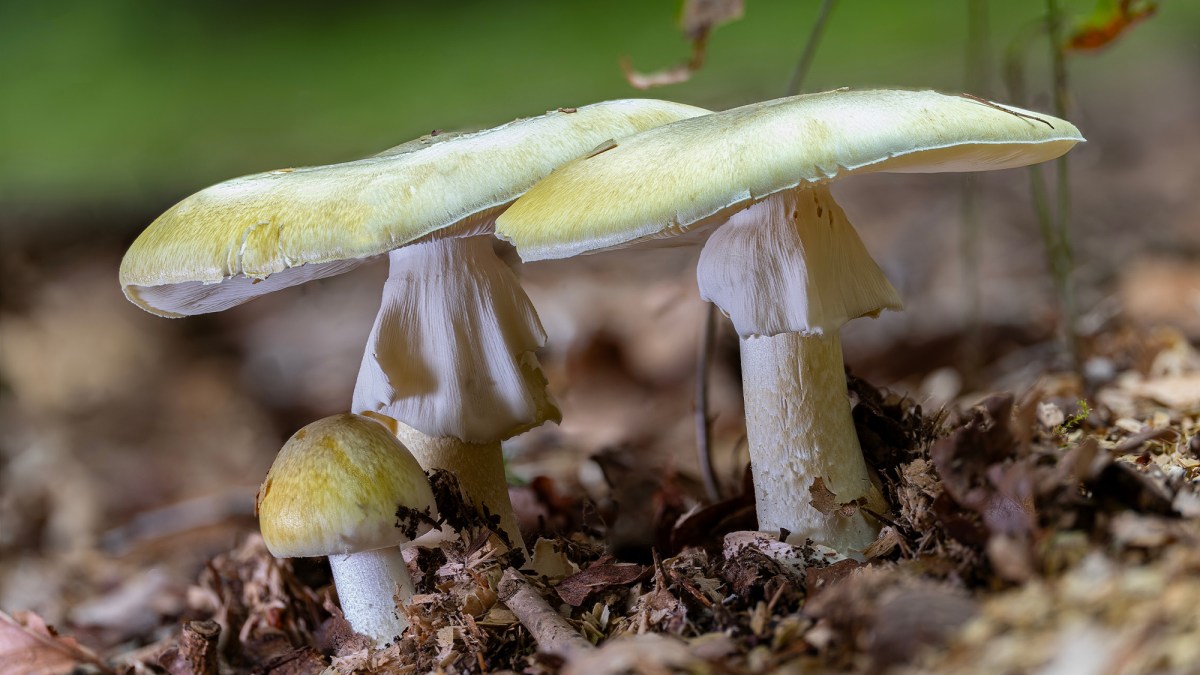
Although officials are asking Californians to refrain from picking any wild mushrooms anywhere in the state, the CDPH has linked the current outbreak to two species in particular: western destroying angels (Amanita ocreata) and death caps (Amanita phalloides). It says the two species closely resemble several edible mushrooms, and that “even experienced foragers may have difficulty” distinguishing these poisonous species from the safe varieties.
According to an identification guide for western destroying angels, which are part of the Amanita genus, these mushrooms with white caps and white gills are often mistaken for button mushrooms, puffballs, and paddy straw mushrooms. The most important identifying feature of western destroying angels can be found at its base, which has a bulbous, sac-like structure known as a volva.
Another type of Amanita mushroom, the aptly named death cap, is widely considered the most dangerous species of mushroom in the world. It’s linked to around 90 percent of the poisonings that occur globally, and eating just half of one is enough to kill a person. Although they’re native to Europe, death caps now thrive in North America and especially on the West Coast. They are often mistaken for paddy straw mushrooms, field mushrooms, and puffballs. Death caps can be identified by their pale greenish-yellow caps, purely white gills, and the bulbous volva at their base.
“While western destroying angels typically bloom into spring, death caps would normally be declining this time of year,” the CDPH explains. “Instead, these mushrooms continue to appear abundantly in multiple regions. Recent rains are suspected to be a contributing factor of this unusual resurgence.”
Read Next: These Are the 12 Most Dangerous Plants Hiding in Plain Sight. How Many Can You Identify?
This explanation aligns with an earlier public-health warning that was issued by the California Poison Control System on Dec. 12. By that date, area mycologists were reporting a “banner year” for Death Caps due to early seasonal rains in the San Francisco Bay Area, and the CPCS had already confirmed 23 poisoning cases stemming from foraged death caps, including a family of seven with a 19-month-old child. In every case, the individuals developed symptoms within 6 to 24 hours of eating the mushrooms.
“This is the most massive cluster of amatoxin cases I’ve seen in my 40-plus years in poison control,” CPCS executive director Thomas Kearney said in December. “We knew immediately that we were facing an unusually dangerous season.”
Read the full article here
