



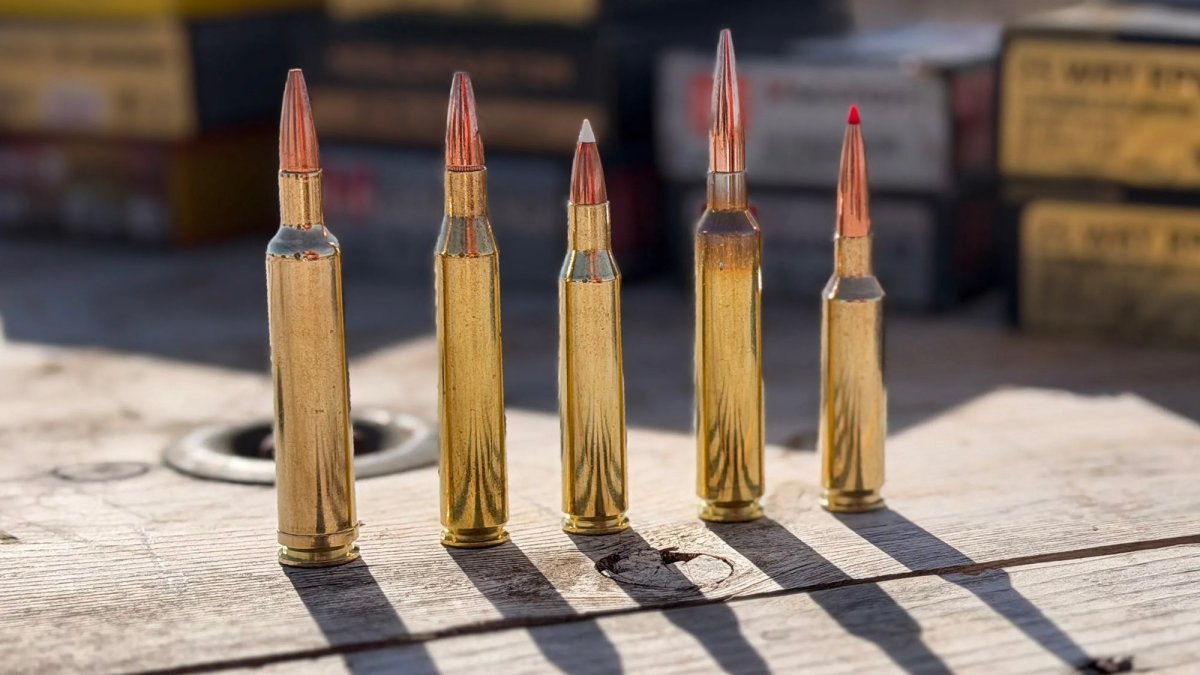

It looks like 2026 is shaping up to be the year of the quarter-bore. With the 25 Creedmoor catching fire, Weatherby’s introduction of the intriguing 25 RPM, and heavy interest in the 25 PRC wildcat, it seems the twenty-fives are finally gaining some respect in the Modern Cartridge Design era.
That it has taken until now for the 25s to garner this attention has been a sore-spot for the quarter-bore aficionados. Many .257 diehards suffer from a red-headed stepchild complex. If I do a story on the best antelope cartridges, or the best rounds for open-country hunting, and I don’t include everyone’s pet 25, they take the perceived slight personally.
That reflex to find insult hasn’t been helped by the recent flood of new cartridges and bullets for the 6.5s, the 6mms, the 30s, the 7mms, the 22s, and even the 338s — pretty much everything other than the 25s. But this year that has changed. The quarter-bore crowd has reason to be excited with new cartridges, and a slew of new bullets, to choose from.
Love for the Classics
I count myself among the .25-caliber faithful. I have long histories with both the .257 Roberts and the .257 Weatherby Magnums. The Roberts was my go-to pick back in the day when putting together deer rifles for my kids. We all ended up with some fine-shooting examples, and my son really embraced the round, making short work of the deer and antelope he confronted.
The .257 Weatherby was one of my earliest ballistic aspirations. Back then, I’d pour over the catalogs from gun and ammo companies, looking at the velocity and drop charts, comparing rounds, and dreaming about someday owning these ultimate hunting rigs. The .257 Weatherby, along with the 7mm Rem. Mag., and .338 Win. Mag., were always among my top contenders, but the fiscal realities confronting my 13-year-old self made the idea of owning one a distant prospect.
Eventually, I had a couple .257 Weatherbys to call my own, and they served me well on Coues deer, mule deer, and other Western game.
I’ve had a soft spot for the .25/06 as well, thanks to my brother who picked one up more than 30 years ago and has been tipping deer over with it since. The solid performance of that gun, a vintage Steyr, has endeared me to ought-six’s little sibling.
Old-School 25s vs. Newcomers
The arrival of the 25 Creedmoor, officially introduced in 2025, and the 25 Weatherby RPM, announced earlier this year, poses an interesting question to hunters and shooters, whether they have experience with the .25s or not: How do the classics stand up against these newly minted rounds?
Is this another case, as many hunters seem to feel, of marketing hype by Hornady and Weatherby attempting to drum up interest in another “pointless” introduction that’s more sizzle than steak. “They don’t do anything my (fill in the blank) doesn’t do,” is the motto of this crew. And worse, “they are only doing this to sell more guns!” these cynical sportsmen proclaim, which is apparently an unforgivable sin for gun and ammo companies.
Or, are these whiz-bang quarter-bores the next big thing, dragging this long-neglected bullet diameter from the Dark Ages into to the light of 21st Century ballistic performance?
.25-Caliber Shootout
To see how the twenty-fives stack up against each other, I assembled a field of rifles in the various cartridges and shot them head-to-head. You can see the whole project in the video that goes with this story.
My goal wasn’t to pass judgement on the relative merits of the cartridges, in terms of their precision or other factors relating to their performance. That wouldn’t have been fair to a couple of the rifles in particular, which were traditional hunting rifles rather than modernized precision rigs.
Rather, I wanted to capture the vibe of these cartridges in the different platforms, all of which still are relevant in my opinion — though there’s no question that the older configurations no longer hold the sway they once did.
Why It Took This Long for the 25s to Feel the Love
Before delving into the results, it’s fair to ask why the twenty-fives lagged so many other calibers that have benefited from the trends in Modern Cartridge Design these last twenty years.
It’s a classic chicken-and-egg dynamic. The successful introduction of rounds like the 6.5 Creedmoor, 7 PRC, 6mm ARC, and 300 PRC require both a new case and chamber design and bullets that can leverage the advantages of the chambering.
In calibers like .308, .243, .264, .284, and .224 there have always been a broad array of bullet weights, including heavy-for-caliber offerings that are key for MCD rounds. In .257, we had nothing that fit the bill until the 131-grain Blackjack bullet appeared in 2018. As cool as that bullet was, with its sexy .330 G7 BC, it was a niche offering that was adopted by relatively few shooters.
But the people that used the bullet had excellent results, and interest in it gained momentum. In the meantime, we had MCD rounds coming out of the woodwork in all other major bullet diameters. The widespread success of these rounds set the stage for companies like Hornady, Berger, and others to trot out high BC .257-caliber bullets, paving the way for the commercial introduction of the 25 Creedmoor and 25 Weatherby RPM.
The Field of Rifles
I gathered rifles in the following cartridges: .25/06 Remington, .257 Roberts, .257 Weatherby Magnum, 25 Creedmoor, and 25 Weatherby RPM. They included:
Snapshot of the Results
These results below are interesting, but they require some context. First, this is not an apples-to-apples accuracy comparison. Given the radically different designs of the rifles, it’s little wonder that the custom 25 Creeds outshot the old-school Winchester Model 70 in .25/06 Rem. Second, the variety and quality of the available ammunition precludes a head-to-head analysis.
The main takeaways are that it pays to try different loads in any rifle to see if there is a strong preference for bullet type and weight. Also, handloading is still the best way to get the best precision from a rifle.
The handload data shouldn’t be construed as the ultimate option for those 25 Creeds. That was an expedient middle-of-the road recipe, where I wasn’t able to chase either velocity or dispersion. The handloads were carefully crafted (and did quite well) but its more than likely there’s room for improvement with them, too.
| Rifle | Cartridge | Ammo | 5-Shot Group Avg. | Velocity | ES | SD |
|---|---|---|---|---|---|---|
| Winchester Model 70 Featherweight | .25/06 Rem. | Nos. 115-gr. BT | 2.011 in. | 2960 fps | 74.0 fps | 17.2 fps |
| Sisk Remington 700 | .257 Roberts | Fed. 100-gr. SMK | 1.170 in. | 2950 fps | 74.2 fps | 20.1 fps |
| Sisk Remington 700 | .257 Roberts | Hrn. 117-gr. SST | 2.400 in. | 2558 fps | 57.2 fps | 15.3 fps |
| Weatherby Mark V Backcountry Guide | .257 Wby. Mag. | Wby. 92-gr. Hammer | .921 in. | 3717 fps | 78.4 fps | 22.2 fps |
| Weatherby 307 Alpine CT | 25 Wby. RPM | Wby. 133-gr. Berger EH | .778 in. | 2967 fps | 53.4 fps | 12.6 fps |
| Christensen Arms Evoke | 25 Creedmoor | Hrn. 128-gr. ELD-X | .801 in. | 2780 fps | 37.4 fps | 9.9 fps |
| Christensen Arms Evoke | 25 Creedmoor | Hrn. 134-gr. ELD-M | 1.210 in. | 2711 fps | 71.7 fps | 18.1 fps |
| Falkor 7Even Custom | 25 Creedmoor | 138-gr. A-Tip Handload | .621 in. | 2784 fps | 47.3 fps | 10.7 fps |
| Falkor 7Even Custom | 25 Creedmoor | Hrn. 134-gr. ELD-M | .833 in. | 2837 fps | 42.0 fps | 11.4 fps |
| Falkor 7Even Custom | 25 Creedmoor | Hrn. 95-gr. ELD-VT | 1.194 in. | 3269 fps | 52.5 fps | 14.8 fps |
| Impact NBK Ultralite Custom | 25 Creedmoor | 138-gr. A-Tip Handload | .514 in. | 2778 fps | 27.9 fps | 6.9 fps |
| Impact NBK Ultralite Custom | 25 Creedmoor | Hrn. 128-gr. ELD-X | 1.111 in. | 2895 fps | 47.5 fps | 12.4 fps |
| Impact NBK Ultralite Custom | 25 Creedmoor | Hrn. 95-gr ELD-VT | 1.337 in. | 3261 fps | 63.3 fps | 17.1 fps |
.25/06: Winchester Model 70 Featherweight
See It
.25/06: Winchester Model 70 Featherweight
This rifle is a throwback to another time. The walnut stock, thin-profile blued barrel (not threaded, of course), and pre-64-type action made this the poster child for the American hunting bolt-action for decades. It’s the Rifleman’s rifle.
It is easy to carry, has a proven action that’s utterly reliable, drop-dead looks, and includes features that set the standard for the modern hunting rifle. The three-position safety on the bolt-shroud, for instance, has been the gold standard for functionality. And the stock profile, with its flat comb and trim fore-end, defined the American Classic look, which dominated hunting rifle design for generations.
Model 70 Performance
The sleek silhouette of the Model 70 Featherweight hints at the rifle’s nimble handling. The stock geometry was designed with offhand shooting in mind. The rifle shoulders quickly and has wonderful balance. When running it unsupported it feels like a natural extension of the shooter’s hands.
The .25/06 Rem. has a “just right” feel in the Winchester. The recoil when shooting it in practical field positions isn’t bothersome at all. When prone with a bipod shooting groups it is a bit snorty, especially when compared to the other rifles in this evaluation.
Not only does the rifle’s design harken to another era, but so does its accuracy. When I first started evaluating firearms three decades ago, rifles like this Featherweight were the norm. Synthetic stocks were rare, muzzle brakes weren’t very common, and accuracy guarantees were less common still.
The groups turned in by this .25/06 explain why.
Shooting Nosler’s 115-grain Ballistic Tips, the rifle printed 5-shot groups averaging 2.011 inches. Muzzle velocity (MV) averaged 2960 fps, and over the 20 shots had an extreme spread (ES) of 74 fps with a 17.2 fps standard deviation (SD). Federal’s 100-grain Barnes TSX load did a little better, with 5-shot groups averaging 1.866 inches and an average MV of 3024 fps with a 77 fps ES and 15.0 fps SD. Both are adequate for deer at moderate ranges, but by today’s standards are lackluster.
I had an overwhelming pang of nostalgia with the first group I shot with the 115-grain Ballistic Tips. The first four rounds clustered beautifully, only to be ruined by a fifth round “flyer.” Those four shots measured an impressive .397-inches center-to-center but opened to 1.263 inches with final shot.
With a group like that, many hunters would swear up and down they had a sub-half-MOA rifle on their hands “if they did their part.” Never mind the fifth shot wasn’t a flier and forget that they rarely (if ever) “did their part” again — that chance clustering of those rounds established a mental high-water mark that no amount of subsequent data could wash away.
.257 Roberts: Sisk Remington 700
Charlie Sisk is a gun maker down in Texas who has done a lot of work customizing Remington 700s. I turned to him in the early 2000s to make a pair of .257 Roberts, one for me and the other for my daughter, Ava. He did some truing (aka blueprinting) on the actions, which amounts to machining different surfaces to make them square and consistent.
Depending how far down the gunsmithing rabbit hole one goes, that includes: squaring the receiver face to make it perpendicular to the bore axis; squaring up the bearing surfaces in bolt lug recesses; lapping the bolt lugs so they bear evenly in bolt recesses; making sure the bolt face is perpendicular to the bore axis; reworking the barrel threads for a better fit between the receiver and barrel.
As with many custom builds, the chamber on my .257 Roberts is snug, probably cut at minimum SAMMI specs. As such, some factory ammo is stiff on the bolt close. Rifles like this beg for either high-quality factory loads, or handloaded ammunition.
Sisk Remington 700 Performance
This is another handy little rifle with traditional geometry, features, and lines. The two-lug 700 action is one of the most vetted systems of all time, and when modified by a skilled hand is capable of excellent accuracy.
The ergonomics of this rifle favor simplicity. The two-position safety, a detachable box mag that’s easy to remove and load, the classic stock with solid checkering done in a tough synthetic material, and the ability to reliably single-feed rounds make this a hunting tools that prioritizes the KISS principle.
Traditionally, the .257 Roberts uses bullets from 87 to 120 grains, with many big game hunters gravitating towards the 110s and 115s. In my handloads I’ve used the 110-grain AccuBond quite a bit as well as 100-grain Barnes bullets in both the TSX and TTSX lines.
I hadn’t shot this rifle in quite some time, so I ended up running factory ammo through it. It didn’t care for the Hornady 117-grain SSTs at all. The 5-shot group average was 2.400 inches with a muzzle velocity of 2558 fps. The ES of 57.2 fps and SD of 15.3 fps were perfectly acceptable for factory loads.
The rifle was much happier with custom loaded ammo from Federal via their custom shop. The 100-grain Sierra Match Kings averaged 1.17-inches for five shots, going at 2950 fps with an ES over the 20-shot string of 74.2 fps and a 20.1 fps SD.
.257 Weatherby Magnum: Weatherby Mark V Backcountry Guide
For decades this round has worn the crown as king of the quarter-bores. Developed in the late 1940s by Roy Weatherby, it set a new standard for performance and in the opinion of many experienced hunters it is the quintessential open-country big game cartridge. The fact that of all the Weatherby cartridges it was Roy’s favorite is also telling.
This belted cartridge, with its distinctive double radius shoulder, is a .25-caliber dragster. For the velocity-first crowd it is the ultimate ride. With light bullets, like the 80-grain Barnes TTSX it steps out at more than 3800 fps. The range of available bullets goes up to the 115s, with numerous 110-grain options to pick from.
For this test I focused on the 92-grain Hammer custom, which is an interesting bullet. It is a monometal design, made of copper alloy, but unlike the traditional Barnes copper bullets, it is designed to upset quickly and violently upon contact with the target, shedding petals while retaining the core.
If this load is a “modern” .257 Weatherby Magnum offering, then so is the rifle I used.
The Mark V Backcountry Guide Model is quite a departure from the original Mark Vs, which tended to have high-gloss walnut stock, skip-line checkering, prominent white plastic spacers, and an exaggerated reverse comb and pistol grip.
This rifle has a much more contemporary feature set. The camo on the carbon fiber stock, carbon-wrapped barrel, 3-D printed buttpad, and threaded barrel are all thoroughly modern.
Weatherby Mark V Backcountry Guide Performance
This was one of the more pleasant surprises of this evaluation. In the video, the 92-grain Hammers tore downrange at an average velocity of 3714 fps and printed a tidy .632-inch group. When I put 20 shots on paper at my range the average 5-shot group with this load came to .921 inches, with the MV at 3717 fps, a 78.4 fps ES, and 22.2 fps SD.
The rifle itself is bombproof. The Mark V action, with its crisp 54-degree bolt throw, ran without fail. The oversized two-position safety, another hallmark of the Mark V, is so easy and intuitive to operate. The learning curve with the Mark Vs is basically nothing.
The fore-end on the stock includes two flush mounted Spartan Precision magnetic adapters for seamless integration with that line of bipods, tripods, shooting sticks, and other supports. If I had my way, Weatherby would ditch the swivel studs and put QD cups in their place. That would really bring this rifle fully into the modern era.
25 Weatherby RPM: Weatherby 307 Alpine CT
The newest cartridge to carry the Weatherby name joins the other two RPMs that were introduced in recent years — the 6.5 and 338 RPMs. Like those rounds, the 25 Weatherby RPM is based on the .284 Winchester Magnum, with its distinctive rebated rim. (RPM stands for Rebated Precision Magnum.) The cartridge works with a standard .477-inch bolt face — the same as a .308 Win. or .30/06 — but the blown-out body increases powder capacity to squeeze more velocity from the case.
Weatherby is offering the 25 RPM in 18 different models across their Mark V and 307 lines. The Alpine CT I’ve been shooting pairs the 700-pattern two-lug action with a lightweight carbon stock from PEAK 44. The carbon-wrapped barrel from BSF also helps keep the rifle’s weight down. Weatherby added a combination ARCA rail with a Picatinny section up front to the stock, also from PEAK 44.
This sets the rifle up nicely to work while clipped into a tripod, or with a high-quality bipod mounted. While not an NRL Hunter-style competition rifle — the 3+1 round hinged-floorplate magazine would be too great a detriment in a match — it has many of the features that make those rifles so accurate under field conditions, such as the nearly vertical pistol grip, high-quality TriggerTech trigger, and flat-bottomed fore-end.
Weatherby 307 Alpine CT Performance
So far, this rifle has run like a charm. Everything about it is smooth. It loads easily, chambers rounds without a fuss, is easy to cycle, and extracts and ejects empty cases without fault.
It also shoots very well. In the video, it lost out to its older brother with the .943-inch five-shot group, compared to the .632-inch group from the Mark V in .257 Weatherby Magnum. But as I mentioned in the video, a single group isn’t a valid indication of overall performance.
When I put four 5-shot groups on paper with the 133-grain Berger Elite Hunter they averaged .778 inches, which is excellent. I recorded an average muzzle velocity of 2967 fps, with a 53.4 fps ES and a 12.6 fps SD, which is outstanding for factory ammo.
When you look at those numbers in light of the Berger’s .315 G7 BC you end up with an impressive combination for long-range work.
But is it significantly better than the 25 Creedmoor? Using environmental data typical of where I shoot, at 600 yards, the 25 RPM has 64.5 inches of drop, and drifts 19.2 inches in a 10 mph left to right crosswind. My Falkor 25 Creedmoor rifle with factory 143-grain ELD-X bullets at 2902 fps drops 69.8 inches at 600 yards, with 19.7 inches of drift.
That doesn’t take away from the Weatherby’s performance in the slightest. The 307 Alpine CT is a confidence-inspiring shooter, and for someone who wants a cartridge that’s a bit off the beaten path it is an attractive option.
25 Creedmoor: Falkor 7Even
This is one of three 25 Creedmoors I shot as part of this project. It combines the Falkor 7Even action with a Proof Research steel pre-fit barrel in an AI chassis with a Triggertech Trigger.
To date, I’ve run about 240 rounds through the rifle, mostly the three Hornady factory offerings in the 25 Creed. They are the 134-grain ELD-M match load, the 128-grain ELD-X hunting round, and the 95-grain ELD-VT, which is a hybrid that combines match bullet features in a lighter varmint style projectile.
In addition, I’ve started to handload for the 25 Creed as well with the 138-grain A-Tip.
Falkor 7Even Performance
The 7Even is a high-end precision rifle action. It has all the bells and whistles you could want in a competition rifle. To name just a few, it has an integral 20 MOA Pic rail, integral recoil lug, interchangeable bolt-head system, wire EDM cut lug ways, Nitride finish, and can be ordered in left- or right-hand versions with either a 90- or 75-degree bolt lift.
It is wonderfully slick and runs with a minimum amount of effort. With its slightly oversized bolt handle and 90-degree throw it gives tremendous leverage when operating the gun. The M16-style extractor — finished in an eye-catching red that adds a splash of color to the rig — and plunger ejector have worked perfectly.
The 134-grain ELD-Ms average .833-inch groups based on four 5-shot groups. The average MV of that 20-shot sample was 2837 fps, with an 11.4 fps SD and ES of 42 fps — very good numbers for factory ammo.
The 95-grain ELD-VTs zip along more than 400 fps faster than the ELD-Ms, averaging 3,269 fps. The ES and SD values of 52.5 fps and 14.8 fps aren’t bad, and my groups averaged 1.194 inches.
My handloads with 138-grain A-Tips over a moderate charge of H4350 performed much better. Those groups average .621 inches at 2784 fps, with a 47.3 fps ES and 10.7 fps SD.
My gut tells me this rifle will continue to do better as I get the handloads more dialed in, but it certain demonstrates proof of concept as far as the accuracy potential of the 25 Creed goes.
25 Creedmoor: Impact NBK Ultralite
This custom build is one of the sexier rifles in my arsenal. The skeletonized Impact NBK Ultralite action, paired with the Manners Nightstalker chassis in a high-gloss radioactive green makes quite a visual statement. Rounding out the build is a carbon-wrapped barrel from Proof Research that was chambered by Jesse Redell at R1 Precision, Mack Bros bottom metal, and a Triggertech Rough Diamond trigger.
Impact actions are at the pinnacle of the precision rifle world, renowned for their accuracy, glassy smooth bolt throw, and reliability. The NBK Ultralite has the same DNA but in a much lighter package. Instead of a full-length integrail Pic rail, the Ultralite has two shorter sections. The receiver is also skeletonized along one side, and the bolt has deep fluting. These and other subtle touches knock the weight down to 24 ounces, as compared to 36 ounces for the Impact 737R match rifle action.
The Manners Nightstalker has excellent adjustability and comes with an ARCA rail that sits flush with the magazine well. At the front of the fore-end is a section of Picatinny rail that’s been inset into the stock. It’s a fantastic design.
The chassis also comes with bridge for mounting night vision and other accessories, making this a great platform for thermals and other tech for hunting critters in the dark.
Impact NBK Ultralite Performance
This rifle excels in terms of fit, finish, and functionality. From an individual standpoint, all the components are well thought out, and they integrate with each other in a flawless manner.
Hornady’s factory ammo has done fairly well in this build, but as with the Falkor 7Even rig, the handloads delivered the most impressive results.
The 138-grain A-Tips printed 5-shot groups averaging .514 inches, with a MV of 2778 fps, ES of 27.9 fps, and a 6.9 fps SD. As good as that dispersion is, there’s a caveat that the wind conditions that day were horrific, with strong sideways gusts up to 25 mph. If we discount the horizontal spreads of the groups, and just measure the vertical components the average dips to .268 inches.
The factory 128-grain ELD-X bullets averaged 1.111 inches for their 5-shot groups, with a 2895 fps average MV, 47.5 fps ES, and 12.4 fps SD.
The spreads on the 95-grain ELD-VT bullets was the least precise of the ammo I’ve tested, with groups averaging 1.337 inches, at 3261 fps. The ES for that 20-shot data set was 63.3 fps and the SD was 17.1 fps.
25 Creedmoor: Christensen Arms Evoke
The Evoke is designed for the budget-conscious shooter. It is a solid rifle that delivers really good performance at its price point, which is around $1,000 give or take.
It has a solid feature set, including a flush-mounted detachable box magazine, recessed Pic rail at the tip of the fore-end, vertical pistol grip, positive texture molded into grip and fore-end, threaded barrel, Cerakoted metal work, and adjustable Triggertech trigger.
Christensen Arms Evoke Performance
I really like the way this rifle handles. It has good balance and pointing characteristics, and is comfortable whether going prone with a bipod, perched on a shooting bag, or off-hand. The two-lug Remington 700-pattern action operates smoothly, without binding or any hiccups.
The Evoke has a generously-sized bolt knob and bolt handle which augments the shooter’s control and provides more leverage while running the bolt. The accuracy of the rifle is good as well.
Related: Christensen Arms Evoke: An Excellent (And Affordable) All-Purpose Hunting Rifle
Among the factory loads, the rifle had a strong preference for the 128-grain ELD-X. The groups averaged .801 inches, which is terrific. The average muzzle velocity with the 128s was 2780 fps, and it had an impressive ES of 37.4 fps and an SD of 9.9 fps, which is about as good as factory ammo gets.
Running the 134-grain ELD-M, the rifle grouped 1.210 inches on average, with a muzzle velocity of 2711 fps. The 20-shot ES was 71.7 fps and it had an 18.1 fps SD.
Final Thoughts on the .25-Caliber Shootout
One takeaway from this project is that modern rifles in modern cartridges tend to shoot better than rifles and cartridges of yesteryear. Now this isn’t an absolute by any means — but the data from this evaluation and all the other shooting we do supports this general observation.
Of course, you can tune a .25/06 to a high level of performance that rivals, or exceeds, any of the results presented here. Get a custom barrel with a faster twist rate and use high-quality components assembled by someone who knows what they are doing and you’ll be in business. Especially if you know how to handload to a high standard.
Raw numbers are one thing, but I don’t think it is fair to rate this field solely on the data compiled here.
As I mention in my video, the connection shooters and hunters have to the rifles and cartridges they choose has a strong emotional component to it. And no class of cartridges evoke those feelings more than the quarter-bores.
While I was genuinely impressed by how well the .257 Weatherby shot, the performance of both the 25 Creeds and the 25 Weatherby RPM was revealing. I can easily picture a new generation of young shooters developing deep ties to these modern .257-caliber rounds as significant as what I felt for the .257 Roberts back when.
Read Next: Why Some Rifle Cartridges Endure, and Others (Even Favorites) Die Out
Let’s ignore the data altogether for a moment. During the weeks I’ve spent shooting these rifles I can honestly say that I derived as much pleasure shooting the Winchester Model 70 Featherweight in .25/06 as any of the other guns here.
I might not have been able to squeeze bug-hole groups out of it, but the way it handles, its classic looks, and how nicely the .25/06 balances with its design make it as fine a choice as any in the field. And that’s the magic of the 25s.
Read the full article here
