




This story, “Poachers, Politics, and Perils: An Old Warden Remembers,” appeared in the March 1974 issue of Outdoor Life.
The muzzle of a rifle grows bigger and blacker when you have an eye-level view three feet from your face and the outlaw behind it means business. The man who confronts it is looking at death.
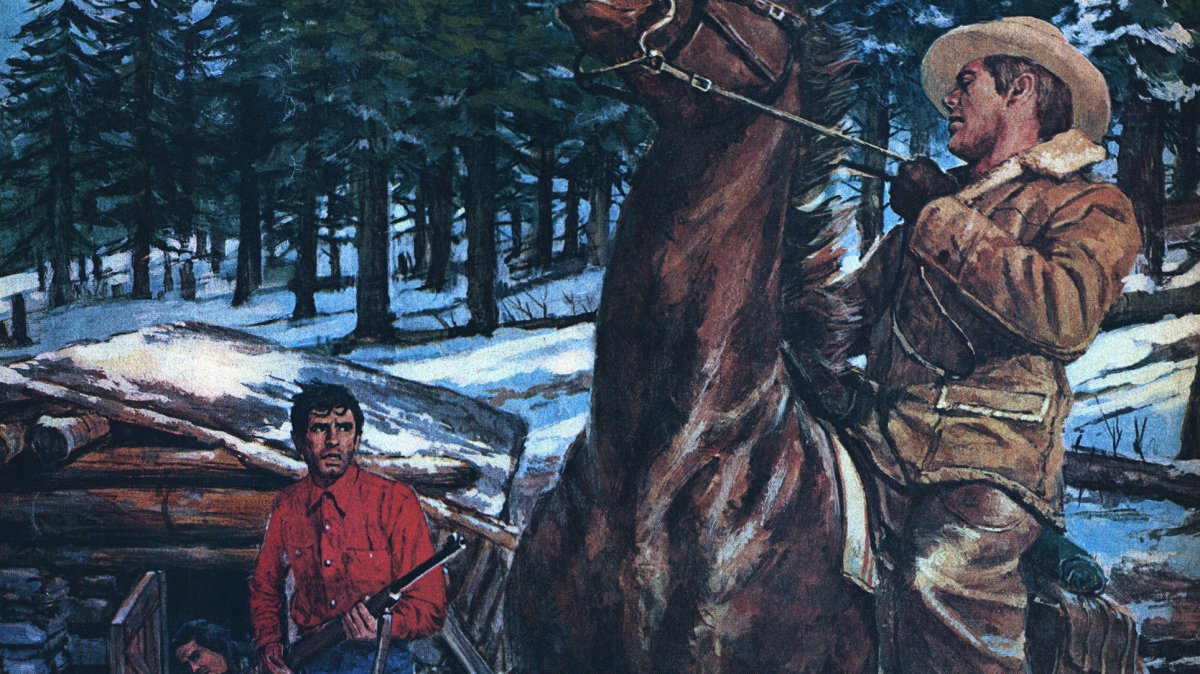
That’s how it was with Forest Ranger J. W. Johnson one November afternoon in the remote Pecos high country of northern New Mexico.
Deer and elk seasons had closed, but Johnson had found two men in a half-dugout cabin, with elk and deer heads scattered around outside. Some of the kills were obviously fresh.
The men identified the officer by his hat and resented the intrusion. Johnson reined in his horse only a few feet from the cabin door and found himself looking down the wrong end of a rifle.
“Turn your horse and get the hell out of here,” growled the voice behind the gun.
The officer tried to reason with the man but got nowhere. His own pistol was on his belt, under a tightly buttoned heavy coat. Finally the ranger turned his horse and rode away — half expecting the smashing impact of a bullet in the back of his head.
The ranger phoned me that night, and I promised to send two of my best deputy wardens out the next morning to go back to the cabin with him.
The three officers made camp the first night at a Forest Service cabin 12 miles back in the wilderness. They rode seven miles to the suspects’ cabin the next morning, but the men had skedaddled. However, they had left bedrolls, provisions, and traps, indicating they might return. The officers watched the cabin until dark, then rode back to the Forest Service camp for the night. They spent the next two days the same way, and I heard nothing from them.
Worried, I went to see for myself what had happened. Despite six inches of snow and zero temperatures, Dee Bibb, a deputy sheriff, and I started the ride at 2 a.m. and reached the Forest Service cabin at dawn. To my relief, there was a light in the window. My men were okay.
We all rode to the suspected poachers’ place after breakfast, but the only scrap of identification we could find in the cabin was a bit of paper with “Mora, New Mexico” written on it. Mora was a town on the other side of the range.
We also found coyote and bobcat carcasses half buried in the snow, and among them I saw the carcasses of two pine martens.
“These will clinch the case,” I said. Although martens were extremely rare in New Mexico, it was legal to take them. It was doubtful that anyone other than the two suspected poachers would have marten skins to sell. If we could find the fur dealer who had bought them, we’d be able to get the names of the men we wanted.
I believed the skins would be sold to a dealer I knew in Las Vegas, New Mexico, 30 miles south of Mora.
Johnson and I called on the dealer and resorted to subterfuge. confident that he would not knowingly reveal the names of the violators. He had recently paid $3,000 to settle an illegal beaver transaction of his own.
“Joe,” I said, “we want you to settle an argument. My friend here claims there are pine martens in the Pecos high country. I’ve bet him ten bucks there aren’t. What do you know about it?”
The ruse worked. “You made a bad bet. Barker.” Joe said. “I bought two skins last week.” He led us to a back room and showed us two prime marten pelts.
“All right,” I said, “who sold you those?”
He finally showed us his purchase record with names and addresses.
Ve drove to Mora and picked up one of the suspects. but the mother of the other said he wasn’t home. We didn’t believe her. and we waited in the house for two hours. Finally I saw a closet door opening slowly. I covered it with my .45 and said, “Come out with ’em up.” He did.
The pair drew fines of $300 on the game violation and six months in jail at hard labor for assaulting a forest ranger with a deadly weapon.
That sort of thing had to be expected now and then. It was part of the job of being a game warden. It still is, for that matter.
In my early years as chief game warden of New Mexico, however, politics posed more of a threat than guns. I was appointed to the post in 1931.
Related: The Manhunt for Claude Dallas, the Poacher Who Killed Two Idaho Game Wardens and Fled
At that time the chief game warden was also director of the game department. With very few exceptions, state game and conservation departments of the day were run by and for politicians — usually by small-time politicians for big-time ones.
I knew one state in which the function of the state game farm was to supply the governor, judges, members of the legislature, and other bigwigs with pheasant dinners at Thanksgiving. Christmas. and other occasions. The boss of the party in power listed the names of the eligible and handed the list to the director of the conservation department, and the birds were delivered.
Later a new conservation director took office, and at Thanksgiving time the political boss dropped a paper on the director’s desk with a curt “Here’s your list.” The director looked at the list, tore it up, dropped the pieces into the wastebasket, and answered with an equally curt “Don’t slam the door when you go out.”
In another case, the highway commissioner of a certain deer state, who had his eye on the governor’s job, was adopted into a local Indian tribe as a publicity stunt. He sent two henchmen to a reputed poacher to buy venison for the ceremonial dinner. On the way back to town, the car was stopped by game wardens. Two illegal deer were in the trunk. An angry highway commissioner phoned the game director.
“Your damn game wardens have got two of my men in jail,” he sputtered. “I’ve got to have that venison for the dinner tomorrow night, and I want it taken care of.”
“You have my word,” the director promised. “It’ll be taken care of — in court. And I’ll even see that the papers get the story,” he added. All attempts to get even failed.
My home state of New Mexico — where I’d lived since I was three (I was born in Texas in 1886) and where I had worked for the U.S. Forest Service from 1909 to 1919 — was no exception. The politicians had it just about their own way.
I decided at the beginning of my career that my biggest job was to get politics out of my department. That meant enforcing the game and fish laws impartially.
When I talk about my experiences in trying to carry out that policy, I don’t mean to boast: I only want to give today’s sportsmen an idea of how heavily politics weighed on game departments 40 years ago, and tell how one state managed to rid itself of the burden.
I was fortunate to have a strong commission behind me, and it backed me to the hilt.
I took office as State Game Warden of New Mexico on April 1, 1931, and retired on July 1, 1953, at the age of 66. In those 22 years we successfully prosecuted a lieutenant governor, a governor’s son-in-law, the state chairman of the party in power, a legislator. a chief of state police, prominent ranchers, doctors, and lawyers, and even a member of my own game commission — as well as 10,000 other citizens.
My first big test came soon after I took office.
A prominent attorney and a long-time friend of mine was apprehended by one of my deputies for fishing out of season and without a license, and for keeping undersize trout.
He was arrested and asked to wait while a nearby fisherman was checked, but when the warden returned, the attorney was gone. When the warden finally nabbed him 12 miles down the road, the attorney became abusive and demanded that the case be dropped.
“Your boss is a good friend of mine,” he said. “I even endorsed him for his job. You’ll be out of work if you press these charges.”
I went to Las Vegas to back my deputy and found the attorney on the warpath.
“You know I endorsed you to the governor for your job,” he said. “Who does your pipsqueak warden think he’s prosecuting?”
“I know you endorsed me,” I said. “I even have a copy of the wire you sent the governor here in my pocket.”
I pulled it out and read: “I recommend my friend, Elliott Barker, for state game warden because I know he will enforce the law without fear or favor.”
“Forget that baloney,” he growled. “You know I didn’t mean … “
“You made the governor a promise,” I said, “and I wouldn’t let you down for the world. On top of that, I took an oath of office. Let’s go see the judge.”
He paid a $50 fine and court costs and got a fair amount of unwelcome publicity. That case did our department a world of good.
Some people said my job wouldn’t be worth a plugged nickel if I tried to prosecute the state chairman of the party in power. But I had no choice. The chairman killed a doe antelope in an area where only bucks were legal, and when one of my wardens arrested him the politician insisted that I handle the case. The incident happened in a remote area, but the warden agreed to let the chairman bring the antelope to me so that I could file charges of illegal possession.
That wasn’t exactly what the chairman had in mind. He showed me the doe but begged to be let off, reminding me of the embarrassing publicity that awaited him. I refused, and he went to court, entered a guilty plea, and paid a $100 fine. Then he said, “All right, Barker, now let’s go and have a cup of coffee.” The case was never mentioned again, and we remained good friends for years.
In another case a popular lieutenant governor, who was a friend of mine, shot into a herd of antelope and killed a doe instead of a buck. He was arrested, but he seemed to think he could fix the charges if he could keep me from finding out about it.
However, the warden who had caught him got word to me, and I was at the checking station when the lieutenant governor reported.
He was abusive and said he’d have me fired if he had to go to court, but the case was handled routinely, and the politician paid his fine and took the publicity. He was angry for two years before burying the hatchet and resuming our friendship.
Lee Beal, a national-forest supervisor, and I once checked a truck stuck in the mud and found blood and deer hair. Tracks indicated that two men had abandoned the truck, gone to the homestead of a well-known poacher, returned with a pack mule, and took home one or two deer.
We had tried in vain for years to get a conviction on the poacher, and I was especially eager to make this case stick.
On the way to his home we spotted a car with out-of-state license plates and surmised correctly that one of the suspects was clearing out. But we had no evidence that would allow our stopping the car.
When we confronted the poacher he admitted killing a deer. “The meat is quartered and in a carton in the back room,” he said.
I opened the carton, found something interesting, and told the poacher I was going to charge him with killing two deer illegally. He protested vehemently. “I’ll plead guilty to shootin’ one,” he said, “but not two. There’s only four quarters of deer in that box.”
In court the next morning I filed charges for killing two deer, and the poacher hit the ceiling. He shook his fist at me from the witness stand and yelled, “I told you it was only one deer, and I’ll swear to that!”
I opened the carton and laid out the four quarters of venison.
“Your honor,” I said, “I call your attention to the fact that there are two right hindquarters here. If they came from one deer it was a most peculiar animal. The prosecution rests.”
Before we were through with the case we filed more charges for illegal possession of venison, growing out of the distribution of contraband deer by the man we had met on the road. He and the poacher had quite a market-hunting operation going.
Another time one of my wardens, watching dove hunters from the road through binoculars, saw a man and a woman shoot two illegal quail. He checked their licenses and asked if they had seen or shot any quail. They said no, and a check of their game bags revealed only doves. When the warden persisted they became abusive.
Searching the weeds for the dead quail, the officer noticed something strange about the plump woman. There were three bulges in her blouse where nature provides only two. When the warden accused her of hiding the birds there, her husband blew up.
“You can’t talk to my wife that way,” he yelled. “What she has in her blouse is none of your damned business. You say it again and you’ll get a fistful of knuckles in your face.”‘
“Quiet down,” the officer said. “You’re both under arrest. Hand over your guns.” The guns were surrendered and laid aside. Then the warden turned to the woman.
“Lady,” he said, “I’ll give you two minutes to produce those birds. If you don’t, I’m going in after them.”
She blushed, turned her back, and pulled out not two but six quail.
There was one other case I won’t ever forget. It involved as tight a spot as Lee Wang, a forest ranger, and I had ever been in.
While watching a pair of tough-looking characters, recently come to New Mexico and reputed to be dangerous gun toters, Wang saw one kill a fawn antelope and let it lie. The ranger contacted me, and we took the fawn for evidence.
We later confronted the pair at their camp and told the violator that he had been seen shooting the antelope. He said nothing about the charge but objected vigorously to going 80 miles to court in the county seat.
There was a justice of the peace nearby, and we arranged with him to hold the trial at the poacher’s camp that evening.
The camp consisted of a large open-ended tent with a small table in front of it, several log-block stools, and a campfire off to one side. In the tent were two beds, on each of which a young woman was lying with a rifle at her side. The scene was lighted with two lanterns.
We faced a hard-looking crowd. On one side were the ranger and myself. On the other were the two women, the suspect and his partner, and a local man who owned a place nearby and had a reputation as a bad actor.
Wang and I had left our pistols in our car, to make sure we didn’t provoke an incident. Two of the men were wearing sidearms. That made four guns against none, and I didn’t like the odds. When I started to fill out the complaint I liked them even less. There was a tablecloth covering a pile of dishes on the table, and when I moved it accidentally I saw the butt of a pearl-handled revolver only inches from the suspect’s right hand. He carefully slid the cloth back over it.
Then one of the men called me aside. “You better forget this, Barker,” he said.
“Why?” I asked.
“Because these guys are used to getting out of real trouble with the law. They won’t stand for a piddling case like this.”
I walked back to the table without answering, and saw a chance to improve my situation. The suspect left his seat, and I quickly sat down in his place, making the concealed revolver within six inches of my hand instead of his. I could see that the crowd didn’t like it.
After hearing the case, the justice of the peace found the suspect guilty and fined him $50, plus $5 court costs. The outlaw peeled a $50 bill off the top of a roll as big as my fist and offered a second one to pay the court costs, but nobody could make change. One of his buddies walked out with the ranger and myself.
“You were lucky tonight,” he said, and I’ve never doubted his word. But I still think that pearl-handled revolver had something to do with our luck.
Read Next: The Night a Wisconsin Game Warden Took One Last Call
Since those early days there has been a marked upgrading of most game and conservation agencies, and improvement in public attitudes toward the enforcement of game-and-fish laws. In many states, however, there is still a need for stiffer penalties against the game-law violator. But the situation today is much better than it was when I began my law-enforcement career in 1931.
Looking back, I like to think that through the years our game department-backed by a strong game commission, supported by organized sportsmen, and blessed with a topnotch crew of enforcement officers — succeeded in convincing a lot of would-be violators that we meant business. That is something that pays dividends in any state — for sportsmen and wildlife.
Read the full article here
