



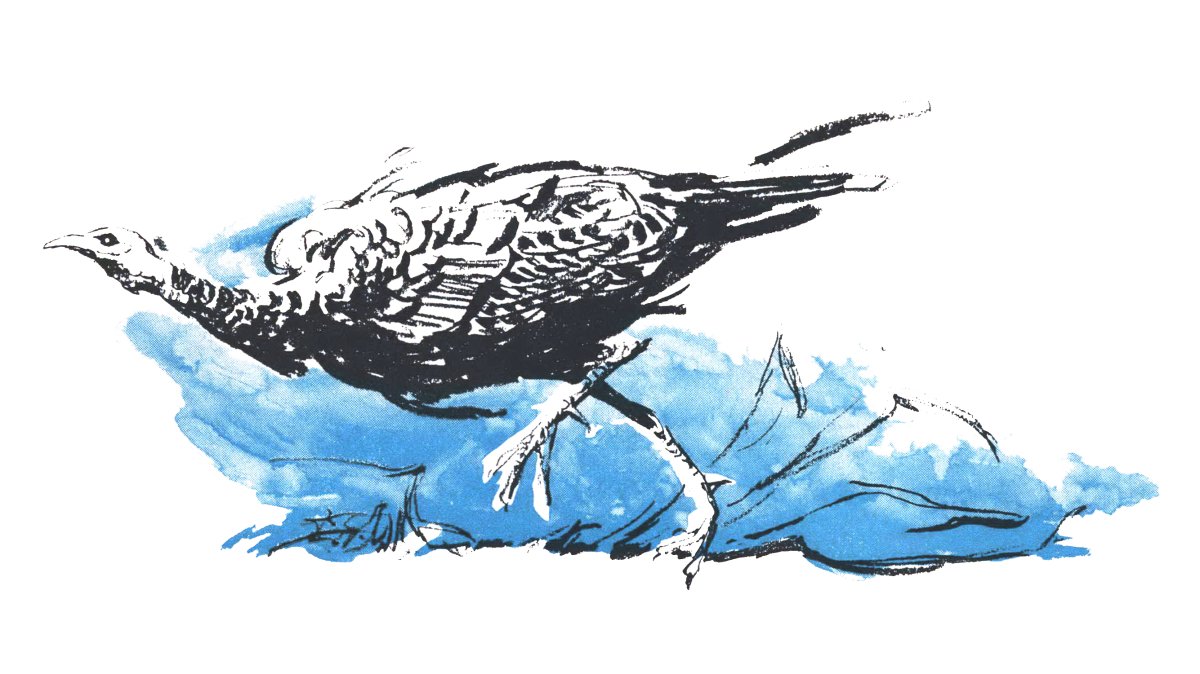

This story, “Nightmare Gobbler,” appeared in the January 1966 issue of Outdoor Life.
The green jungle of the swamp pressed around me, its stillness broken only by the pounding of my heart in my ears and by the rustle of footsteps in the dense thicket to my right. The steps were slow, irregular — one, two, pause — one, pause — one, two, three, but they angled toward an opening that lay in front of me like a narrow lane cut through the brush. Carefully, I placed my 12 gauge Remington automatic to my shoulder, took a deep breath, and waited. Then, suddenly, he stood in front of me, tall, resplendent, every iridescent feather outlined in the sunlight — surely the largest wild gobbler ever seen by man.
The front bead of my shotgun was on his head. I squeezed the trigger, but the gun would not go off. My front finger searched frantically for the safety catch, but there didn’t seem to be any safety on the gun. Again, I strained at the trigger until I thought that either it or my finger would break off. Miraculously, the gobbler stood there, growing taller by the moment.
I broke into a cold sweat and sat up, wide awake. I looked at the illuminated dial on my wristwatch. It was 2 a.m.
I was having another one of those wild nightmares which had plagued me since I first laid eyes on the big gobbler in Blackwater Swamp. Unless something happened soon, I would be a mental case. That bird was driving me completely out of my mind. I dreamed about him every night, always with the same results. The gun wouldn’t fire, or my finger simply would not obey my will and pull the trigger. Once I had a dud shell in the chamber and another time I was too weak to lift the gun.
My actual experiences with the big bird had been almost as exasperating as those nightmares, with one exception. I’d never had the turkey in my sights and close enough to kill. It had become more than just a challenge. It was an obsession — something to be accomplished before I could ever again find peace of mind. I had located this gobbler before season opened in 1957.
Blackwater Swamp, a part of the 85,000-acre Blackwater Wildlife Management Area in Santa Rosa and Okaloosa counties of western Florida, is some 70 miles from where I live at Fort Walton Beach. Each morning for several days before the spring gobbler season began, I drove those 70 miles early enough to station myself before daylight on a hillside dropping off into the swamp. The marsh area I overlooked from this vantage point was some 300 yards wide and extended along the creek for half a mile. At the upper end were two acres of pine trees taller than those around them, and the other end was studded with large bay trees.
Both places made excellent roosting sites for the big birds.
On that very first morning in April, I discovered that my choice of locations had been a lucky one. The first blush of dawn had spread over the eastern sky when I heard a gobbler on the roost. He was too far away for me to see him, but his shrill,
high-pitched gobble told me that he was an old bird and most likely as wild and cagey as he was old.
Read Next: How to Turkey Hunt
To make sure that the gobbler was a permanent resident and not just a visitor to this section, I drove back to that hillside each morning before daylight, stood in the expanding aura of dawn, and listened to him gobble. He was the same bird. There was no mistaking his wild crescendo before and after he flew off the roost to stalk the swamp floor. On opening day, I was never more confident that I would bring a gobbler home. I drove to the same spot where I had parked on previous mornings, and, in the darkness, worked my way down the hillside to the edge of the swamp. I picked out a place where I would be well concealed in a thicket of titi bushes and yet have a limited vision of the swamp floor. At first light, the swamp slowly came to life.
Shortly after daylight, the old tom gobbled; he was approximately in the same location where I had heard him before. He wasn’t more than 100 yards away, and I mentally put him in the bag. I waited for a few minutes, then gave the low, seductive love notes of a hen. He answered immediately, and I was so sure he would fly right into my lap that I put the yelper down and readied my gun. The gobbler had heard me and knew where I was, so I did not call again, but for some unaccountable reason, when he left his roost tree, he did not fly toward me but directly away to the other side of the river.
I waited until he gobbled on the ground before I picked up my box and answered. For an hour or more, he paraded up and down the far side of the Blackwater River, where there was too much brush for me to get a glimpse of him. I yelped only at the proper intervals, or what I thought were the proper intervals. From the way he answered, he seemed interested, but he never came any closer and finally went out of hearing in the other direction. Only then did it dawn on me that taking this bird might not be as easy as I had anticipated.
Up to this time, the gobbler hadn’t let me see him, but that didn’t bother me. I’m too old a hunter not to know that the better the trophy the harder you often have to work for it. Big-game hunting taught me that.
I am a banker, and over the past 30 years I have worked in commercial banks throughout most of the United States, including Alaska. Wherever I was, I took time out to hunt, and my trophy list includes elk, antelope, grizzlies, moose, and caribou. I thought I had tasted both the pinnacle and the plinth of big-game hunting in those far places of the continent until one day about a dozen years ago when Leon Bishop, one of my quail-hunting companions, walked into my bank office at Fort Walton Beach.
“Let’s go turkey hunting,” he said.
“In the spring?” I asked.
“There is such a thing as a spring gobbling season,” he replied. “At this time the toms and hens are making love, and all you’ve got to do is sit down in the woods somewhere and wait until you hear one of the tom turkeys gobble. Then you make notes like a love-sick hen and the tom comes running.” I don’t have to tell you any further that Leon had never been turkey hunting. Neither had I, but it sounded like a great idea. Someone had told him of a swamp that had a large flock of turkeys in it, and we were there the next morning before daylight. Shortly after dawn, the toms started gobbling all around us. I counted five in different directions near us, and we could hear several more in the distance.
“This is as easy as hunting squirrels,” I whispered.
Leon nodded. “All we’ve got to do is get a couple close enough to shoot,” he said.
Three years later, I still hadn’t got my first gobbler close enough. I had learned the hard way that getting within range of a gray squirrel and being close enough to draw a bead on an old tom turkey were about as far apart as digging ditches and being an astronaut on the moon. I had bought enough books on the subject to own a small library. I stockpiled a closet full of camouflage clothes and enough turkey calls to start a turkey-call business. I listened to instructions by the hour from records and from experienced gobbler hunters. During the spring season, between riding long distances before dawn, coming home by midmorning and working in the bank all day, then spending my evenings making plans for the next morning, I learned to get along with very little sleep. I didn’t know it then, but I was just going through the apprentice stages of becoming a turkey hunter.
Now I was on the trail of a gobbler I wanted more than any other trophy I ever hunted. I had an obligation to myself to prove that I was as good a woodsman as I had once thought I was.
The second morning of the season, I changed my tactics a bit. Half an hour before dawn, I worked downhill to a spot as close as I dared get to where the gobbler had been roosting when he flew out of the tree the morning before. I figured that if I could be closer to the roost tree, I might have a better chance to entice him to the ground between me and the river and call him in from where he landed on the swamp floor. I was concealed. As dawn filtered into the trees, I kept watching the treetops, trying to make out the shape of a turkey on one of the limbs, but I could never spot him until he gobbled the first time. When I saw his head move near the top of a large bay tree, I wondered why I hadn’t seen him sooner. He was in plain view on one of the big limbs, and he kept craning his long neck this way and that, as if inspecting the ground for danger.
My cedar box turkey yelper was lying beside me. Moving my hands slowly and cautiously, I got the box and made the notes of a hen. On the limb, the tom craned his neck ludicrously, then stretched it and gobbled again, making the swamp ring. I sat perfectly quiet, and after a while he turned around and faced me, balancing himself in such a manner that I was sure he was ready to launch his bulk off that limb and fly down in front of me. He never quite got around to flying toward me. He stayed on the roost until long after daylight, gobbling frequently and twisting his neck.
Read Next: How I Finally Killed the Legendary Cohutta Gobbler, the Turkey Every Hunter Wanted
During this time, I got in a couple of hen calls. He always answered, shrilly and excitedly. Whether he spotted some movement on my part or made me out there in the brush, I’ll never know, but after a long while he pitched off the limb and flew across the river. We went through the same performance of the first morning before he finally cut off his gobbling and went on into the swamp.
Shortly after this, I began to talk to myself and have nightmares. Every day for a week, including those preseason mornings, I had driven 140 miles or more before my working day began. I wasn’t getting much sleep, and on several occasions while talking with customers I found that I was not following their train of thought at all. My mind was off yonder in Blackwater Swamp, and I was seeing my big gobbler on his tree limb and hearing his challenge. I was beginning to wonder whether that turkey gobbler was the worst influence I ever had on the business at my bank.
“I guess I’ll either have to give up turkey hunting or the banking business,” I told my wife.
“Maybe I can find a job,” she said. That, I knew, was the finest loyalty and affection any man might expect from his wife. She was only kidding, of course, but her remark indicated that she knew how much that one gobbler meant to me, and it helped me make my decision to stay with him until the season ran out.
“Remember,” she said, “what you learned in the second grade at school, that ‘with patience, perseverance, and a little bottle of sweet oil, the snail will at length reach Jerusalem.”
“I wonder what store in this town has a good supply of sweet oil,” I replied.
But this gave me an idea. Aubrey (Shorty) Ammons, one of the best turkey hunters I knew in west Florida, lived in Vernon, about 60 miles northeast of Fort Walton Beach. That afternoon I drove up to see him.
“Have you any idea what I’m doing wrong?” I asked him.
“From what you tell me,” he said, “he’s a cagey one, all right. Probably doesn’t trust anything he can’t see. Maybe he’s been fooled before by hen yelping that wasn’t a hen. Might be easier to find yourself another gobbler.”
“But that’s the one I’ve got to have,” I said.
He grinned. “Know how you feel. Been after a few of them kind myself. It’s a strange thing, but sometimes the smarter an old tom is the less yelping it takes. Maybe you’re calling too much.”
“Very little,” I assured him.
“Then don’t call at all,” he said. “Cluck a time or two to let him know where you are, then just sit. He might even go off in the other direction, but keep on waiting.
After a while, his curiosity may get the best of him and he’ll come back to see what’s going on. If everything else fails, and you think he’s gone and you haven’t got anything to lose anyway, sometimes if you’ll yelp like a hen and follow it immediately by gobbling your box, he’ll think another tom has moved in and come on the run.”
I had only two more days before the season closed, and at this stage I was willing to try anything. Besides, what Shorty told me made sense.
I was half groggy from the strain of the past weeks as I drove up to Blackwater Swamp next morning. When I parked my car on the backroad, it would have been easy to lie back in the seat and go to sleep. I guess I had more determination than enthusiasm on that particular day. So I got out, loaded my gun with No. 4’s, and walked over to the hillside above the swamp.
Luckily, my bird gobbled before daylight. I had expected to find him again in the bay trees, but instead he was roosting in the tall pines bordering an open meadow at the north end of the swamp. By this time I knew every square foot of that area, so before dawn I tiptoed through the woods to the edge of the meadow opposite the pines and about 200 yards from the roost tree. I made myself as comfortable as possible in a clump of bushes to wait for dawn. I wasn’t sleepy anymore.
Somewhere behind me an owl hooted. The gobbler answered. After an interminable time, the raucous voice of a crow seemed to be the signal for the swamp to wake up. With the growing light, the volume of woods music increased and the turkey gobbled again. Not until then did I dare try my yelper. The habit of making hen yelps was so strong that I almost called as I always did, but I remembered in time and gave only two or three drowsy clucks of a hen. The gobbler answered immediately and I knew he had heard. Even so, it was difficult to put the box down and not yelp back at him. But I did.
I didn’t see the gobbler until he flew out of the tree. He landed in the clearing opposite me, did a little dance in a half circle, then stretched his neck and gobbled. Again I forced myself to leave the caller where I had put it on the ground, and I waited. I kept telling myself that he knew where I was and then arguing that I wanted to be sure he knew where I was, but I remembered the advice I’d driven 120 miles to receive. I’d also had experience before at calling too much, so I sat with as much patience as I could muster.
I’ve hunted turkeys for many years now, but that gobbler put on the finest show I have ever seen. He paraded up and down the far edge of the meadow like a king before his army, strutting, gobbling, and making fancy little pirouettes. Then he’d suddenly straighten up and run a 40 or 50-yard dash in record time, as if he were chasing an imaginary hen.
During all this time, over an hour, I was gradually being eaten alive.
I had used all my mosquito repellent the day before, and even if I’d had a supply I wouldn’t have dared move my hands to rub it on my face and neck. The mosquitoes and gnats were having a feast, but I knew that if I wanted a chance at that gobbler there wasn’t a thing I could do about it but sit and itch and suffer.
Then, suddenly, the gobbler seemed to decide he’d done enough begging before an unresponsive hen. Walking majestically and occasionally stopping to strut, he went out of sight into the brush. When he gobbled, I knew he was going the other way and my heart dropped into my boots. It looked as if, cagily as I had played it, I’d lost again. It seemed hopeless anyway, so I played the trump card my turkey-hunting friend had suggested. I yelped like a hen and followed it immediately by gobbling the box.
The tom in the brush answered, and after about five minutes, when I began to wonder if I had interested him at all, he again appeared at the edge of the meadow, strutting up and down as he had done before. After another long period, during which it seemed that he was about as close as he would come in my direction, I went all out. Taking a chance that he would see the movement, even though I was well hidden, I yelped again and followed it by rattling the lid against the box to make a gobbling sound. Since he continued to strut, I felt that I hadn’t even made him suspicious, so I yelped and gobbled a third time.
Then I put the box down beside me and began to prepare myself for another drubbing by this wise old bird. Surely he had sensed that something was wrong or he would at least have circled in the brush around the meadow and come up behind me to investigate. I was thinking that I’d have one more day when the gobbler across the meadow suddenly stopped strutting and stood up, looking in my direction. So far as I knew, I hadn’t moved a muscle except to work that box, but from the way he looked toward me I was sure he had seen me.
Read Next: 12 Old-School Tips for Tagging Wary Gobblers
My blood pressure jumped when he suddenly lowered his head and came charging toward me like a football player with an open field in front of him. His unexpected maneuver so startled me that when he ducked behind a small bush out in the meadow, I almost forgot to raise my gun. I guess Providence prompted me in time, because when the gobbler came within range I had my bead on him, shot, and turned him over.
The gobbler weighed 18 pounds and had a beard 12 inches long. During the years I’ve hunted I have killed larger birds, but he was surely the finest of them all. As a memento, I keep his feet in my office and have cemented his beard into the empty shotgun shell that killed him, and occasionally wear it as a bolo tie. That big gobbler gave me my finest hunting hour.
Read the full article here
