



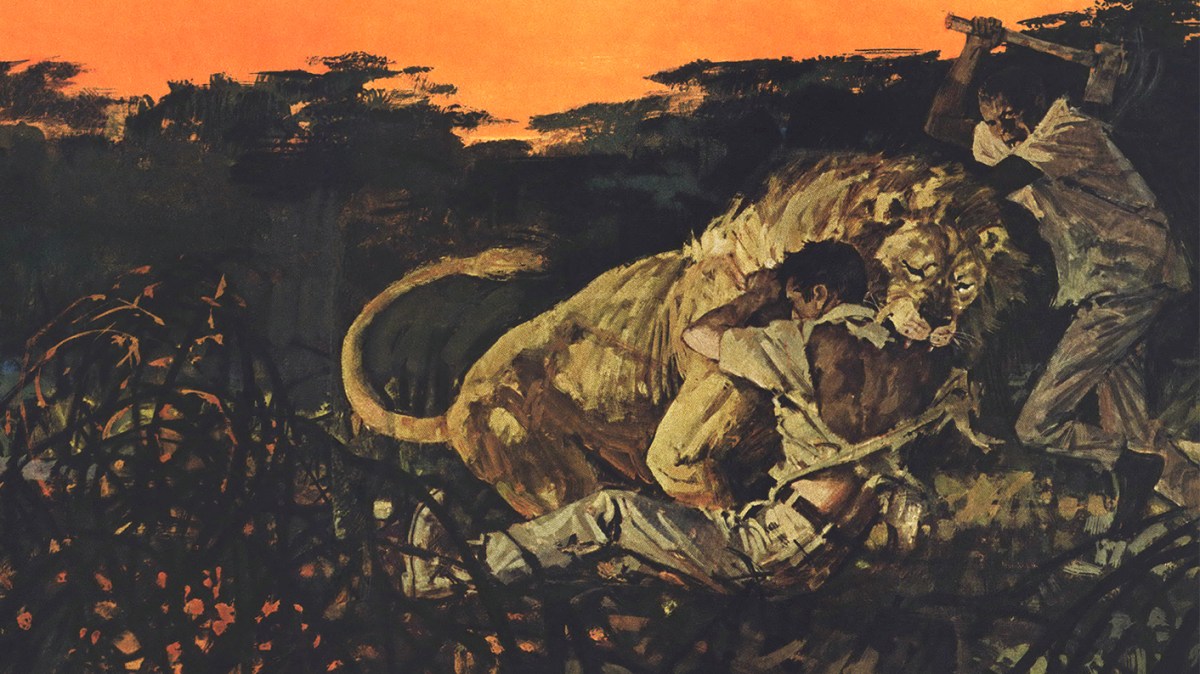

This story, “Most Dangerous Game?” appeared in the May 1972 issue of Outdoor Life.
I grew into hunting because my natural father, Clary Palmer Wilson, has long been a professional hunter in East Africa, and hunting is in my blood. My earliest memories are of being on safari when I was five or six years old. Between safaris on which Clary guided clients, he often took my mother, my two brothers, my sister, and me for a month or two on safari while he hunted elephants for the ivory.
Once on such a trip, when I was about six, a rhino walked between our tents and stood sniffing some of the toys I had left on the ground. I was utterly captivated and could hardly be kept from running closer. The rhino soon left, without giving any trouble.
On another safari I remember as a child, a leopard chased a bleating native goat through one of our tents, which was open on both ends because of the heat. Next morning we found where the leopard had killed and eaten most of the goat and hung the remainder in a tree, hardly a stone’s throw from our camp.
We lived on a farm near Lushoto, Tanzania, where we raised cattle, sheep, and pigs and kept a large vegetable garden. It was game country, and we had a lot of trouble with forest hogs rooting up our vegetables. Cape buffalo occasionally broke fences to feed in our gardens. Lions and leopards occasionally killed our livestock.
Throughout my boyhood my fascination with these wild animals and their habits and with hunting them far overshadowed any slight interest I had in farming. Clary, at age 16, had guided alone a group from the Field Museum of Natural History in Chicago to collect big-game specimens, and my desire to hunt was just as fierce. By the time I was 15, I had dropped out of school and was hunting elephants and hippos for their ivory, and crocodiles for their hides.
Today, at 25, I am a full-time professional hunter. I am licensed as a professional white hunter in Tanzania, East Africa, and I am also a registered guide in Alaska.
While visiting in the United States when I was a boy, I met Bud Branham, an Alaska guide, and we remained good friends and corresponded for many years after I returned home to Africa. I came to the U.S. to attend college in 1963, and at that time Bud Branham legally adopted me, which makes me one of the few people in the world with two fathers.
Three years ago I graduated from Texas Christian University with a degree in Business Administration. I now am an American citizen and work as a full-time partner with Bud, who is also licensed as a white hunter in Tanzania. We have an agreement with Clary, my natural father, to work with him winters in Africa, where we hunt what until recently was the Selous Game Reserve, the largest game reserve in Africa, an area that was closed to human entry for about 50 years. During the rest of the year, we hunt in Alaska.
Related: I Faced Man-Eating Tigers, Vicious Wild Boar, and Roaming Bandits in Korea
Africa still offers the greatest variety of big-game hunting in the world, while Alaska is still the largest wilderness in the U.S. Alaskan hunting is superb, though the number and variety of game animals there do not approach Africa’s. I can think of no two better places in the world to be, and to earn a living as a professional hunter.
My earliest serious big-game hunting was for hippos for their ivory. Hippos were regarded as vermin at that time, though they are viewed in a different light today. In any case, I regard hippos as dangerous because I have had many close calls with them.
When I was 13 years old a neighboring farmer and I drove to a nearby swamp, hoping to shoot some hippos. It was a thickly grown area and impossible to penetrate, so we waited for the animals to leave the swamp in the evening to graze in the surrounding areas.
We waited until dark and saw nothing, so we started walking back to our camp. It was pitch black. Suddenly we heard an animal running toward us in the grass, and then it loomed up as a huge black blob close in front of us. My companion held a small flashlight on the animal, which proved to be a hippo. It veered to our left, as if trying to get behind the light, and followed the light as it was moved. Then it came back toward us.
The hippo was about eight feet away, its huge mouth open and the ivory gleaming in the dark, when it broke through a bush, charging directly at us. I fired almost from the hip, and the solid bullet from my .375 H. & H. Magnum hit the animal in the neck. It dropped just six feet away.
As a teenager I got $1.50 a pound for hippo teeth. Hong Kong was the big market. A large bull-hippo tooth may weigh as much as two pounds. All of the teeth are usable as ivory, but they grow progressively smaller toward the rear of the mouth. The four front teeth are by far the largest.
I know of many occasions when Africans have been mauled or killed by hippos. It isn’t uncommon for the animals to tip a boat and then maul the occupants in the water. Occasionally a hippo will attack on dry land, sometimes without apparent provocation. Getting between a hippo and the water he wants to reach can be extremely dangerous.
I once put a .458 bullet into a hippo’s lungs as he ran into the water across a river from me. He dived, then surfaced so he could see me, and dived again, to surface closer. Each time, he surfaced and submerged so quickly that I couldn’t get a shot. He finally charged me up the bank of the river. I killed him at 15 feet with a shot in the head.
Hippo hunting for ivory was mainly a matter of creeping up to a pool in a river where the animals were sleeping and waiting for them to come up to get air and look around. The proper shot is right below the ear. Hippos shot early in the morning normally float. If shot in the afternoon they don’t float for a couple of hours, and they will drift downstream. I had two African helpers who always watched for hippo carcasses drifting downstream from where I hunted. When they saw one, they hauled it out, cut the head off, and put the head near an anthill. Between the ants and the meat’s rotting, in a couple of days the teeth were easy to pull.
It was pitch black. Suddenly we heard an animal running toward us in the grass, and then it loomed as a huge black blob in front of us.
In my opinion, the rhino is the most dangerous of African game, because he is so stupid. He hears very well and has an excellent sense of smell, but his eyesight is poor. Often there seems to be no logic to his behavior; he is completely unpredictable. A rhino may run away from you, then suddenly change its mind, swing around, and come for you like a tank.
Once when I was a youngster, not even carrying a rifle, I was with Clary and one of his American clients when two rhinos apparently scented us from about a mile away and charged toward us. They puffed and thrashed through the brush, breaking down bushes and small trees. We heard them coming, then saw them as they broke into a tiny opening. We thought they would come around some brush that stood in front of us. But no, they came through the brush.
Clary was carrying his .450 double rifle, and he dropped one rhino when it hit the brush and the second one after it broke through the brush. The second rhino fell no more than five or six yards away from us.
A lot of professional hunters in Africa do not consider the rhino very dangerous, and some of these men have had more experience with them than I have. My point is that rhinos are dangerous when you are walking through the brush hunting other species. If you are looking for rhinos and are prepared for them, the danger isn’t so great.
Of the African big five — the elephant, lion, Cape buffalo, leopard, and rhino — most professional hunters I know rate the buffalo as the most dangerous. He’s smart, he’s quick, he’s tough, and he’s big: a bull may easily top a ton. The danger is not from animals in a herd, but from lone bulls or groups of two or three bulls, old fellows that have been kicked out of a herd and are wandering about on their own. They are sore as hell at the world, and they’ll sometimes charge with no provocation.
By contrast, buffalo in a herd are perfectly docile. I wouldn’t hesitate to walk unarmed up to a herd of 2,000 buffalo. I have never heard of a buffalo charging out of a herd. A wounded buffalo is a cunning and dangerous adversary. I can remember the first one I tangled with. We didn’t really have a close call, but it could have been.
We needed some buffalo for camp meat. Clary wanted to try a .300 Winchester Magnum with silvertip bullets, to see how the bullets performed on a buffalo. I was to back him up with a .450. Clary asked his gunbearer, who was a new employe, to bring his pack of bullets off the table in his tent, but when we found a buffalo we learned that the African had forgotten them.
Clary had but four silvertip loads for the .300. The old bull we found didn’t see us, and Clary hit him with all four bullets. A couple were angling shots that went high through the back; another broke a front leg. The bull was hurt but still on his feet.
I was sitting around with my head where it shouldn’t have been, and I hadn’t grabbed my rifle, because I thought my gunbearer was right next to me. Clary turned and told me I had better shoot because the buff had seen us and was about to charge. I turned to get my rifle and saw the African running away, carrying the rifle.
I sprinted after him, caught him. grabbed my rifle, and dashed back just in time to see the buffalo start his charge. I dropped him about 30 yards away.
Last year one of my clients wounded a big buff, and it ran off into a thick patch of brush. I left the client and the gunbearer and went after the bull alone. A wounded buffalo may lie down and wait for you, or he may double back and get behind you.
Although I’ve never had a wounded buffalo actually get behind me, I know many hunters who have. Clary was a pretty good teacher, and he insisted that when I followed a wounded buffalo I walk two or three yards at a time, then stop to check every bush in front of and on both sides of me. I try to be sure that I don’t get closer than 20 yards from the animal, so that I’ll have time to fire at least one shot if he charges.
I moved quietly, slowly, straining to see the buffalo. I ghosted past a bush and stopped and looked up. I saw black but wasn’t sure whether it was a buffalo. I think now that the animal, which was concealed behind a bush, saw me stop and look and decided I had seen him. The black area I was staring at started to move, and suddenly it was the wounded buffalo, charging me. I fired and knocked him down about 30 feet away. He lay there, moving his head, but he couldn’t get his front legs under him to get back up.
As soon as I fired I yank-slammed the bolt, readying for another shot. I knew that if the bull got up and charged again I would have time for just one more shot. I covered him and waited for seconds that seemed an eternity.
Finally his head dropped. and I decided that he probably couldn’t get up.
Nevertheless, I decided to move to one side so that if he did manage to get to his feet he would have to turn and look for me, thus giving me a little more time to aim and fire. Further, a shot into his side would be more likely to stop him. There is a lot of bone in the skull of a buffalo.
As I started to move I glanced down and saw three live rounds of ammunition on the ground. I opened my bolt and found that I had been covering the wounded buffalo with an empty gun. A defect had jarred open the magazine’s floorplate when I fired.
The lion stands out among Africa’s big five for his speed in a charge. He is also most tenacious of life and will press a charge with all his energy even when mortally wounded.
I was 16 when I experienced my first lion charge. I was hunting with one of Clary’s clients when we came upon five lions. The client shot at a large male at about 140 yards, breaking one of its front legs. The wounded animal immediately charged.
Even with a broken front leg, that animal leaped 30 feet at each bound (we measured the leaps afterward). I started shooting as soon as the lion began the charge. I was using a .458 elephant rifle, and I hit him in the chest four times, knocking him off his feet each time. Yet he got up and kept coming the first three times. Any one of those three shots would have killed the animal in moments, yet he had enough vitality to get up and continue the charge. My last shot stopped him just 14 paces from where we stood.
The client also had aimed at the charging lion, and he thought he was shooting. Instead. he had ejected a shell each time he got lined up. He turned pale when I scooped from the ground his four live rounds.
My friend Pete Becker had an encounter with a lion that illustrates the animal’s perseverance. Pete was hunting crocodiles in southern Tanzania with one helper. It was lion country, and at night they piled thornbrush in a half-circle around one side of the bush vehicle, and Pete put his cot next to the car.
One night at such a camp a lion prowled about. They heard the animal breathing and walking through the grass, and occasionally it growled. Pete tried to spot it with a flashlight, but the lion simply lay down in the grass, and Pete couldn’t see it.
The animal was so persistent that Pete stayed up all night, shining his flashlight around from time to time and holding his rifle ready. At first dawn he hadn’t heard the lion for about an hour, so Pete lay down on his cot and told his helper, who had got some sleep, to get a fire going and to make some tea while he caught a few minutes sleep. The next thing Pete knew he was looking eye to eye with the lion, which had leaped over the thornbrush barrier. The animal grabbed him by the shoulder and dragged him off the cot.
“I didn’t panic,” Pete told me. “I thought it was a hell of a thing and wondered what the lion would do next.”
The lion dragged him through the brush where the helper had opened it to bring in some wood. Pete managed to get his sheath knife out, and he stuck it into the lion’s side. The animal dropped him. About then the helper came running with an ax in his hands, ready to attack the lion.
Pete staggered back to the fire and wondered why he felt no pain. He was beginning to shake a bit, so he lay down on his bed, thinking he would recover in a few minutes.
Suddenly the lion was back. It again grabbed him by the shoulder and pulled him off the cot and through the thorn-brush barrier.
“I started to feel pain then,” Pete told me, “and I didn’t know what to do. I tried to struggle, but the lion held me firmly, his teeth in my shoulder, arm, and upper chest.”
Once more the courageous African ran out with an ax. This time he whacked the lion twice on the head with it. Pete got his knife out again and stuck the lion. He believes he penetrated the lung. Again the lion dropped him and left. They didn’t see it again.
Pete washed off his wounds with hot water. The nearest dispensary was 50 miles away by bush and trail, and Pete had to drive it with one hand, for his helper couldn’t drive. Changing gears was a problem.
Pete has recovered use of the arm, but he’ll carry lion scars for the rest of his life.
A miss is as good as a mile, I suppose, but a close miss makes a man think a bit. One of my closest scrapes with a lion occurred when I was 15 and on an elephant hunt with Clary.
I had set up my cot a short distance from camp, under a little tarp. At that age I was determined to prove how brave I was, and I wanted to be alone. I had a mosquito net over the cot, a kerosene lamp nearby, and a flashlight. I kept my gun at hand.
I read for a time after I got into bed, and while reading I repeatedly heard an animal walking in the grass. It came almost up to my shelter. When it was near I aimed my flashlight toward the sound, but the reflection from the mosquito net prevented my seeing it. Whenever I shined the light toward the sound, the animal ran off.
In the morning, I found tracks where the lion had walked to my cot and then had walked off.
About 10 :30 I went to sleep. I was awakened at 3 a.m. by Clary, who said I had better get into his tent. He also went to the tent where guests Jackie and George were sleeping and told them they’d better join us.
Clary had seen a lion standing near his tent, and he had become aware that it had prowled around our camp all night. When Clary told Jackie this, she went pale. About an hour earlier she had walked a few feet from her tent. In the dark she had seen what she took to be a native cow. She ignored it. A few minutes later she returned to her tent. The animal, of course, had been the lion.
Next morning I found tracks where the lion had walked to my cot and then had walked off.
The next day we were told by some Masai living nearby about a lion that had mauled one of their people. It was an old lion that had just started to turn man-eater.
Every night thereafter we heard that lion prowling around our camp. We tried to shoot him, but he was too smart. Finally he got on our nerves and we moved on. I was just lucky that he didn’t grab me off my cot.
African nights can be beautiful or frightening with sound, depending on your viewpoint. I like to hear hyenas, lions, leopards, and elephants at night. We had a cook who didn’t pay much attention to the sounds — until one night. We had a family-run camp in a game park. Clary would take safaris out from it and leave me to see that the guests had meals and that their beds were made. I had to shoot camp meat for the help, and I averaged a buffalo a month for about two years there, when I was 13 and 14.
Clary would set up the camp and send me out to it. On one occasion I got to camp in the evening and found the helpers all sleeping in front of our tent. They told me that elephants had been coming into camp every night, and they were badly frightened. One man wasn’t there, and I asked about him. The others pointed upward. The fellow had built a little platform about 25 feet up in a tree, where he was spending his nights.
There was happiness in camp now that Bwana Mike was there, and they all rolled up in their blankets and went back to sleep.
Unknown to me, the cook had gone to a village about nine miles away to drink pom be, a native beer. He had seen me come by in the car, and he decided that he’d better shag it back to camp. He started off, walking along the track at night without a light, when a herd of elephants came along. The cook climbed a tree, from which he watched the elephants go to the river and drink water, then move on. He climbed down and was only a mile or two from camp when a herd of buffalo came along. He climbed another tree. The buffalo stayed there most of the night.
Meanwhile, I woke about 2 a.m. and heard a leopard grunting and coughing as it walked around our camp. Then the leopard was in the middle of camp, in the open. There he lay in front of a tent, panting. He wasn’t belligerent. I stood in my tent door, rifle in hand, and watched. The moonlight made the leopard clearly visible.
As I watched, I noticed that the leopard kept looking to the right of my tent, where we had a zebra skin stretched. Finally I put a spotlight on the cat, and he got up and walked around the sleeping helpers and went off into the brush, coughing and groaning.
I finally realized what had happened. The leopard had first been on the side of the camp from which he could see the hair and patterned side of the stretched zebra hide. Then he had come around to the other side, and the zebra had seemed to disappear. All he could see was the fleshed side, and this turn of events had puzzled him. He had apparently lain down to mull things over.
Meanwhile, the treed cook heard the leopard coughing near camp. Then the buffalo herd left the area. But just as the cook was about to climb down, a lion came walking down the moonlit track, so he stayed in the tree. The lion didn’t see him but walked directly under the tree and went on down the road.
As the cook again thought about climbing down from the tree, here came the leopard, coughing and grunting. It walked close by and disappeared into the brush.
When the cook arrived at camp about 6: 30 that morning, he was still shaking over his harrowing night.
There aren’t many full-time professional hunters in today’s world. Some people oppose hunting of any kind, and their numbers seem to be increasing. Being a professional, I have given a lot of thought to the ethics of hunting and to the relationship between man and the other animals on earth. I have concluded that people who oppose hunting do so strictly on an emotional basis and that hunting, under modern game-management techniques, is no more wrong than butchering cattle, sheep, or other animals.
I am proud of my profession, Like other sportsmen, I am concerned about environmental changes in the world. In Africa, the growing human population and the taking over of game lands for agricultural uses constitute a real threat to wildlife. In Alaska, some factions want to “develop” the country by pushing roads into wilderness. Alaska’s population is also growing, and too often the wilderness values and the wildlife take second place. The developers have the horsepower to get their way.
Read Next: Carmichel in Zimbabwe: The Croc That Wouldn’t Croak
Progress to me is the establishment of more wilderness areas, an increase in game numbers, and a better understanding of the values of wilderness and wildlife.
Read the full article here
