



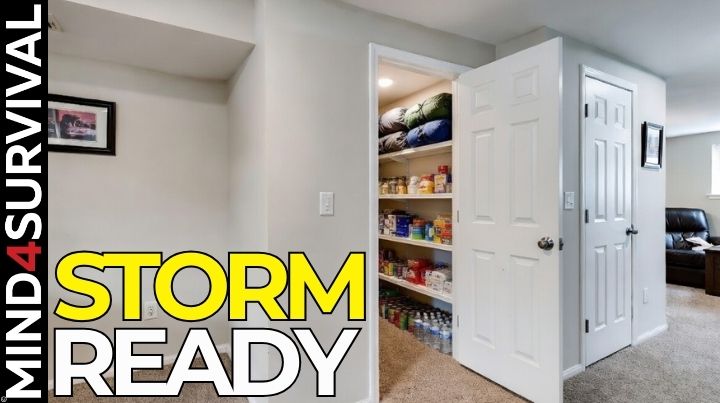

When the siren wails and the sky turns that bruised shade of green, not having a good option is not an option. Your greatest asset in that moment isn’t luck—it’s a plan. And the cornerstone of that plan is knowing exactly where you and your family will ride out the storm.
For many, the idea of a “safe room” conjures images of expensive, contractor-built bunkers that cost as much as a new car. But safety shouldn’t be a luxury item. You can build a highly effective tornado safe room yourself on a standard budget, using materials you can find at a local hardware store.
This isn’t about building a doomsday fortress—although that would be cool. It’s about creating a hardened, secure space within your existing home that can withstand violent, 200+ mph winds and flying debris. It’s about buying you improved safety and security, which together buy you peace of mind.
(Disclaimer: This article contains affiliate links for which I may receive a small commission at no cost to you if you choose to purchase a product through a link on this page.)
TL;DR: A DIY tornado safe room, built with proper materials and anchored to a concrete base, can save lives. Assess your home, plan the location, reinforce walls with plywood and steel, and install a tested door for real protection against violent storms.
Quick Look at What You’ll Learn
Why You Need a Dedicated Safe Room
You might be thinking, “I have a basement. Isn’t that enough?”
While basements are generally safer than upper floors, they aren’t foolproof. Debris from a collapsing house above can trap you, and standard residential construction isn’t designed to withstand the crushing weight of a falling structure or the missile-like impact of a 2×4 traveling at 200 mph.
A dedicated safe room is different. It is an independent, reinforced structure designed to remain standing even if the house around it disintegrates.
It provides three critical layers of protection:
- Structural Integrity: It resists wind pressure and suction.
- Impact Resistance: It stops flying debris from penetrating the walls.
- Separation: It is anchored securely to the foundation, independent of the home’s main framing.
The Strategy: Where to Build
Before you spend a nickel, you need to choose the right location. Location dictates your budget and the complexity of the build.
The Basement Option
If you have a basement, this is your best starting point. Building a safe room in a corner of your basement uses the existing concrete walls for two sides, saving you money and labor.
The Slab-on-Grade Option
If you don’t have a basement, you’ll need to build on the ground floor. The most practical location is usually a large closet, a pantry, or a laundry room. The key here is the foundation. You must be able to anchor your safe room directly into the concrete slab of your home. A wood floor over a crawlspace will not hold a safe room down in an EF-4 or EF-5 (261+ mph) tornado.
Building Your Safe Room: A Practical Guide
This guide focuses on a wood-frame safe room reinforced with steel sheeting. This design is accessible for a confident DIYer and meets FEMA standards for residential protection when built correctly.
This guide provides a general overview of FEMA P-320 guidelines for building a saferoom in your home, but local regulations may vary. Always check your local building codes before starting.
💬 Important Safety NoteThis article shares practical, budget-friendly ideas for building a tornado safe room based on widely accepted FEMA and ICC guidelines. However, every home is different—structural conditions, soil type, local wind zones, and building codes vary widely.
What works in one house may not be safe or legal in another.
Before you start cutting, drilling, or pouring concrete:
- Consult a licensed structural engineer or qualified contractor to review your specific plan and site.
- Check your local building department for permits, inspections, and code requirements.
- Follow FEMA P-320 or ICC 500 standards as the minimum technical benchmark for safe-room construction.
This guide is for education and planning only. It is not a substitute for professional design, engineering, or permitting. Your safety—and the safety of your family—depends on getting the details right the first time.
Step 1: Gather Your Materials
FEMA recommends 3 square feet per person. To build a standard 4×4- or 4×6-foot safe room, you will need materials that prioritize strength.
- Studs: Double up your 2x4s or use 2x6s for added strength.
- Sheathing: Three layers of ¾-inch plywood.
- Reinforcement: 14-gauge steel sheets (this is the “armor”).
- Anchors: Heavy-duty concrete wedge anchors or Simpson Strong-Tie anchors.
- Door: A dedicated safe room door assembly (often the most expensive component, but non-negotiable).
Step 2: The Foundation and Anchoring
Your safe room is only as good as its connection to the ground. If the wind can lift it, it’s not a safe room; it’s a box kite.
- Clear the Area: Remove existing drywall, flooring, and framing down to the bare concrete slab.
- Inspect the Slab: Ensure your concrete is free of major cracks.
- Install the Bottom Plate: Use pressure-treated lumber for the bottom plate. Drill through the plate and into the concrete. Space your anchors no more than 12 inches apart. This density is crucial for resisting the immense uplift forces of a tornado.
Step 3: Framing the Walls
Standard framing won’t cut it here. You are building a cage.
- Double Studs: Fasten two studs together to create a thicker, stronger wall post.
- Spacing: Place these double studs on center, 16 inches apart.
- Blocking: Install horizontal blocking between studs to prevent them from twisting under pressure.
- Ceiling Joists: Frame the ceiling just as you did the walls. The roof of your safe room must be as strong as the sides to protect against falling debris.
Step 4: Armoring the Structure
This is the step that separates a closet from a safe room. You need to create a barrier that prevents debris from penetrating.
- Plywood Layer 1: Attach a layer of ¾-inch plywood to the outside of your studs (the side facing the rest of the house). Use plenty of construction adhesive and screws, not nails. Screws provide more grip and holding power than nails do.
- Steel Sheeting: Securely mount the 14-gauge steel sheets to the plywood. This steel is your shield against projectiles.
- Plywood Layer 2: Cover the steel with a second layer of ¾-inch plywood. This adds mass and structural rigidity.
- On the inside of the room, apply another layer of ¾-inch plywood. This “skin” creates a shear wall that keeps the room square and rigid.
Step 5: The Door Assembly
Do not skimp here. A standard solid-core door will fail instantly against tornado debris. You need a door assembly tested to withstand missile impact (specifically, a 15-lb 2×4 moving at 100 mph).
- Buy, Don’t Build: Unless you are a master welder, purchase a pre-fabricated steel safe room door and frame.
- Hardware: Ensure it has three distinct locking points (deadbolts) and heavy-duty hinges.
- Installation: Follow the manufacturer’s instructions precisely. The door frame must be tied directly into your reinforced wall framing.
Ventilation and Essentials
A safe room isn’t just a box; it’s a life-support system for a short time.
- Ventilation: You must have airflow. Drill ventilation holes near the ceiling and the floor, but ensure they are protected by steel grating to prevent debris from entering.
- Lighting: Wire the room for lighting, but keep battery-operated lanterns inside at all times. The power will likely go out.
- Communication: Cell service might fail inside a steel-reinforced box. Consider running a hardline if possible, but at a minimum, keep a NOAA weather radio inside.
The Mental Component: Confidence in Construction
Building a safe room is a project that pays dividends in peace of mind long before you ever use it.
You aren’t just hoping the storm misses you. You know that’s not preparedness. Instead, you are actively preparing for the possibility that it won’t. That shift in mindset—from passive victim to proactive protector—is what prepping is all about.
This project is achievable. It requires sweat equity, a budget for materials, and skills, but with time and effort, it is within reach for the average homeowner. Take it one step at a time. Plan your build, source your materials, and get to work. Your family’s safety is worth every hour you invest.
Additional Resources
Read the full article here
