




This story, “A Bad Beginning,” appeared in the Nov. 1964 issue of Outdoor Life.
“Wanna see wife shoot sheep?” Harry Chipesia asked me. “Better hurry!”
The Beaver Indian guide and I were looking for a grizzly in the Tuchodi Lakes country near the northeast corner of British Columbia, 100 miles southwest of Fort Nelson. We had climbed a knob that overlooked a rugged canyon, and, from our vantage point, we could now look all the way up the basin to the great ice fields at its head.
About four hours earlier, my wife Ellnora, our outfitter Don Peck, and Harry and I, riding up the canyon to make a fly camp, had stopped to glass for game, and the guide announced that he saw a sheep on a slope above us. Peck took a long look and shook his head. “That’s only a rock,” he said.
But the Indian wasn’t satisfied. He kept the glasses on the same spot for five minutes. Then, “Rock no move,” he protested mildly. We rode another half a mile and stopped for a second look with a spotting scope. There was no longer any question that we were watching a sheep and a good one, a Stone ram almost as white as a Dall, with a full curl or better.
We tied our horses and Ellnora and Peck started the hard climb to where the ram lay, far above timberline. Chipesia and I headed the other way to look for a bear. I never asked, but I suspect the guide timed things purposely to let me watch the climax of Ellnora’s strenuous stalk. It took us more than an hour to get to the knob and we hadn’t much more than reached the top when he grunted his invitation, “Wanna see wife shoot sheep?”
Sure enough, when I got my 7X glasses up, I made out the ram, still bedded in the same place, two miles across the valley. I had no more than spotted him when he started a quartering run down the mountain. We were too far to hear Ellnora’s shot, and I started cussing because the ram had spooked before she and Peck got within range. But when the ram staggered and fell and I saw my wife and Don stand up behind a rock so close to where the sheep had been lying, I decided they all must have been in the same bed. It turned out Ellnora had laced a 150-grain bullet from her .270 into the ram at 12 paces, after a climb that would have winded a lot of men.
Her ram was as good as we had thought, almost white, with golden, curling horns that measured 37 inches, the kind of head you’ll appreciate the rest of your life.
Chipesia and I found no grizzly sign, but that didn’t matter. There was a celebration by the fire at our fly camp under the ice fields that night. I’ve been told that good luck that follows bad is doubly appreciated, and that was the case this time. Up to now, our hunt had been dogged by a series of misfortunes. We had never made a more discouraging start.
My wife and I had made our first hunt for sheep, in the Alberta Rockies, three years earlier, in 1954. I was 43 at the time and had hunted most of my life, but for nothing bigger than deer and antelope. I grew up at South Bend, Indiana, and now live in Lakeville, a few miles south of there. Operating two gas stations takes up about half my time and I spend the other half hunting and fishing.
Ellnora had done no hunting when we were married, but she and I share a deep enthusiasm for the outdoors, and, about 1940, she went with me to Ontario for deer. She took to it right away, and since then we have made many trips together. But the one to Alberta was our first pack trip. We had a good time, but we didn’t get within range of a satisfactory head and came home empty handed.
We picked British Columbia for our next try, in September of 1957, and decided on the Tuchodi Lakes country as the place and Peck as the outfitter. He runs a hunting and fishing lodge at Trutch, on the Alaska Highway 200 miles above Dawson Creek. OUTDOOR LIFE readers will remember him as the author of “Ross and His Rifle,” which appeared in this magazine in January and February, 1963. Mountain-bred and bush wise, we figured Peck for a man who could show us game, and we had him figured right.
He’s the only north-country outfitter I know of who keeps most of his horses back in the remote mountains year round. He has corrals at Tuchodi Lake, 80 miles from his lodge, and flies back and forth in a small plane to do the chores. There’s winter grass, and most of the horses make it through from one year to the next. Having them available in the heart of good game country saves considerable time. By flying to Tuchodi Lake, a man could be hunting within an hour.
We’d heard enough about that section to know we were going into one of the best game areas left in North America. In addition to sheep, goats and caribou are plentiful, there are moose and black bears in some of the valleys, elk in a few places, and grizzlies in limited numbers. There are also big wolves, and now and then a wolverine. One walked within 35 feet of me before our hunt was over.
We left home early in August, intending to take our time to Dawson Creek and the Alaska Highway. It took us three weeks to drive the 3,000 miles. We carried a 15-foot aluminum canoe on top of our car and it paid dividends both in fishing and in photographing wildlife.
That part of the trip went well. It was when we started up the Alaska Highway that hard luck set in. At Mile 160, we came on an overturned car with a woman passenger lying in muddy water at roadside, in agony from broken bones. We carry a first-aid kit, and we knew it would be close to two hours before an ambulance could arrive, so we gave her a codeine tablet, got her on one of our air mattresses, and covered her with blankets. She was so badly injured the ambulance crew refused to move her off the air mattress. It went south to Fort St. John, but caught up with us at Peck’s lodge a day or two later.
We had never seen anything like that endless reach of bog, and here our troubles really began.
It’s possible to set a float plane down on the Tuchodi Lakes (they lie in roadless mountains about 100 miles northwest of Trutch), but neither Ellnora nor I like flying into that kind of country. We decided to go in to Peck’s base camp by packhorse from Mile 370, above Fort Nelson.
For that part of the trip, Don had engaged Mac McGarvey to pack us in. An old-time Hudson’s Bay Company packer, now living in Taylor, he had formerly outfitted and guided in the Tuchodi Lakes country, but had sold out to Peck a year or so before.
We’d have a hard, five-day ride through unmarked country, and to keep expenses down we agreed to supply our own tent and cooking outfit and do the camp chores. Mac would lead the way and wrangle the horses. Doing it that way, he agreed to take us in and out for $300. Meantime, our supplies for the 20-day hunt would be flown to Peck’s base camp from Dawson Creek. Mac had a dozen horses running loose along the highway where we intended to start out, but it had been months since he had seen them, and, at this point, we encountered a real setback. We arrived at the rendezvous to find that Mac had trucked a horse to the area several days before and spent the time riding up and down the Tetsa River Valley, but he had been able to find only five of his animals. That meant Ellnora and I would have to share a horse. We’d ride double where the going was good and take turns walking where it wasn’t.
We left the highway on the morning of September 1 and soon forded the Tetsa. Up to that point, it was easy, although we saw no pack trails, only an occasional game trail that never seemed to go the way we wanted to.
A few hours later, we came to the great belt of muskeg that runs between the Alaska Highway and the mountains. We had never seen anything like that endless reach of bog, and here our troubles really began.
We had ridden less than 50 yards into the stuff when one of the pack horses bogged to its belly. It kicked and floundered and tried to get out, but every movement only made it sink deeper. Mac and I hurried to get the pack off, wallowing to our knees in ooze ourselves. By the time the horse was unloaded, it had quieted down. We got a rope around its neck, snubbed it around Mac’s saddle horn, and snaked the bogged animal free without much help from the victim.
We repacked and tried to pick a safer route, but in the next 600 yards we had three horses down and helpless at one time. Worst of all, Mac’s mare ran a stub into her shoulder as she sank into the mire, leaving her lame for two weeks.
The third horse of that unlucky trio didn’t go all the way down. Its hind legs sank out of sight, but its front feet stayed on top. It sat there on the muskeg like a big unhappy dog, scared, discouraged, and making no effort to free itself. Mac and I were finally forced to resort to the risky business of rolling it over backward to loosen it from the muck. Ellnora protested we’d tear the poor brute’s legs off, but there was no choice, and we got it out without injuring it. We rode until dark that night and made only five miles in all.
It was the worst day my wife and I had ever experienced.
The horse went plunging down, feet braced and sliding, with pack boxes flying in every direction. The top pack, a large canvas bag, hit 100 feet down and burst open like a pumpkin.
We crossed Sheep Creek the next day, finding scattered caribou and grizzly tracks on the sand bars, and putting the worst of the muskeg behind us. By the third day, we were getting closer to the mountains and the going was fairly good, though we rode much of the time through brush as high as the horses. We camped that night in a high meadow with good grass, knowing we’d have no more bog troubles. But the mountains proved to have pitfalls of their own, as we discovered the next forenoon.
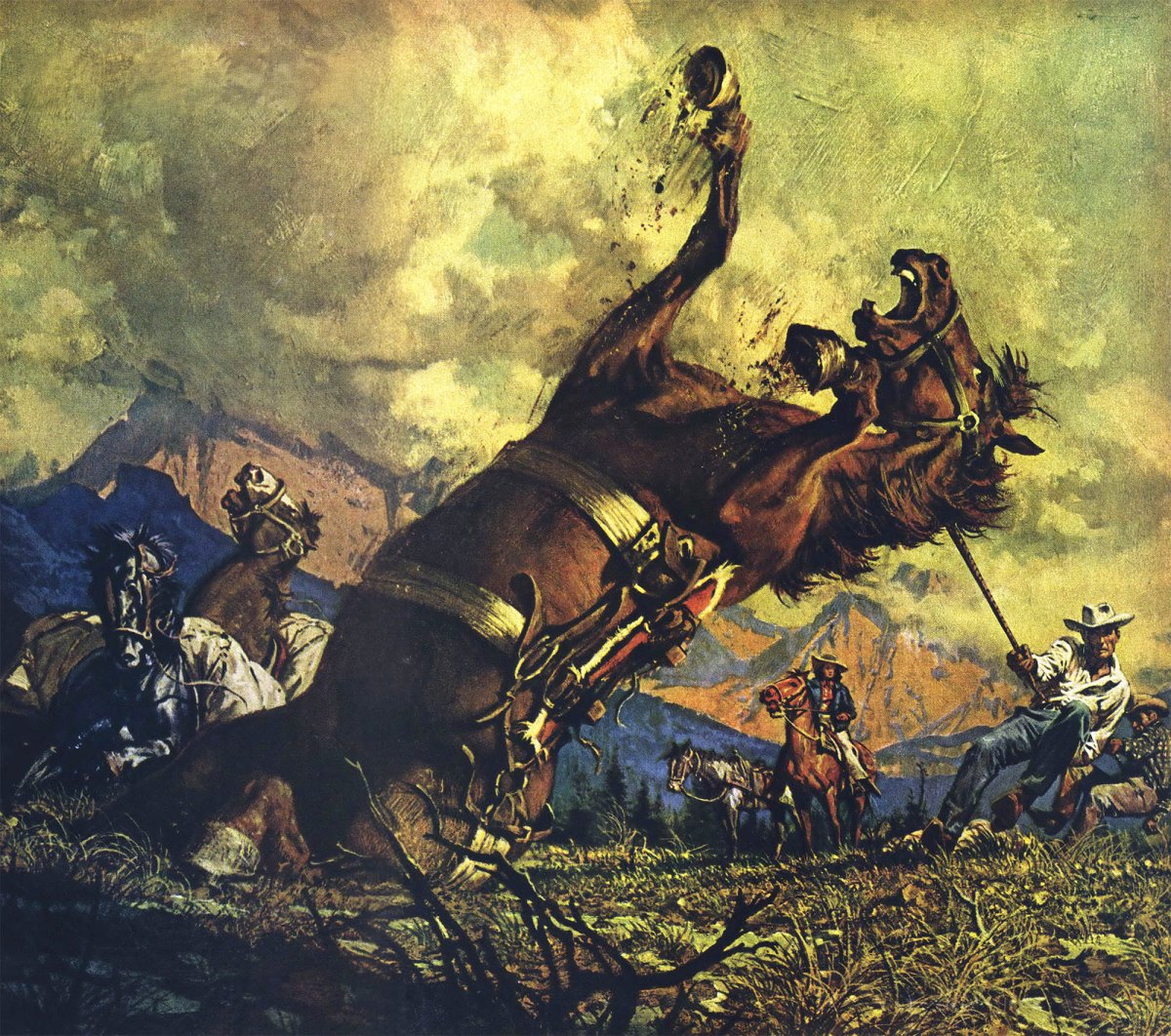
We were picking our way along a razorback ridge, with awesome slopes dropping off into sheer canyons on either side, when the top pack loosened on one of the horses. When Mac attempted to tighten the diamond hitch, the horse started to buck. To save himself from being thrown down the slope, Mac had to let go the halter rope. The horse went plunging down, feet braced and sliding, with pack boxes flying in every direction. The top pack, a large canvas bag, hit 100 feet down and burst open like a pumpkin. I don’t know how the horse managed to stay on its feet on that terrifying slope, digging its hoofs six inches into the loose scree and plowing furrows as it slid. A fall would have meant a dead horse, but after 500 yards the animal managed to brake to a stop, shaking all over and so frightened that it refused to budge out of its tracks when we reached it.
We lost some things in the canyon bottom, including our medical kit, but we gathered what we could and coaxed the horse back to the top of the ridge. Before we finished, we spotted a plane headed for Peck’s base camp and assumed it was carrying our supplies. But, at that point, Lady Luck delivered a body blow. When we reached the camp a day later, no plane had shown up and Don had had no word concerning the supplies. Now we were really worried. It began to look as if the jinx that was hounding us was going to end in tragedy.
We spent the next day with Peck’s crew and two Texans who had finished their hunt and were waiting to go out on the plane that brought our supplies. Our anxiety mounted by the hour. Finally, we heard a man shouting on the far shore of the lake. It turned out to be Art Burrell, of Dawson Creek, the pilot of the missing aircraft. He was loaded down with survival gear, hiking to camp after a crash landing in the swift Tuchodi River.
He had been within two miles of camp, the day we saw him fly over, when his motor failed. Trying to land in the river, the plane struck boulders and bounced up into the bush, shearing off small trees as it went. Art was banged up, stunned, and dazed, but had no bones broken. The plane was a $25,000 wreck that was left where it lay, except for salvaging instruments and a few parts. Some of our food had floated off downriver when a cabin door was torn off, but we retrieved the rest of our supplies.
Burrell stayed with the downed aircraft 48 hours, as flying regulations required, then headed for Tuchodi Lake. It was a tough hike for a man in his condition. Ironically, Mac, Ellnora, and I had passed only a few hundred yards from where he was down, on the opposite side of the river, the morning after he crashed, but we saw no sign of him because of the rough country.
Mac, Ellnora, and I had passed only a few hundred yards from where he was down, on the opposite side of the river, the morning after he crashed, but we saw no sign of him because of the rough country.
It took two more days for search planes, hunting for Burrell, to spot our smoke signals, which we had set up at the base camp. My wife and I put in the time fishing for grayling and Dolly Varden trout, which were both plentiful right in front of our tent. A float plane finally flew the two Texans out on September 9, and, the next morning, Ellnora and I headed into the mountains with Peck, Harry, Harry’s brother Alex, who’d wrangle the horses, and Tom Robinson, our cook. We were riding into some of the finest game country I had ever seen, but, by that time, we were five days late and my wife and I had encountered so many setbacks our hopes had turned dim.
Things started to pick up, however. We rode 18 miles the first day and made camp in a high basin that had grass for the horses, a thick stand of timber for wind protection, and a snowfed creek for water.
Next morning we separated, Peck and Ellnora going up on one mountain, Harry and I on another. When we returned to camp that night we recalled seeing seven goats and 22 sheep. Spotting that much game added up to a good day even though there was only one shootable animal in the lot, a billy Ellnora and Don stalked but couldn’t get close enough to for a shot.
The following day, Ellnora killed her ram, as I related in the beginning, and when we crawled into our sacks that night she and I agreed the jinx was broken. But we still didn’t guess how good our luck was going to be.
We spent only one night in the fly camp. When we awoke in the morning, the little creek that tumbled past was bone dry. The afternoon before it had been a raging torent, but we were right up under the ice fields, the temperature had dropped below freezing during the night, and there was no melt water now to fill it. We broke camp before that stream and the others down the canyon began to rise again with the heat of the day.
About noon, riding back toward our base camp, we saw a goat high on a cliff. He looked good through the glasses, so Harry and I dropped off to try for him. It took an hour and a half of hard climbing to get to him. We found the goat feeding in ground birch, almost at the rim of a sheer cliff that fell away as if the side of the mountain had been sliced off. It was a poor place to risk a shot, for if the goat dropped over the cliff his horns would be almost sure to be broken. But he carried a tempting head and I decided to chance a shot at him.
My rifle was a Winchester Model 70, rechambered by Weatherby to their .300 Magnum caliber, with a Unertl 4X scope. I was shooting handloads with 76 grains of No. 4350 powder behind a 200-grain bullet. With that combination, I could kill the goat in his tracks. I estimated the range longer than it was, however, and my shot hit a few inches high in the shoulder. He went down and stayed, but I kept the scope on him and after two or three minutes I saw a leg kick. I shot again, hitting near the center of his neck. He started to slide, then plunged out of sight. I set him down as a lost trophy.
We saw the billy lying almost on the brink of the immense wall that dropped close to 1,000 feet straight down, and he was not quite dead.
But when we worked our way up and over a steep pitch we saw him lying almost on the brink of the immense wall that dropped close to 1,000 feet straight down, and he was not quite dead. He offered nothing now but a back shot, but I didn’t hesitate. That one finished him. Harry and I inched our way down, got a rope around his leg, and anchored him. We had to skin him where he lay, no more than a step or two away from that awesome drop into space. We got back to base camp at dark. There was no longer any question that our luck had undergone a great change.
Ellnora wanted a moose, so the next morning we broke camp and pushed up the Tuchodi to look for one. We camped at a spot where the valley squeezed down to a bottleneck with huge peaks towering up on either side, many with snow on top and waterfalls shimmering down their green flanks. The sun didn’t get in here until after 11 a.m. and was out of sight by 4:30 p.m.
We made camp early, and, about 5 o’clock, headed for a beaver pond where Don thought we might find moose. We stayed an hour and, at intervals, he or Harry scraped a dead stick on a tree and followed up with a loud grunt or two, but they got no results. Shortly after we started back to camp, however, we surprised a cow in the river. She spooked, and then we made out a big bull watching us from the opposite bank.
Ellnora’s .270 was a Winchester Model 70 with a scope identical with mine, and she was shooting 150-grain handloads charged with 54 grains of No. 4350 powder. We both used Nosler bullets.
The moose didn’t seem to think we were any threat. Maybe, in the failing light, he mistook our horses for other moose. Anyway, he gave Ellnora plenty of time to get out of the saddle and pull her rifle from its scabbard. She had a little trouble making out the dot reticule in her scope against the black shape of the moose, but her shot broke his back and she finished the job with Peck’s handgun. Our guides carried no rifles.
The moose wasn’t quite as good as we had thought. He was a big bull, but had started to go downhill from age, and his antler spread was no longer what it should have been. But he was my wife’s first moose and she was delighted.
We put in the next day resting and taking baths, managing the latter by digging a hole in the ground, lining it with a tarp, hanging a canvas around it like a shower curtain, and filling the hole with hot water.
In the next few days, Ellnora and I hunted up the Tuchodi to the snowfields and walls of ice that form its head-waters, on the eastern boundary of the Cassiar District, but failed to find a goat for her, a good ram for me, or a grizzly, which was the trophy my wife wanted most of all.
Though we had poor luck hunting them, that section of British Columbia is good bear country. Blacks are plentiful and grizzlies far from rare. A garbage-hunting black was shot on the porch of Peck’s lodge at Trutch while we were there, and, a few days later, a grizzly was killed from the backdoor of a gas station on the highway nearby. While we were off in the mountains hunting, a black broke into a cache at Don’s horse ranch and tore up our tent, supplies, and cooking outfit.
Alex Chipesia, our wrangler, had had the strangest and most exciting bear encounter I had ever heard of. Trapping beaver the year before, he and his father were sleeping under a tarp rigged as a lean-to, with a fire in front. Alex was in a mummy-type bag with a zipper at the top. About 2 a.m., the father woke up and threw wood on the fire. He had no more than lain down again when a medium-size black bear walked under the lean-to, grabbed Alex, and started to chew on him, bag and all. He couldn’t get out of the bag and the two trappers had no rifle with them, but the father went for the bear with a knife. It knocked him aside, then turned back to Alex. While its attention was diverted, the father managed to get in a fatal knife thrust. The wrangler had deep scars on both arms to show for the attack. No one knows what prompted the bear’s boldness, but a white trapper in the area told us he thought it might have been because the Indians had been skinning beavers and had got the fat and scent on the sleeping bag.
We saw fresh bear sign just about everywhere we went, but we couldn’t seem to locate the bears that had left it. Finally, Peck decided to pull out of the Tuchodi River country and try the wild basins between it and the Muskwa River to the south.
A medium-size black bear walked under the lean-to, grabbed Alex, and started to chew on him, sleeping bag and all.
It was a hard trip for the horses, but it took us into a paradise of goats, caribou, many good rams, and moose in unbelievable numbers. Our luck held, too.
Riding back to camp the second evening, Don and I stopped to glass the upper slopes of a mountain, and he picked up a lone sheep above timber a couple of miles off. A sheep keeping to itself that way is likely to be an old ram, so we set up the spotting scope. It was a ram, all right, and it appeared to have a full curl. We’d have to wait until morning to get a closer look.
We left camp after breakfast and rode to the foot of the mountain, but we couldn’t locate the sheep. Climbing on foot, Harry finally spotted him and one look with the scope convinced me he was the best Stone ram I had ever seen.
Halfway up to him, Harry, Don, and I broke out of a ravine to find a bull moose and two cows in front of us, directly between us and the sheep. We knew if we spooked them our ram would high-tail out of the country, so we slid back out of sight and cooled our heels until they fed down into a draw below us.
From there, the only way we could get to the sheep unseen was by following a small, deep trench that angled up to the top of the mountain. The bottom was covered with ice and it was a slow and difficult climb.
The wind was shifting, too, blowing first down the mountain and then up, and at last it gave us away. I heard a tinkle of falling rock, poked my head over the rim of the trench, and saw the ram on his feet, looking directly down at us. I hissed to warn Don and Harry, and motioned that I’d try the shot from where we were. It was a long 300 yards and everything was wrong, but it was that or nothing.
The trench was so steep I could neither stand erect nor sit to shoot. I took off my pack, made a pad on a rock and leaned in against the floor of the trench in what amounted to an upright prone position.
I squeezed off and saw rock fly short of the sheep. He didn’t spook, so I put the dot on the top of his shoulder and tried again. We found later that the first shot went into his lungs, but he showed no sign of being hit. He walked a few yards higher, stopped again, and stood staring at us. Since he seemed willing to wait, I moved out of the trench to a better place for my third shot. It knocked him off his feet and brought him sliding and rolling for 200 yards down the mountain toward us. He stopped against a rock, dead, on a slope so steep it took us another 10 minutes to climb the 100 yards up to him.
Though heavily broomed, his horns measured 38 inches around the curl and had a 14-inch base. Peck figured his age at 18 years, a ripe old age for a sheep. He was a fine trophy. Two of my 200-grain bullets had gone into his lungs and opened up perfectly.
Next morning, Ellnora knocked off a fine goat with 9½-inch horns, going up onto the permanent snowfields for him. On the way back to camp, she, Don, and Alex barged headlong into a grizzly. They were riding over a rock ridge, with Alex in the lead and Don and Ellnora bringing up the rear, when the wrangler saw the bear. They piled off their horses, she tugged her .270 out of its scabbard, and they ran ahead.
Ellnora had dreamed of a grizzly from the time we planned the hunt, and it was one trophy I hoped she’d take above all. Maybe she was too eager. She and Peck came face to face with this one at 20 feet, and, in the excitement, she couldn’t get the covers off her scope. The bear didn’t give her much time, either. He took one startled look and didn’t even wait to growl. Just spun around, lit out a mile a minute, and was out of sight in about six jumps. He was a good-size bear, too, the only grizzly we saw on the hunt. We rested and took pictures for a day, and then Ellnora and I went after a couple of caribou. There were plenty of good heads to pick from and the hunt was easy and uneventful. That wound things up, and none too soon.
Read Next: My Bush Plane Crashed. I Went Sheep Hunting Anyway
October was only a week away now and fall was settling in, with shorter days and increasingly cold nights. We rode back to Peck’s corrals, packed, and went out with Mac, the way we had come in. October 1 saw us back on the Alaska Highway, ready for the long drive home.
It was the best hunt of our lives, and neither my wife nor I will ever doubt again that a bad beginning can turn into a good ending.
Read the full article here
