



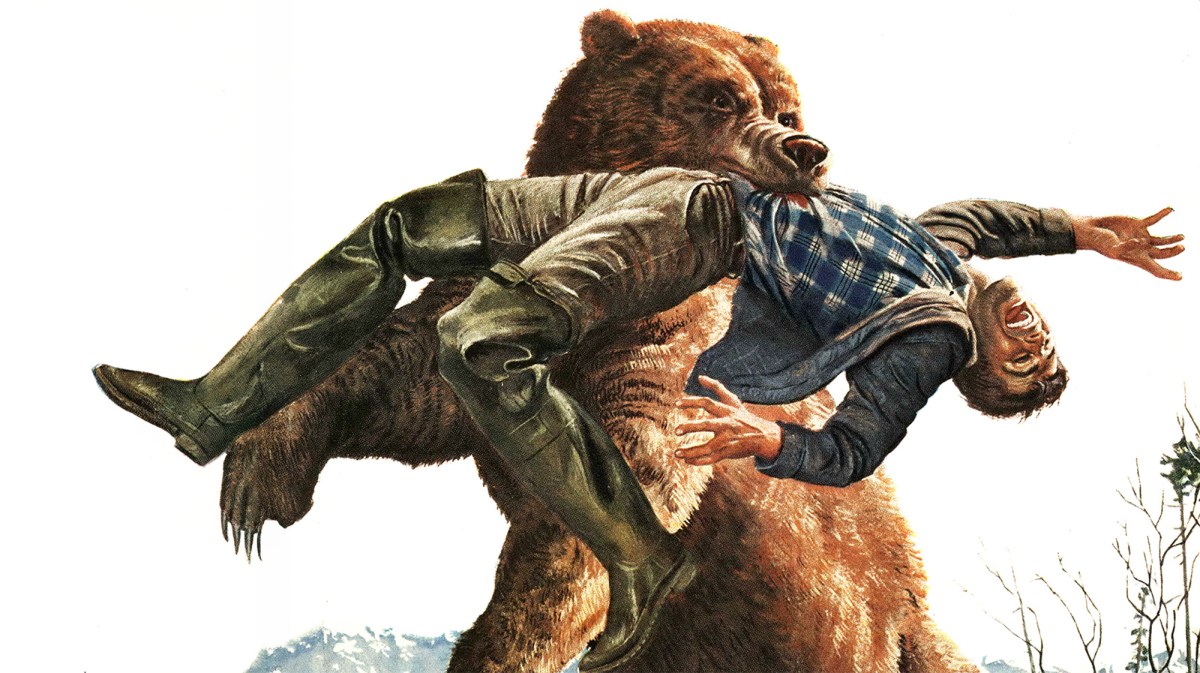

This story, “The Shy Killer,” appeared in the October 1955 issue of Outdoor Life. You can read more stories from legendary outdoor writer Jim Rearden here.
One dark night in the summer of 1953, a brown bear about the size of a brewery horse, pigeon-toed and inquisitive, nosed into a tent pitched on the Alaska Peninsula. A moment later a shot was fired inside the tent, then another. A flashlight went on, and an angry, half-scared Texas voice reeled off a string of oaths.
Next morning the Texan, a summer employee of U.S. Fish and Wildlife Service, was busily hacking the huge carcass into chunks and indignantly lugging them out of the tent when Jim Branson, the service’s district agent, arrived from Kodiak. The way I heard it, the Texan quit his job then and there and demanded to be taken back to civilization — and far away from brown bears.
The young fellow probably thought he’d come close to death, and perhaps he had. But I have a hunch that brownie didn’t go into the tent to chew him up. Most likely it smelled something good to eat in there, or maybe it was just curious. I wouldn’t care to try arguing the Texan into that, though.
Despite the brown bear’s tremendous size and strength, and despite being tagged as one of the world’s most dangerous beasts, he is a shy animal. Many incidents have helped earn him his reputation for ferocity. Whenever a brownie comes to grips with a man the result — or at least the story about it — is spectacular, but it’s surprising how many men live to tell of being mauled by this largest of all land flesh-eaters.
For example, Jim Kennedy related to me how in the fall of 1942 Alex Flyumn, who lived at Kakhonak Bay on Illiamna Lake, tangled with a brownie. For years Jim was a bush pilot and lived at Lake Clark, 25 miles from Illiamna, but now he resides near my home at Fairbanks.
Alex knew brown bears, for he’d lived in the area 30 or 40 of his nearly 70 years. One day that fall he put on his hip boots, took down his double shotgun, and headed for the lake to do some bird hunting. As he walked down the trail he saw a brownie sow with twin two-year-old cubs ambling toward him. He stepped off the trail, went into the alders a fair distance, and watched the bears pass, just as he’d done before under similar circumstances. Then he hit the trail again. But he’d gone only a few yards when he heard a noise behind him, turned, and saw the sow bearing down on him.
He threw his unloaded shotgun up to fend her off, but she slapped it out of his hands, splintering the forearm and bending the action. The blow also knocked Alex down. Then the sow picked him up by his right side, as a lynx does a rabbit, and shook him until his teeth rattled and he couldn’t tell which way was up. Knowing it was his only chance, he played dead. She slammed him down and walked off, but he kept still and waited for her to return. She did. She sniffed at him, rolled him over, sniffed some more, and left.
Later Alex, a tough, fiery man, hurt and mad, staggered to his cabin for a rifle, intending to return and shoot the bear. His wife stopped him, and yanked off his boots. They were puddled with blood. She bandaged him and put him to bed.
Jim Kennedy arrived next day with a load of grub. When he saw Alex he tried to argue him into flying to the hospital in Anchorage, but Alex refused and said he’d be all right. Next spring Jim saw him salmon fishing in Bristol Bay. He had a hernia the size of a cantaloupe on his right side where the bear had broken through his abdominal muscles.
The brown bear’s shy, you ask?
Yes, he is. That one experience of Alex’s was an exception. Many times before when Alex had stepped off a trail, brown bears had wandered by — and kept going. If he’d expected trouble that time he certainly would have loaded his gun and been on the alert.
I’m not trying to give the impression that brownies are so shy they won’t attack men. They will, and do. In Alaska they will kill at least one man a year and chew up several others, and because they do it’s hard to convince people that these occasional attacks seldom are unprovoked.
Speaking of bears chewing on men brings up an interesting point. I’ve read accounts of and talked with about two dozen people who’ve been attacked in recent years, but I’ve yet to hear of anyone getting clawed by a brownie. In all the cases I know about the bears bit and chewed — sometimes repeatedly and in general throughout the body. Why is it that the bears don’t go into action with their most formidable weapons — their four and five-inch, rapierlike claws? I don’t know, and no one I’ve asked has any convincing explanation.
I’ve heard it suggested that bears limit themselves to biting because of an innate fear of man. That doesn’t make much sense to me. My guess is bears bite because that’s their natural way of killing. Even when they kill a man they don’t eat his body. So far as I’ve been able to find, there’s only one known case of an Alaska brownie eating human flesh. It occurred in 1916, and the person had drowned.
Just what kind of bear is this shy killer? For years there’s been much confusion over his place among the many bears grouped in the genus Ursus. Two years ago Dr. Robert Rausch, a biologist with the Arctic Health Research Center at Anchorage, in revising the classification of some Alaska grizzlies, concluded that, “a single but highly variable species of grizzly bear occurs in Alaska.”
While he didn’t try to establish the status of bears that inhabit the panhandle area, not having enough specimens to work on, he determined the existence of three subspecies for the remainder of the Territory. They are: 1, the interior or mainland grizzly; 2, the Kodiak, Afognak, and Shuyak Island grizzly, and 3, the Alaska Peninsula bear. The last two are commonly called brown bears or Kodiak brown bears.
Rausch’s work helps to explain why some bears even far down the Alaska Peninsula are impossible to distinguish, by casual inspection, from grizzlies killed well into the interior. He adds that skulls of some adult females and young males from Kodiak Island cannot be differentiated from skulls of mainland bears.
For record-keeping purposes, however, the Boone and Crockett Club takes the position that “in general the brown bear range can be considered to extend approximately 75 miles from tidewater.” The 1952 edition of its book, Records of North American Big Game, includes a map shaded from about Baranof Island, along the coast, and taking in most of the Alaska Peninsula, and it states that bears killed in this area “will be considered as brown bears.” Actually the bears are found on Alaska’s coastal mountains, usually on the Pacific side, north and west to the far end of the Alaska Peninsula. They also roam some of the large coastal islands, including Admiralty, Krusof, Baranof, Chichagof, Hinchinbrook, and Montague, as well as those I’ve already mentioned.
In judging trophies, attempts doubtless will continue to be made to separate brown bears from interior grizzlies. Otherwise no interior grizzly would ever again be listed in the record book, for the subspecies known as the brown bear sometimes seems to forget to stop growing.
It’s almost impossible for a person who has never seen a brown bear to imagine its awesome bulk. There’s little doubt that some reach a weight of over 1,500 pounds, and skins have been known to measure over 14 feet from tip of nose to tail. An 11 or 12-foot-square skin, however, is considered extremely large.
Their feet are huge — rear pads sometimes measuring 18 inches long and front ones a foot wide — and the tracks they leave are monstrous. But big tracks don’t always indicate a big bear. Length of stride and the depth the tracks sink into the ground are more reliable guides.
It’s hard to reconcile this picture of wild, primitive might with the animal’s true, retiring nature. Yet those who know the brownie best emphasize that normally he’s peaceful and much prefers to mind his own business and stay as far away from man as possible.
You can spend months in Alaska’s bear country, and unless you hunt hard and keep your eyes open, you may not see a single brownie. One summer I spent four months at Chignik, a real brown-bear hot spot, and most of the time I was in the hills. I found plenty of tracks — some wet on dry rocks — came upon many half-eaten salmon, and heard animals wading past our camp at night, but I saw bears only about a dozen times.
One reason for this is that usually the instant a brownie gets a whiff of man — his nose is his best sense — he’s off like a streak.
But he has his pride, and it’s this quality, I think, that may cause an individual bear occasionally to override his innate caution and mangle a man.
Perhaps pride isn’t the word. Maybe it’s dignity or self-respect, or both. One summer day in 1947 Tarleton Smith and I were rounding a sharp bend in Black Lake on the Alaska Peninsula in our outboard skiff when we saw a brownie walking down the beach about 150 yards away. We had the wind, and he didn’t spot us until we were within 100 yards of him. Did he run? No, he kept walking — a little faster perhaps. We moved closer, and I saw him watching our every action out of the corner of his eye.
Suddenly he found an excuse to leave us without ruffling his dignity. He saw a long-dead salmon on the beach, loped over to it, picked it up, and walked with great decorum toward the thick alders. When he reached them he dropped the putrid salmon and broke into a branch-busting run.
Most big-game animals have a dignity of sorts, but I think the brown has something special in this respect. He’s king of his bailiwick, and he knows it. It’s out of character for him to flee from man, but he realizes he has to. And he’s far from being stupid. Dr. William T. Hornaday, former director of the New York Zoological Park, rated the brownie’s intelligence above that of the gorilla, white-tail deer, bighorn sheep, wolf, and coyote.
If there is such a thing as inherited fear and respect of man, the brown has it. He once was market-hunted for his hide, and has been stalked by rifle-toting sportsmen for over 70 years.
As early as 1885, brown-bear skins were sold in volume to the Russian nobility. Aleut and half-breed hunters diligently pursued the animals from one end of the Alaska Peninsula to the other. When Russian demand dropped off prior to World War I, the skins were sought for dress-uniform hats worn by various crack regiments of the German, Russian, Austrian, and English military. About that same time American sportsmen started going to Alaska for bear hunting.
Such intense hunting would have been enough to make the bear extremely shy of man. But on top of all this, many commercial salmon fishermen traditionally take a pop at a brownie whenever they see one, and have been doing it for years. I’ve heard of one Kodiak fisherman who claims to have killed 17 during the 1953 salmon-fishing season alone. Three others claimed they killed nine on the mainland last summer. Such shooting is illegal, of course, but it’s difficult to prevent.
A sportsman hunting with Slim Moore, a Fairbanks big-game guide, killed a bear on the Peninsula a few years back that previously had been wounded by a rifle shot. I saw the skull, and the animal’s lower jaw had been broken. It had healed with the lower front teeth protruding at about a 45° angle.
I’d hate to estimate the number of brownies wandering around with festering bullet wounds caused by haphazardly placed shots from salmon fishermen’s .30/30’s — fired from offshore boats, of course. It would be interesting to know how many “unprovoked attacks” on men are made by such bears.
“Unprovoked attack” usually means that the person assaulted didn’t bring it on himself. But there’s usually some cause behind the bear’s actions.
For example, last summer Paul Garceau, working on Afognak Island for the Alaska Department of Fisheries, was counting salmon in a small stream that empties into Perenosa Bay. While counting he spotted a young male brownie about 300 yards away and heading toward him. Paul yelled when the bear came within hearing distance, thinking to scare him off. Most bears would have high-tailed it for distant parts. This one turned and went into a thick alder patch, through which ran a bear trail that ended right where Paul was counting salmon.
Suspicious, Paul readied his .30/06 but continued to count fish. Suddenly the bear appeared in the trail, galloping directly toward him. He fired, but the bear kept coming. He fired again, and it dropped — 30 feet from where he stood.
The animal obviously had come out on the losing end of a fight with another brownie. Its upper left canine tooth was missing, claws had raked the right side of its face, and its nose was broken.
Was its attack on Paul unprovoked? So far as Paul is concerned it was. If the bear had roughed him up, or worse, it would have been small consolation to think that the animal was seeking revenge for its own injuries.
Clint Stockley, also engaged in a fish count on Afognak some years previously, was walking up a stream when, without warning, a brownie rushed him from the dense alders along the bank. He started shooting as the bear hit the water, and after each shot he jumped back while working the rifle’s bolt. When Stockley finally anchored the bear it lay exactly where he’d been standing when the animal appeared — about 10 feet away. Stockley has no idea why the bear charged.
I’ve heard of many such instances, and not all turn out quite so well for the man.
A few years back a trapper named King Thurman was found dead in his cabin on the Chickaloon flats. Apparently he’d left his shack, unarmed, to get a bucket of water, and been jumped about 100 yards away. The bear didn’t finish him, and he crawled back to the cabin where he painfully scribbled a note on an old mining-location notice. He wrote left-handed, as the bear had mangled his right hand. He printed the words down the page like a list of groceries, and many letters illegible.
The 1911 Revenant Hoodie
See It
“Have ben tore up by a brown bear. No show to get out. Good by,” he wrote. And later, “I’m sane, but suffering,” he printed. Then came some lettering that couldn’t be deciphered. His last effort brought, “The (two words illegible) of death.”
Thurman’s entire right side was torn and chewed from the shoulder down, the ribs loosened from the backbone. His left hip was torn, as were his right arm and the calf of his right leg. He ended his suffering with a bullet from his rifle.
It’s difficult to explain such actions on the basis of the animals’ usual behavior. Attacks by wounded bears, however, are understandable since the brownie is courageous and, when badly hurt, will fight to the death. A common tactic is for a crippled bear to circle and surprise a hunter attempting to track him down.
It isn’t just the wounded bear that hunters must watch for when following a cripple. Other bears seem more likely to attack when a cripple is near. On Kodiak a native hunter named Chowischpack came upon a bear which he shot and badly wounded. He and a companion followed the blood trail into a thick patch of alders, and suddenly he came upon a large unwounded male bear which charged immediately. He was killed before his friend could reach him.
The first brown bear I saw was the color of a Jersey cow, and cowlike, was grazing complacently on a grassy hillside. That was early spring. Later, when the salmon are in, brownies feed almost entirely on fish.
When bears are feeding on salmon, Indians in the Lake Clark and Lake Illiamna regions take advantage of their habit of fishing the same holes night after night. The Indians want the hides and also the prestige that goes with killing a bear.
An Indian will peel a straight willow stick and tie it to the barrel of his rifle so he can poke the white stick in the bear’s direction and tell where he is pointing in the dark. Then he will lie near a trail or heavily fished pool at night, and when he sees the vague form of a bear, he will poke his gun that way and pull the trigger. After shooting, most Indians run like hell. They call it “poke shooting.”
Allen Hasselborg, who has lived on Admiralty Island for 50 years, and Dr. Will Chase of Cordova, who started hunting Alaska bears before the turn of the century, are among those who claim that when a bear attacks a man there’s a good reason for it. They feel that the bear has been surprised and acts impulsively, or it has been wounded, or perhaps the person attacked is carrying freshly killed game giving off a strong blood scent.
Another way for a person to get in trouble with a brownie is to turn and run from him. It’s like running from a dog—you’re just encouraging him to follow. Sometimes, too, in trying to take off upon catching a human’s scent, a bear because of his poor eyesight will run directly toward the person.
If my hand hadn’t been gripping the forearm of the rifle he would have bitten it off.
Once in a while a hunter who has been attacked realizes that the bear wasn’t after him for a meal. One of these is Jesse L. Hatch of Seward, who had a close call with a brownie last September. Jesse was a student at the University of Alaska while I was a faculty member there, and this is what he wrote when I asked him to describe his encounter:
“While stillhunting for moose about two miles off Kenai Highway, my companion and I separated. He continued straight on, and I drifted down the left side of a ridge to cross a small valley and ascend another ridge.
“As I got to the valley floor and started across I walked around a small patch of alders, and cleared the far end by about 10 feet. I heard the snapping of branches, and in one motion slipped my .30/06 rifle off my shoulder, snapped the safety off, and made a half turn.
“Then I saw him charging right out of those alders full bore. He never stood to look me over, but charged the instant I got by him.
“At the time I didn’t think he was so high, but he sure stuck out on both sides and impressed me as being as wide as any brownie I’ve ever seen. I tried to step backward and raise my rifle, but I didn’t make it. He was too fast. He bit me three times — once through the hand and twice just above the wrist. I believe that if my hand hadn’t been gripping the forearm of the rifle he would have bitten it off.
“After chewing on me he brought his right paw off the ground and cuffed me on the left shoulder, sending me through the air to land on my back 10 to 15 feet away. My gun was on my chest in my right hand. My left hand was useless. I still hadn’t pulled the trigger.
“I looked up to see the bear make one jump for me. He landed astraddle, and from where I lay, his hind legs looked a long way back.
“His head was directly above me, jaws open. I swung my rifle off my chest, having just enough clearance below his jaw to do so. The gun butt was resting on the ground when I pulled the trigger. I fired into his throat, and he fell straight down, pinning me under him. Then he started thrashing and pawing the ground.
“The force of the 180-grain Core-Lokt soft-point bullet half turned his body so that all his paws were on my left side. My head was at the ruff of his neck, and I could see him clawing the ground.
“While this was going on I would wiggle out a little and he’d scratch some more and I’d wiggle. Finally I made it out from under him. I was wearing hip boots at the time, and my feet had slipped up to where my knees should have been. This didn’t slow me down. I stood up and spotted a good-size birch and ran for it.
“The bear got up and made a jump for me, but he crumpled when his feet hit the ground. I saw that was my chance to get up the tree.
“I climbed about 30 feet before I stopped. The sensation of trying not to use my chewed-up hand and broken arm meant nothing — I had no control over them — for my biggest concern was my safety. I sat in the tree and watched the bear crawl into the alders and die. My companion came to the tree and helped me out.
“So far as this bear attacking me without provocation is concerned, I’d like to give you my ideas on it. Before this happened my friend and I heard two calf moose bawling. I believe the bear had separated them from their mother and had singled one out for his breakfast. Unfortunately I stepped between the bear and his calf. This I will believe to my dying day.”
Unfortunately people like to classify things — either the brown bear is a man-killer or he isn’t. But I think it’s important to make it clear that the brown doesn’t normally stalk and attack humans because they’re humans, and that such attacks usually are brought on by other factors, as in Jesse’s case.
Read Next: The Legend of Frank Glaser, the Toughest Woodsman Alaska Has Ever Seen
Because these bears frequently come in contact with men in parts of their range, such attacks are inevitable. It’s something like a farmer getting kicked to death by his horse. It happens, but the horse doesn’t ordinarily hunt the farmer down to kick him.
The brown bear is dignified and timid but he’s also a dangerous animal, and anyone traveling in his country should pack a heavy rifle. That’s what helps to make him, for many sportsmen at least, the No. 1 big-game trophy of North America.
Read the full article here
