



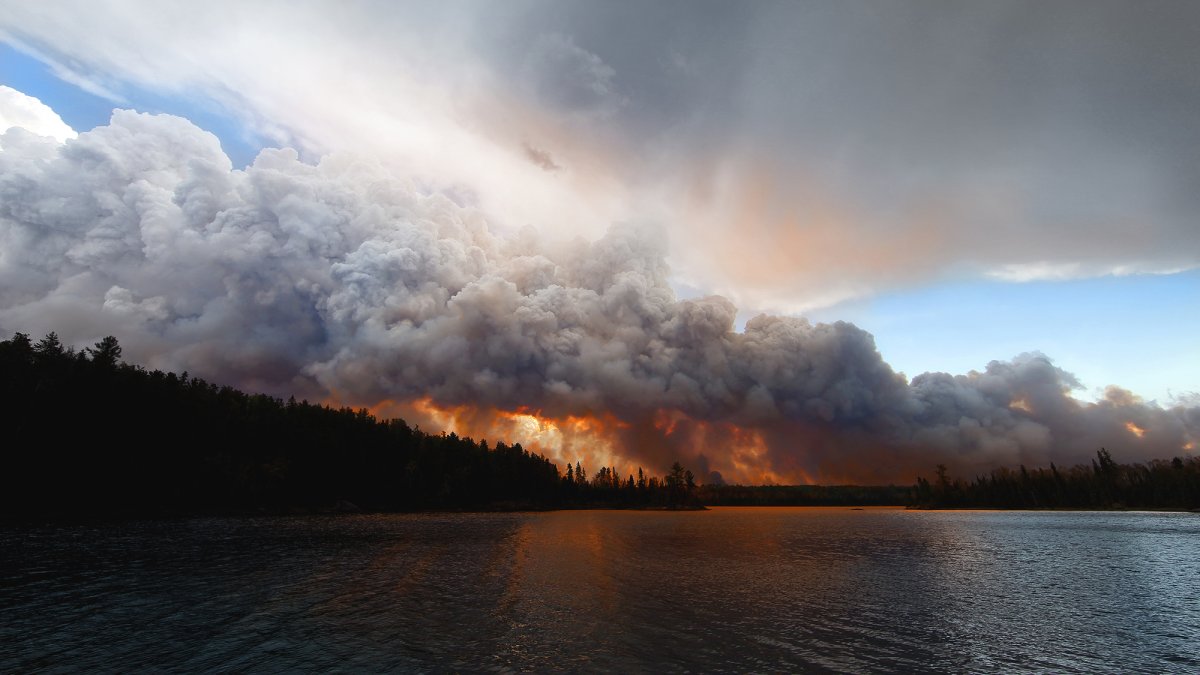

Northern Minnesota has been ravaged by wildfire this summer. For weeks, these fires have burned through areas of the Superior National Forest and the Boundary Waters Canoe Area Wilderness, even forcing the Forest Service to close and evacuate the popular canoeing and camping area. While wildfires in this part of the Northwoods are not uncommon, this year’s fires were more extreme than usual. They led to prolonged and hazardous air quality issues that drifted south and impacted much of the country.
What’s frustrating for a lot of folks inside the Forest Service is that just before this wildfire season, their agency faced some brutal cuts by DOGE under the Trump administration. In many cases, the very folks who were needed to battle these wildfires were let go or forced to resign. On top of that, grant money for important forest management projects was delayed.
So on this episode of the Outdoor Life Podcast, I’m talking with Aaron Kania. He’s a former wildland firefighter and a retired U.S. Forest Service district ranger for this area of Minnesota. And he and his Forest Service colleagues had been working for years on a plan to implement prescribed burns that would reduce wildfire risk and improve forest health in this part of Superior National Forest. But then DOGE came calling.
Listen to this episode of the Outdoor Life Podcast on Apple, Spotify, or wherever you get your podcasts.
Full Interview Transcript
Outdoor Life: All right, Aaron, thanks for joining the Outdoor Life Podcast, man. Where are you?
Aaron Kania: I’m actually out on Lake Vermilion. We live in a rural area and I have better cell reception out on the lake than I do at the house. So a little easier to connect with you here.
Outdoor Life: Nice. Yeah. Okay. So for folks who can’t see what I’m seeing, Aaron is in the back of a canoe. He’s got his life jacket on and he’s just easily paddling across Lake Vermilion.
Aaron Kania: It’s a beautiful day out here.
Outdoor Life: Yeah, it looks calm out there.
Aaron Kania: It is. It’s a little smoky. Honestly, it was foggy this morning and it’s smoky now. But conditions are good. I mean, these are honestly the best conditions for the firefighters. We have a lot of fires outside of the Ely area and the Boundary Waters Canoe Area Wilderness right now. So these conditions are the moderate conditions that we need for firefighters to be effective. It’s actually the reason I’m able to canoe today is because the firefighters are making so much progress up there, and I feel a little more comfortable with how things are going.
Outdoor Life: Yeah. Well, that’s a great segue, because it’s exactly what I wanted to talk to you about. We’ve, and everybody else has, kind of covered these big fires and the subsequent temporary closure of the Boundary Waters. But I think to just get a much better understanding of what’s going on up there and potentially why, you were like the perfect person to talk to. So to kick this thing off, would you just talk about your background, kind of starting as the National Forest Service district manager? Talk about the area that you managed and what your responsibilities were.
Aaron Kania: Yeah, absolutely. I feel I was the luckiest guy ever. An absolute dream job. I was the Kawishiwi district ranger with the U.S. Forest Service. And the Kawishiwi District is based out of Ely, Minnesota, which is a beautiful, quaint little town. Very much focused on the tourist. It’s known as the canoe capital of the world. And the Kawishiwi District is really the heart of the Superior National Forest. It’s the middle of the Boundary Waters. And the Boundary Waters is the most visited wilderness. And the Kawishiwi District is the busiest district, and we have the busiest entry points.
So I just love wilderness. I love the outdoors, hunting, fishing. And this is really my dream job to finish up my career. So I was there starting in 2020 during COVID, and then ended in a retirement that I had planned well in advance, December 31st of 2025.
Outdoor Life: Gotcha. And what were you doing in that window? What were your kind of day-to-day responsibilities? What kind of stuff were you working on?
Aaron Kania: Oh, it was cool. No two days were ever the same. I was responsible for being a wilderness steward, so a lot of decisions around the wilderness. Also wildfire management, and a long history with wildfire and incident management teams. There’s stuff outside of the wilderness like logging and timber sales, ATV trails, and even mining. And so the Kawishiwi District is known because of the proximity of copper-nickel mine proposals to the wilderness. So a lot of work related to that. I started here under the first Trump administration and then was here for the Biden administration, and then the second Trump administration. So there’s a lot of pendulum swinging back and forth around the mining issue.
But then we also have the seaplane base. So we have three beaver float planes based out of Ely. We have an airport and there’s a helitack base out there with the helicopters, and then an air tanker base at the same place. So when we have fire season, we have a lot of aircraft parked at the airport ready to go. We have fire crews, fire engines. And yeah, just really a lot of stuff. There’s about 80 to 90 employees of the U.S. Forest Service based out of Ely. It’s one of the biggest employers in Ely. And then so much of our economy is dependent on natural resources associated with the national forest.
Outdoor Life: Yeah. You and I had met maybe a little less than a year ago, I think. And at the time you were telling me about this really expansive prescribed burn project that you and others in the district had been working on. And you were like really excited about this project.
Aaron Kania: Yeah.
Outdoor Life: So can you, for the listeners, explain what that project was and is, and kind of why that was so important to you?
Aaron Kania: Sure. Yeah. It’s called the Fernberg Corridor Project. And I actually extended my retirement date out 11 months in order to get that at least close enough to the finish line.
And what that is, is on the Superior, we’re very strategic about where we do work. We take a look at the maps, see where the highest risk is. Risk is the probability of something occurring and what happens if that thing occurs. So in the Fernberg corridor, it was prime for a large wildfire to happen. And then there’s a lot of homes and businesses, cabins, resorts, camps. Like there’s a Boy Scout camp out there, a Girl Scout camp. So it was really the highest risk on the forest. And that’s where we focused our energy around planning.
And that planning started with a blank map. And I think this is what was really exciting: this is the first time we had really robust consultation with the Ojibwe tribe. They have treaty rights here through the Treaty of 1854 to hunt, fish and gather off of the reservation. So it’s kind of unique, if you think in a national perspective. And so we started with a blank map and we really met with the tribe and said, what do you think? How can we best honor your treaty rights? And their response was, think like fire. Like, you have all these imaginary lines on the map that don’t exist on the land. And if fire were to be there, where does fire want to be? It’s not gonna stop at the wilderness boundary. It’s not gonna stop at the break between Forest Service land and Minnesota Department of Natural Resources land, right? It’s gonna move across that landscape until it gets to a lake or a river. And that’s where it’ll stop.
And so that’s where we started this project, the blank map. And then, with the tribe, they started drawing lines on the map and said, fire could potentially travel all the way out here. And then when you turned all the layers back on, well, there’s a big wilderness boundary across that line. And so we did the hard work — this is honoring the tribes — to do the outreach with the environmental groups that are also very motivated to steward these wilderness. They’re wilderness protectors. And so we wanna honor that relationship too, in the Wilderness Act and the rules and laws around the Wilderness Act.
So that’s what we did. And it did take us four years, but that was the work we needed to do to make sure it was transparent. It was public and there was a lot of comments. And we incorporated those comments and concerns into the work we were doing. So yeah, that did get signed in May of 2026. There was a government shutdown in there, so we weren’t able to finish it before I retired, but it got signed soon after.
Outdoor Life: Yeah. We’ll get into that part in a second. But just to back up a little bit, to be clear here, you were gonna do prescribed fire in the wilderness, right? That’s part of this plan, which would’ve been kind of a unique thing, right?
Aaron Kania: Yeah. It’s fairly rare when you look across the whole of the Forest Service. There are forests that are doing prescribed burns. The Bob Marshall’s one of them, or at least manage use of fire. And we’ve done that here on the Superior. This is very much a fire-dependent ecosystem. There’s natural ignitions like from lightning, but historically there was also quite a bit of fire that was started through cultural burning practices by the Ojibwe. They were using fire on a daily basis to manage blueberry habitat or for moose, or even just to open up around their campsites. It’s a pretty buggy place up here in summer with mosquitoes. And so it was a way for them to manage the forest around their campsites, to kind of open it up with the wind pass through.
And so it was common. Like, fire is common here. This is definitely a fire-dependent ecosystem and it needs fire. So on the Superior, in the last 20-plus years, 25 years, we’ve put a lot of prescribed fire on the ground through a public process, through environmental impact statements and environmental assessments. After the 1999 blowdown, there was a lot of fire that was management-ignited in order to reduce that fuel load. And then even just as far back as, or as close as, 2024, we did a couple prescribed burns. One was on Slim Lake, which is just north of Ely. And that went from outside the wilderness to inside the wilderness — just a really low-intensity fire that burned down to the shore of Slim Lake. And then another one up on Hegman Lake, which was the same thing.
We used the portage as a fire line and then did a really low intensity. It was super cool because we started at night along the shores of Hegman, which has this tremendous old-growth white pine. And by doing prescribed fire at night, the intensity was really low. And so it was able to consume some of the balsams and understory, but didn’t impact those majestic white pines that are in there. And that very likely could be used during this fire season to slow or stop these large wildfires that we have going.
Outdoor Life: Yeah. Well, there’s a lot there to get into, but I’m curious about the general benefits of prescribed burns in this sort of north woods, lake country habitat. You and I are hunters. We love grouse and deer. I think that we see these wildfires burning out of control and folks are like, oh no, fires are bad. This is a bad thing. We’ve got all these smoke issues. And the general public kind of gets turned onto this idea that forest fires are bad. But you’re talking about intentionally prescribed burns for habitat benefits. So what happens when a forest like this has fire?
Aaron Kania: Yeah, maybe one clarification. So outside the wilderness, we do a lot for habitat, or just reducing the fuel load. Inside the wilderness, a big part of it is to return naturalness, right? To get us back to that natural variability of fire return, because we’ve excluded fire for so long. There was that 10 a.m. rule, 100-plus years ago. And then we also did not allow the Ojibwe to burn in their traditional manner. So we’ve excluded fire. So what’s happening now is the forests have grown up. And there’s so much out there — here we have balsams and brush and branches and trees that have fallen down. And that’s not natural. That’s not historic. The anomaly here is that we haven’t had fire for over 100 years. And so a big part of what we’re trying to do is return fire to the land so that fire can play its natural role.
And fire can actually play its cultural role. And it’s amazing. I was just out on a prescribed burn we did a couple years ago called the Pitchaburn. And it’s open in there. You can actually hunt in there because you can see through the forest. There’s blueberries galore. And that is where the wildlife ends up. There’s grouse, like obvious signs of grouse everywhere. So if people are in the area, there might be a plethora of blueberry pickers and people out grouse hunting. ‘Cause that’s the thing — when the grouse takes off, you can actually get a shot off, right? The forest isn’t so thick. And if you go into a balsam stand, it’s hard enough to walk through, let alone walk through with a shotgun. Or if you see a bird, to be able to actually have an effective hunt.
So it’s night and day difference when you go into an area that’s had a prescribed burn, just how productive, how healthy that forest is. And I would clarify that further with a low-intensity prescribed burn versus what we’re seeing now, which is fire really at its worst, right? Because there’s such a buildup of branches and trees in there that fire really is catastrophic, and it’s not natural. What’s happening out there is not natural because of that buildup, because of decisions man has made, right? Decisions to suppress fires and decisions to not allow indigenous burning. So what we’re seeing out there is not natural. That low-intensity prescribed fire is a way to bring it back towards that natural variability that we saw historically.
Outdoor Life: Yeah. Okay. So you had this proposal, you had tribal buy-in, you have these big aspirations. You also, I imagine, had to get local buy-in, right? The residents around Ely, folks who have cabins and folks who have lodges up there.
Aaron Kania: Yes.
Outdoor Life: How do they feel about the Forest Service lighting a fire in the woods? What was that process like?
Aaron Kania: Well, not everyone’s convinced, right? There’s definitely risk. And I think the risk of a prescribed burn is a lot lower than the risk of a catastrophic wildfire. So what we did is we built a lot of trust — a lot of community meetings, a lot of open house meetings, a lot of field trips. Like even your trip up here, just seeing the land firsthand so that you’re able to convey what it looks like. Sprinkler systems. We just had a fire off of the North Arm Road this past spring. And that was one of the areas we really focused on for doing that proactive work — reducing the fuel load in a strategic way near their cabins and properties. So we were planning for a prescribed burn, and a wildfire happened first.
But that community, they had their evacuation plan ready. They had their sprinklers ready, some of them. And then they knew that that workload was happening. They had trust. Not everybody’s gonna be convinced or not worried. I mean, honestly, those were some of my most anxious nights, was the night before a prescribed burn. You make that decision, you’re watching the weather, everything’s in place. And I was the one that said yes. And as a leader, when you say yes, you take responsibility for the consequences. And if a prescribed burn had escaped, yeah, I’m the one, the face in the community that takes responsibility for that. And so those are sleepless nights, you know? But again, just trust in my people, my crew — some of the most experienced firefighters out there work out of Kawishiwi, work out of Ely.
And a lot of experience, and I had a lot of trust, and they had trust in me, and they knew I supported them and backed them up, and we’re doing the work we needed to do.
Outdoor Life: That all sounds really great. Everybody for the most part’s bought in. And you guys end up landing a $10 million grant, right?
Aaron Kania: That’s correct. So in that very area I was talking about, the North Arm and the Echo Trail, we had Under Secretary Homer Wilkes come out. He’s the U.S. Department of Agriculture, the under secretary — I mean, way up there. And he came out for a visit. And we had everybody out there for that visit. We did a field trip. We showed him what prescribed burns look like. We showed him what the wilderness looks like. It was February and there was no snow, which is unheard of here. So he saw the effects of climate change directly. For no snow in Minnesota, that’s a problem.
Outdoor Life: What year was this?
Aaron Kania: This would’ve been in 2024. February of 2024 is when he came up.
Outdoor Life: Okay, gotcha.
Aaron Kania: Super guy. He was, like, an admiral in the Navy, if I remember correct, but just a really squared-away guy. But he saw — so we had the Minnesota DNR, we had the county, we had private landowners, we had other agencies. And that was his take-home. He goes, we don’t see this everywhere across the country. Communities are divided. The states are fighting with the feds. And here in Minnesota, we’re getting along. And we’re all on the same page. We’re all moving in the same direction. And he was really motivated by that. He’s like, you guys are the exact example of what we’re looking for to get this work done. And again, trust, right? Faith. He saw that because we’re working together, we have a plan. He had trust in us. And we were able to compete for and receive that $10 million grant.
And we were pretty actively putting that together to get it done on the ground. We had all of our environmental work done. This is slightly outside the Fernberg corridor. It’s just to the west of the Fernberg, on the Echo Trail. And so that’s the work we’re getting ready to do with that $10 million.
Outdoor Life: Sounds great. And then when does this get delayed? What’s the holdup?
Aaron Kania: Well, then there was a change of administration, as we know, going from 2024 to 2025. And DOGE came along — Department of Government Efficiency — and put the pause on that funding. So we had that money in our accounts. We were actively putting together the grants, the contracts. We were reaching out to contractors, getting them set up in the system so that they could bid on those contracts and get to work. And then when DOGE put the pause on it, we had to basically stop work. And that was roughly, I think, early in 2025 — like maybe February or January, really early on in the transition — that we stopped work on that project, on the funding portion of it.
Outdoor Life: Timing is important here, because burning happens usually in the springtime, right?
Aaron Kania: Yeah. We have two burn windows for prescribed burning. Really in the spring, after the snow melts, before the leaves come on the tree, we usually have a small window there to get some burning done. And then in the fall, towards the end of fall, September, October, we just have these beautiful fall — leaves start falling off the trees and we can burn again. And then during the winter, we do actually quite a bit of burning during the winter, but that’s mostly piles. So we’ll cut balsam tree with chainsaws and pile them up. And then you go out there, and it’s actually a small-scale operation. Just a fire engine crew, and they’ll go out with a drip torch and drip along on those burn piles.
Or in timber sales, some of our loggers — it’s part of the contract — that they build really large piles where they deck the logs. They’ll do whole log. They’ll bring the whole log to the landing and then strip off the treetops and limbs, and then we’ll burn really big piles at the landing. But that’s when we have two or three feet of snow on the ground. So those fires don’t spread.
Outdoor Life: Gotcha. Okay. So you had won this grant, you’d started work on it, then got delayed. The grant is ultimately later approved, or how was it ultimately resolved?
Aaron Kania: Yeah. So we did a lot of work. Some of our local elected officials — in particular, I’ll give a shout out to our county commissioner — was very active. He knew the risk. And he did a lot of work with the Forest Service in D.C., working with some of our federal elected officials, just to really reiterate how important that work is. And there was new conditions put on getting that money back. And that was reprogramming that money more towards timber sales, prioritizing timber sales, which is great. We need timber. We do a lot of timber sales here. It’s just, in the Ely area, we’re really far from markets. And we do have timber sales, but they have to be marketable. And so generally that’s our best for us, in order to be profitable, to get the wood to the mill.
And then, for that first round, we had used a really strategic approach. There’s all kinds of concepts out there, but really, if you can do that work along the road — and so they’re kind of long, they’re not very wide, but 100 feet on either side of the road — that’s what takes that fire out of the crown, puts it back on the ground, gives firefighters a chance. But when you’re removing that wood out there, there’s a reason why we didn’t log it. And that’s because it’s not marketable. So we don’t have a market for balsam. You don’t have a market for dead wood, you know? And so you really have to have some incentives out there to get that work done. And that’s what this grant money went to.
“The risk of a prescribed burn is a lot lower than the risk of a catastrophic wildfire.”
So it was really strategic. It was really well thought out. All the environmental paperwork was done. And it was shovel ready. It was ready to go. And then, when we had to take roughly eight months to fight for that money back and then repurpose our strategy, you don’t end up with the same outcome. Then the objective is timber sales. And the objective isn’t really to stop a wildfire, right? And it’s very different on the landscape. It’s very different — how a block of timber doesn’t stop a fire. The fire can even go through that timber stand. It might be slower, it might be lower intensity, but it can still move through that timber sale. So it didn’t have the same effectiveness as the original plan.
Outdoor Life: Yeah. I feel like this is something that we’re seeing in forests kind of all over the country where, obviously, the Trump administration has put an emphasis on natural resource extraction. And when it comes to forest services, that’s often means logging. And I think among the general public, there is this idea that, well, if we can log it, we should log it, because that spurs the economy and we’re using that resource. And that reduces the risk of fire rather than a prescribed burn, which costs money and we’re not getting anything out of the resource to put back into the economy. But there’s a lot more nuance to it than that, right? You can’t just log anything with trees, right?
Aaron Kania: Yeah. I mean, this isn’t a cornfield in Iowa, right? We have so much diversity in our forest. And at Ely it’s rocky, it’s wet, it’s steep. And so it’s not really even conducive for logging. There are places, and we’re certainly managing those. But I would say timber plays a major part. That’s the way that you are generating revenue. You’re generating revenue for the local economy and people in the economy, but it’s not the whole solution, right? I’ve seen it really effective where a timber sale plus a prescribed fire will stop a wildfire. Timber sales are a major part outside the wilderness, obviously, where you can manage the forest, you can reduce that fuel load, and you can make some money on it. You can put money back in the federal coffers.
But when that’s then matched up with other activities like prescribed burn, like hand pile and burning, you can really be effective in changing fire behavior. And that’s what’s critical about here. Plus, we’re creating different markets. We’re making markets for small-scale contractors who are buying equipment. They’re buying these things called masticators, which basically grind trees up and make wood chips out of them. Well, those wood chips could be sent to market and they could produce other materials that don’t compete with our existing markets. Like biomass — so wood pellets. Everybody out there that’s got a wood pellet stove — making wood pellets is huge. Here we have an iron mining industry and they make taconite pellets, which is, the iron goes into these little balls that then get shipped off to the mills and turned into steel.
Well, we could use biomass in those facilities to heat up the iron. And so it works with our markets and it reduces the fuel load at the same time. So there’s a lot of things we can do creatively. I think that $10 million would adjust the economy kind of on the supply side. Put more material out there. And then get contractors. We had a whole bunch of contractors lined up to start doing this work and they were buying equipment, getting ready to go. And then it got paused.
Outdoor Life: Yeah. And then of course we fast forward to this summer and the wildfires around the Boundary Waters, or around Ely, make national news. Folks who are hundreds of miles away from the forest are impeded by wildfire smoke. We’ve had outdoor festivals and all kinds of stuff canceled because of those air quality issues. And I just can’t help but wonder, would some of that work have helped make these fires maybe not so bad? How do you look back on that now?
Aaron Kania: Yeah, it’s really hard to look into the crystal ball, because how long would it have taken to get the contractors on the ground and doing the work? There’s a lot of unknowns here. But we would have been a lot further along than we are now, which is nothing, right? A lot of these projects would have been in place. They would have been effective. I think of over on the Echo Trail in particular — like, that work would have been happening. And maybe it would have changed the outcome. This will be for the future — we can look into this more. We’ll put some maps together of the work that was planned in round one and the work that our firefighters are doing right now. But if our firefighters didn’t have to do this work right now, they could have done other work, right?
And also the cost, right? So it’s a lot cheaper to plan work well ahead of time — do it in kind of an eight-to-10-hour day — versus what we’re doing now, which is hotshot crews out there doing the work. Extremely expensive, using equipment in emergency conditions. Firefighters are placed at risk because they’re closer to the wildfire while they’re doing that work. The heat and temperature — it’s super hot out. It’s horrible conditions to be doing that work. And you’re at risk. So why not do that work in a planned manner? Fernberg was a little bit further away. It was early on the planning process. But eventually that will be taken effect. So what I’ve heard, these firefighters are doing just amazing work and it’s really effective.
I think they’re probably implementing a lot of the work we planned that we were gonna use along the Echo Trail. So they’re probably putting it into effect right now. But yeah, if you look, a fuels break that’s in place is a lot more effective than a fuels break that’s in the planning process.
Outdoor Life: Yeah, no doubt. I think that when a lot of the DOGE cuts to the Forest Service were happening, and then all the holdup of grants in the Forest Service, but also fish and wildlife, it was hard for folks, I think, to see how those cuts or delays would actually have any impact in their life, actually on the ground, right? You hear about these cuts to a government agency and that feels a little removed from your everyday life. But in your mind, is this an example of that kind of coming to fruition? Like, you had what was seemingly an efficient, well-thought-out plan that was then delayed, and that had a real-world impact.
Aaron Kania: It did. And we haven’t even talked about the human impacts on people working for the Forest Service, and how that played out during these wildfires. So, again, the Kawishiwi District is the busiest district on the busiest wilderness in the country. And we had 12 wilderness rangers prior to the cuts. That’s fully staffed. They’re extremely experienced. We really get the best of the best because we have all these youth camps here. And so kids here start canoeing at eight years old, or even in a car seat, they’ll be in the canoes. And so they grow up with canoeing. And then, a coming-of-life event, they’ll canoe from Ely up to the Hudson Bay. And there’s a lot of people here that have that much time canoeing before they even turn 18.
Related: Feds Fire 4,400+ Public-Land Employees, Including Forest Service Workers, National Park Staff
And then they go work for the resorts and as outfitters, and they get more years of experience. And then on top of that, we have Minnesota North College – Vermilion, which is a two-year college that’s focused around the outdoors and wilderness management. Like, the Boundary Waters is the classroom for Vermilion. And so they have all this life experience — like 10 to 15 years life experience — plus the technical training. And then they come over to the Forest Service as volunteers or interns, just to get on the crew. And then they get on the crew and, literally, they’re seasonal, right? ‘Cause you have to go during the open-water season. And they’ll be out there and they’ll work the summers for the Forest Service, but they have benefits and a retirement system. And they’ll literally work until they retire, like 25, 30 years as a wilderness ranger.
And those were the people that were getting cut, right? So the DOGE cuts all started with this thing called the fork in the road. Like, we all got an email one night. And it was basically, why don’t you quit working for the government? Go get a real job. And that’s how it started. And then it progressed to, if you don’t leave, you will probably get fired. And so then they were offered deferred resignations. And I think some may remember what we call the Valentine’s Massacre on Valentine’s Day. A whole number of employees who were probationary — that means they had just started their federal career, or they had taken a different job in the government and they were back on a probationary period — got termination notices. And so those were wildland firefighters even, because they have red cards.
And so they might work on the timber crew, but when we have fires, like right now, they’re out on the fire line. They’re on the engines. Our wilderness rangers were getting terminated. People at our front desk were being terminated. And the front desk — you can’t fully understand and comprehend how critical that is, right? So the Kawishiwi District had 20,000 people a year go through the front desk. Everybody called the front desk, right? So they’d see a fire, hear a report of a fire, and people in Minneapolis and Chicago and Milwaukee would call because they’re like, oh, hey, next week I got a Boundary Waters trip. And where’s this fire? Is my trip canceled? And our phones would just light up. Social media would light up. Families would call and say, hey, my kids are out there on a canoe trip. Are they safe?
Are they safe? Can you check in with them? So our front desk would call a wilderness ranger on the radio and say, hey, are you on Lake Three? Can you check on this camp and make sure they’re safe? Their family’s calling. And so when you take away those pieces — the wilderness rangers, the timber crew, the front desk, and our firefighters — that has real-world implications. And we saw that immediately when the wilderness closure went into effect. It was widely reported that there was eight rangers and four canoes heading out across the Boundary Waters. And the Boundary Waters — you’ve been here.
Outdoor Life: Seems impossible.
Aaron Kania: Yeah. Like, even on the length of this podcast, not paddling hard, we’ve only gone a couple miles. And so, just the amount of time it takes to evacuate the Boundary Waters — and you need a lot of people. So what ended up happening is I heard stories from my good friends that they’re like, hey, I just got a call from the Forest Service and they’re wondering if I can come back, if I can volunteer and do an evacuation. And they were just —
Outdoor Life: Folks who had been let go?
Aaron Kania: Folks who had been let go, who had resigned under duress. And then the front desk — there’s just nobody there. Our hours at the front desk had been cut back. The outfitters were issuing permits for the Forest Service because the Forest Service didn’t have the staff. And so these have real-world implications. If we had 12 seasoned rangers that are just incredible — I mean, ultra, ultra athletes when it comes to canoe paddling, these are the elite — and they’re not there. And so a lot of times we could partner them with a volunteer or someone else and we would double our workforce during an emergency and get people out of harm’s way. And that just wasn’t available. Trying to staff fire engines when you don’t have enough qualified red-carded members.
That was it. There was a lot of lightning, right? There was a lot of fires. We can’t underestimate that the scale of this was a lot bigger than what we’ve seen here before. But I think in years past, we would have had enough employees to staff the engines, to knock down some of those fires outside the wilderness, and then stay on them — park an engine on them, go there, stay there every day and make sure they don’t wake up again, come back to life and take off running.
So I think we’ll be having more conversations. And I think those are the kind of questions people want to know the answers to. And, again, that’s also why I’m running for the Minnesota House. So after I retired, I put my hat in the ring for running for the Minnesota legislature, because I’d reached out to my local representative and asked him, hey, can you stand up? These are your constituents that are being fired. They’re starting families and buying houses and contributing to the economy. Can you help us out? They’re all union members, or most of them are. And, thankfully, the union stood up for them and there were some lawsuits and people got returned to work, came back to work — but not all of them. So it’s that human factor that is really what’s most difficult in all of this.
Outdoor Life: Yeah. As you campaign and go around your district, how big of an issue is the natural resources management — kind of everything from recreation in the forest to resource extraction? Is that the number one issue in the district?
Aaron Kania: Yeah, 100 percent. So mining is probably the biggest issue. Whether it’s our iron mines, which have laid off 700 employees, and the immediate effects of that, the downturn in our economy because of that. And those people leaving the area. So what’s the immediate solutions? How are we addressing that? All the way to copper-nickel mining on the upstream edge of the Boundary Waters, and how to tackle that. I think up here in Northern Minnesota, there’s three legs to the economic stool that we traditionally talk about. And that’s taconite, which is iron mining. There’s timber and there’s tourism. And really that’s what people want to know. We’re losing population up here. As far as unemployment and economics, we’re really struggling. And so we’re looking at those traditional base of our economy to find innovative ways to put people back to work and encourage people to stay or move back here.
So it really is. I mean, there’s so many issues with healthcare, childcare, schools, insurance, taxes, but almost — again, I’ve talked to over 800 people at their door. Like, I knock on people’s door and talk to them, and I wanna hear what voters are saying, and that’s what they’re saying. That and divisiveness. They’re so tired of the divisiveness. And really that’s a big part of the problem here — we’re so divided over so many things, but even with our natural resources. So somebody with my background who’s actually worked through these problems and brought people together — like very divergent interest groups together, like the tribes, like environmental groups and loggers. When you can bring that together and work towards solutions, that’s powerful. And I think that’s where people are really interested in supporting me and my campaign.
Outdoor Life: Yeah. Kind of last line of questioning for you. If you win this campaign and you get the seat, and you’re able to implement one thing for the district and you’re like, that’s something that I’ll hang my hat on — what would that be? What would that look like?
Aaron Kania: You know, Alex, that is probably one of the best questions I’ve heard, because people will say, what’s your top three priorities? And I love that you’re like, what is that legacy, right? ‘Cause they’re putting everything into this campaign. And you gotta be motivated, right? There’s gotta be more than just a title to this. Or really —
Outdoor Life: Yeah, you could just be retired. You could just be fishing right now. But instead you’re campaigning.
Aaron Kania: Exactly. So in our family, we had a real heart-to-heart conversation, because we knew that this would be an all-in endeavor. I’m involved in so many things, right? Forest management, prescribed fire, trails. I’m on Vermilion, and so clean water, healthy fish that don’t have mercury in them. And so my better half, she said, running for office is the through line. It’s the thing that connects all the things you’re interested in. And that is really motivational — how much time and effort I put into all these projects and ideas.
But, to answer your question, I think really it is about forest management. There’s not a lot of people in rural Minnesota that are focused on forest management. This wildfire issue — that is front and center to all of us, whether you’re an iron miner or a canoe guide, right? You’re impacted equally by these fires. And forest management, healthy forests, is important. And I think that’s a place with my background that I can really bring a lot to the table — and the committees that you serve on as a legislator, to be that voice in rural Minnesota with experience that has the relationships and networks to bring ideas forward and to compromise on those ideas, to find solutions. It has to be bipartisan. And I think that’s what I’m really offering to voters in this district: a knowledge of what’s important to us, and then a path forward of how we’re gonna get it done.
Outdoor Life: Yeah. Just to put a finer point on that, could you talk about the difference in Ely when, maybe say, last year when tourism is popping and everyone’s going out to the Boundary Waters and having their vacation and the lodges are full, versus what we saw this summer where the Boundary Waters is closed and people aren’t coming? What’s the difference?
Aaron Kania: Yeah. Well, I’ll give you an example. Even over on the shore, there’s Highway 61. It goes up the North Shore to Grand Marais. There’s fires over by the Gunflint Trail. And there’s a really iconic place there. It’s called Betty’s Pies. And normally you go to Betty’s Pies, they’re parked on the highway, the parking lot — they have people help you park because it’s so crowded. And then you get in line for a pie, like 45 minutes to an hour is not an uncommon experience. And we were just there last week checking in with the owners, and we walked right up to the window. There was parking spots. I mean, that is night and day different from what you expect. Ely was a real challenge because so many people were evacuated and moved into Ely from outlying areas.
Read Next: This USFWS Announcement Has Duck Hunters on High Alert
So there was a shift. There was a shift in people. Now, obviously, they have a double whammy of economics — that their businesses closed down, but they’re also evacuated and maybe even living in a hotel or Airbnb in town. And so they have kind of a double expense. They’re losing money from not being operating, and then they’re losing more money from having to pay for housing and everything else. And then in Ely, a lot of firefighters were there. So the fire crews were coming in. They were going to the restaurant. So there was a little bump just because of the fire activity and a shift in dynamics. So I thought Highway 61 was really maybe more of an indicator of what the overall general economy in Northern Minnesota — how it’s been impacted.
That was just absolutely shocking. Like, how much of a difference — 70 percent drop in activity, easily. And 70 percent is probably even conservative. So, a really major impact.
Outdoor Life: Yeah. Well, Aaron, I appreciate all the insight. And yeah, I definitely have learned a ton from you about just the nuances of fire up there. And I hope that you have a successful campaign. And yeah, I hope to talk to you in the future too.
Aaron Kania: All right. Well, I really appreciate your time, Alex. And yeah, maybe from the hunting stand next time. There we go. We’ll check in from the deer stand and we’ll be past the election and past this fire season, hopefully.
Outdoor Life: Yes, hopefully. If the fires are still going by deer season, then we know we got serious issues.
Aaron Kania: Yeah, for sure. All right. Thanks.
Listen to this episode of the Outdoor Life Podcast on Apple, Spotify, or wherever you get your podcasts.
Read the full article here
