




We may earn revenue from the products available on this page and participate in affiliate programs. Learn More ›
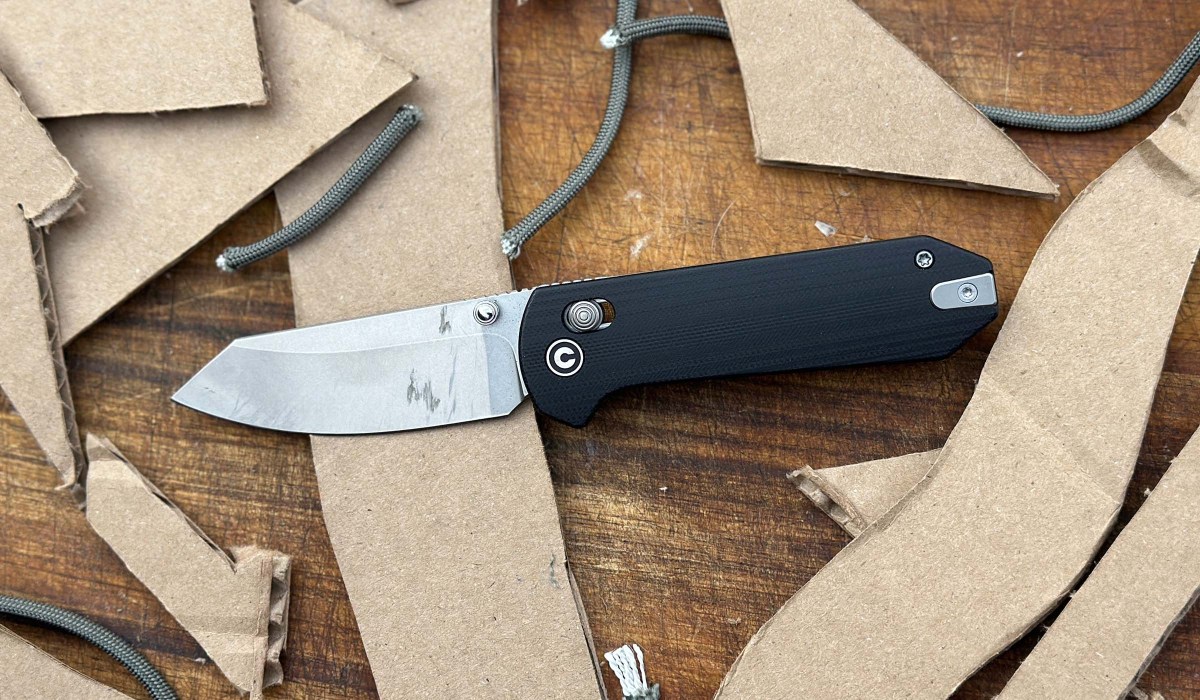
After collecting and testing hundreds of knives, it takes a lot for me to get excited about a new design. But, occasionally there’s a blade that cuts and carries so well I’m compelled to tell the world about it. I’ve been carrying the Civivi Yonder in my EDC rotation for three months and I cut tested it against two excellent folders. Its performance in daily use and head-to-head testing put it on my list of my favorite EDC knives of all time.
Get it From Amazon
Get it From Civivi
Get it From DLT Trading
-
Price:
$67 (Retails for around $60) -
Very lefty friendly -
Weight:
2.8 ounces (measured) -
Closed Length:
3.74 inches (measured) -
Open Length:
6.63 inches (measured) -
Thickness:
0.45 inch (measured) -
Blade Stock Thickness:
0.09 inch (measured) -
Thickness Behind the Edge:
0.01 inch (measured) -
Sharpened Edge Length:
2.73 inches (measured) -
Spade-point blade -
Blade Material:
14C28N -
Blade Hardness:
58-60HRC -
Crossbar lock -
G10, micarta, or wood scales -
Caged ceramic ball bearings -
Designer:
Zac Whitmore
Blade Steel
The Yonder has a 14C28N blade, which is hardened to 58 to 60 HRC. Dr. Larren Thomas of Knife Steel Nerds did a test of several popular budget knife steels and 14C28N came out on top.
“After reviewing many of these steels I think 14C28N is the best. It has high toughness, above average corrosion resistance, and decent edge retention. It is also ‘fine blankable’ and easy to sharpen with any stones…,” he says.
So while 14C28N is no S30V, it’s a great steel choice for a knife under $100.
Design
35,000 Miles with 1 KNIFE | The NEW Civivi Yonder
Zac Whitmore is one of the most universally liked and respected people in the knife industry. He put his years of experience using and reviewing knives into designing an EDC blade. Whitmore designed the Yonder with the help of his friend Ben Peterson — one of my favorite knife designers. He wanted to make a knife that would work well for a wide range of people with a neutral, comfortable handle. The knife is also completely lefty friendly with a reversible pocket clip and ambidextrous lock. The blade is meant to be utilitarian, tough, and a great cutter. The end product is a knife that’s made to be a companion through all life’s adventures.
Testing the Civivi Yonder
I find it’s best to do cutting tests as a comparison so that I can cut a material with knife A and see if it’s better than knives B and C. I put the Yonder up against the Kershaw Bel Air and CJRB Pyrite Light — two of my favorite knives in their respective price points.
Read Next: Best Knives Made in the USA
Cardboard is a go-to knife testing medium because it’s consistent and ultimately is what a lot of EDC knives end up cutting in real life. Instead of slicing up a flimsy Amazon box, I used a nice thick grade of cardboard to see what these knives can do. The Yonder cut cleanly and with little effort in a straight push cut. The Bel Air had slightly less resistance and the Pyrite Light had noticeably more while making the same cut. What I noticed while cutting was the minuscule differences in blade thickness and grind geometry.
The Yonder and Pyrite Light’s spines measured 0.09-inch thick and the Bel Air’s measured 0.07 inch. Just behind the edge the Yonder and Bel Air measured 0.01-inch thick and the Pyrite Light measured 0.02-inch thick. So the two knives that sliced the best have a thinner grind. The Bel Air and Yonder also have a lot of belly to their blade shape, which aids in slicing.
As I moved on to making S-shaped cuts and using different grips through the cardboard, the results were consistent. The Bel Air was the top dog, with the Yonder trailing just behind it, and the Pyrite Light required the most effort. A feature that held the Pyrite Light back was its large finger choil, which snagged cardboard on a few occasions and halted the cut abruptly. The Yonder doesn’t have a full flat grind, and it’s more of a high saber grind. That grind helps the knife not get bound up as it pushes through material, which was especially noticeable while making sharp turns.
When I started cutting the paracord though, the tables turned. The sweeping blade shape that helped the Bel Air and Yonder cut through cardboard held them back on cordage. Paracord is fairly slick compared to other cordages and when a blade has a lot of belly it will slip down the blade rather than being cut. The Pyrite’s straighter blade shape traps the paracord in place and slices right through it. The Yonder ended up in third place while cutting paracord close to the grip and with just the third of the blade near the tip.
All three knives were equally good at piercing. The difference is the Yonder’s tip is stronger, which makes it far less likely to snap off while doing questionable things (prying) with your pocket knife.

Civivi Yonder Action and Ergonomics
The Yonder is a small knife, but it has the ergonomics of larger knives. While doing the S-cuts, the Pyrite Light immediately produced hot spots on my hand. The Yonder was perfectly comfortable throughout testing. I never felt the pocket clip and I never felt like I wanted more handle length. It’s worth noting that I have large hands too — I’m 6 feet, 6 inches with an XL glove size. Even though the Yonder doesn’t have a choil, you can choke up on it for making detail cuts using the flat spot that’s right near the plunge grind. The jimping just above the thumb studs have just the right amount of grip without being too aggressive. The jimping and overall handle shape locked my hand in place and I could use less grip force while making difficult cuts.
The Yonder is an elite group of EDC knives that are practically perfect in the pocket. The deep carry clip holds the knife securely and discreetly. Its slim width and short overall length leaves plenty of room for keys or a phone in your pocket. Its size also makes it easy to retrieve those items from your pocket without interference.
The Yonder’s action is about as good as a crossbar lock can get. It doesn’t have that snappy feel you get from a well-tuned detent on a frame lock, but the blade opens with authority with very little effort. It will also roll out smoothly, which isn’t always possible with a strong detent.
Competitive Offerings
I really like the Yonder, but it’s also worth looking at these other great knives.
- Civivi Baby Banter ($59): A smaller knife with a better action, but the Yonder is a better cutter overall.
- Vosteed Porcupine ($69): A great option if you want a slightly bigger knife.
- Kershaw Leek ($61): A USA-made knife that’s a great slicer. But, it’s an assisted opening knife.
What the Yonder Does Best
The Yodner is a true EDC knife and it excels at being easy to carry and cutting through a wide variety of materials with ease. It’s also one of the best value EDC knives at around $60. In my over 200 piece knife collection, I don’t have a knife under $100 that I like more than the Yonder.
Read Next: Best EDC Knives
Where the Yonder Can Improve
I love this value version of the Yonder, but a premium version would get the most out of this knife’s great design. I think titanium and S110V would turn this great value knife into one of the best EDC blades ever made.
Final Thoughts
Zac Whitmore’s years in the knife industry shows in his flawlessly designed Yonder. You can see the small, thoughtful details that only come from experience throughout the design. Those details add up to a knife that’s a joy to carry and use.
Read the full article here
