



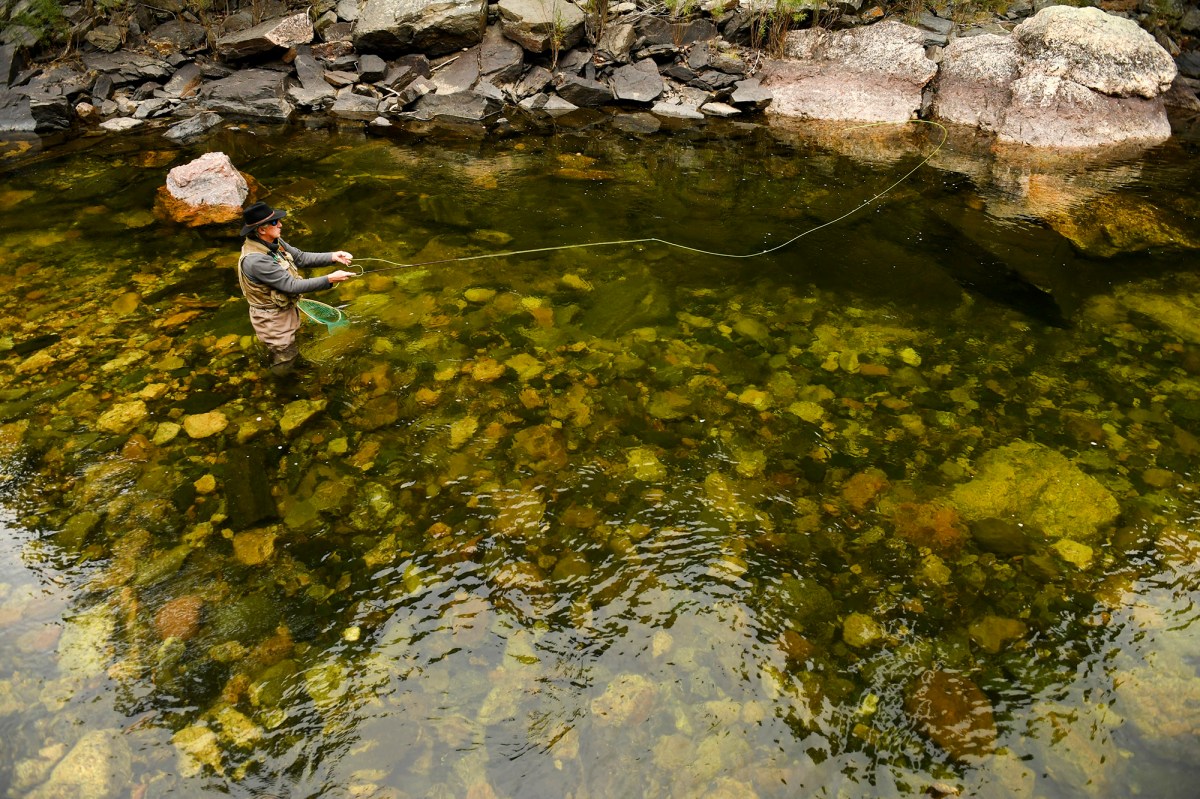

After fishing and fretting through the lamest winter on record, I’m certainly not the only angler out West with concerns about a low-water summer. Of course, these worries go far beyond the trout streams. Our regional freshwater infrastructure relies wholly on the cyclical falling and gradual melting of snow, which has been in short supply recently. This has huge implications for anyone who lives out West, and for farmers and firefighters in particular.
Editor’s Note — This is the second of three articles about the perfect storm of fire, drought, and dust bowl conditions across the West in 2026.
- Record-low snowpack threatens water supply. Colorado faces its worst snowpack in recorded history, impacting water resources and increasing drought concerns.
- Colorado River Basin under strain. Operating at 36% capacity, the river system’s over-allocation issues worsen, affecting millions in the Southwest.
- Fishing season shifts earlier. Anglers advised to fish now, while the fishing is good. Warmer temperatures and reduced flows are shifting traditional timelines.
- Potential for fishing restrictions. Rising water temperatures may lead to temporary closures to protect stressed trout populations.
- Late snowfall or rain could help. Spring snow and summer rain could help salvage the season.
Bottom line: With record-low snowpack and early runoff, water scarcity and altered fishing conditions challenge the West. Act now to make the most of the current fishing opportunities.
Here in Colorado, where I live, most of us expected the data to reflect the lack of snow we’ve seen since November. But that didn’t make the bitter pill any easier to swallow when that data dropped this month: We are now looking at the lowest snowpack levels since the state started tracking it around 40 years ago, in 1987. Combine that with a record-breaking heatwave in March that started melting snow in the mountains more than a month before usual, and you have a recipe for anxious weathermen and water managers.
“There’s no sugar-coating the data right now,” Colorado state climatologist Ross Schumacher wrote in a blog post earlier this month. “It’s now safe to conclude that this has been the worst year for Colorado snowpack in recorded history.”
On Friday, the Bureau of Reclamation announced that it will take action to protect the Colorado River System amid the historic snow drought. At this point, the Bureau says, the Colorado River Basin will be operating at roughly 36 percent storage capacity.
Related: ‘Everything Is Ready to Burn.’ The West Braces for a Brutal Fire Season
Now, keep in mind that this is already the most strained and contested river system in the West (and perhaps the entire country). Drought has been a near-constant in the region for around 26 years, and experts say the river has always been overallocated — meaning there was never as much water as managers planned for when they established the original Colorado River Compact in 1922. The seven states that rely on this water have for years struggled to agree on how to share the dwindling resource, and the most recent round of negotiations just collapsed.
This shortage will affect tens of millions of water users in the Southwest — particularly farmers and irrigators, but also the cities and utilities that get their electricity from Colorado River dams. The worst-case scenario would be if Lake Powell, which is only 23 percent full, drops far enough to reach “dead pool.” This would impact downstream delivery and could cause the hydroelectric turbines in Glen Canyon Dam to stop turning.
So, to prevent this from happening, federal water managers will be releasing a staggering amount of water from upstream via Flaming Gorge Reservoir, which spans Utah and Wyoming and holds back the Green River. Officials expect the lake levels at Flaming Gorge to drop by around 35 feet over the next year.
“Anglers should expect reduced flows,” Bureau of Reclamation public affairs specialist Anna Perea tells Outdoor Life in an emailed statement, referring to streamflow forecasts in the West. “Low flows may mean that streams will be warmer and fish may be stressed. Rafting and floating opportunities may be limited.”
Anglers in Colorado’s Front Range got some even harsher news on Tuesday, when water managers announced plans to drain and close Antero Reservoir, one of the premier stillwater trout fisheries in the South Platte watershed. Just like the situation on Lake Powell, this drawdown is a band-aid fix to prop up Cheesman Reservoir, which supplies drinking water for more than a million people in the Denver metro area.
Antero is designed for this sacrificial purpose, and it’s been drained before in response to drought — most recently in 2002, which is the closest historical comparison to this year’s meager snowpack. But it’s still painful for all the anglers who love Antero and its huge trout. Colorado Parks and Wildlife has enacted an emergency fish salvage there, with bag limits lifted through May 13. Some local guides are speculating that CPW will try to move as many trophy trout as they can to other reservoirs in the system.
These water woes go beyond the Southwestern region. The effects of a weak winter are being felt across the West, from the deserts of New Mexico to the Washington coast and nearly every watershed in between. The only outliers, it seems, are parts of the northern Rockies in Idaho, Montana, and northwestern Wyoming. Their mountains might not be smothered in snow, but they are sitting closer to normal in terms of their snow-water equivalent — the amount of water that would enter the rivers if all the snow melted off at once.
But since I live near (and drink from) the upper Colorado River, my state is as good a place as any to establish some sort of fisherman’s forecast for this year’s river season. And while things do look bleak and boney going into the summer, there are reasons to stay optimistic.
For starters, the fishing is already off to a strong start in this neck of the woods. We also got around a foot of snow in the central and northern mountains last week.
Adjust Your Calendars and Expectations
In a typical year, the trout fishing in Colorado starts to pick up in April and early May, before runoff turns the rivers high and muddy. Things then pick back up sometime in June or July, as runoff subsides and the rivers drop into shape. By mid-August and into September, we’re typically past the peak of trout season at lower elevations, when many of those rivers will reach their warmest temperatures of the year. This is usually the best time to hike into the high country, where there are enough alpine lakes and feeder creeks to keep an angler busy.
This year’s trout calendar is looking much different, however. And in many places around the state, some of the year’s best fishing is already happening. This would include the upper Colorado River and some of its tributaries in the central part of the state, where Minturn Anglers is based.
“People are calling the shop and asking when’s the best time to fish, and I’m like, ‘Right now,” says Cole Tretter, who runs the shop in Minturn and manages their guided trips. Tretter tells Outdoor Life that his guides are making plans for an earlier and more condensed summer season, and they’re already encouraging potential clients to book earlier in the summer than they normally would.
Here in northern Colorado, my local rivers seem to be around four to six weeks ahead of schedule: The ice melted quicker, the bugs are hatching sooner, and in some areas, runoff is already kicking in to an extent. This means that some of the spots where I typically focus my efforts in early May were fishing lights-out toward the end of March and early April. Tretter and his guides have seen much of the same.
“What I’ve been telling people, as far as river flows, is that we’re a month ahead,” Tretter says. “But then as far as hatches and the spawn, we’re even more ahead [of schedule]. Typically rainbows start spawning at the end of March into April, but I heard reports of fish spawning as early as February this year. And then with things like caddis hatches, we’re seeing some really intense hatches right now that aren’t typically happening until May or even June some years.”
Tretter says the main stem of the upper Colorado has been especially productive this spring, but that flows have still been on the lower side as water managers focus on filling the upper reservoirs that act like water savings accounts. This is a complex and difficult job even under the best conditions. And as we’ve already seen (and noted above), it’s especially tricky following an unusually warm and dry winter like the one we just experienced.
“People are calling the shop and asking when’s the best time to fish, and I’m like, ‘Right now.’”
Cole tretter, minturn anglers
The Colorado River Basin, and the northern half of the state in general, is also faring a little better than the southern half in terms of snowpack. According to the most up-to-date watershed maps, the situation on the Arkansas and Rio Grande Rivers is looking especially dire. The situation is even worse in parts of Utah and New Mexico.
“Right now, more than one-third of Colorado is in severe drought or worse, with extreme and exceptional drought already impacting key headwater regions,” says Katie Weeman, marketing and communications director for the Colorado Water Conservation Board. “Colorado’s statewide average snow water equivalent (the amount of water contained in snow) is sixty-one percent of the median, which is the second lowest snow water equivalent in the past forty-six years.”
Weeman also explains that due to the scorching March temperatures, these drought conditions have only gotten worse.
“It’s been snowing up here [recently], which is great. We love that,” Tretter says. “But I think at this point, it’s all going to be too little too late. I don’t think any amount of snow in April or May is going to save us from what’s inevitable.”
Keep a Close Eye on Water Temps
It stands to reason that if the fishing is heating up a month ahead of schedule, conditions will probably deteriorate sooner than they would in a typical year. This means the major trout rivers in Colorado and beyond are likely to warm up by mid-summer and could surpass the 68 to 70 degree range, where trout start to become stressed. This is where temporary or full fishing closures become necessary.
These are known as hoot-owl restrictions throughout the West. And since each state has different cutoffs and regulations, it’s really up to anglers to decide when to give fish a rest. Personally, when I start seeing water temps creeping above 67 degrees, I’ll shift my focus from the bigger, lower-elevation rivers to the smaller, colder streams higher in the mountains. If you want to keep at it in the valleys, this often means fishing early in the morning and getting off the river by mid-day.
“As of right now, when we’re booking out ahead for July and August, we’re booking only morning half days,” Tretter says. “We’re probably going to be getting on the water at like 6 or 7 a.m. … but I’ve also heard rumors and warnings about the potential for full-day fishing closures, which means they shut us down entirely.”
Colorado Parks and Wildlife did not respond to a request for comment about the potential for warmer water triggering hoot-owl rules this summer. So it’s hard to say when these closures could come into play. But if you don’t already carry a thermometer in your fishing pack, this is a good year to start using one.
Have a Plan B if You’re Trying to Float
The other inevitability at this point is a shorter and briefer window for floating. Some popular rivers in Colorado and nearby states might not even be navigable in a drift boat or raft for much of the summer. This is especially true of smaller tributaries, like the Eagle River, which Tretter says has already peaked for the year. The Eagle came up in late March, and there doesn’t appear to be enough snow on the surrounding peaks to trigger another big runoff event.
Down in Durango, in the southwestern corner of the state, Duranglers co-owner John Flick says his business is also planning for an earlier, shorter float season. Flick and his guides have special, limited permits to float the upper Rio Grande, which is known for some of the best dry-fly fishing in Colorado. The surrounding San Juan Mountains are also a mecca for backcountry fly fishermen due to the sheer number of creeks and small streams in its wilderness areas.
Flick says his guides are still planning to float the Upper Rio starting in May, even though runoff has likely already peaked in that part of the state. A few recent snowstorms have given him reason to be hopeful, though.
“The only thing that could change things now is if we keep getting these spring snows and it stays cold. I’m always optimistic when it comes to that stuff,” Flick says. “Come August, I don’t know. But I know the first part of the summer is going to be just fine as far as fishing and floating [on the Rio Grande]. Usually we float into the second week of July, and I would think we’ll still be able to float at least through the third week of June.”
As someone who’s been fishing and guiding in southern Colorado since the early 1980’s, Flick also has a much longer perspective on things than younger anglers. He’s seen plenty of low-water years, and says the closest comparison to this year’s conditions was in 2002 (which was also one of the worst fire years in state history).
“That was a similar spring as far as snowpack, but we didn’t get any of this precipitation that we’re getting right now,” Flick says. “I’ve been here long enough, and so have some of the older farmers, to know that we’ll get the moisture. We always do. It just might not be when people want it.”
This year’s snow drought also tracks with the larger shifts that Flick has seen in Colorado’s weather patterns. Over the last 40-plus years, he’s witnessed some of the same changes that climatologists and researchers have pointed to: shorter winters with less snow combined with hotter, drier summers.
Back in the late 80s and 90s, Flick says, he’d tell visitors wanting to fish the high country to not even consider coming out until August. Over the years, that timeline crept up to the point where the Fourth of July was a better marker for good fishing at high elevations. This year, he says, those creeks could be fishable as early as the first week of June.
“It’s all kind of moving forward because we just don’t get the snow that we used to,” Flick says. “But we’ve seen all these ups and downs as far as weather and snowpack goes. So we don’t panic too much.”
Read Next: Trout Fishing in the West Isn’t Doomed — If You’re Willing to Work for It
Besides, he says, folks have had all winter to sit and worry about the weather. Now that it’s spring and the fish are happy, it’s time to get out and make the best of it.
“Everybody is already worrying about hoot owls and all that shit. But I think we have a long ways to go before that,” Flick says. “Ski season sucked. But you know, it might just freaking rain all of June.”
Read the full article here
