




From the Fourth of July to Labor Day the lakes around my home in southwestern Michigan are overrun with boats of every description. Water skiers, swimmers, and sailors are out in full force. Most fishermen confine their angling to early morning and late evening, and the pike fishermen of early spring have given up in disgust. Where am I in July and August? I’m trolling near the myriad of boats and catching more pike than I do during the 10 other months combined. I’m also catching my biggest pike of the year.
The lakes I fish receive a tremendous amount of angling pressure. My home in Niles is just a few miles from South Bend, Indiana, and only 90 miles from Chicago. Most of these lakes are small, and many are almost completely surrounded by homes and cottages. In my area pike that are 10 pounds or larger usually rate newspaper space.
Despite all of these adverse factors I caught 10 pike, each weighing more than 10 pounds, in one eight-day period last July. One of these fish was the largest pike I’ve taken in Michigan. I’ll never forget the excitement that monster generated.
It was the last Sunday in July. The sky was cloudless, and the early-afternoon temperature was in the 90’s. When I left home I noticed my next-door neighbor, Bill Gillespie, washing his car. Bill was a high-school senior then, and he’d never fished for pike, though I’d often asked him to accompany me.
“Hey, Bill,” I said. “Let’s go fishing. It’s a good day for pike, and it’s about time you caught one.”
A half-hour later we shoved my cartop boat into Diamond Lake, the bottom contours of which I know like a book. A shallow shelf drops off sharply into water 20 feet deep all around the 1,000-acre lake. I wanted to troll just off the shelf, and my six-horsepower outboard motor soon put us into position.
My pike-fishing rig consists of a seven-foot standard-action spinning rod fitted with a closed-face reel loaded with eight-pound-test monofilament. I’d brought along an extra rod for Bill, and we began trolling deep-running plugs.
We were hardly organized when I had a hit. It turned out to be a pike of about four pounds, and I didn’t waste more than a few minutes fighting him. A quick scoop of the net, and pike No. 1 was in the boat.
About 20 minutes later my plug stopped dead, as if it had plowed into a thick weed bed. The resistance didn’t feel like a strike, but from force of habit I reefed back on my rod. The plug didn’t move an inch, but in that instant I felt action. It was an odd sensation, as if I’d hooked a log on the lake bottom and rolled it over.
But then my rod throbbed a couple of times, and I knew I’d hooked a monster pike—nothing else in the lake is that heavy.
“Good gosh, Bill,” I yelled. “Get your line in—fast!”
Bill put his head down and began cranking his reel for all he was worth. “Don’t lose him, Jack,” he kept saying.
“Lose him?” I said with a gulp. “I can’t even budge him!”
I was turning the reel handle, but my monofilament was going the wrong way. The drag had already slipped three times, and I hadn’t gained an inch. Then the fish turned, and I got some line back. But the big pike stayed deep, and I couldn’t even begin to raise him off bottom.
We slugged it out that way for 10 minutes. The fish would run, my drag would scream, and I’d just hang on and hope for the best. Eventually his runs got shorter, and I became certain that I had a chance of beating the monster.
I loosened my drag and began to pump-fish. I’m convinced that this tactic is the best way to handle big fish with light tackle. When you get a lunker off bottom, he’s likely to power-dive suddenly. Such a dive can snap your line if your drag is set tightly. The idea is to pressure your fish, moving him a few feet closer, by raising your rod. Then you quickly lower it and reel in the slack.
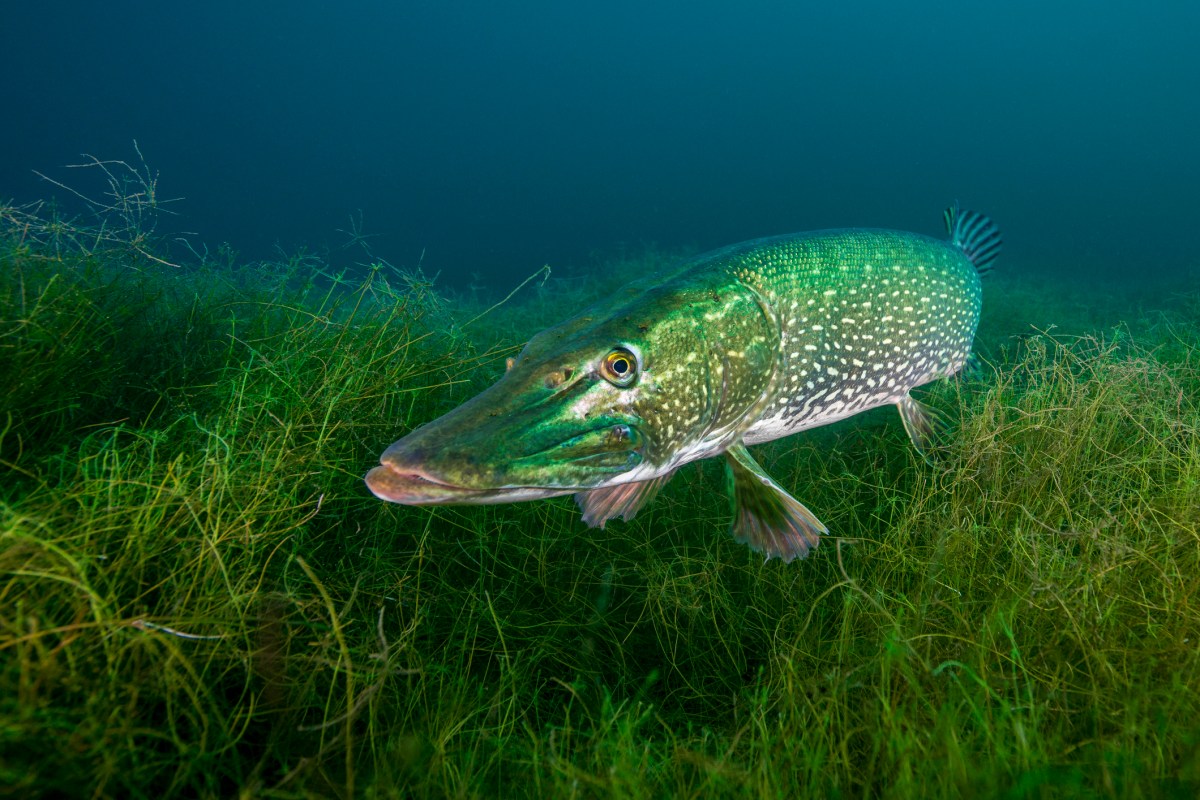
I don’t know how much time I spent pumping, but suddenly the big fish was on the surface 20 yards off our stern. I watched him wallow out there, a great log-like shape of yellow and black and white.
“Look at him, Bill,” I said excitedly. “He might make twenty pounds.”
Minutes later the pike was just under the surface, circling close to the boat. Then I noticed something that sent my hopes crashing. The entire plug was on the outside of the pike’s mouth—he couldn’t be hooked too solidly. Instinctively, I let up on the rod pressure. The fish reacted like an exploding bomb. In a snake-like rush he tail-walked through sun-sparkling spray and then zipped for the depths.
Ultimate Pike Catch & Cook With the Griz
I let him go, then carefully worked him back to the surface. Now he was lying motionless except for slowly fanning fins, and I could see every inch of him in the clear water. His eyes seemed to glare at me with hate, and I noticed that a single point of the forward treble hook was embedded in the corner of his mouth.
Bill had no idea of the proper way to handle a net, so I chose my words carefully. “Get the hoop just under the surface, and keep it near the boat,” I told him. “I’ll work the fish in close, then you scoop him up tail-first. Don’t take him head-on, or you’ll snag the hooks in the net. Ready? Here he comes!”
Bill made only one mistake—he heaved too soon. The big pike skidded out of the net and dived again. I worked him back to boatside, and Bill tried a second time. He meshed the whole fish, but he was holding the net handle at the butt end and couldn’t lift the thrashing critter out of the water.
“The rim,” I yelled. “Grab the rim!”
We both got our hands on the rim of the net, lifted, and dropped the squirming mass into the boat.
“We really got him!” Bill said, unbelieving.
There was no need to remove the plug from the pike’s jaws; it had ripped free sometime during the netting process. I was sure I’d caught a 20-pounder, but the scale’s needle stopped at an even 18 pounds.
I discovered my hot-weather pike-fishing system five years ago, and I’ve been cleaning up on northerns ever since. The technique developed as a by-product of my scientific research on bass fishing. In 1959 I was working on my master’s degree in fisheries and wildlife at Michigan State University. My thesis was titled “The Taking of Bass by Hook and Line,” and it involved a three-year study. During that time, I caught and classified more than 1,500 bass. I wrote two stories on the subject, and both were published by Outdoor Life (see “Why Bass Strike,” March 1962; and “Things That Catch Bass,” April 1962).
Once the research bug infects you, you never quit trying to learn something new. I’ve learned a lot more about bass fishing since the early 60’s, and I catch about 1,000 a year now. Practically all of those fish are released, but I tag a lot of them and keep detailed records on every fish I catch.
One of the reasons I catch so many fish is that I’ve got the time to go after them. I’m 32 and single, and I teach fish-and-wildlife biology in the Niles Community High School. I’m also outdoor editor for the Niles Daily Star. I can fish every day after school, and all summer long.
Back in 1962 I decided to make a study of bass movements during various seasons. I began trolling all depths, from surface to bottom, during every month in which Michigan bass fishing was legal. Our bass season normally opens in late May or early June. During June I caught most of my bass—and many small pike—in depths from the shallows down to eight feet. As the weather warmed I began catching more and more bass in water eight to 15 feet deep. I also hooked quite a few pike in the same areas.
Since my basic research motive was determining movement patterns of fish, I frequently trolled as deep as 35 feet. In early spring I caught very few fish of any type in 20- to 35-foot depths. But as the heat of summer developed, I began to notice a new pattern. I started catching some bass in all depths, but my pike catches were becoming concentrated. During July I caught very few pike in waters shallower than eight feet. And the eight-to-15-foot depths that showed good pike action in June now produced only an occasional small fish. But in the 20-to-35-foot depths, I caught far more pike than bass, and the northerns averaged much larger than those I’d caught at any other time of year.
I get a bigger kick from a 10-pounder than from a three-pounder. The only big fish in my area are pike, so the object of my research suddenly switched from catching lots of fish to catching big fish.
I landed my first really big pike four years ago while fishing near Dowagiac, Michigan. It was a boiling summer day when I left home, but a strong wind helped to temper the heat. I was driving down a dusty road when I heard a car horn honking behind me. I stopped, and Jerry Lundy pulled up.
“If you’re going fishing,” he said, “how about taking me along?”
Jerry was then one year out of high school. He’d been a student in some of my classes and had often gone fishing with me.
I get great satisfaction out of teaching boys to fish. I’ll drop anything I’m doing if I can talk a boy or two into going fishing. When those kids fight their first good fish, their faces really light up. Usually, they’re hooked, too.
Anyway, Jerry didn’t have any tackle in his car, so we had a problem. I’d planned on spin-fishing for bass with artificial nightcrawlers, and I hadn’t brought along any other bass lures. By luck, I had a casting rod in the car and a few boxes of deep-running plugs in my glove compartment.
“You can’t work artificial crawlers with a casting rod,” I told Jerry, “so I guess we better go trolling for pike. Magician Lake is the closest pike lake. It’ll be rough out there, but let’s try it.”
Magician Lake has a couple of islands, and we motored my cartop boat to the lee side of the closest one. We hadn’t been trolling five minutes when something almost yanked the rod from my hands. I reared back, and the battle was on.
Read Next: The Best Pike Lures
That pike and I went at it for 15 minutes. By the time I worked him close to the boat, we’d drifted far out into rough water. My wrists were almost numb when I saw enough of the pike to realize that he was the largest I’d ever hooked. Big pike have spade-like snouts, and when that massive head suddenly rolled above the whitecaps, all I could do was gulp.
We were downwind of the fish, and we were drifting so fast that I had difficulty working him within reach of the net. Jerry made a couple of unsuccessful swipes, and I guess we should have lost the pike. But it was exhausted and couldn’t do much more than roll over. I finally handed the rod to Jerry, grabbed the net, and heaved the 15-pounder aboard.
Then I looked at the plug. The front treble hook was embedded in the pike’s jaws but was no longer attached to the body of the plug. The tin lip on the front of the lure was crumpled. Two of the points on the rear treble hook were jabbed deeply into the flesh on the outside of the pike’s mouth.
To understand why my system works, you have to understand what happens to most Northern lakes during various seasons of the year. When the ice breaks up in spring, the water in a lake begins what is commonly called a turnover. The key point here is that water is heaviest, or at its maximum density, at 39.2°. Both colder and warmer waters are lighter. In winter the heaviest, or warmest, water is on the bottom of a lake. Water above this layer is progressively colder the closer it is to the surface.
When the ice goes, the surface waters are warmed by sunshine. This makes them heavier, and they begin to sink, replacing the colder (and lighter) waters below. This displacement process, speeded by wind and wave action, continues until all the water in the lake is at maximum density (39.2°). At this point, all the waters in the lake have literally turned over.
Mainly for this reason, spring fishing is good in the shallows. The warmest water, the oxygen, and the baitfish are there. As summer approaches, the surface waters get warmer than 39.2°. Now these waters are lighter than the colder depths, so they remain on the surface. The turnover is now complete. A reverse process takes place in the fall.
Since pike prefer relatively cold water, they move out of the shallows during the heat of summer. I’d been well aware of this fact for years, so I was not surprised when I began catching pike in the depths during my 1962 research trolling. As for big pike, I think that they favor deeper water during all seasons of the year—for no other reason than that big fish apparently like big water.
There are a couple of biological facts that should be mentioned. Many fishermen think that pike, because they shed their teeth then, don’t feed in summer. This is myth, and fisheries biologists know that pike do feed during the hot months just as other fish do. Biologists also know that pike move food through their digestive tracts very rapidly. Northerns have a fast growth rate, and it takes a lot of food to keep them going.
Most fishermen fail to find pike in summer because they fish the wrong depths. I found out in a hurry that you can fish too deep, as well as too shallow. In most lakes oxygen content diminishes rapidly at depths below 35 feet. Without sufficient oxygen, no fish can survive. As a general rule you won’t find pike below 30 feet. And I discovered during my trolling experiments that in summer there are almost no pike in waters shallower than 15 feet.
Now I had the fish almost pinpointed. Most hot-weather pike are in water 20 to 30 feet deep. The only problem was that when I trolled these depths I found either feast or famine. In some places I caught pike almost one after another; in other likely spots I couldn’t get a strike. There had to be an answer, and I finally discovered it.
From my notes I found that I caught most of my pike immediately off sharp drop-offs. Proper depths over a gradually sloping bottom didn’t produce nearly so many hits as did the same depths near a steep underwater bank.
Pike, unlike walleyes, prefer to stay above the bottom of a lake. They are cruising fish, with a highly developed predator instinct. At a sharp drop-off a big pike finds the ideal water temperatures of the depths and yet he is close to the shallows that support the prey fish he feeds on.
Knowledge of the bottom contours of your lake is all-important. I wouldn’t think of fishing an unfamiliar lake unless I had a bottom-contour map or an electronic depth finder. With either aid I can find water deeper than 15 feet and I can find steep underwater banks. By pinpointing these areas, I pinpoint home base for practically all of the summer pike in the lake.
Trolling is the best bet for summer pike because these fish like a fast-moving lure. And plugs will outfish live bait. Another advantage of trolling is that your lure is working new water continuously. The faster you troll, the more water you cover.
My first choice of plug color is red and white. My next two preferences are solid green and solid yellow. Plug size isn’t important. The critical factor is getting your lure down to the proper depth.
I’ve found that a lure running 15 to 20 feet under the surface produces the most hits. I have a system for determining how deep a given plug will run at various trolling speeds. I let out 40 to 50 yards of eight-pound-test monofilament and then troll from the depths toward the shallows. When my plug hits bottom I back up to that spot and measure the water depth. I vary my trolling speed till I get my plug hitting bottom in the effective depth zone of 15 to 20 feet. Then I’m ready to start fishing.
I’ve found that the average deep-running bass-size plug is in the proper depth when I run my six-h.p. motor at one-third to one-half speed.
I’m not about to claim that pike are schooling fish. And yet I take about 500 pike every summer, and I know that they prefer certain spots. I don’t know why one drop-off area is better than another, but I do know that certain small areas consistently produce year after year. I’ve also discovered that for some reason the choppy side of a lake produces more strikes than the calm side.
My records show that pike are liable to begin a feeding spree anytime during the day. And I’ve concluded that once summer fish begin feeding, they go wild for three to four weeks. This pattern holds true for all of the pike lakes in my area. If the fishing is hot on one lake, it will be hot on all neighboring lakes.
As a general rule in the area I fish, pike action peaks at the height of the summer tourist business. In other words, the hotter the weather, the better the fishing. This is fine with me because I love the sun and I love to swim. I often take a break in my trolling and dive overboard for a refreshing swim.
The ideal tackle for this summer fishing is a heavy-duty casting rig loaded with 100 yards of 15-pound-test monofilament. I use lighter tackle because I want all the excitement I can get from big fish. I’ve had many lunkers tear loose from my plugs, but only one fish has broken my eight-pound-test line. That was some years ago, and in those days I always shut off my motor when I got a strike.
It was a windy day when I hooked that monster, and he blitzed upwind. As soon as I stopped the motor I began drifting rapidly away from the fish. Anyway, I never got back one turn of line. I tightened my drag as much as I dared, but that fish never shifted out of high gear. The whole show was over in less than 30 seconds. My 100 yards of line zoomed from the reel and … snap!
Since that day I’ve never killed my motor when I’ve hooked a fish. If my line goes out too rapidly I shift into forward and take off after the fish. I’ve motored my boat a good many miles while chasing big pike.
Regardless of your choice of rod and line, you should always use a wire leader at least 12 inches long. A sturdy long-handled net is also a must. So are long-handled pliers, needed to remove hooks from a pike’s needle-toothed jaws. I unhook pike with a hemostat, a self-locking pliers-type instrument used by doctors.
The amazing thing about summer pike fishing is that you don’t have to be an expert fisherman to get expert results. All you really have to do is get your plug to the right depth in the right kind of water and then hang onto your rod.
I’ve converted many would-be fishermen to avid fans during a single fishing trip. Glenn Squires comes to my mind as a top example. Glenn is a 48-year-old Cassopolis, Michigan, attorney whose summer home is on the shores of Diamond Lake. Glenn wasn’t much of a fisherman, mainly because he assumed that southern-Michigan lakes were fished out. A mutual friend of ours had asked me to take Glenn fishing, which I did. We fished Diamond Lake and had a good day. Glenn caught some nice pike and was impressed with the action.
A few days later Glenn phoned me. “The darnedest thing happened,” he said with more than a trace of excitement. “I bought a couple of those deep-running plugs, and my wife Joan and I went out on the lake in our pontoon boat. We started trolling in the same place you and I fished.
Read Next:
“Right off the bat Joan hooked a monster. She finally got the fish up to the boat, and that pike looked a yard long. Then everything went to pot ’cause we didn’t have a net. Joan’s line snagged around the motor, the pike made a lunge, the line snapped, and we watched that fish swim away with the plug in his mouth.”
“Well, heck,” he groaned. “We were just fooling around. I never thought we’d go out and hook a big pike that easily.”
“How come you didn’t buy a net?” I asked.
Glenn has since bought a landing net, and he is now one of my most frequent fishing companions. That’s what can happen when you tangle with summer pike.
This article was originally published in the June 1968 issue of Outdoor Life.
Read the full article here
