



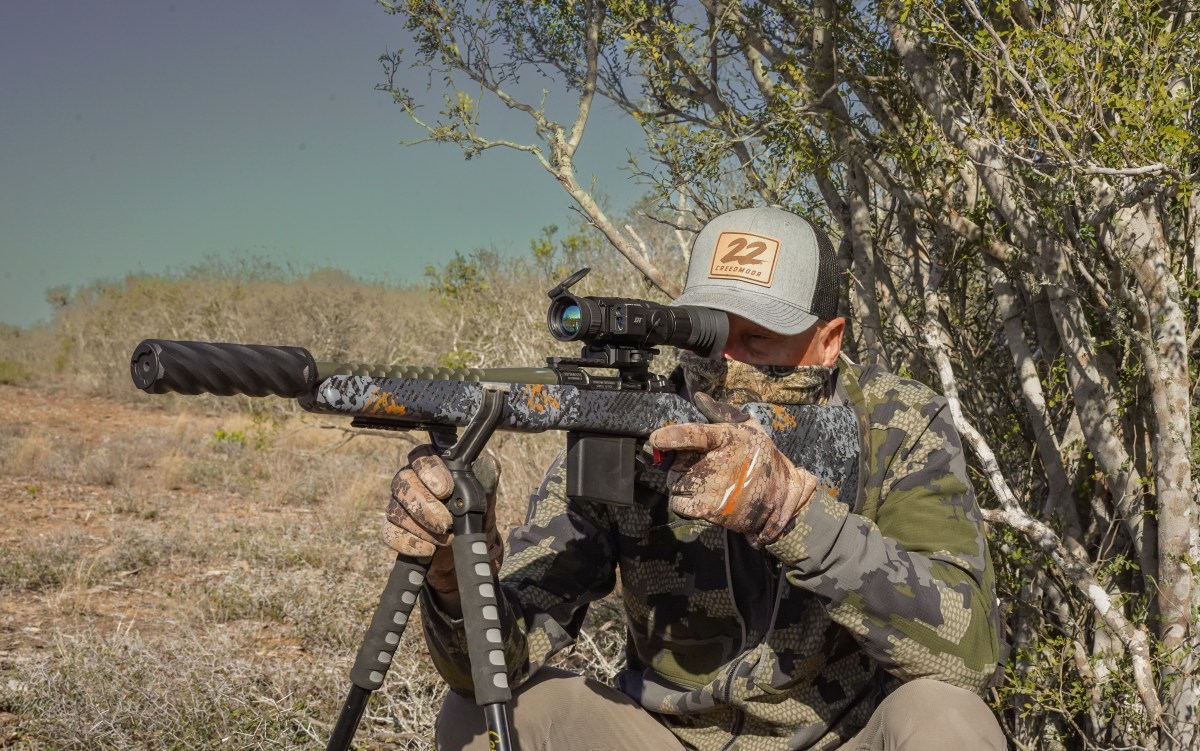

This has been an interesting year in the thermal industry, with the uncertainty of import tariffs slowing the introduction of new models and brands discounting their existing product lines to make room for introductions later this year or in early 2027.
That said, there is some real innovation in the category, with new high-end thermal scopes from RIX, Nocpix, and Pulsar, exciting entries in the mid-price range, and some very good value in do-everything thermal devices from DNT, RIX, and AGM. We’re impressed with Sig Sauer’s introduction of a stupid-simple thermal scope that pairs nicely with an equally utilitarian rangefinding monocular.
As we’ve discovered in this, the third year of our dedicated thermal testing, it’s impossible to evaluate every new product on the market. Many brands offer several versions of the same product, differing only in the resolution of the thermal sensor and the size of the objective lens, and it was a struggle to pick just one or two from the same-seeming collection. However, we pulled together some of the most popular brands and scopes across a range of price points.
Here are the best and most exciting thermal weapon sights of the year.
- Editor’s Choice: Pulsar Thermion 2 LRF XL60 – $7,199
- Great Buy: DNT Hydra – $2,443
- RIX LEAP L12R – $7,099
- NOCPIX RICO 2 S75R – $8,800
- RIX Storm S6R – $3,199
- Guide TU650 LRF PRO 3.0 – $4,599
- Sig Sauer ECHO RV50-LRF – $3,999
- AGM Rattler V3 LRF 35-384 – $2,795
- Pulsar Trail 3 LRF XR50 – $4,499
- Athlon Cronus ATS PRO 50L-640 – $5,624
- AGM Adder V2-60
- Nocpix ACE S60R
- Nocpix SLIM
Jump to How We Tested Thermal Scopes
Get It From Amazon
Get It From Midway USA
Get It From EuroOptic
Pulsar’s Thermion scope has been on the leading edge of thermal tech and performance since it introduced the XG50 in 2020. The platform has scaled up with each new iteration, and this year’s rangefinding XL60 hits new highs in sensitivity, run time, durability, and ease of operation.
The fact that a 1024-pixel thermal led a fairly small but impressive field of 1280-pixel scopes says a lot about the Pulsar’s ability to enhance image quality with a best-in-class display and processing that boosts contrast of its relatively underpowered sensor.
The Thermion2’s most noticeable upgrade is its big 60mm objective lens, but its 10-hour run time is impressive, and its 2,800-yard detection range is among the best in our test. As close readers of our test know, we quibble with the published detection ranges of thermals; we think “recognition range” is a much more useful metric. In the case of the Pulsar, we put the recognition range at about 550 yards, plenty for nearly any hunting situation we’d expect to encounter at night and among the best in our field.
The Thermion2 is built on a 30mm tube, and standard medium-height rings make mounting a cinch. Also easy: the scope’s intuitive 3-button navigation. One button zooms the image, another records or stops recording content, and the third navigates the menu, which is accessed via a rubberized button on the scope’s left turret. Zeroing is a cinch and field deployment is among the fastest and least confounding in the field.
“This scope fired up fast and was quick to deploy on the tripod,” notes tester Derrick Ratliff, who also praised the spring-activated lens cap that eagerly swings out of the way. The ambidextrous focus control, two finger-grabbing dials on either side of the rangefinder tower, is easy to operate, even with gloved fingers.
The round display is especially easy on the eyes, resembling the dimensions of a daylight scope, and the high-resolution display supports the sharpest picture-in-picture we’ve ever tested. Other plusses: the 10-hour run time and easy interchange with Pulsar’s excellent StreamVision2 mobile app. The rangefinder is fast and precise.
We handed down some demerits, as well. The frequent refresh is so abrupt and jarring that it interferes with operation. “I’m surprised the refresh is as harsh as it is given the price,” notes Ratliff. And we wish Pulsar would abandon its proprietary rechargeable batteries and join the industry movement toward interchangeable 18650 cells. The Pulsar cells are powerful, but if you lose one you’re on the hook for a pricey replacement.
But overall, the Thermion2 LRF XL60 is a first-order thermal scope. It’s fast, clear, easy to use, and was the consensus choice for the best weapon sight of this year’s thermal test.
Great Buy: DNT Hydra – $2,443
Get It From Amazon
Get It From Midway USA

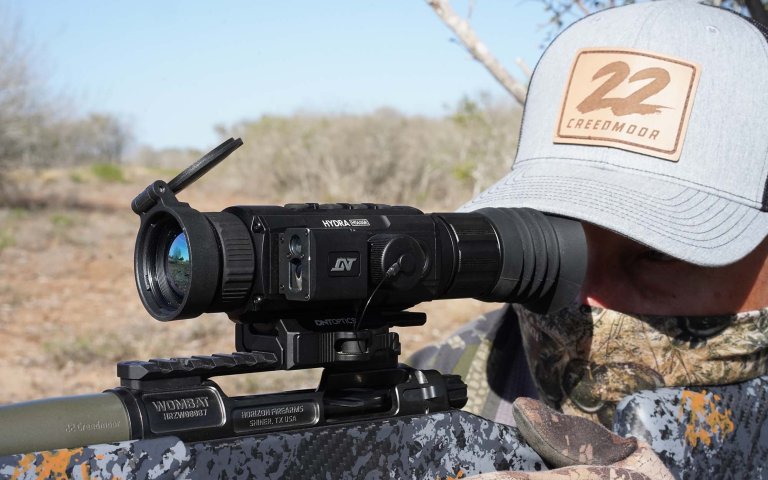
If you’re looking for a do-it-all thermal, it’s hard to beat this versatile workhorse from DNT. The Hydra is probably at its best as a weapon-mounted scope, a role that is enhanced with its decent laser rangefinder and basic but capable ballistic calculator. But snap the DNT off its quick-detach rail mount, and the unit becomes a nimble thermal monocular.
We tested this capability, zeroing the Hydra to our 22 Creedmoor, but then liberating it from the gun to scan the Texas brush country for pigs and coyotes. Once we had acquired a target, we clipped the device back on the rifle and made the kill. In the daylight, we measured this talent, timing the span between scan-and-fire and then assessing its ability to hold its zero. We could make the transition in under 10 seconds, with no appreciable stray in its aiming point.
DNT claims the Hydra can also function as a clip-on thermal. We didn’t test this capability, but given its eye-filling display, low mounting profile that would easily mate with a low-power variable daylight scope, and generally responsive controls, we can’t quibble with that additional functionality.
We liked the double-tough metallic housing and oversized eyepiece of the Hydra, and had no trouble zeroing or running the unit in the field. Its 1.5x base magnification is a little low, but it provides a satisfyingly wide field of view as both a monocular and a scope.

DNT Hydra
The 4-hour run time was a little disappointing. We had to make sure to have charged 18650 cells ready to drop into the Hydra in the course of a long sit. And its display, optimized for pulling double duty as a viewer and a scope, appears to be far away down a long tube. The display has two features that are more distraction than aiming aids: a cant indicator that shows when the scope is off its vertical axis, and an angle measure that shows positive and negative incline. The image would be cleaner without those two adornments that don’t add much to its performance.
But overall, testers considered the image to be crisper than its specs indicated, and the tactile LRF button is easy to find and operate in any of the Hydra’s three modes.
“It’s a good option for a first thermal purchase,” notes tester Scott Einsmann. “It’s all you need for 100 yards and in. The mount needs work, though. It’s not particularly well thought-out.”
Note that DNT makes 10 versions of the Hydra, four with laser rangefinders and six without, so be prepared to wade through a lot of options in the product line. But the HS635R is one of the rare bargains in the thermal category. For about $2,500 you get a serviceable viewer and a very good weapon-mounted scope with a solid build, an honest warranty, and plenty of performance. For all those reasons, the DNT Hydra HS635R is our Great Buy for this year’s Outdoor Life thermal test.
DNT Hydra HS635R Specs: Sensor Resolution 640×512
- Display Resolution 1024×768 Micro-OLED
- Pixel Pitch 12um
- NETD <18mK
- Objective Lens 35mm
- Magnification 1.5x base, 6x digital
- Detection Range 1,200 yards
- Rangefinder Range 1,300 yards
- Battery Type 18650
- Warranty Repair or replace for undetermined length of time
- Features 3-in-1 features: weapon-mounted scope, clip-on, and monocular, laser rangefinder, ballistic calculator, picture-in-picture, wireless connectivity to mobile app, ships with rail mount, rugged metallic housing
Get It From Amazon
Get It From Scheels
Get It From Midway USA
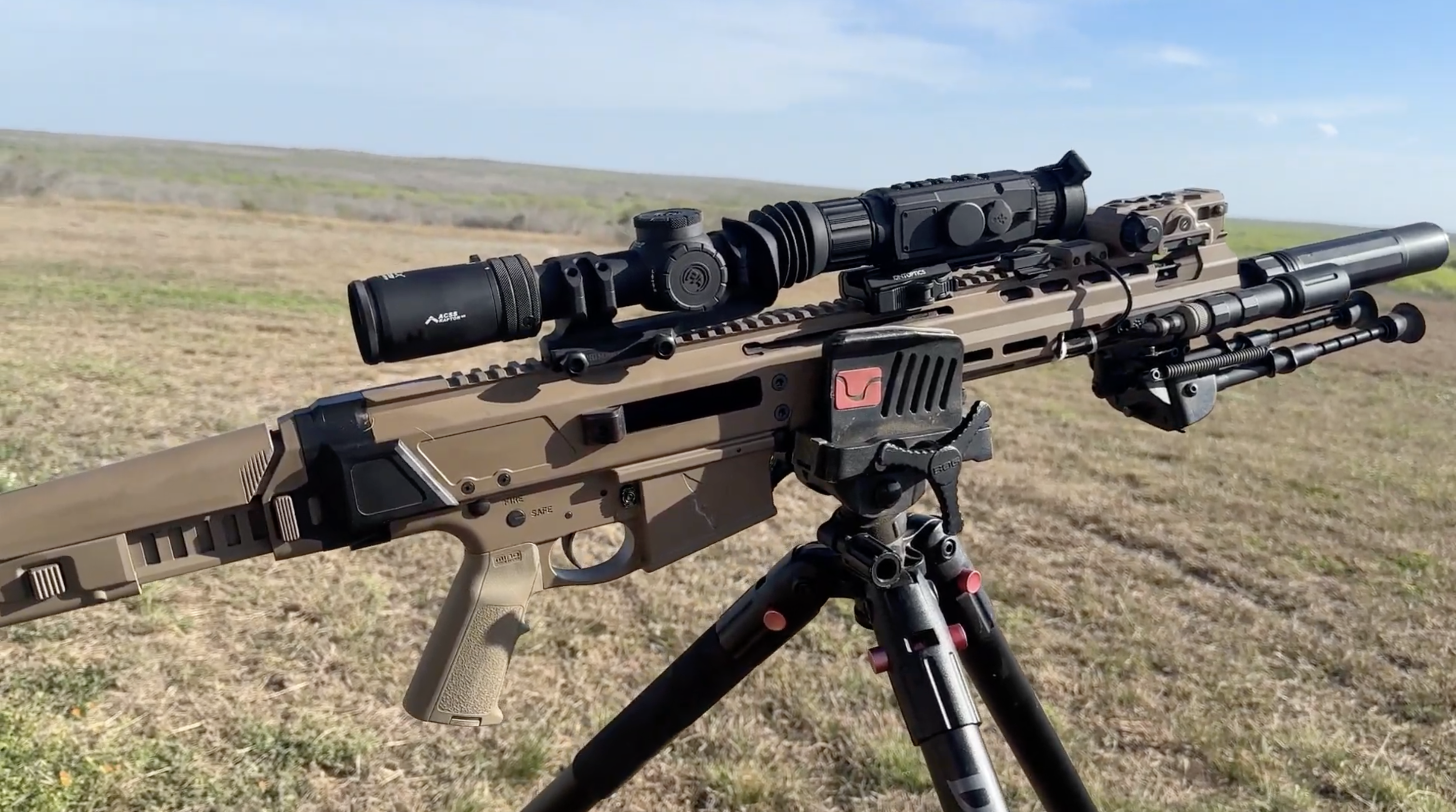
This seriously capable thermal scope was in a horse race with Pulsar’s Thermion2 for the top weapon sight of our test. It produced the best image of any device in the test, and the easy three-knob/2-button operation is fast and intuitive. We liked the buttons’ positivity, and the optical zoom lets users make fine adjustments to the image without blowing out the resolution as magnification increases.
Other remarkable features: the round high-definition display that looks like that of a traditional daylight scope, the handy tuck-away throw levers on the focus and zoom controls, and the built-in laser rangefinder that is tied to a fast and useful ballistic calculator. Not only did the LEAP detect animals at 1,000 yards, identify them at 500 yards, but it gave us a range-adjusted hold based on the specific caliber and flight characteristics of our 22 Creedmoor bullet (Hornady’s 80-grain ELD-X).
The LEAP L12R’s 2x base magnification is an interesting choice, one we applaud. It’s pretty low considering the long operating range of this thermal, but at base mag, its wide field of view makes this a great scanning scope. Once you detect a target, the optical zoom lets you select the magnification you prefer. That’s a big deal, considering that the zoom progression of most thermals is in multiples. The RIX, with its selectable zoom control, allows users to infinitely adjust the magnification. The 1280-class sensor is robust enough to keep 400-yard images resolved through about 6x.
“This is a very easy thermal to zero,” notes OL gear editor and thermal tester Scott Einsmann. “Intuitive controls. Very easy-to-read-display. Its best attributes are its form factor, ease of use, and fast rangefinder.”
So, why didn’t the LEAP L12R win the top thermal award?
Some testers thought the 15-inch-long, 3-pound thermal is just too large for most walk-about hunting scenarios. Others thought the Pulsar’s 1024-pixel sensor was just as sharp as the RIX 1280-pixel engine, and still others felt the RIX’s build was more plasticky and therefore less durable.
The scoring came down to just one or two points, which should encourage would-be buyers that the LEAP L12R is one of the top thermal scopes of the year, and is worth the stiff $7,100 price tag. The 5-year warranty from RIX is a comforting protection for such a significant investment in a high-performing thermal.
RIX LEAP L12R Specs
- Sensor Resolution 1280×1024
- Display Resolution 2560×2560 AMOLED
- Pixel Pitch 12um
- NETD <15mK
- Objective Lens 60mm
- Magnification 2x base, 6x digital
- Detection Range 3,390 yards
- Rangefinder Range 1,312 yards
- Battery Type 18650 rechargeable cell
- Warranty 5 years, with 5-day repair
- Features Classic round display, 6.5-hour run time with swappable batteries, metal lens cover, flip-out levers on focus and zoom controls, easy 3-knob/2-button operation, built-in laser rangefinder, ballistic calculator, 5-year warranty
Get It From EuroOptic
Get It From Midway USA
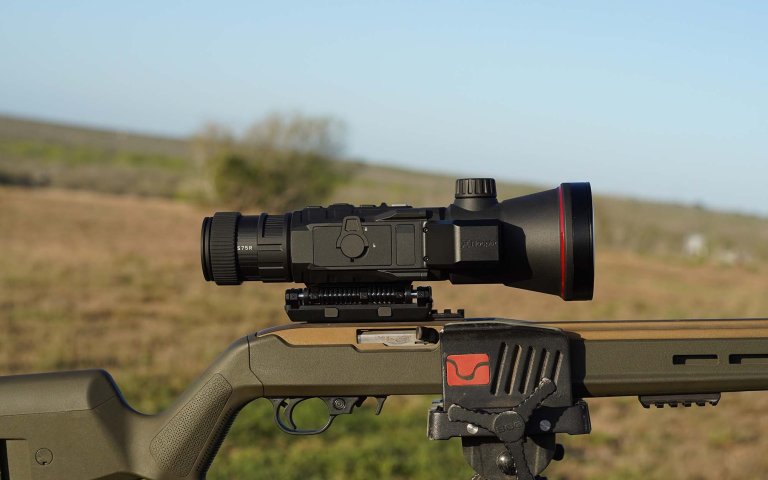
Nocpix must have a source for germanium that other brands don’t. That’s one explanation for the RICO 2’s crazy-big 75mm germanium objective lens, which is so large that users may have to employ mounting hacks to fit some rifles. Because germanium, along with the sensor that converts temperature differentials into visible pixels, is the most expensive component of a thermal, the RICO’s oversized lens contributes to its high price, along with its high performance.
“It delivers a stunning image,” said one tester. “It’s smooth, clear, and contrasty, and the rounded display looks and feels like you’re looking through a traditional scope.”
What sets this scope apart is its large, wide, and extremely generous eyebox. Many thermals have what I’d call a stingy eyebox, requiring users to crowd the eyepiece and use black bellows to block stray light. The frequent result is night-blindness. But the RICO 2’s eyebox is so shallow and wide that we had to mount the scope pretty far back on our rifle’s receiver. The result is the most immersive viewing experience I’ve had with a thermal, and the relative lack of night-blindness is a testament to the high-resolution sensor and high-definition display.
The laser rangefinder is fast, the refresh rate is virtually unnoticeable, and the stepless zoom fast and precise. The twist-to-focus knob behind the objective lens is fast and precise, if it’s not particularly handy for left-handed shooters. And we reckoned that the RICO 2’s recognition range, out to about 700 yards, is the best in this year’s test.
But we also had to reckon with the $8,800 price tag. That’s simply too much for many weekend thermal hunters to pay. If you’re a professional night hunter or have so much disposable income that you can drop a month’s wages on a sight, then this high-performing thermal may be for you. For the rest of us, it’s just a little too much scope for the money.
Nocpix RICO 2 S75R Specs
- Sensor Resolution 1280×1024
- Display Resolution 2560×2560 AMOLED
- Pixel Pitch 12um
- NETD <15mK
- Objective Lens 75mm
- Magnification 3x base, 10x digital
- Detection Range 4,250 yards
- Rangefinder Range 1,200 yards
- Battery Type 18650 rechargeable cell
- Warranty 5 years, with 5-day repair
- Features Field and forest modes, 70mm eye relief, 23mm exit pupil and distortion-free eyepiece, stepless zoom lever, ballistic calculator
Get It From Amazon
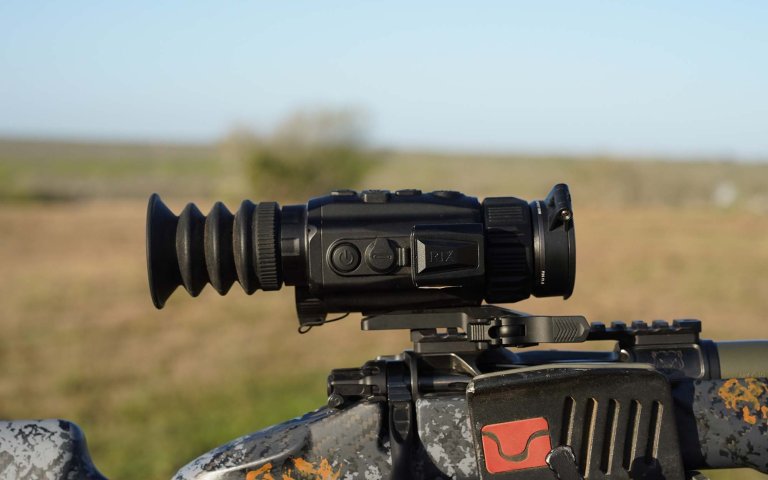
Like the AGM Rattler and the Athlon Cronos ATS scopes, RIX has a number of variations on the Storm line of carbine-optimized sights. There’s a 256-pixel model and a 640-pixel model, and the Storm S3 line has versions with and without laser rangefinding.
We tested the 640-class LRF model that offers a ton of performance for just over $3,000, the sweet spot for serious thermal hunters. I’d say this model is optimized for hog hunting in a field or mid-range predator hunting, where you don’t always know the distance or situations you’ll face. With a 2x base mag and a 1,300-yard laser rangefinder, you have the tools to reach out to 400 yards or so, though the unit is at its best inside 200 yards.
Like the DNT Hydra, the RIX Storm S6R can be detached from the rifle and used as a hand-held monocular, then snapped back onto the rail and used as a weapon sight. Of those dual uses, I’d say it’s optimized as a sight, where the optical zoom keeps images from degrading, the responsive LRF can be deployed, and where the return-to-center reticle and adjustable picture-in-picture feature make it a sweet-shooting unit.
Tester John Barth was especially pleased with the performance of the RIX.
“If I was to pick one scope with an LRF feature for all my clients to use, it would be this one,” he noted. “It’s a great all-around scope. The LRF works great, the humidity setting clears the hazy image, and the compact and durable build is an improvement over previous Storm models.”
I found it was quick to deploy, light to carry, and unfussy in its operation, thanks to its four-button navigation. RIX employs an in-screen map of its function buttons that advises users of the button they pushed and the function it’s about to activate. For late-onset thermal converts, it’s a really useful tool to avoid getting lost in the menu.
In all, the Storm S6R is a solid investment in a do-everything thermal that is priced right for its attributes.
RIX Storm S6R Specs
- Sensor Resolution 640×512
- Display Resolution 1024×768 AMOLED
- Pixel Pitch 12um
- NETD <20mK
- Objective Lens 35mm
- Magnification 2x base, 8x optical
- Detection Range 1,969 yards
- Rangefinder Range 1,312 yards
- Battery Type 18650 rechargeable cell
- Warranty 5 years, with 5-day repair
- Features Sun and rain modes, 32 reticle combinations, ballistic calculator, independent picture-in-picture magnification, return-to-center reticle function, functions as hand-held monocular or weapon sight, ships with quick-detach rail mount
Get It From Amazon
Get It From Guide
This is a sophisticated thermal scope that is being held back a bit by its 640-class sensor. If it had the same high-resolution sensor of the Pulsar Thermion2 or the RIX Leap 12, it would be every bit their peer.
As it is, it’s a very good scope, and the price, $2,000 to $3,000 less than those flagship models, makes it a good buy for hunters looking for performance in the underpopulated strata of thermals between the entry-level and the holy-crap.
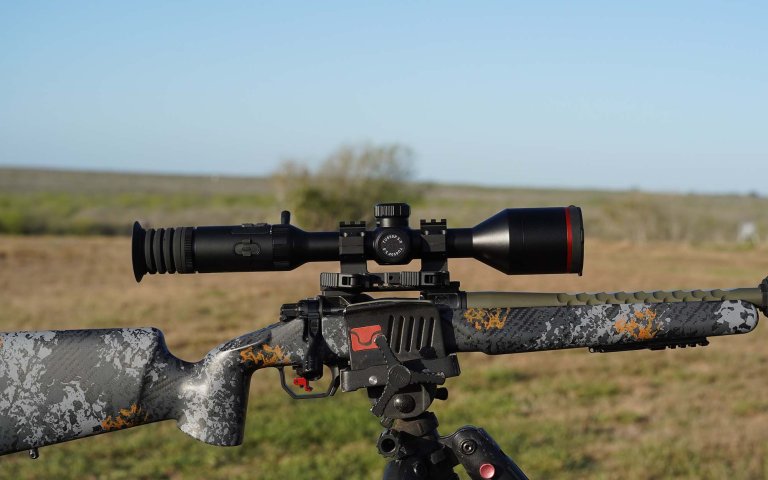
In its form factor, operation, and even display, the Guide TU650 LRF PRO 3.0 (that’s a mouthful) looks and functions like a traditional daylight scope. The power-changing dial ahead of the eyepiece ramps up and down the magnification, just like a normal scope, and the rounded 1-inch display mimics that of a traditional optic. The external lines, with a 30mm tube, “turrets,” and a big objective bell are familiar.
Additionally, the Guide has some really useful operational assets. Below the power button, located where you’d expect the elevation turret of a traditional scope, is the image focus knob. To the left, where you’d expect the parallax control on a daylight scope, is the menu selector. Access the Guide’s substantial features by pushing the button and turning the knob.
Further simplifying operations, the eyepiece has two buttons. The forward button captures photos and video, the rear button activates the through-the-lens laser rangefinder.
For all those smart features, the Guide gave us some fits as we zeroed it, largely because its reticle increments didn’t correspond to familiar subtensions.
“Even with some head-scratching at the zero bench, I was able to shoot it out to 500 yards,” notes tester Derrick Ratliff, who praised the Guide’s controls and “normal scope” image and operation.
The TU650 has a very good rangefinder and corresponding ballistic calculator, and other features such as a ranging tool and height measurement tool that help with target detection. The Guide also has what it calls its “Hyper-Light Algorithm,” an AI-assisted image processor that sharpens the edges of objects and helps extend detection distance.
Maybe because the rest of the scope was so good, we wanted it to deliver a better image. From its base magnification of 3.7 and right up to about 12x, the image was sharp and fairly crisp. Above that, and the image became foggy and indistinct, which cut down its utility to about 400 yards. That’s a shame because the fast and accurate rangefinder was able to range objects out to 1,500 yards; it was just impossible to tell if they were cows or varmints.
But the impressive 14-hour run time on two rechargeable 18650 cells and internal battery, the shutterless refresh, and Guide’s 10-year warranty justify our assessment that the TU650 LRF Pro 3.0 is one of the best mid-priced thermals on the market.
Guide TU650 LRF PRO 3.0 Specs
- Sensor Resolution 640×512
- Display Resolution 2560×2560 AMOLED
- Pixel Pitch 12um
- NETD <18mK
- Objective Lens 50mm
- Magnification 3.7x base, 30x digital
- Detection Range 2,800 yards
- Rangefinder Range 1,630 yards
- Battery Type 2 18650 rechargeable cells plus rechargeable internal
- Warranty 10 years
- Features Ultra-wide display, in-lens laser rangefinder, 14-hour run time, ships with rail mount, shutterless NUC, 10-year warranty
Get It From EuroOptic
Sig Sauer entered the thermal market with its excellent ECHO CV25 clip-on that mates seamlessly with the company’s TANGO-MSR, turning that 1-10x26mm LPVO into a night operator. That was followed with last year’s rail-mounted ECHO SV35 and SV50 models, which are optimized for carbines.
This year, Sig has extended its reach with three full-size thermal rifle scopes at different resolutions and price points. We tested the ECHO RV35 and the ECHO RV50-LRF (the third scope is the 384-pixel RQ35 that costs $2,099). Operationally, the 35mm and 50mm models are nearly identical, with the $2,999 RV35 powered by a 640×512 thermal core and no laser rangefinder. The RV50-LRF has the same sensor but an added laser rangefinder and costs $3,999.
To further confuse things, Sig sent us two thermal viewers to pair with the scopes. The ECHO MV50-LRF monocular is the most useful of the two and allows a shooter’s partner to scan the landscape and range a target. That range can then be communicated to the shooter’s ECHO scope via Sig’s BDX wireless data exchange. We’ll have a more granular review of the two monoculars (the other is the MV50-DV Dual View that doesn’t have a rangefinder) in our viewer test.
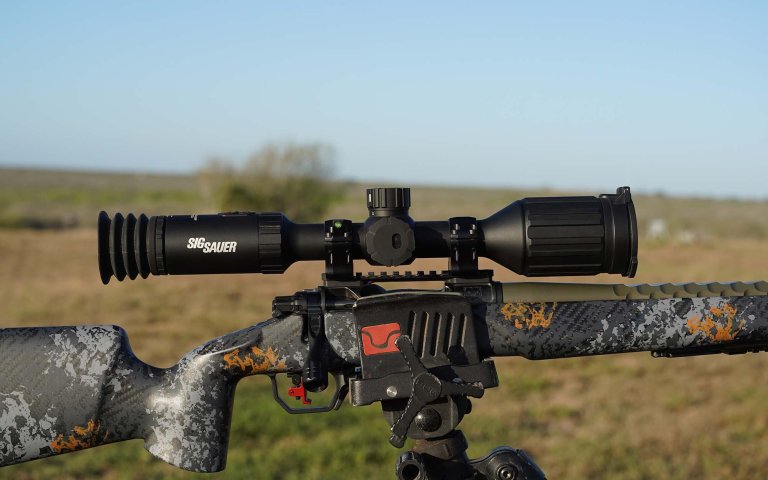
Sig has put a lot of work into both the form factor of the scopes and their simple operation. The most obvious feature is the power control, located on the top “turret” that’s analogous with the elevation turret on a daylight scope. A smart twist turns it on, rotate it further to standby mode, or turn it back to off. The simplicity extends to the two-button navigation on the eyepiece. One button activates the fast and precise through-lens laser rangefinder, the other captures photos or videos. Short and long pushes on the buttons activate different functions.
Those same buttons pull up the menu, which is navigated with twists of what on a daylight scope would be the power-changing wheel. That’s it. Two buttons and a dial. The only other control is the big, grippy focus wheel on the objective bell that tacks up images.
If the operation is pleasingly simple, the combination of short and long presses and menu scrolling perplexed some testers.
“The controls are not intuitive and are hard to use, especially in the heat of the moment,” when you can’t afford to be trapped in a menu screen. The image generated by the ECHO RV-50 LRF is similarly disappointing. It’s curiously washed out in each of the unit’s eight color palettes. Tester Scott Einsmann noted that the Sig is stunning inside 100 yards, but degrades with both magnification and distance.
“It can detect past 1,000 yards but images start losing significant detail at 300 yards,” he notes, adding that the Sig’s laser rangefinder is among the best in the test, whether in single-target or scan modes, and greatly exceeds the unit’s recognition distance.
Other testers had a hard time connecting both thermal scopes — the RV50 and the RV35 — to either the companion Sig monocular or to the BDX 2.0 app. That’s too bad, because one of the main value propositions of these devices is their connectivity, their ability to share aiming points and ballistic data.
That said, of all the thermal scopes in this year’s test, most of which I evaluated for several months of our long Montana winter, the Sig Sauer ECHO RV50-LRF was the one I kept on my coyote gun. The reason: it’s an honest, simple, and durable unit. It stayed in my pickup through cold nights and rough roads and never failed to power up, retain its battery life, and give me distance-adjusted aiming solutions in any condition. It was easy to use with gloves. I killed a bunch of coyotes with it, never worried about connecting it to my phone or any other device, and grew confident in its performance. Sig’s exceptional lifetime warranty similarly boosted my confidence.
The RV35 brings those same talents, but its puny 35mm objective lens will further muddy the image. Is the RV50, with a 42 percent larger objective lens and laser rangefinder, worth an additional $1,000? I think so, just as I think you’ll be slightly disappointed in its image, as we were.
Sig Sauer ECHO RV-50-LRF Specs
- Sensor Resolution 640×512
- Display Resolution 1024×768 AMOLED
- Pixel Pitch 12um
- NETD <20mK
- Objective Lens 50mm
- Magnification 2.5x base, 20x digital
- Detection Range 1,000 yards
- Rangefinder Range 1,000 yards
- Battery Type 18500 rechargeable cell
- Warranty Lifetime
- Features Ships with SIG 30mm rings, ballistics calculator via Applied Ballistics Ultralight, connects to SIG’s BDX 2.0 app, 12 hours run time, 8 color palettes, lifetime warranty
Get It From Pyramyd Air
Get It From Amazon
Get It From Midway USA
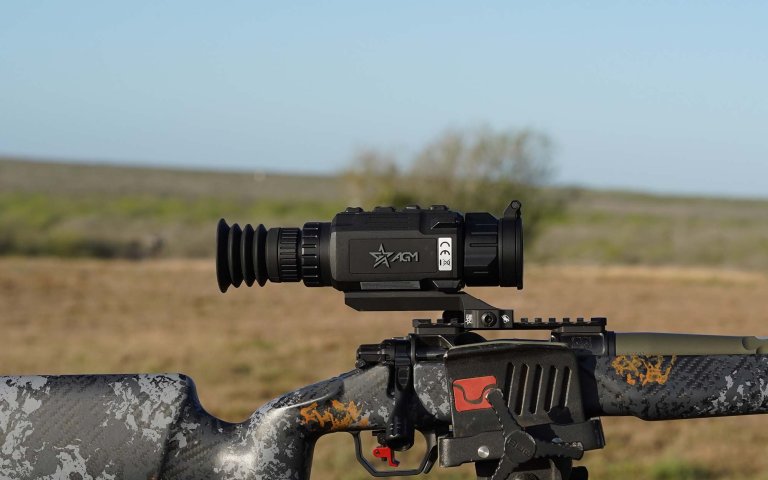
Pity the thermal customer who has to differentiate all the nuanced variations within a brand’s product line. Take AGM. The company’s Rattler, a line of rail-mount compact thermal weapon sights, has 11 iterations that differ in objective lens diameter, thermal-core sensitivity, and price. Do you shop by performance? Price? Retained value?
The 35mm, 384-class Rattler V3 tries to cut through the noise with an affordable thermal sight that features in-lens laser rangefinding, a shutterless NUC that doesn’t freeze up as it refreshes, and a high-resolution display that helps boost the anemic resolution of its thermal sensor.
That distinction may not reduce AGM’s product-line confusion but this particular Rattler V3 is a model worth shopping for because it generally bats above its weight.
Before we get into its virtues, some Outdoor Life testers dished out derision.
“AGM should stop trying to sell every single thing and slap $3,000 for a rangefinder,” fumed tester John Barth, who called the resolution “shameful for a 384” and suggested that a more appropriate price is closer to $2,000. “My biggest complaint is that the 3.5x base magnification is a lot for a scope with this low resolution.”
He’s not wrong. The Rattler V3 performs well at that lowest magnification, but its sensor just can’t hold up as you double and then triple the magnification. But for a predator hunter who might be reaching out to 200 to 300 yards, the unit has appealing attributes. It’s the only 35mm unit with a through-lens laser rangefinder on the market, and its high-definition display and shutterless NUC give it an operational edge over its 384-class peers. Its ballistic calculator, though, is so much window dressing. You don’t really need that attribute if you’re deploying a flat-shooting rifle inside its 300-yard operational window. The NE-4400 cells are powerful, but we prefer interchangeable, non-proprietary cells.
On the plus side, we love the big, bold buttons and oversized objective-bell focus ring that are designed to be used with gloves. We like its 7-hour run time. We like its included premium rail mount. We like the high-def display that boosts the somewhat anemic thermal sensor. And we like its 5-year warranty. Bottom line: it’s a solid, useful mid-range thermal that has features of scopes that cost $1,000 more.
AGM Rattler V3 LRF 35-384 Specs
- Sensor Resolution 384×288
- Display Resolution 1920×1080 OLED
- Pixel Pitch 12um
- NETD <15mK
- Objective Lens 35mm
- Magnification 3.5x base, 28x digital
- Detection Range 2,710 yards
- Rangefinder Range 1,000 yards
- Battery Type NE-4400 Li-Ion rechargeable cell
- Warranty 5 years
- Features 6 thermal palettes, 10 reticles, 7-hour run time, ballistic calculator, shutterless tech, in-lens laser rangefinder, shot-activated video recording, ships with premium rail mount
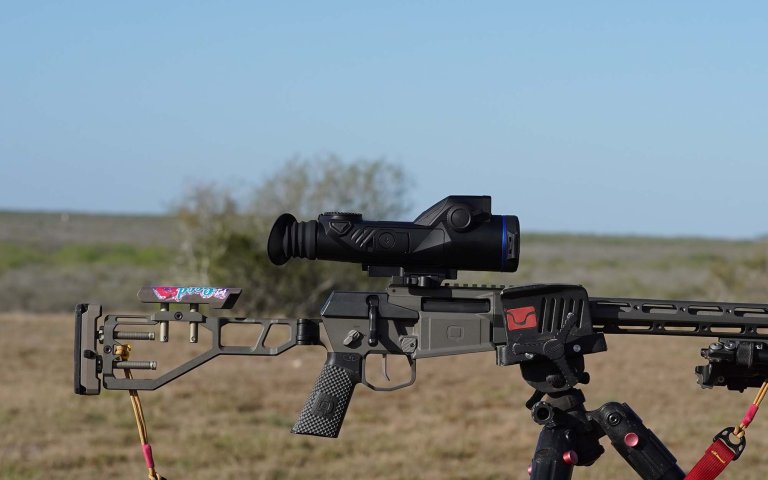
Get It From Midway USA
Get It From Amazon
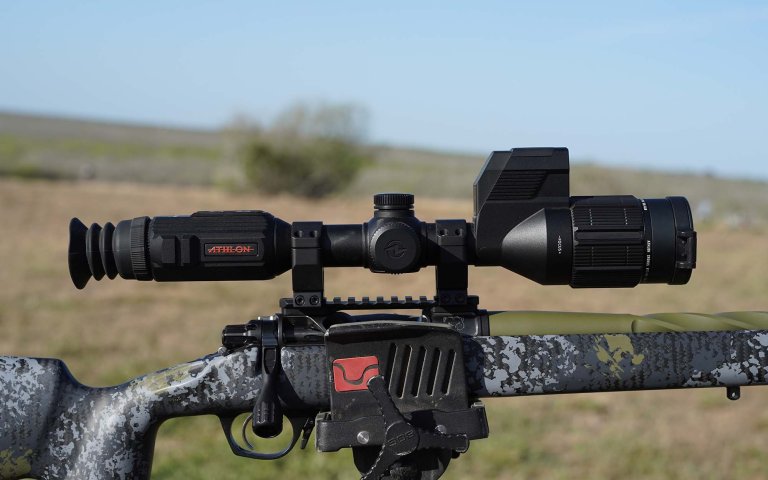
The introduction of this new product line from Pulsar was one of the most anticipated thermal of the year, and while its novel Euro-looking form factor doesn’t disappoint, its performance left us a little lacking.
Let’s look at the design first. It’s as curvaceous as a surfboard, mounting to a rifle’s rail with an included quick-detach mount that screws to the thermal’s belly and allows for low mounting height. Then there’s the thermal engine. It’s a standard 640×512 sensor, but it has a lower system NETD of <18mK than most Pulsar products. That’s a measure of sensor “noise” – the lower the NETD the clearer and crisper the image derived from sensors of similar resolutions.
The Trail 3 perpetuates the rough refresh that has come to define the Pulsar brand.
“The refresh is so violent it’s like an eye-doctor appointment,” notes tester Derrick Ratliff, who also struggled with the zeroing process. “The zero function is four screens deep and it took much longer than it should to perform.”
Once zeroed and in the field, the Trial 3 revealed more of its assets. Testers were generally impressed with its clarity and, since most of us are regular Pulsar users, we navigated the Trail 3’s menu pretty seamlessly. The biggest deviation from the norm is its rotary control in the eyepiece and some different (for Pulsar) buttons and functions. Inside the ring are buttons that capture photos or videos, others that activate the menu, and still others that increase the magnification in steps or activate the picture-in-picture mode.
Additional buttons, on either flank of the eyepiece, switch magnification and palettes (left button) and activate the laser rangefinder (right button).
The rotary control allows users to creep up and down the magnification in .1x increments, rather than being limited to the course steps of the digital zoom. It’s an elegant way to fine-tune the image to fit the shooting situation. Another fine detail: the circular picture-in-picture can be independently zoomed while the main image remains at a certain magnification. It’s a feature that enables really precise shooting at an aiming point while retaining the situational awareness provided by a wide field of view.
While most testers felt the image was in line with the 640-class sensor, tester John Barth considered the new Trail 3 to lag behind Pulsar’s Thermion2 XP50 from a few years ago.
“It’s beyond me that the resolution and clarity hasn’t kept up with rising consumer expectations,” he noted.
The test team turned in mixed opinions on what Pulsar calls the Trail 3’s “bilateral focusing mechanism.” That’s a fancy term for ambidextrous dials on either side of the laser rangefinder housing that focus the image. I felt they were fast and handy; tester Ratcliff thought they were hard to reach and operate while the rifle was mounted on a tripod.
The Trail 3’s very Euro battery, which fits in a plastic retainer that in turn fits in a recess in the thermal’s flank, is a little fussy. But the rangefinder is fast and precise. The reticle and overall handling are on point, and for an all-around, mid-range thermal scope, it’s well done if a bit overpriced for a 640-class sensor.
Pulsar Trail 3 LRF XR50 Specs
- Sensor Resolution 640×480
- Display Resolution 1920×1080 AMOLED
- Pixel Pitch 12um
- NETD <18mK
- Objective Lens 50mm
- Magnification 3x base, 24x digital
- Detection Range 2,500 yards
- Rangefinder Range 1,300 yards
- Battery Type Pulsar’s LPS7i rechargeable cell
- Warranty 5 years, 3 years + 2 years with registration
- Features Button-and-wheel navigation, round picture-in-picture display, 10-hour run time, ambidextrous focus, 10 shooting profiles, connection to mobile app, ships with quick-detach rail mount
Get It From Pyramyd Air
Get It From EuroOptic
One of the jobs of an Outdoor Life gear tester is to speak up for our readers, many of whom are on limited budgets and who rely on our guidance for good deals. This isn’t one of those deals. We felt the Cronus ATS PRO 50L-640 was overpriced by at least $1,000.
The MSRP of $5,624 may not be what you find it for at retail, but it’s the price we were given, and it simply doesn’t keep up with 640-class thermal scopes that offer a better image and more features for around $4,000.
With that out of the way, the Athlon has some appealing features, including its easy two-button navigation, with menu selection accomplished by tapping the top of what would be the elevation turret on a daylight scope, then turning to the applicable function. The left-side dial, where the parallax would be on a traditional scope, activates the precise and fast laser rangefinder.
The build is in line with what we’d expect from a flagship thermal sight, with positive buttons and a big, grippy objective-bell focus control. The laser rangefinder sticks up like a conning tower and tended to snag brush. But our main complaint was that the image just wasn’t in line with the price.
“The quality of construction and the quality of image isn’t as good as others in its class,” noted OL tester Derrick Ratliff. And tester David Stroud concluded that it’s a “decent thermal scope but for this price there are better choices.”
We found few significant demerits. The Cronus ATS PRO will get you in the thermal game, and is an adequate sight out to about 400 yards. But given all the choices on the market, we’d expect either a more powerful sensor or significantly more features to justify the price.
- Athlon Cronus ATS PRO 50L-640 Specs
- Sensor Resolution 640×480
- Display Resolution 1440×1020 OLED
- Pixel Pitch 12um
- NETD <25mK
- Objective Lens 50mm
- Magnification 2.95x base, 23.6x digital
- Detection Range 1,600 yards
- Rangefinder Range 1,600 yards
- Battery Type 1 internal, 1 external rechargeable cell
- Warranty 5 year with registration
- Features 7 thermal palettes, recoil-activated recording, onboard Wi-Fi, wireless connectivity to mobile app, 2-pound weight, 10-hour run time, ships with 30mm rings
Buy From EuroOptic
Buy From Amazon
Pros
- Shot-activated video recording
- Integrated ballistic calculator
- Best display resolution in class
- Internal/external battery dual-power system
- 9-plus hour run time
- Top-turret operation is fast and simple
- Rounded display resembles traditional daylight scope
- Red and green monochrome palettes reduce night-blindness
- Ships with 30mm ADM Recon Mount
- Extremely easy to zero
- 5-year warranty
Cons
- At over $7,000, wildly expensive
- Unexpected shut-downs with battery drain

AGM Adder Hog Hunting
The future of thermal hunting is here, and it’s gonna cost you. The new 1280-class Adder V2-60 from AGM Global is bright, clear, sensitive, and fully capable of making range-adjusted nighttime shots out to 1,000 yards. The price for that performance? An eye-watering $7,300.
Anyone who has ever used a thermal scope has wanted it to perform like a daylight scope. But the technology that converts temperature variation into visible images is so full of noise and distortion, from the processor to the software that sharpens images to the digital screen that projects them to your eye, that thermal hunters have to accept headaches, eye strain, and astigmatism as a price for seeing into the night.
The V2-60 is the closest I’ve come to a thermal scope that delivers an image that’s in the same galaxy as that of a traditional scope. It achieves that performance with a souped-up 1280×1024 sensor, one of the most powerful in the class, and a high-resolution 2560×2560 digital display that is crisp and contrasty. But it’s AGM’s software that fuses these components into an almost pleasing image.
Add a blazing-fast 1,000-meter through-the-lens laser rangefinder, cold-and-warm viewing modes that reduce eye strain, an on-board ballistic calculator that displays distance-adjusted holdover, and a 9-hour run time, all packed in a fairly trim 30mm aluminum tube.
All that performance combines to make the AGM Adder V2-60 the consensus winner of our Editor’s Choice as the top thermal scope of the year.
But there’s more. Two features of the Adder that may get lost in its specs include a ½-power magnification step. Most thermals have what’s called “step zoom,” in which the magnification doubles with every tap of the button. Those big steps can create large gaps in the zoom range, but the Adder’s incremental zoom creates a much more usable magnification range. Second, that 1-inch hyper-sharp display is slightly rounded, giving users the visual perception of looking through a traditional scope.
The AGM wasn’t without its flaws. Tester Alex Robinson struggled with unexpected shut-downs.
“When the external battery was low, but the internal battery was full, the scope shut off repeatedly,” he noted.
The AGM had hot competition from Nocpix’s new 1280-class ACE S60R scope and Pulsar’s Thermion 2 XL50. On paper, the Nocpix has the more impressive array of features. But here’s where the power of image-enhancing software tips the scales. In head-to-head-to-head comparisons, testers unanimously noted that the Adder had the clearest and least eye-straining image. That’s a squishy but important consideration for thermal users who might be behind their scopes for hours at a time.
Still, there’s the issue of the high cost of the AGM. Readers who aren’t immersed in the realities of thermals might be put off by the price. But readers who know that, just as with traditional optics, with thermals, generally, the more you pay, the more you get. That’s certainly the case with the remarkable, full-featured, investment-quality AGM Adder V2-60.
| Thermal Sensor | 1280×1024 |
| Display | 2560×2560 |
| Pixel Pitch | 12-micrometer |
| Sensor Sensitivity | <18mK |
| Frame Rate | 25Hz |
| Magnification | 2.5-28x |
| Objective Lens | 60mm germanium |
| Rangefinder | 1,000-meter detection range, through the lens laser |
| Image Storage | 32GB on-board |
| Price | $7,345 |
Nocpix ACE S60R
Buy From EuroOptic
Buy From Scheels
Pros
- 1-3x ocular magnifier
- Rounded display increases clarity and detail
- Simple single-button/single/dial operation
- N-Link system connects to other Nocpix devices
- 1,300-yard through-lens laser rangefinder
- 32GB on-board image storage
- Ability to “hot-swap” batteries without shutting down device
- Ballistic calculator displays range-adjusted reticle hold
- Standard 30mm tube
- 5-year warranty
Cons
- Very expensive
- Inconsistent connection to mobile app
- Glitchy rangefinder performance on inclined targets

Nocpix Ace Hunting Footage
Every tester (and every tester’s thermal-using buddy) was more excited to put their hands on this new flagship scope from Nocpix than any other thermal. It’s gotten tons of hype not only for its exceptional performance but for its astonishing price of just under $8,000.
While it would be easy to dismiss that price as a stratospheric extravagance, there’s a lot in this scope that justifies it. Let’s start with the stunning resolution. It ran head-to-head with the AGM Global’s flagship and just ahead of Pulsar’s remarkable Thermion2. Its 1280-class thermal core generates a rich and detailed image, but it’s the high-resolution 2560-pixel display that makes looking through this scope almost like an AI-rendered video, so sharp and vibrant are the images it delivers.
Like the AGM Adder, the Nocpix ACE uses a slightly rounded display that imitates the circular field of view of a daylight scope, a design that somehow reduces eye strain. It was also one of the few scopes that was useful in daylight. Adding to the conventional feel is the Nocpix’ 30mm tube, which accepts standard scope rings, and a very smart magnification ring on the ocular lens. This manual magnification enables users to add between 1-3-power in addition to the digital magnification without causing any reticle shift. It’s a very handy feature when you want to add just a bit more magnification to a scene without doubling the digital zoom.
We also liked the easy operation of the ACE S60. A button in the eyepiece powers on the unit, starts and stops recordings, and fires the laser rangefinder. For other menu items, simply tap the button on top of the elevation turret, then turn the turret to navigate selections. And, man, are there a lot of selections.
Among its more noteworthy attributes: an onboard ballistic calculator that adjusts the reticle to your specific load’s impact at distances determined by the rangefinder. Once you have your dope loaded, simply range a target, and you’ll get a range-adjusted holdover. The through-the-lens laser rangefinder is fast and fairly accurate, though some testers noticed incorrect ranging at severe angles.
The ACE S60R also utilizes Nocpix’s new N-Link, a Bluetooth-enabled frequency that communicates with other Nocpix devices. A user scanning with the Nocpix Quest thermal binocular, for instance, could range a target and transmit that information wirelessly to the ACE scope, where it would show up as the range-adjusted reticle hold. It’s a slick system that elevates the capabilities of a hunting team and is especially handy in the fast-paced coyote competitions that tester David Stroud competes in.
Stroud, who uses a variety of high-end scopes in the Texas predator-hunting circuit, was especially emphatic about the talents of the new 1280-class ACE.
“I have the ACE H50R and have used it for the past few months, but the S60R is on another level, entirely,” Stroud noted. “I will probably invest in the ACE S60R as my next thermal.”
We had only a few quibbles with the Nocpix, but they were enough to knock it out of the top spot by a single point. The most common problem was inconsistent connection to the mobile app, and then getting the app to refresh with our ballistic data.
But the Nocpix is the scope that other thermal weapon sights will be judged by. It’s not only the flagship for Nocpix, but for the entire industry. An investment in the ACE S60R is soothed a bit by its durable build and its remarkable 5-year warranty. Even more remarkable: warranty claims are addressed at the brand’s Dallas-area service center within five days, so users won’t be without this remarkable scope for long.
| Thermal Sensor | 1280×1024 |
| Display | 2560×2560 AMOLED |
| Pixel Pitch | 12-micrometer |
| Sensor Sensitivity | <15mK |
| Frame Rate | 50Hz |
| Magnification | 2x base magnification, 24x zoom |
| Power | Dual-battery operation |
| Reticles | 10 reticles, 7 color palettes, pre-set holdover values |
| Price | $7,999 |
Nocpix SLIM H35
Buy From EuroOptic
Buy the 384 Version from Midway
Pros
- Dual viewer/sight functionality
- Quick-release Pic-rail mount
- >1 MOA point-of-aim shift through magnetic alignment
- Ambidextrous one-hand operation
- Powered by common 18650 rechargeable batteries
- Intuitive 3-button navigation
- Durable magnesium alloy chassis
- Perfect configuration for AR carbines
Cons
- No rangefinder
- Middling resolution
- QD mount isn’t particularly precise
You have to use this handy, versatile, and priced-right thermal to fully appreciate its abundant talents. It’s a hand-held monocular, configured for decent mid-range scanning. But it can snap onto a mount in seconds, with the aid of a magnet for indexing, and the SLIM becomes a capable rifle sight. We tested this function for return to zero and it was right on after removing it and putting it back on.

Nocpix Slim Return to Zero Test
This dual-use unit is the answer to those hunters who recognize that, in order to be in the hog- and predator-hunting game, you need both a thermal viewer and a thermal scope. But who has the budget to afford both? This single unit might not be the ideal of either platform, but it’s good enough at both that budget-minded hunters should seriously consider it. In fact, it was a close second to the Athlon Cronus ATS Pro 25P-250 for our Great Buy award.
Tester Alex Robinson crystallized its place in the category.
“This seems like a great option for a new night hunter or a pig hunter who will be shooting at 100 yards and in. I like the easy functionality, small profile, and the ability to remove it from a rifle and use it as a handheld viewer.”
As in any Outdoor Life gear test, testers identified some shortcomings. First, its 640-class sensor is pretty good for hog hunting inside 250 yards, but it’s not sharp enough for the long-range shooting that characterizes most nighttime coyote hunting. Second, the quick-release Pic rail mounting interface is fast, for sure, and it’s pretty precise, but it’s not a system that will warm the hearts of long-range precision shooters. Nocpix claims a 1 MOA deviation in return to zero between the transition from viewer to scope, and that’s about right. That +/- is right in line with the expectations of most hog hunters.
This is not a ding on the unit, but rather on the Nocpix digital ecosystem — every tester tore his hair out with infuriatingly frequent firmware updates. Another demerit: no rangefinder.
I tested the value proposition of the viewer-to-scope capability, and timed the transition. I used the SLIM H35 as a hand-held viewer, identified a steel coyote-sized target at 200 yards, slapped the Nocpix on my 22 Creedmoor, cinched it down, reacquired the target, and then made a first-shot hit all within 13 seconds. I recorded no point-of-impact shift.
We liked the fact that the SLIM uses standard flat-top 18650 batteries, has a smart magnetic charging port for quick power-ups, and has recoil-activated filming.
In short, this isn’t a full-featured scope or viewer. But it’s not intended to be. Instead, it’s intended to be a one-and-done do-it-all thermal that can capably transition from a viewer to a rifle sight.
| Thermal Sensor | 640×512 |
| Display | 1024×768 |
| Pixel Pitch | 12-micrometer |
| Sensor Sensitivity | <18 mK |
| Storage | 32 GB internal |
| Frame Rate | 60Hz |
| Magnification | 2x base magnification |
| Length | 8.5 inches |
| Weight | 18.7 ounces |
| Price | $3,299 |
How We Tested the Best Thermal Scopes
We tested this year’s class of thermals in the places and style that most American hunters use them: in Texas hunting coyotes, bobcats, and wild hogs.
We based our test out of Thermal Ranch a ranch in South Texas brush country that specializes in hunting hogs at night. We also had access to a shooting range with steel targets out to 1,000 yards.
We strapped all thermal weapon sights onto either Horizon Firearms bolt guns or ARs chambered in 22 Creedmoor and zeroed the thermals at the range in both daylight and after dark. We used the thermal viewers to assess hits, just as a range spotter might do with daylight optics. And we used the stationary targets as the basis for assessing thermal image, sensitivity, focus, and operating range.
But the bulk of our testing was in the field. We called for predators and sat in blinds for hogs. In quiet moments between calling sessions and while waiting for hogs to appear, we cycled through thermals’ menus, practiced navigating their buttons and features in the dark, and assessed image quality, various features like rangefinders and color palettes, and recorded videos and photos through the devices. And we killed coyotes, hogs, and bobcats, enough to confirm the talents of many of the submissions in real-world conditions.
In daylight, we further evaluated the units, rating them on ease of use, connectivity to a mobile app, versatility for a wide range of uses, thermal features, image resolution and overall image quality, and durability. And we assessed their value, asking of each submission: how much performance do you get for the money. This particular category, considering thermals can cost several thousand dollars, is among testers’ (and buyers’) most important considerations.
The unit with the highest overall score wins our Editor’s Choice as the best submission in the category. The thermal with the highest Price/Value score wins our Great Buy award.
The Outdoor Life Thermal Test Team
This year’s Outdoor Life thermal test team includes a pair of Texans who handle more thermals in a month than most of us do in a year and three Outdoor Life editors who evaluate gear with a combination of objectivity and close attention to detail and value to readers.
John Barth operates Thermal Ranch in Duvall County, Texas. He has a wealth of experience evaluating thermal optics across a range of manufacturers and price points.
Texan David Stroud actively participates in the growing competitive coyote circuit, hunting all night across Texas at least a couple weekends a month and using a wide variety of thermal viewers and weapon-mounted sights in his pursuit of fur and prize money.
Derrick Ratliff is the founder and president of Horizon Firearms in Bryan, Texas. Ratliff was an early adopter and manufacturer of the 22 Creedmoor, a round that’s become a darling of night hunters for its flat trajectory, mild recoil, and hard-hitting performance on predators and hogs. We ran Horizon’s bolt guns chambered in 22 Creed, fueled by Hornady’s 80-grain ELD-X ammunition.
Alex Robinson is Outdoor Life’s editor in chief and frequent member of OL’s gun and optics tests. He’s an avid deer, turkey, and waterfowl hunter and is relatively new to hunting with thermals.
Scott Einsmann is Outdoor Life’s gear editor, and oversees all of OL’s flagship gear tests. As the youngest member of the test, he’s also a digital native, an important consideration for navigating thermal devices.
Andrew McKean is Outdoor Life’s optics editor and designed our test methodology as well as handling most of the testing logistics.
Things to Consider Before Buying a Thermal Scope

Testing Thermal Scopes
The author coyote hunting while testing thermal scopes.
The first thing you should consider if you’re in the market for one of the best thermal scopes is how you’ll use it. Do you want a rifle-mounted scope, with reticle and even a built-in laser rangefinder? If that’s the case, then you’re looking at a fairly expensive subset of thermals. Or maybe you just want a unit to see into the night. A hand-held thermal will do just fine, at a fraction of the cost of the thermal scopes, but without any ability to place after-hour shots.
Second, consider your budget. You can spend anywhere from about $1,000 to well over $10,000 on these devices. But if you’re simply interested in a viewer to detect animals or maybe a car parked at a trailhead, you won’t need all the bells and whistles of a scope. But if you want a plug-and-play scope to shoot coyotes or varmints after legal shooting light, then you should expect to pay well over $3,000 for the most capable rifle-mounted sights.
FAQs
Thermal units range in price from around $1,000 for basic thermal viewers to over $7,000 for the most sophisticated rangefinding scopes. Keep in mind that these aren’t night-vision units, which can cost only a few hundred dollars. Thermal scopes depend on a rare-earth element called germanium, which supplies temperature-sensitive glass for thermal units. Generally speaking, the best combination of attributes, capability, and overall utility of thermal units will set you back around $3,000.
That’s a great question. You’ll generally see a couple of different resolution equations mentioned for thermal devices. One measures the sensitivity of the sensor, or the interface that receives the thermal image. The bigger the numbers, the more detail the sensor is receiving. That’s generally a function of quality components and size of the objective lens. For higher-quality units, look for sensor resolution of about 640×480 pixels. You also want to pay attention to the display sensitivity. That’s a measurement of how much detail you’ll see on the screen of the device. The higher the number, the more contrast and detail you’ll observe. Resolution of 1064×748 provides very good visibility.
There are a number of quality brands on the market, but generally European brands only have thermal sights or what are called clip-on units, intended to be used with a standard riflescope. Units from Russia and Southeastern Europe generally have a good combination of rangefinding riflescopes and hand-helds, though quality is variable. Then there are American brands such as Trijicon and Burris that have consumer versions of their military-grade thermals.
Generally, thermal scopes and viewers are illegal to use in pursuit of game animals, like deer or turkeys. But most states allow their use for non-game animals, like coyotes or raccoons. You’ll have to check with your state’s hunting regulations to see if they’re expressly prohibited. Because they occupy a gray area, it’s a good idea to also check with your local game warden.
Final Thoughts on the Best Thermal Scopes
The best thermal scopes and clip ons are getting more affordable and accessible by the day. Until you are able to see through the darkness and pick up thermal signatures several hundred yards out in the field, you might not think you need one of these devices. But once they reveal all the hidden secrets of the night, you’ll want one just to see what happens around you in the dark.
But not all thermals are created equally. Generally speaking, you get what you pay for, with the cheaper units lacking some crucial attributes, but the most expensive having more modes and capabilities than most people normally need.
Read the full article here
