



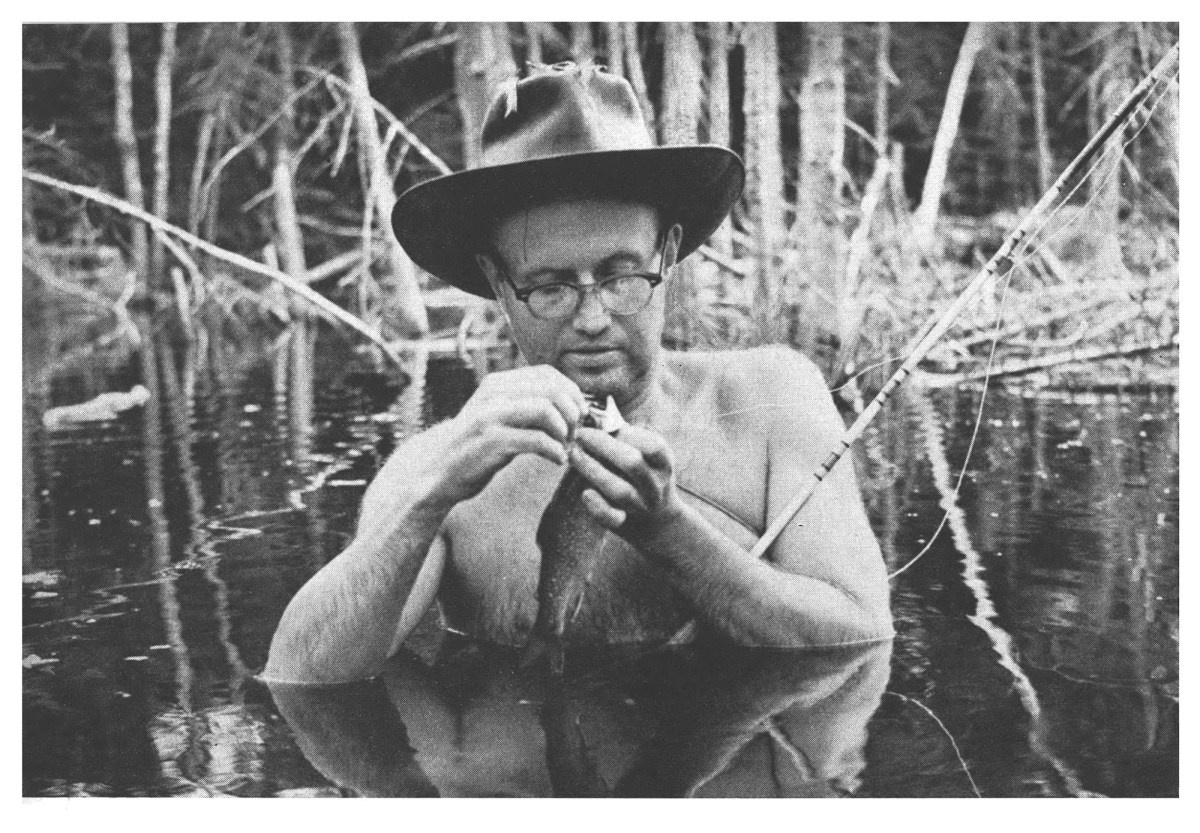

This story, “Bog-Trot for Trout,” appeared in the July 1965 issue of Outdoor Life. The annual “fever” the author refers to below might be giardia — we really can’t recommend wading in beaver ponds anymore.
We had fished the beaver bog with no success for nearly an hour, but Jeff, my six-year-old son, and I knew the trout were there. We had seen them darting under logs in the pools as we approached. But no matter how carefully we tried to creep up, the trembling earth gave us away.
“Let’s go back to the brook, daddy,” Jeff said. “I can catch them there.”
“We’ve already done that. They’re too small,” I replied. “They grow bigger here in the bog. We just have to figure out how to catch them.”
“This is no fun,” Jeff retorted.
“You have to be patient. You’ll never learn to be a good fisherman until you learn patience,” I said, knowing I sounded pompous. I sat on a beaver-felled birch and lit my pipe, preparing to outthink the elusive wild brookies.
Jeff wandered a few feet away to peer down a hole about 16 inches across and three feet back from the edge of the brook. It had apparently been made by a beaver boring up from the stream.
“I can see water. It’s all black. I bet trout hide in there,” he said, lowering his worm-baited hook into the hole.
“I’m afraid not,” I replied, “at least not now. You’ve been stomping around like a rhino. You’ve got to move quietly. It’s very …”
“Wow!” Jeff yelled, yanking a 10-inch brookie out of the hole. Jeff dropped his rod and fell on the trout as it glistened in the late-spring sun.
“Look at him, daddy,” Jeff cried. “He’s the biggest I ever caught. I’m going to get more.”
True to his word, he pulled seven more wild trout, all 10 to 11 inches, out of that hole.
I didn’t know it then, but that experience seven years ago infected me with a fever that returns each spring: A desire to find and fish beaver ponds on wild-trout streams. I’ve fished dozens of beaver ponds and have been successful about half the time. I wish I could say I discovered spots where trout were two and three-pounders, but that isn’t so. Most beaver-pond trout I’ve caught have been under 12 inches, but almost all were wild fish, fat and sassy, and extremely good eating.
I came to my present home in Claremont, New Hampshire, from Massachusetts nearly a decade ago, and was delighted to find I was in a fine trout-fishing area. My primary interest is in fly fishing, which I have been doing for nearly 30 years, and there is superlative fly fishing for trout in the Granite State, articular! in its lakes and ponds But several times each year, I hanker for a try at the wilderness beaver ponds.
New Hampshire’s vast wilderness areas are laced with small streams, many holding native brook trout. The only catch is that many of the streams are too small, too fast, or too rocky to sustain fish of any size. I have worked brooks for miles around, including nearby Vermont, and frequently have found them full of trout. But, oftentimes, the fish were in the four or five-inch class. These same fish given proper feed and a more suitable habitat — conditions sometimes created by a beaver pond — would rapidly grow to keeper size.
Both Vermont and New Hampshire have stocking programs of rainbows, squaretails, and some browns, in many of the major brooks, and those fish are keepers when they are dumped in. My reference is not to these put-and-take streams, but rather to the backwoods brook:; no fish-hatchery truck could reach. How do you find these brooks and how do you know beforehand if there are beaver workings on them? You find the brooks through use of topographic maps, a compass, and plenty of tramping over hill and dale. If you like to hunt, you’ll have an easier time searching for hidden streams when the foliage is off the trees. Fall is the brook trout’s time for spawning, and you can easily spot them on gravel beds of clear streams.
Read Next: How to Catch Big Trout on Soft Plastics
Of course, not all streams hold native trout, although most do in New Hampshire, but the real problem is to find beavers plus trout. Maps don’t indicate beaver ponds unless they are big and have lasted many years. There are, however, many natural ponds that have been increased in size and sometimes improved by beavers damming the outlet. If there’s an ample population of beavers in your state. you’ll often find them in areas marked on topographic maps as swamps, but you may also find them where there are no natural swamps.
There’s no substitute for exploratory trips into the woods. Keep it up for a few years and, in that time, your maps, with the beaver ponds you’ve marked on them plus notes on the condition of the ponds, will provide invaluable fishing information. But remember that beaver dams and beaver colonies aren’t permanent and that conditions that produce trout for several consecutive years may deteriorate.
Another way to find beaver ponds is to cultivate the friendship of a bog-trotter, that unique breed of angler who shuns the trodden way, preferring to spend his fishing hours working through swamp and forest. Every trout community has one or two of these men, but be forewarned that of all fishermen, bog-trotters are the most close-mouthed. They regard the trout-bearing ponds they’ve discovered as their own property. There is also good information to be learned from beaver trappers, if there are any in your area. As I’ve already mentioned, my first experience with beaver-pond trout was seven years ago. The previous fall, I had been partridge hunting on the east slope of Mt. Sunapee in Newbury, N.H., along the Johnson Brook trail. About halfway up the mountain, I found a beaver bog. An area of perhaps one acre was partly inundated by a series of small beaver dams across the brook. The brook itself split several times through the bog. There were one or two beaver lodges visible, but there were also signs that some beavers were living under the banks of the stream. The entire set-up appeared to have been created by a colony of lazy beavers.
Many of the small dams, most only 10 or 15 feet long, were badly in need of repair. There were the usual dead trees standing in the flooded area. I had often hunted by Johnson Brook, but hadn’t thought of it as a possible trout stream, since it dwindles to a trickle in summer and isn’t stocked.
That fall afternoon, as I reached the bog, a partridge flushed and I got off a quick shot. I found the dead bird bobbing in a pool, and when I reached for it a trout perhaps eight inches long scooted away. I spent some time peering into the various pools in the bog and spotted more trout. It was the following spring that Jeff and I went up the mountain to fish this bog.
I didn’t return to Johnson Brook until 1962. I was with fellow Claremonter Vic Pomiecko, a school teacher. My own job, incidentally, is managing editor of the Daily Eagle, the city’!” newspaper. We were headed for Lake Solitude atop the mountain via the Johnson Brook trail, instead of our usual route up the south side on the Andrews Brook trail. I described trout fishing at Solitude in a story titled “Remote Ponds Near Home,” which appeared in the May, 1963, issue of OUTDOOR LIFE.
We were amazed to find the beavers had built two big dams that went the entire width of the bog, backing up a pond of more than an acre and obliterating an entire section of the trail. There was room to cast, and we tried flies for awhile. When we got no hits. Vic dug under some rocks and found a few worms. Armed with these, he walked along one of the dams to the location of the old channel. He quickly took an eight-inch trout out of the channel. Running behind on our trip to Solitude, we moved on, pleased to have found that trout were still there.
much research has been done on the relationship of beaver ponds to trout. Much of it supports what fishermen have already discovered: that beaver ponds sometimes help and sometimes hinder trout growth and population. There are no set rules, but a few generalities are valid.
For example, there is little doubt that a beaver dam or a series of them on a stream provides more aquatic insects for trout to feed on. There is also much evidence to suggest that beaver dams provide the best fishing for the first few years after they a.re built. Later, depending on a variety of conditions, the water they back up may go sour. The oxygen content may fall below the minimum required, and the slower-moving water may become too warm in sumn1er to sustain the brook trout that cannot long survive if the water temperature consistently stays over 76 to 78°.
Beaver dams often back up large bodies of slow-moving water-ponds of 75 acres have been recorded. The flooding water kills the trees, which means loss of shade and warmer water. The accumulation of silt in a beaver pond frequently smothers trout eggs. To spawn successfully, trout need water flowing over gravel. However, trout, if not trapped between dams, can run upstream to spawn. Studies have also shown that beaver darns are not an impassable barrier to trout. Some trout work their way through beaver dams, up or down, and, during spring run-off, they may go over the top.
The type of stream a beaver pond is built on is relevant. If the stream is cold, rocky, and fast-moving, the beaver dam can be an asset. There is little forage for trout in fast mountain streams, and the cold water retards trout growth. A dam slows the stream. allows silt and aquatic insects to accumulate, and warms the water. A beaver dam on such a stream would probably assist the trout.
On the other hand, there are streams that have a summer temperature and oxygen content which make them, at best, marginal habitat for trout. A beaver dam in this situation could spoil the fishing. For this reason, I avoid dams on sluggish streams. It isn’t often you’ll find trout in a beaver meadow that lies open to the summer sun. I look instead for ponds on mountain and forest streams.
Sometimes, a pond that has soured will be freshened by natural means. Spring floods can flush out a pond. This scatters some of the trout, I am sure, but those that remain have a better habitat. Then, too, beavers frequently move to new locations after they have exhausted the food around them. The old dams gradually fall apart, the water begins to move again, and the fishing improves.
Although most remote ponds are likely to produce better fish, don’t pass up roadside waters. They sometimes yield good fish. I know two Vermonters who found such a pond about five years ago. They were driving by and spotted fi.sh rising. Out of curiosity, they stopped, tried their luck, and took some brookies weighing more than two pounds. It’s only fair to point out that this wasn’t a natural situation. It seems that a few hundred fingerling trout had been dumped in there years before and had been forgotten.
My experience with beaver-pond fishing has largely been confined to New Hampshire, and, in every case, I was catching native trout. However, some states stock rainbows, browns, and brookies in beaver ponds and are apparently quite successful in their programs. Rainbows and browns can stand higher temperatures and, therefore, might be the most logical candidates for beaver-pond stocking.
n my research on beaver-and-trout relationships, I’ve found some interesting studies. One of the most informative is titled, Effects of Beaver on Trout in Sagehen Creek, California. This study covered the years from 1954 to 1957, and was published by Richard Gard of the Zoology Department of the University of California. The Sagehen study concentrated on one beaver colony of 14 dams and the resulting ponds. Trout present included rainbows, brookies, and browns.
Gard concluded that the Sagehen Creek trout benefited from the beavers. It is interesting to note that the 13-mile creek is different from some lower-altitude Eastern streams. Sagehen rises from two permanent, cold (37°) springs at an elevation of 7,400 feet and empties into the Little Truckee River at 5,800 feet, says Gard, adding that water temperatures over 78° in the main channel are rare.
The Sagehen study also produced valuable data on the feeding habits of brook, brown, and rainbow trout. Gard discovered that the trout were selective feeders, but each species in a different way.
“Brown and brook trout from the ponds,” states Gard, “contained an average of over two and four times as many bottom organisms, respectively, as did their counterparts from the stream. The reverse is evident with rainbow trout, since they contained over twice as many bottom organisms in the stream as they did in the pond. Perhaps this species difference in feeding accounts for the observation that brook and brown trout often do well in ponds, whereas rainbow trout usually do better in stream situations.”
Gard also found that the most numerous organisms in the pond bottom and in the stomachs of all trout were immature midges. Helgrammites were eaten mainly by brown trout in the winter and spring. All trout from ponds, except winter rainbows, Palpomyia larvae in fair numbers. Brook trout in summer made the most use of large caddis worms. Brown trout ate many Liriope larvae in winter and spring. In the stream, all species of trout made good use of the abundant Ephemerella nymphs. especially rainbows in the spring.
Gard found that brookies and browns m ponds fed heavily on abundant pond-bottom fauna, whereas in the stream, rainbows utilized the bottom fauna to the greatest extent. Sagehen trout ate few strictly terrestrial insects.
There is no formula for finding good beaver-pond fishing. When hunting for beaver workings, I like to walk upstream. Frequently, the sign of their activities is carried downstream by the spring floods. Short chunks of peeled sticks, neatly knifed to a point on both ends, are one sign. If you find one such stick, you can be sure that somewhere up ahead you’ll locate the colony.
If you prefer fly fishing, most beaver ponds don’t give you much chance to practice your art. There’s usually a tangle of bushes around you, and the bottoms of the ponds are too treacherous for wading. Sometimes you can find a beaver-felled tree to walk out on, and sometimes there’s a good place on the dam where you can use a roll cast, but more often than not it’s a spinning or bait-casting situation.
When fishing a beaver pond. you’ll do better if you concentrate in the area of the dam, where the water is deeper. Also, If possible, try to fish the stream channel. Trout that shun the warmer shallows of the pond sometimes make a home in the colder, deeper water of the old streambed.
If you’ve been getting good trout in a beaver pond one year and the following year discover that the spring freshets have broken the dam, don’t forget to try downstream. My son, Jeff, caught a nice 13-inch brookie while fishing the South Branch of the Baker River in Dorchester. The trout had apparently been carried downstream from a beaver pond.
We also got a bonus with this trout, a thrill that sometimes comes to those who explore backcountry streams. We were fishing half a mne downstream from the beaver workings, picking up a five-inch trout occasionally. We gradually became conscious of a roaring sound in the forest. We struggled along through snow-laden hemlocks and spruces — it was late May but we’d had a two-inch snowfall at higher elevations — and noted that the streambed was inclining sharply up. Bursting out or the thick cover, we came upon a waterfall about 20 feet high, and it was in a pool at the bottom. of the falls that Jeff caught his trout. We continued on and found a beaver dam about a quarter of a mile upstream, where we took several 10-inch trout.
The best time for beaver-pond fishing appears to be in the spring, early sum-mer, and fall. As most anglers know, when water temperatures climb, trout seek out deeper, colder spots or spring holes, and their feeding seems to be more limited and more selective then. Also, it is a lot pleasanter for a fisherman to be in the woods in spring or fall. I’ve caught trout in beaver ponds in midsummer, but I haven’t fished enough during that time to say with assurance that it is better or worse. I would suppose that the cooler, mountain beaver ponds at higher altitudes would stand up well all summer.
If you’ve never tried beaver-pond trout fishing, don’t sally forth the first time convinced you’ll hit the jackpot. You may, but the odds are against it. Be prepared to draw a blank in at least half the ponds you fish. Sometimes you won’t even have to bother to rig your rod. Your nose and eyes will tell you to go away. I found such a situation in the Dorchester area. With Vic Pomiecko, I climbed a small mountain in the course of a four-mile hike toward a small swamp and brook that showed on our topographic map. We sweated in the hot, June sun, swatted deer flies, and wondered why we weren’t fishing some nice lake. We found the brook and swamp and the beavers were there, but that was all. The ponds, and there were several of them, were scum-covered, stagnant bodies of water simmering in the sun. The stench from the ponds and the beaver lodges was overwhelming.
We left there with a cloud of black flies trailing us. But I balanced the ledger the following spring in the same general area when Jeff and I found the waterfall and he caught the big trout. And that, essentially, is the charm of beaver-pond fishing. You never know what you’re going to find.
Read Next: The Best Mosquito Repellents
A word of caution on clothing is in order. Wear a long-sleeved shirt on your excursions and carry plenty of bug dope. If you don’t, the insects will drive you nuts. I even carry a headnet with me, especially during the black-fly season. But, if it isn’t the black flies. it’s the mosquitoes or some other buzzing, biting creature. A cigarette or a pipe will help to keep them away from your face. A cap or a hat is also an asset. It cuts down the area on which the bugs can feed. The best footgear is a pair of all-rubber boots. Don’t wear good leather boots. They’ll be soaked and caked with mud in no time and ruined by the end of the season. I sometimes think a pair of sneakers is a good solution, if you don’t mind walking in them. Usually, at some point, you’ll go in up to your waist, so you have to reconcile yourself to getting more than your feet wet.
Read the full article here
