



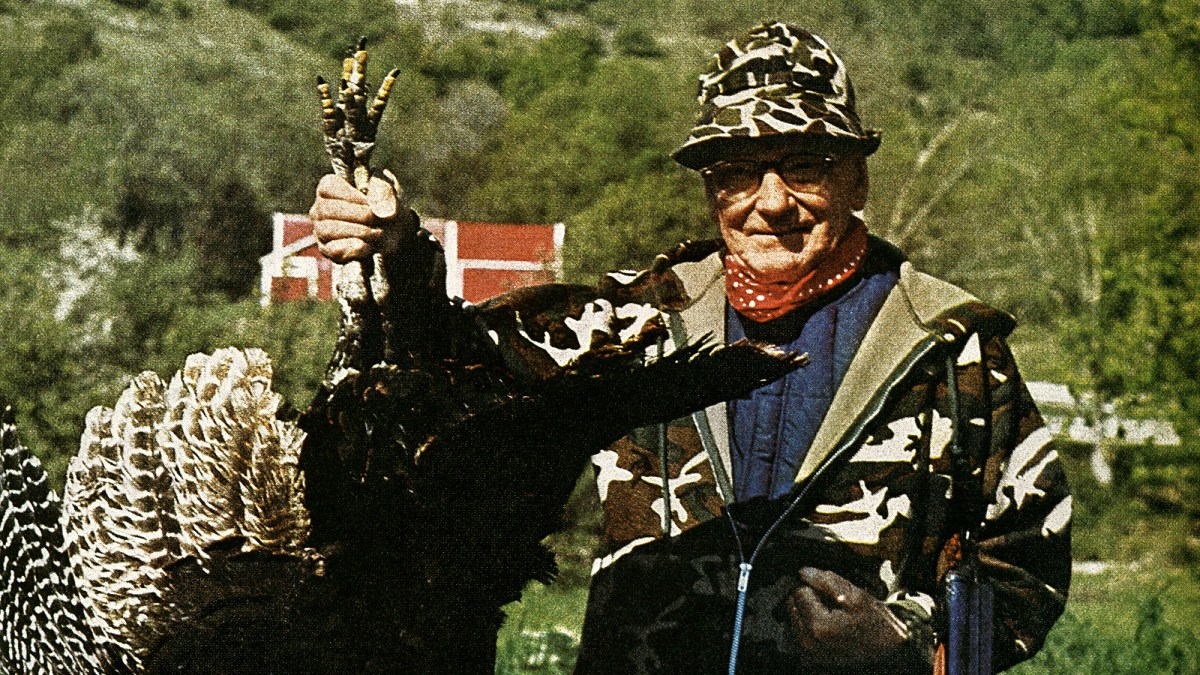

This story, “After More Than a Century, These Yankees Hunt Wild,” first appeared in the May 1974 issue of Outdoor Life.
Sometime in the mid-1800’s an unknown Vermont hunter killed the last native wild turkey shot in the Green Mountain State. In the spring of 1973, John Hathaway of Pawlet bagged the first wild turkey in a gobbler hunt that was sponsored by the state Fish and Game Department as part of its turkey-restoration program. Between these two dates lies the story of a heartening success in modern wildlife management.
During Colonial times wild turkeys were abundant in Vermont, especially in the southern section. But unrestricted hunting and the destruction of habitat through lumbering caused the birds to disappear completely before the turn of the century. In 1870 three-fourths of Vermont was wooded; by 1930 most of the state had become open land. Since then, however, maturing forests have reclaimed cut-over hills and abandoned farms, once more creating favorable habitat for turkeys.
The same situation prevailed in certain other Northeastern states — notably Pennsylvania and New York – where remnant surviving flocks have been substantially increased by the relocation of live-trapped wild birds.
The emphasis here is on wild birds. In earlier efforts to restore turkeys to Vermont hundreds of birds reared on game farms were released by well-meaning sportsmen’s clubs and individuals. But these artificial1y raised turkeys were several generations removed from the superior native strains and were unable to withstand rugged Northern winters or to reproduce under natural conditions.
In the late 1960’s the Vermont Fish and Game Department decided to try its hand at reestablishing wild turkeys. There were no surviving remnant flocks, so the department had to start at the bottom with scientific studies of weather patterns, habitat, food supplies, and land use.
Mast crops such as acorns and beechnuts are staples of the turkey’s diet in spring, fall, and winter. Fruits and seeds are eaten year-round, and insects and grasses are favorite items in summer. The birds get most of their food on the ground, and when deep or crusted snow lies over the land they must depend upon such vegetation as they can find sticking up through the snow or in sheltered spring seeps.
The Fish and Game Department’s studies showed that southwestern Vermont, roughly from Brandon south to Arlington, offered the best combination of conditions necessary for successful turkey stocking. Biologist William E. Drake was named leader of the state’s turkey project, and everything was set to go.
The next step was to obtain the turkeys to establish flocks in Vermont. Neighboring New York’s Conservation Department (now the Environmental Conservation Department) granted permission to trap 15 to 20 turkeys during the winter of 1968-69 and again during the winter of 1969-70. Winter is the most favorable time for live-trapping because the birds tend to band together in large, concentrated flocks.
During the first winter, Bill Drake used baited areas and cannon-fired nets to trap 17 birds in south-central New York. These birds were released in the Pawlet section some 20 miles southwest of Rutland. The following winter 15 more turkeys were trapped and released in the Hubbardton area near Lake Bomoseen. These two sites provide good turkey habitat and winters there are likely to be relatively mild.
In the spring of 1969, four broods of young turkeys, or poults, were observed in the Pawlet area, and in 1970 six broods were seen. By 1970 one brood was reported from the Hubbardton planting. As time passed, more and more Vermonters were treated to the sight of flocks of 20 to 30 turkeys feeding in fields. In October 1970 biologist Joseph Artmann took over leadership of the turkey project.
Sightings were also reported farther from the release areas, showing that the birds were extending their range. By 1971 turkeys were being reported from Brandon to Shaftsbury in Vermont, and from as far away as Salem and Whitehall in New York. Although some poaching and natural deaths occurred, neither proved to be serious factors.
By 1972 wild turkeys were ranging from Arlington to Middlebury and from the Green Mountains west into New York State. Turkey-watching became a popular sport in Vermont, and in the spring some people even began practicing with calls. Several brands of calls began to show up in sporting goods stores. At least one old-timer, however, refrained from joining in this new activity.
“I can’t abide a bird that talks all that much,” he said as he stood foursquare in front of a general store, “and I don’t aim to waste my time talkin’ back to ’em.”
The first phase of the turkey-restoration program ended with the successful capture and establishment of wild turkeys from New York State. The second phase, begun in 1972, was less successful. It involved trapping and relocating turkeys within the state of Vermont. This time there was not enough snow and the birds were able to move about freely and to find food; instead of concentrating in large flocks they remained in small, trap-shy bands.
During the winter Joe Artmann spent 17 days crouched over a loaded net cannon beside baited areas, but not a single turkey allowed itself to be trapped. Late in the winter of 1973, however, Artmann was able to capture 14 birds, which were released in the southeastern part of the state.
By then the Vermont wild turkey population had reached an estimated 600 birds, and it was decided to initiate a short open season. A controlled spring gobbler hunt was decided on for several reasons.
The turkey’s mating season is in the spring. As the days lengthen and grow warmer, tom turkeys begin to strut and gobble to attract the hens. Wild turkeys are polygamous: one gobbler mates with a number of hens. Most of the breeding is done by older dominant males, and yearling toms accomplish little or no mating. Once they have bred their harem of hens, the toms become expendable.
The breeding season peaks in Vermont from early to mid-May. Wild turkey nests are merely hollows scooped in the forest floor, usually amid concealing cover. Here the hen lays a clutch of 11 or 12 eggs that are tan and flecked with brown. Egg-laying takes place over a two-week period, and incubation lasts for a month. Hatching reaches its peak in Vermont during the second week of June.
During their first three weeks after hatching, the poults are extremely vulnerable to cold, wet weather and to predators. Almost immediately they are able to follow their mother on her daily rounds. Within three or four weeks the youngsters learn to fly, which helps protect them from predators. Soon the growing turkeys get an added measure of safely by roosting in trees at night. Even so, an average brood of a dozen poult is usually reduced to about seven by autumn.
The special season was set for May because most hens would be nesting and would be less likely to encounter hunters. Much of the breeding would be finished by then, but toms would still be gobbling and would still be attracted to calling.
The open season was scheduled for May 9 through May 20, and hunting was restricted to three management zones: A, B, and C. Five-hundred permits were issued — 150 each for Zones A and C, and 200 for Zone B.
Applications had to be made on or before March 31; permits went to the fortunate 500 whose names were selected at a drawing held in Pawlet on April 4. Anyone (including non-residents) holding a valid 1973 Vermont hunting or combination license was eligible to apply. In addition, 79 permits were issued to individuals who owned, rented, or controlled 50 or more acres of land within the zones open to turkey hunting. Holders of these permits had to agree to let others hunt on their lands during the turkey season, and their permits were valid only on property located within the zone specified.
Weapons were restricted to shotguns loaded with No. 2 through No. 9 shot, or bows with broadhead arrows seven-eighths of an inch wide with two or more cutting edges. Hunters were given a seal that was to be locked through the web of a wing. Successful hunters were required to show fully feathered birds to a biologist, warden, or authorized person within 24 hours after a bird was bagged.
Electronic callers, dogs, live decoys, bait, or organized drives were prohibited. Daily hunting hours ran from 5:30 to 10 a.m., a time when toms do the most gobbling but which would bring hunters out of the woods in 4½ hours, thus helping to prevent the disturbance of nests.
Since few Vermonters had ever hunted turkeys, the Fish and Game Department issued a helpful bulletin. Its suggestions are valid for spring turkey hunters everywhere. Among the tips are:
Learn to use a call. Before the sea-son opens, drive back roads at dawn in likely looking wooded areas. Stop every half-mile and listen for four minutes. Repeat this process until you have located gobblers in several areas. Drive your route several mornings because toms may not gobble every morning.
When the season opens, walk these areas at dawn until you hear a turkey. Try to get within 100 yards or so of the gobbler, and then hide before you start to call. A complete camouflage costume, including face netting, is recommended. The idea is to produce the call of a hen to attract the gobbler within range. There are various theories on the amount of calling that should be done, but fewer calls are generally better than too many. Ideally you should call just enough to keep the gobbler coming toward you. Gobblers usually walk toward the hunter cautiously, so be patient and remain hidden.
Checking stations were set up at Ted’s gasoline station in Castleton Corners at the junction of Route 30 and 4A, and across from the Post Office in Pawlet at the junction or Routes 30 and 133.
All was in readiness, and not since word went around that Gentleman Johnny Burgoyne’s Hessians were heading for Bennington back in 1777 had Vermonters mobilized so enthusiastically. Fowling pieces were oiled and polished, and southwestern Vermont hamlets echoed to the sound of turkey calls as fortunate permit holders practiced to attain proficiency on these unfamiliar instruments.
Reports of these doings trickled into neighboring states, including my home state of Massachusetts. As Northeast field editor of Outdoor Life, I wanted lo take part in the proceeding in order to give a hunter’s-eye report and perhaps to bag a Thanksgiving gobbler in the process. But this was just not to be.
Although nonresidents were eligible to apply for permits, none were included among the lucky 500. The next best thing seemed to be to take a trip to the scene of action and report to our readers how things worked out. On the whole, they seemed to work out pretty well.
The morning of May 9 dawned cold and showery, but 5:30 a.m. found practically the entire army of permit holders in the woods, listening for gobbling toms. One of the fortunate Vermonters who heard this sound was John Hathaway of Pawlet.
Following the Fish and Game Department bulletin’s advice, he cautiously worked his way to within 100 yards or so of the sound, concealed himself in the brush, and then began to work his call with nervous fingers. Almost immediately the gobbler responded to the call, and only moments later it appeared.
John thought he was well hidden — until he received a quick and dramatic lesson about the wild turkey’s keen vision. As he moved imperceptibly to raise his gun, the tom suddenly turned and ran. Leaping to his feet, John took a quick bead and fired. The bird, a 21-pound six-ounce tom, dropped, thus gaining John Hathaway the distinction of bagging the first wild turkey in Vermont in over a century.
Another fortunate hunter was Ray Vingoe of Shrewsbury, Vermont, out on his first turkey hunt, armed with a 12-gauge Reming1on Model 1100 loaded with No. 2 shot. Ray was pussyfooting the rough the woods near West Rutland, in an area he’d scouted before, when he heard a gobbler sounding off from a hardwood ridge. “I let out three hen clucks,” Ray said, “and then started walking toward the ridge. But instead of coming toward me like he was supposed to, the turkey went the other way. The next time he gobbled he was farther up the ridge.
“I scratched the call again, and he must have heard it because a later he gobbled again, and I knew he was coming toward me. He sounded like he was a couple hundred yards away, and I hunkered down in some thick stuff and clucked the call again. I could hear him scraping his wings and rustling in the brush. He was still gobbling, and I knew I knew he wasn’t more than a hundred yards out, but I couldn’t see a thing. This must have gone on for fifteen or twenty minutes. I know it seemed like an hour.
“I gave another cluck, and all at once he stepped out from behind a bush about two-hundred feet away. He was fanning his tail and strutting, and my heartbeats sounded louder than his gobbles. He was real leery, but he gradually worked toward me till he was within sixty feet. He acted spooky, so I lifted my gun, took a bead on his neck, and let drive.
“I must have been a little shaky, because I got him near the breast,” Ray added. “Feathers flew in a shower, and the turkey fluttered and flopped around. Then he ran about fifty feet to my right and took off. I fired again and hit him in the wing, and he came crashing down. I thought he was finished, but he got up again and started to run. I nailed him a third time, and he went down for the count.
“Mister, I’ve bagged my share of deer, but I want to tel1 you, this was my greatest hunting thrill so far.”
Ray’s bird weighed 20 pounds six ounces and sported a nine-inch beard.
Donald Wood of Pawlet had an easier time. He looked out his kitchen window and saw some turkeys feeding in his field. Grabbing his gun, he went out the door, took advantage of a little ridge, and sneaked close enough to knock over a 16-pound gobbler.
Somewhat less fortunate was another hunter who shall be nameless.
“I been practicin’ on my call since early spring,” he said, “and I’ve got pretty good at it if I do say so. I was up at three o’clock first morning, and by five-thirty I was back in the woods where I’d heard some gobbling the week before.
“For a long time I didn’t hear a thing. Then all of a sudden I heard a sound like a turkey. It wasn’t a real gobble, but I was sure it was a turkey. It came from up on top of the hill, and I started moseying toward it low and careful. On the way I stopped a couple times and scratched off a hen cluck or two, and this gobble sound come back to me. It sounded like a turkey with laryngitis.
“Well, I kept moseying and clucking, and the gobbler kept talkin’, and then I see a movement in the brush. I pulled up my gun and got ready, and just then the bushes parted. But it wasn’t a gobbler. It was Jim Abel, lives over the hill from me. He had his gun up, and for a minute we stood lookin’ at each other. Then we both started to laugh. It was almost ten o’clock, so Jim and I went down to the tavern and had a beer.”
Another hunter who prefers to remain anonymous told of his experience. Clucking artfully, he called a big gobbler within range and took a fine bead on its head.
“But I guess I had turkey fever,” said the hunter, “because I missed him clean as a whistle. He didn’t stay around long after I shot. He set off like a race horse and then took wing. He looked like one of them Seven-Forty-Sevens taking off. By Godfrey, the sight of that huge bird flying got me so shook I just sat there and watched him go. Time I remembered my gun ‘twould have taken a rocket to fetch him.”
Edgar Cleveland, a Pawlet farmer, got up at 3: 30 the first morning but didn’t hear any gobblers. On the second morning he left his chores undone to take advantage of the 5:30 opening. Again he heard no birds, so he returned home around 6: 30 to do the chores. At 9 a.m. a neighbor stopped by to report that there were turkeys behind his house. Ed climbed into his truck and drove to the area. He didn’t see the birds, but he heard a tom gobbling from the nearby woods. Hiding in a thicket, he started calling and returned home with a 16-pound gobbler.
Junior Harwood of Shaftsbury took one of the largest birds. He was hunting in the Danby section, moving quietly through the rainy woods. When he heard gobbling from a ridge, he worked his call, but the turkey apparently became spooked and disappeared. Somewhat discouraged, Harwood decided to call on his long experience as a deer hunter and try to stalk his turkey as one would a buck.
“Only about a half-hour later I spotted two deer,” Junior said. “Spotted ’em, heck — they almost ran over me. While I was watching them I heard a gobble. Apparently the bird making the sound had spooked the deer.”
Junior did some calling and shortly came up with a 22-pound 12-ounce gobbler.
The weekend gave everyone who hadn’t already bagged his turkey a chance to be afield. Saturday was a sunny day, and Charles (Bud) Cole was abroad on Rupert Mountain before dawn. By nine o’clock he was back at the Pawlet checking station with a 17-pound four-ounce gobbler.
The husband-and-wife team of Wes and Gloria Jordan was also hunting Rupert Mountain that morning. Wes is one of the country’s top makers of fishing rods and until recently was head designer for a well-known Vermont tackle maker.
The Jordans had seen several flock of birds before the season opened, but on this day they hunted for some time without results. When things did happen, though, they happened big. Not one but two gobblers came to Wes’s call. But both birds remained out of range of Gloria’s light gun, and when they looked as though they might spook, Wes clobbered one of them — a 14-pounder — with his 12-gauge.
By the end of the season on May 20 a total of 23 gobblers had been taken. Although this doesn’t sound like a lot of birds out of 500 permits, it is a better-than-average score. In well-established turkey-hunting states an average of 3 percent of the hunters are successful. Vermont’s overall tally is 3.9 percent. Landowners’ scores ran 5 percent and those of license holders 3.8 percent.
About 70 percent of the birds were bagged by hunters living within the section that was open to hunting, which reflects the importance of knowing turkey habits and habitat. The average weight was 18.8 pounds, and the largest gobbler reported weighed 24 pounds. Before the season opened, turkey-project leader Joe Artmann predicted a kill of 20 to 25 birds, a very accurate forecast.
The 1974 hunt will be May 8-19, inclusive. One-thousand permits have been allocated — plus hunting rights to landowners and landholders who qualify. Fifty of the 1,000 permits will go to nonresidents. Hunting zones have been expanded, but the success ratio is expected to remain about the same as last year’s. If all goes well, there eventually may be a fall either-sex season.
One thing is certain. Wild turkeys are making a satisfactory comeback in their former range in the Green Mountain State, and the folks are happy to have them back.
As one native son put it, “With turkeys in these hills again, old Ethan Allen would feel right to home.”
Read the full article here
