



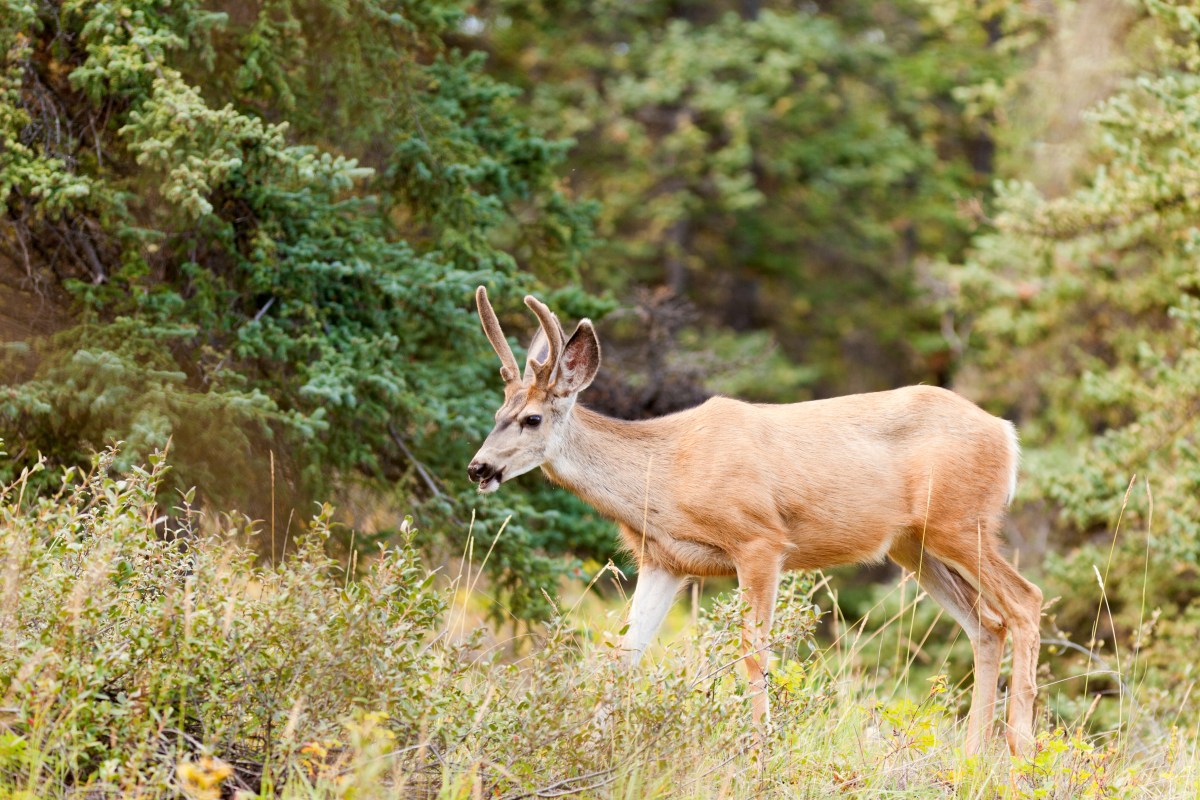

A hunter in Alaska shot a mule deer in April, marking the first documented case of a hunter ever killing one inside the state.
Mule deer are not native to Alaska, which is why they can be taken year-round there. The harvest follows years of increased sightings as mule deer have been migrating into Southeast Alaska and Interior Alaska, around Fairbanks. The harvested deer was a doe that had previously nursed a fawn, according to the Alaska Department of Fish and Game, but was not pregnant this spring.
While the expansion of mule deer — a cherished big game animal that’s increasingly vulnerable in its home range in the Western U.S. and Canada — might sound like a good thing, it poses a real risk to Alaska’s native wildlife. The biggest concern is that mule deer are a potential vector for disease and parasites.
“They’re in Skagway, I’ve seen quite a few [mule deer],” hunter Westin Nelson told ADFG. Skagway, where the hunter lives, is in Southeast and just south of the Canadian border. “About five years ago I saw the first one. My dad pointed it out, he said, ‘You can tell them from blacktails if you look at the ears.’ It’s a dead giveaway. Their ears are huge. If you’ve hunted Sitka blacktails, you’ll know they are undeniably different. These are much bigger deer, and you know it when you see them.”
Sitka black-tailed deer are rare in the Skagway area, according to ADFG. Nelson added that he and his friend (who helped him dress the doe) had a friendly competition going to see who could tag a mule deer first. The buddies have actively hunted for them over the years.
“I just happened to get kind of lucky,” Nelson told Alaska Public Media on Tuesday. While Nelson was aware of the risks mule deer pose to the state’s wildlife, he dismissed any suggestion that he might have contributed to conservation by killing one. “I wouldn’t say I’m super-noble or anything. I just wanted to get one.”
To date, Alaska does not have any documented cases of chronic wasting disease, which affects deer, moose, caribou, and other cervids. While CWD has not yet been detected in neighboring Yukon, it has been detected in the far south of British Columbia.
More urgent and concerning is the possibility of winter ticks hitching a ride on mule deer that migrate into Alaska. The winter tick has not yet been detected in Alaska, but it has devastated moose populations in New England and posed problems for moose in the Northwest Territories and the Yukon.
“All it takes is one mule deer with one female tick on it to come into Alaska, and that would completely devastate our moose population,” Dr. Kimberlee Beckmen told APM, noting that nearly half of the mule deer examined in the Yukon’s Whitehorse area were infested with ticks.
Beckmen is the lead veterinarian for Wildlife Health and Veterinary Services at the ADFG, and she examined samples from Nelson’s mule deer. She found no signs of hair loss or hide breakage on his deer, which is good news — it means the mule deer likely didn’t have a tick infestation this past winter.
Beckmen also sent biological samples to five different labs to test for a variety of conditions, including CWD, brainworm, and lungworm. Another concern is deer adenovirus, a respiratory disease that causes hemorrhaging. It’s carried by deer and can be fatal to calves — including moose calves — especially when they are stressed.
One key way winter ticks harm moose is that heavy tick loads can cause hair loss, skin irritation, and blood loss, which can lead to starvation and death. Deer and elk are fairly good at grooming and tend to remove larval ticks in the fall, according to Environment Yukon’s Animal Health Department, but moose only begin to groom when adult ticks are present — once it’s too late. By then, grooming can cause hair loss and distract moose from feeding, causing a spiraling effect that leads to poor body condition and increased energy demands to stay warm in the winter. Ticks are particularly fatal to yearling moose and calves.
Sightings of mule deer have been reported from the eastern Interior to northern Southeast Alaska, according to ADFG, and all those mule deer likely migrated from within the species’ current range in Canada. The Yukon has an established mule deer population of about 1,000 deer. The earliest known sighting of a mule deer in Alaska was in 2005, and more recently include a mule deer struck by a vehicle around Fairbanks in May 2017, and one photographed by the nearby Fort Knox gold mine the previous year.
“Mule deer sightings have been recorded in Alaska and white-tailed deer sightings have been reported just beyond the Canadian border in recent years,” according to a 2023 report from the Western Association of Fish and Wildlife Agencies. “Deer monitoring is difficult in Alaska due to densely vegetated habitat and remoteness.”
There’s no closed season on mule deer in Alaska and no bag limit, though hunters are required to salvage the entire carcass for meat and ADFG requires mule deer hunters to provide samples to their local agency office for testing to help with disease surveillance and mule deer monitoring in the state.
Units 1, 5, 11 – 13, 20, and 25 are specifically noted as units where hunters may take mule deer. These units range from Southeast Alaska north along the border with the Yukon.
Read Next: Feral Hogs Can Spread CWD. So Why Are These States Still Transporting and Importing Them?
Nelson kept his venison but provided abundant samples from his mule deer to ADFG, including the hide, head and neck, liver, heart, both lungs with the trachea attached, the spleen, the lower colon and two lower legs with hooves.
“The whole hide was really helpful — to see that there is no hair loss or breakage from scratching typically seen with lice or ticks,” Beckmen said. “We are planning to tan the hide for educational purposes, and I am cleaning the skull.”
Read the full article here
