



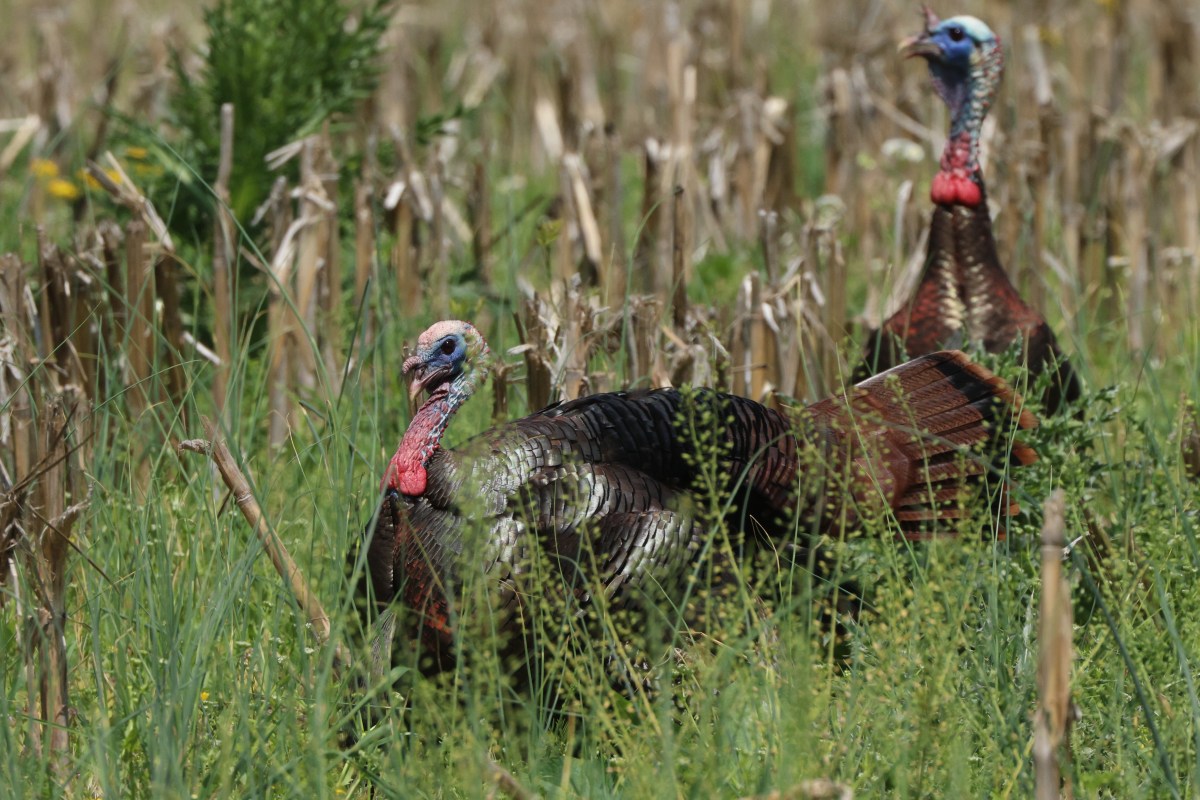

When you’re hunting turkeys after early May, flock dynamics and tom behavior start to change. Gobblers are re-grouping. Hens are nesting. Heavy hunting pressure has likely reduced the amount of gobbling you’ll hear in the woods.
Those are the obvious challenges, but the good news is that there’s still some incredible hunting to be had. I have deep experience hunting late toms, but i’ve also had the opportunity to interview excellent turkey hunters from around the country.
There’s a playbook for killing elusive longbeards at the end of the season. Here are 17 sneaky turkey hunting tips for those late-season holdouts.
How to deal with HUNG UP GOBBLERS?
Our Best Late-Season Turkey Hunting Tips
Use Subtler Hen Vocalizations
Hunters have been yelping on box calls for weeks now. At this point, you might as well call them screech chickens. Longbeards are tired of hearing it. While idea of turkeys becoming call-shy is commonly debated as a myth, you can certainly still repel a gobbler with loud, incessant calling this time of spring. Instead, use subtler hen vocalizations. Focus on clucks and purrs. Use soft yelps. Finesse that tom, and unless he responds thundering gobbles, work him in slowly.
Try Some Gobbler Yelps and Other Bro Talk
This late in the season, sometimes all that tom wants is to get the band back together. He isn’t sure if he can take one more rejection from hens (which are likely heading for their nests) or fight with that pack of jakes again.
So try some three-noted tom yelps. It’s a deep, raspy, short chalk – chalk – chalk. It’s notably distinct from a hen, or even a jake yelp. But that gobbler that won’t respond to hen vocalizations just might come running.
Implement Non-Vocal Turkey Trickery
Consider using non-verbal turkey sounds. The most common and obvious include wing beats and scratching. Use heavy wing beats to indicate fly-down from the roost. Softer wing beats can be used to sound like a turkey, flying a fence or hopping over a fallen log. Scratching in the leaves makes it seem like a turkey is nearby in search of food. Toss in a few clucks and purrs and that can be deadly for even the most pressured longbeard.
Be More Passive and Sit Heavy Transition Routes
Sometimes, you just have to deer hunt them. At this point, you’ve seen where birds like to go and the routes they like to use. Consider no calling or decoying and just set up along these known paths of travel. It’s boring … but can be an effective turkey hunting methodology that few have the patience and dedication to implement.
Read Next: How to Use Trail Cameras for Turkey Hunting
Be More Aggressive and Cover a Lot More Ground
Or you can do the exact opposite. Some hunters choose to cover a lot of ground in search of remaining late-season toms that are still fired up. Maybe they call frequently in hopes of striking a willing talker. Perhaps they don’t. Either way, they’re running and gunning until they see or hear a bird they want to hunt.
Deploy Subtler Decoys
Already ran off about 10 turkeys with that full-blown strutter decoy? Maybe it’s time to bag it for the season. Instead, deploy subtler turkey decoys. Present something non-aggressive, such as a single, feeding hen, a pair of hens, or perhaps a passive-posture jake. (Only use the jake if there’s still a bossy gobbler running around and there are no gangs of jakes that have been harassing longbeards).
Read Next: The Best Turkey Decoys
Camp Out on Known Strut Zones
As fewer hens are receptive, gobblers often spend more time around strut zones now. With experience and good scouting, you’ll know that these locations are often openings in the woods or tucked-away corners of fields that can’t easily be seen. It can be prudent to camp out on these known strutting areas.
Shift to Common Nesting Areas
By the late season, the majority of hens are already on the nest. This provokes a notable shift in the flock’s usage of the landscape. Hens start spending time closer to cover rather than feeding in open fields, pastures, and oak flats. Now, they slink back and spend more time around early successional habitat. Male birds slowly begin following suit.
Hunt Near a Busted Nest
A significant percentage of turkey nests are raided by nest predators. Others are unintentionally destroyed by agricultural and other human practices. In these cases, 10 to 20 percent of hens will likely renest. If you find a recently disrupted clutch of eggs, consider hunting in the general vicinity. That hen will likely seek out a late-season suiter, and she just might drag it by you.
Find Remaining Fields with Shorter Grass
As we dive further into May, foliage gets taller and thicker. Gobblers don’t like walking in fields full of Chinese finger traps. If a field is full of weeds or tangles that trips them up or could potentially slow them down when chased by a predator, they won’t use it. So, find remaining fields with shorter grasses, and you’ll likely spot more turkeys.
Sit a Wallowed-Out Dusting Areas
This just might be the most boring turkey hunting tactic available to man, but it can work wonders to sit over a dust bowl. It’s the equivalent of camping out on a mud wallow for elk or wild hogs. No, it’s not sexy, but I can assure you that it works.
Hunt the Roost Sites
Some hunters don’t like to do it but consider hunting closer to roost sites. Get in tight very early in the morning. Or camp out late in the afternoon. It’s like pushing in close to a buck bedding area when they aren’t traveling far in daylight. Sometimes, you have to push a few more chips to the middle of the table.
Spend Time in Cooler, Shaded Spots
Late-season turkey hunting is synonymous with warmer temperatures. That translates to thermometers reading 80 to 90 degrees, if not more. So, spend time in cooler, shaded spots. Try close to creeks, mature timber, stands of taller cedars, etc.
Hunt Midday Down Times
Not hearing birds right off the rip? Consider sleeping in and waiting until mid-morning to hit the woods. Sometimes, birds that have been conditioned to pressure the first few hours of the day will relax and fire up around 10 a.m. Oftentimes, that type action can crop up intermittently until late afternoon. If a bird gobbles between 9 a.m. and 4 p.m., watch out, because he just might walk right into effective range.
Try Previously Avoided Areas of Properties
By now you’ve hunted your favorite spots hard. So, hunt areas you’ve previously avoided. Oftentimes, turkeys push into these unpressured zones.
What NOT to do when turkeys don’t gobble – I made a MISTAKE
Reposition Quickly and Aggressively on Uninterested Longbeards
That field bird isn’t gobbling? Or maybe he gave one courtesy gobble and sassy silence to follow? Reposition on that turkey. Swing around ahead of its projected path and hit him again. Sometimes, that’s all it takes to bag a seemingly uninterested bird. It’s always easier to call turkeys where they want to go, after all.
Or … Just Keep Hunting Like Normal
Are your turkeys still doing normal spring turkey things? Just keep hunting like normal. You just might score with more time in the woods. Afterall, the greatest turkey killing tool is patience.
Read the full article here
