



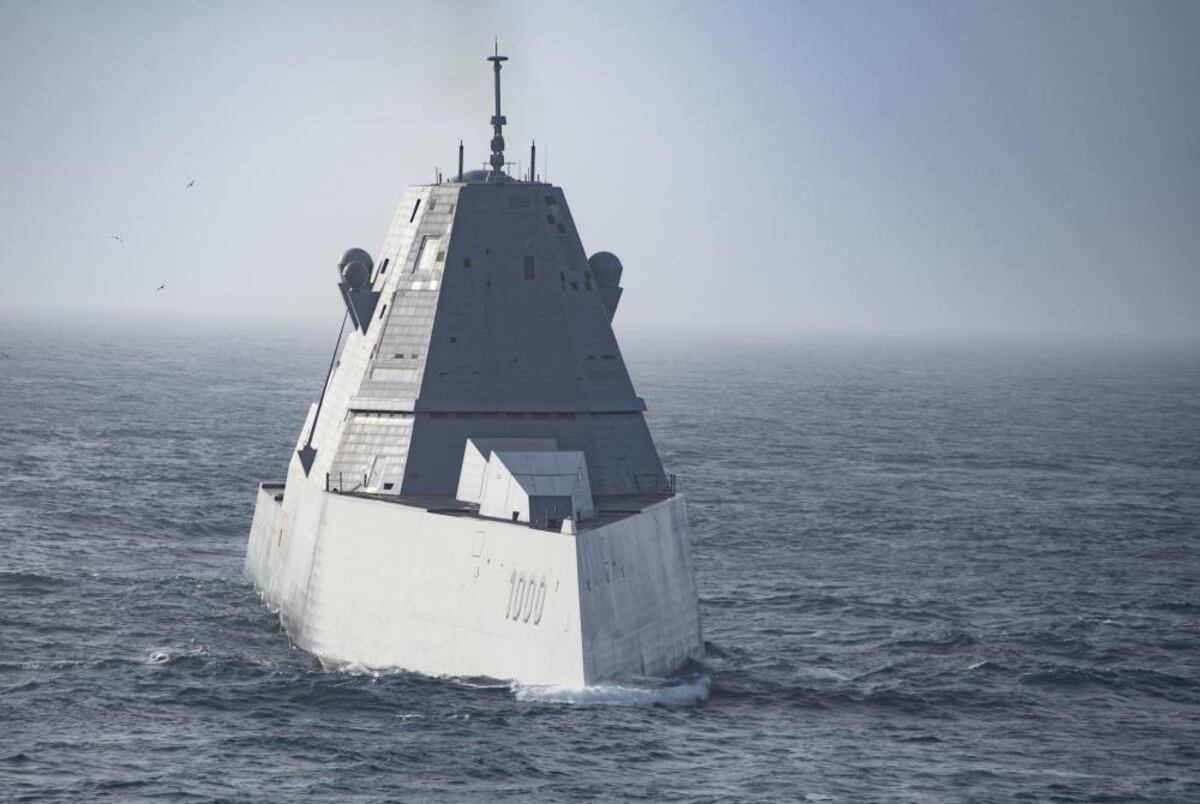

The U.S. Navy’s expensive effort to install hypersonic missiles on three Zumwalt-class destroyers is two years behind schedule, according to government auditors.
In addition to problems stemming from both the destroyers and the missiles, the Navy and Army are reportedly not coordinating work on the joint Conventional Prompt Strike missile program. Missile flight testing scheduled for 2025 has been pushed back to 2027.
“Despite recent successes testing the CPS missile, the Navy faces several programmatic challenges associated with developing, delivering, and deploying the CPS missile on the DDG-1000,” warned the Government Accountability Office report. “These challenges include rising costs, schedule delays, reliability issues with DDG-1000 class destroyers, and CPS production challenges, among other things.”
In search of a mission for the DDG-1000 after escalating costs and capability concerns resulted in the program being cut from 32 ships to just three, the Navy decided in 2022 to arm the Zumwalts with CPS boost-glide hypersonic missiles. CPS uses a two-stage booster to loft a high-altitude glider that can hit a target thousands of miles away in 30 minutes or less.
Two Zumwalts have been delivered, and the third is scheduled for 2028. In addition, CPS missiles will arm Virginia-class attack submarines, while the Army uses a land-based version called the Land-Range Hypersonic Weapon.
However, modifications to the destroyers — such as installing hypersonic missiles and vertical launch tubes — has added costs and delays.
One ship, for example, needed “more cabling than was anticipated in the initial project design, as the contractor cut and removed more cabling than planned from the forward part of the ship for CPS missile launch tube installation,” GAO noted.
In addition, “the DDG-1000 class ships have unique systems, such as its radar, combat, and network systems, that are costly and difficult to sustain and maintain,” GAO said.
The Zumwalts suffer from unreliable power systems and difficulty in obtaining spare parts.
Despite some successful flight tests from land facilities, the CPS missile has also run into problems.
The cost of the missiles has risen sharply: a 2020 Navy estimate of $31 billion for 262 missiles has mushroomed into $41 billion for 224 missiles.
“Lockheed Martin, the CPS missile body prime contractor responsible for production integration, faces significant production issues that it must address to build the missiles at anticipated rates and costs,” said GAO.
There have been problems with heat-resistant coatings, substandard parts and insufficient production capacity, with the factory only capable of producing six or seven missiles a year instead of the desired 12.
Building the CPS missile has also proved too complex for some workers.
“According to Navy and Army program officials, the work instructions are largely written as engineering specifications, which the contractor provides to workers who have recently graduated from high school or vocational school,” the GAO report noted. “Navy production oversight officials said that it is unreasonable to expect workers to understand the instructions provided.”
In theory, the Army should have an easier time with its LRHW missile, which mainly differs from CPS in the launcher. Rather than the cold-gas ejection system that pops CPS from a tube before ignition, LRHW uses a hot-launch system.
However, GAO pointed out a concerning lack of coordination between the two services. For example, while the Navy is responsible for production of the missile body, the Army used its own consultant to study how to increase production.
Thus, “the Navy cannot make decisions in isolation since the Army is buying its own missiles and manages key aspects of production,” the report concluded. Without a joint development and procurement strategy, “the Navy and the Army create the potential for both additional delay and inefficient use of taxpayer funds.”
Michael Peck is a correspondent for Defense News and a columnist for the Center for European Policy Analysis. He holds an M.A. in political science from Rutgers University. Find him at theuncommondefense.com. His email is [email protected].
Read the full article here
