



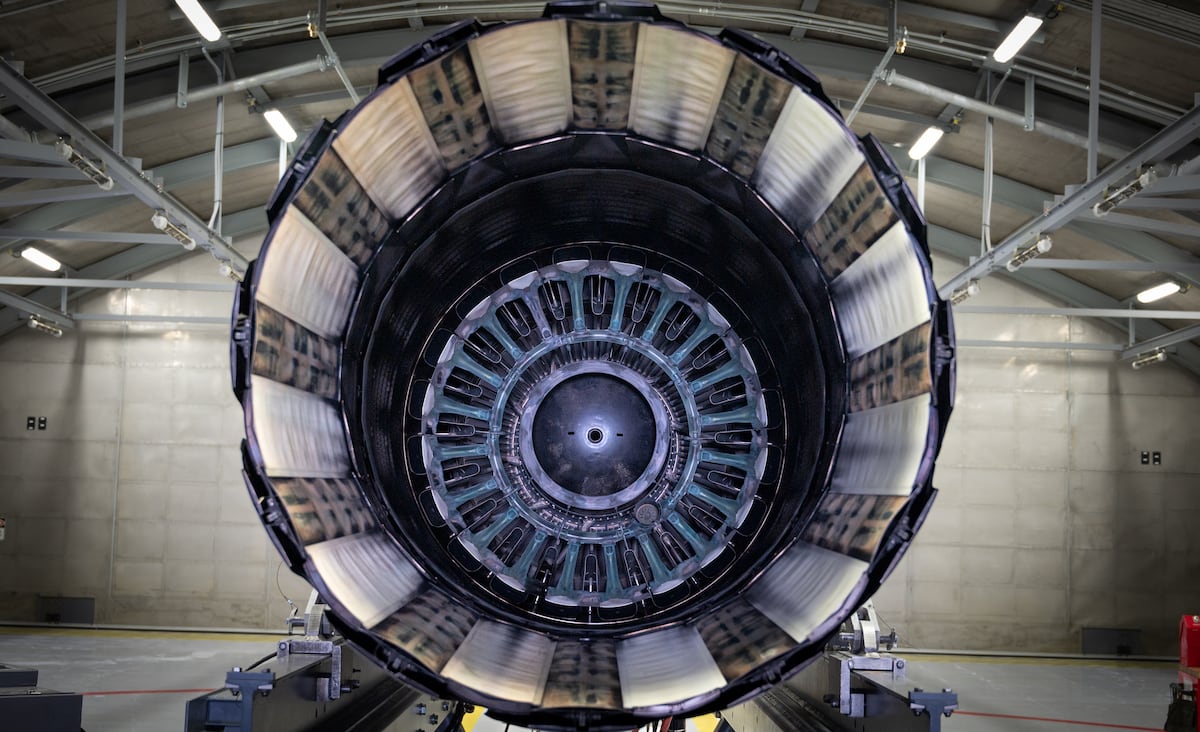

Dissatisfied with the quality of the engines for its fighter jets, the U.S. Air Force is looking for new engines — and perhaps new manufacturers.
“The current industrial base has demonstrated significant challenges, including production delays, quality control issues, and critical obsolescence (i.e., diminishing manufacturing sources and material shortages) across key engine components,” warned the Air Force’s Request for Information. The deadline is Aug. 28.
“The government will pursue a strategic competition requiring industry to innovate manufacturing and guarantee supply chain resiliency,” the RFI said.
The initiative comes as the Air Force struggles with its jet engines.
For example, F-35 fighter deliveries and upgrades have been delayed by engine issues, with a Government Accountability Office report noting last year that “the engine contractor is still not delivering engines to contract specifications after 20 years of production.”
Meanwhile, B-52 modernization has been stalled in part by engine issues that have raised costs by $3 billion and delayed initial operational capability by 15 months, according to GAO.
In turn, the Air Force is now embarking on a multiyear fighter engine procurement project that envisions more than 180 engines per year by 2034. The RFI specifically cites engines for the F-15EX and F-16.
The RFI promises “five foundational pillars designed to drive a paradigm shift in engine procurement and sustainment,” as the government shifts from “legacy procurement toward incentivizing industry-led technological evolution and capacity expansion.” These include “holding vendors accountable” for delivering new engines that are more capable, reliable and cheaper.
The Air Force will focus “on the total lifecycle cost of the engine, not just the initial purchase price.”
Contractors are also responsible for ensuring reliable supply chains.
“We will implement an acquisition strategy that prioritizes ease of maintenance and establishes a resilient, sustainable supply chain from day one,” the Air Force said. “This effort is designed to solve key fleet-level issues by requiring a newer engine with improved supportability.”
“The result is a streamlined logistics footprint that reduces downtime, lowers the burden on our maintainers, and ensures the continuous flow of parts and support to maximize flightline readiness.”
Ultimately, the question is whether the U.S. defense industrial base can deliver. The Air Force intends to “enforce stringent producibility requirements.”
“We will select a partner capable of scaling production to meet surge requirements, guaranteeing a steady and uninterrupted supply of engines for USAF/FMS [Foreign Military Sales] aircraft (e.g. F-15EX and F-16) programs,” the RFI reads.
Companies responding to the RFI are asked to provide a variety of details, such as a timeline for developing and manufacturing an engine. They should also specify “at what minimum volume your supply chain can justify private capital investments (such as facility expansion, tooling modernization, or advanced automation) and how those investments will structurally lower your long-term unit costs.”
With nations competing to obtain raw materials — and China restricting sales of rare earths — the Air Force wants to be certain manufacturers can find the raw materials they need.
“From your company’s market perspective, what are the primary raw material constraints (e.g., specialized titanium/nickel alloys) or manufacturing process bottlenecks (e.g., advanced casting or forging capacity) that pose the highest risk to scaling up fighter engine production?” the RFI asks.
Michael Peck is a correspondent for Defense News and a columnist for the Center for European Policy Analysis. He holds an M.A. in political science from Rutgers University. Find him at theuncommondefense.com. His email is [email protected].
Read the full article here
