



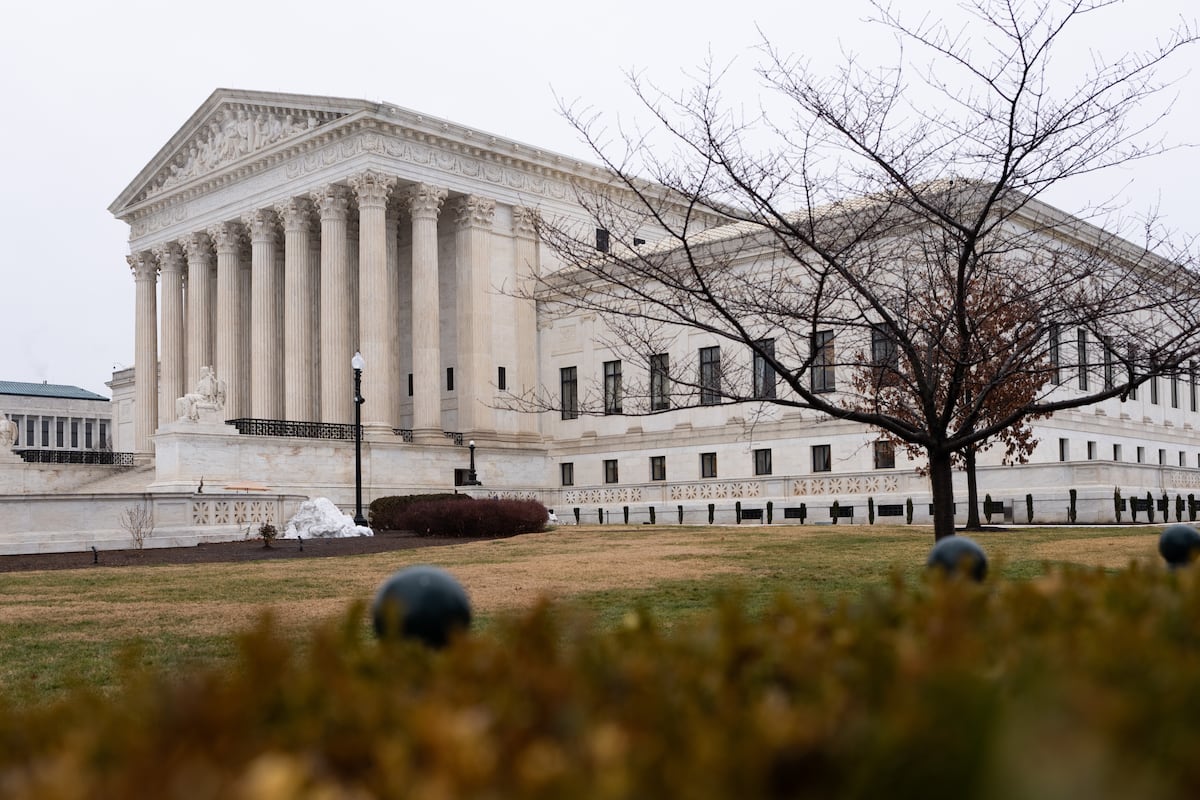

The U.S. Supreme Court has affirmed an Army soldier’s right to sue a military contractor whose employee detonated a suicide bomb on Bagram Air Base, Afghanistan, in 2016.
In a 6-3 decision, the justices overturned a circuit court ruling that said veteran Army Spec. Winston Hencely could not cite state law to hold Fluor Corp. liable for an employee’s actions.
Hencely had sued the company for negligence in state court in South Carolina, where two Fluor subsidiaries were headquartered. The bombing killed five service members and civilians and injured 17, including Hencely, who suffered a traumatic brain injury and lost the use of his left hand, arm and side of his face.
Writing the opinion for the majority, Justice Clarence Thomas said Fluor’s argument — that it had immunity in wartime under federal law that shields the military from being sued for combat-related decisions — and the circuit court’s support of that defense swept “too broadly.”
“Fourth Circuit … nonetheless found preemption simply because the suit arose in a wartime combat setting. [Another case decision’s] rationale, [Boyle v. United Technologies Corporation] justifies no such blanket preemption,” Thomas wrote.
Thomas added that neither the Constitution or any federal statute explicitly preempted the suit.
“The Court has already held that the Federal Tort Claims Act’s combatant-activities exception does not itself apply to suits against federal contractors,” Thomas wrote.
In late 2016, Ahmad Nayeb, an Afghan national who worked for Fluor and had known ties to the Taliban, built a bomb in his on-base space using work materials and tools.
Nayeb failed to board an escort bus the morning of Nov. 12, 2016, after work but no one reported him missing. He then walked across the base toward a staging area for a 5K Veterans Day race and detonated the bomb in a crowd of more than 200.
The Army investigation found that Fluor violated its contractual duties by providing Nayeb with the tools used to carry out the attack and failing to monitor his movements during escort duties.
Troops are barred from suing the U.S. military for injuries sustained in service under the Feres doctrine, a legal restriction stemming from several 1950s era Supreme Court cases.
They are allowed to sue defense contractors for negligence in their duties working for the U.S. government in combat zones but have seen mixed success, either losing their cases outright or winning but seeing them later overturned by higher courts.
Hencely’s suit differed from most previous cases in that he filed in state court in South Carolina, where two Fluor subsidiaries are based, and made claims against the company under the state’s negligence laws.
In their opinion, Thomas, joined by Justices Sonia Sotomayor, Elena Kagan, Neil Gorsuch, Amy Coney Barrett and Ketanji Brown Jackson, upheld the state court’s jurisdiction over companies, adding that contractors do not automatically share the government’s immunity.
“Although the Constitution gives Congress and the President broad war powers, that assignment has never been understood to bar all war related tort suits,” they said. “Absent a statue to the contrary, states can regulate or tax federal contractors on the same terms as any private company.”
Chief Justice John Roberts and Justices Samuel Alito and Brett Kavanaugh disagreed and Alito filed a dissenting opinion.
“May a state regulate security arrangements on a military base in an active war zone? May state judges and juries pass judgment on questions that are inextricably tied to military decisions that balance war-related risks against long-term strategic objectives? In my judgment, the answer to these questions must be ‘no,’ and for that reason, this state-law tort case is preempted by the Constitution’s grant of war powers exclusively to the Federal Government,” Alito wrote.
The families of those who were killed and at least eight other injured service members also have filed a lawsuit against Fluor, but that case was on hold pending the Supreme Court’s decision in the Hencely suit.
Killed in the attack were U.S. soldiers Pfc. Tyler Iubelt, 20, Staff Sgt. John Perry, 30, and Sgt. 1st Class Allan Brown, 46, as well as Fluor contractors Peter Provost, 62, and retired Army Col. Jarrold Reeves, 57.
As a justice, Thomas has sided with U.S. troops harmed by negligence by the federal government in non-combat situations, including medical care and off-duty events.
He has argued that the Feres decision should be overruled. Last year, after the court rejected a case that would challenge the Feres decision, Thomas penned a strongly worded 14-page dissent, calling the law “indefensible” and a “senseless as matter of policy.”
Patricia Kime is a senior writer covering military and veterans health care, medicine and personnel issues.
Read the full article here
