



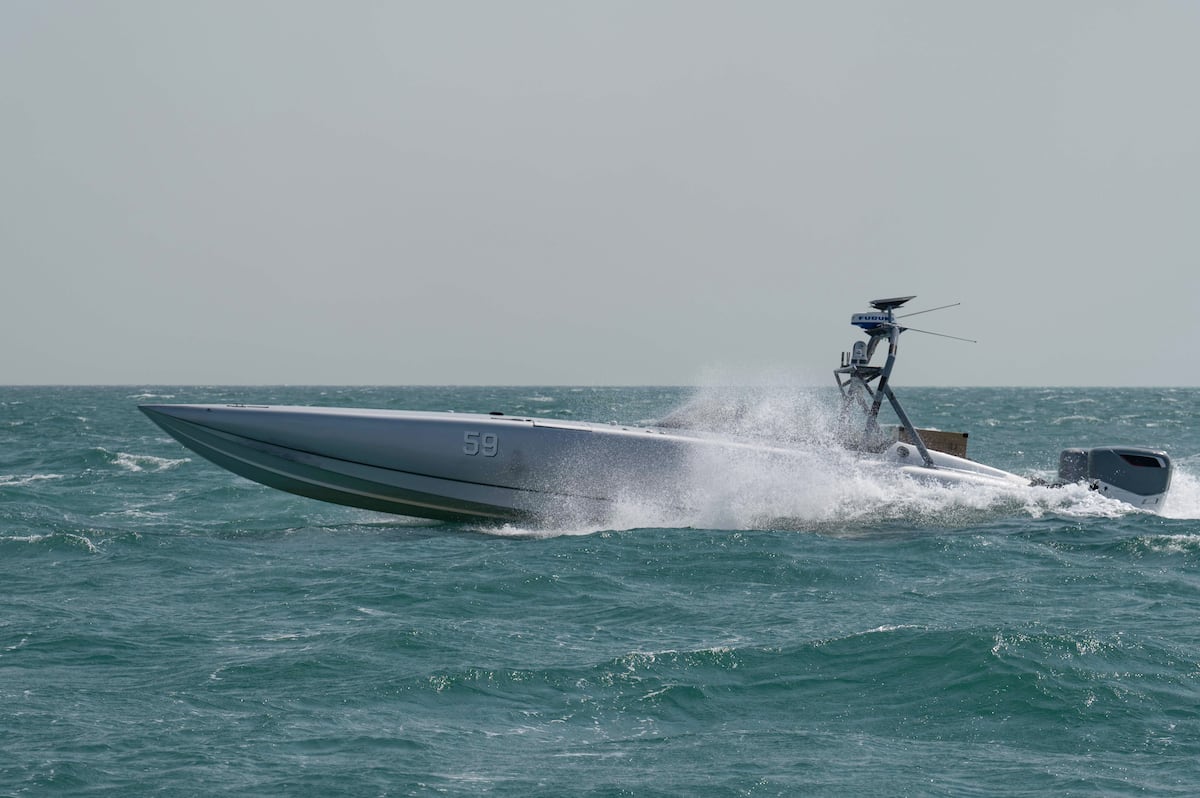

Spurred on by the threat of unmanned boats and small drones in contested waters such as the Persian Gulf, the Pentagon has set out to quickly find a cheap countermeasure.
The Defense Department has put out a solicitation for robot boats that are capable of launching small attack drones — with technology mature enough to be deployed to the field within 120 days.
The goal for the Suitable Warfighting Adaptive Payloads, or SWAP-USV, project is to find “mature, market-ready [unmanned surface vessels] fully integrated with two or more mature, market-ready aerial drones to detect, identify, track, and defeat hostile threats,” according to the Defense Innovation Unit solicitation. The call out set a response deadline of Aug. 10.
To make this happen, DIU created a year-long contest backed by $100 million in prize money. DIU wants to “partner with established maritime manufacturers, autonomy developers, sensor manufacturers, and UAS developers to execute a multi-phase Prize Challenge.”
The SWAP-USV project is billed as a solution to a problem that has also plagued missile and drone defense on land: the economics favor the offense.
“The cost-exchange ratio for detecting and neutralizing asymmetric maritime threats in contested environments is heavily skewed in favor of the adversary,” the DIU solicitation states. Nor can the U.S. military continue to rely “on exquisite, multi-million-dollar naval and aviation assets to intercept these inexpensive targets.”
The solicitation paints the picture of a drone boat that can carry, launch and control at least two small UAVs. The UAVs together should be capable of conducting kinetic strikes with a combined payload of at least 2 kilograms, or just over 4 pounds.
DIU wants a mix of recoverable and one-way attack drones that can patrol ocean, coastal and riverine waters, and loiter on station. The drones, according to the solicitation, should “support one or more operational effects, including ISR, comms relay, electronic warfare, payload delivery, or precision engagement of moving or stationary, as applicable, under operator command.”
The Pentagon also wants the system to be mobile enough to fit into a standard cargo container, on road trailers or on C-17 and C-130 transports.
“Solutions that can launch from unimproved locations or provide additional launch flexibility, i.e. remotely from a container, will be looked upon favorably,” DIU noted, adding that the UAVs should be “technically mature and have an established production line.”
Interestingly, among the maritime threats the DIU solicitation cites are “‘go-fast’ smuggling boats, and semi-submersibles.” Drug cartels have used semi-submersibles to transport contraband from South America to the U.S., and such pseudo-submarines are hard to detect.
The SWAP-USV project calls for robot craft capable of “autonomous surveillance and interdiction of defined maritime operating areas, maximizing operational coverage, probability of detection, interdiction effectiveness, and time on station while minimizing daily operating cost, logistics burden, and required personnel.”
The surveillance elements of the solicitation state that the drone boat must be able to “autonomously follow or shadow a vessel of interest, and autonomously intercept a noncooperative, maneuvering vessel. Autonomous execution of these functions is desired but not required.”
The SWAP-USV Challenge, meanwhile, comprises three “sprints,” or phases, each with separate prize money. To sweeten the pot further, companies that pass the test in each phase will be eligible for procurement contracts backed by a $200 million budget.
Sprint 1 calls for in-water testing in fall 2026, with a goal of deploying a system in the field within 120 days.
“Solutions must include a complete mission ready USV with integrated drone capability system available for testing and evaluation within 29 days of down-selection for Sprint 1,” the solicitation specified. There will be $40 million in prize money.
Sprint 2 will have a fall 2026 deadline and in-water testing in early 2027, with the focus on “expanded payloads, upgraded autonomy, and multi-vendor integrations.” The prize money for that timeframe will also be $40 million.
Sprint 3 will take submissions in early 2027, with in-water testing in summer 2027. The goals of this phase will be announced later, but there will be $20 million in prizes.
Companies must specify which phase they want to join. “The government reserves the right to assign applicants to [Sprint] cohorts based on technical and manufacturing maturity,” the solicitation noted.
Michael Peck is a correspondent for Defense News and a columnist for the Center for European Policy Analysis. He holds an M.A. in political science from Rutgers University. Find him at theuncommondefense.com. His email is [email protected].
Read the full article here
