



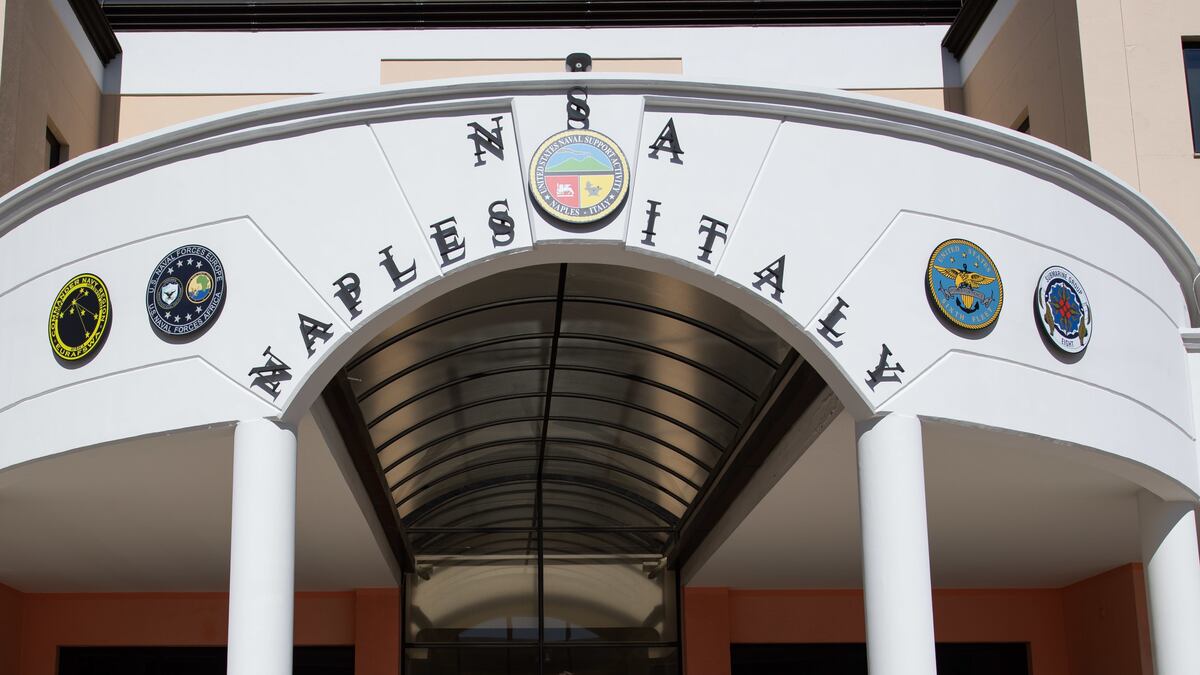

A U.S. Navy installation in Italy confirmed the presence of a toxic gas in some of its non-residential buildings, including schools, after previously rejecting the results of the detection test that uncovered the problem, the service announced.
Naval Support Activity Naples conducted a year-long analysis of radon levels at non-residential facilities from August 2024 to September 2025 but announced on Feb. 9 that the results it received in January were not reliable, as they did not meet the Navy Radon Assessment and Mitigation Program’s quality assurance standards.
NSA Naples has since reversed course, however, announcing May 4 that the results were in fact “valid and reliable.”
“Between August 2024 and October 2025, alpha track detectors were installed for long-term radon monitoring across 1,536 testable locations/rooms in 123 non-residential buildings at NSA Naples,” the Navy said. “Results were obtained from 1,449 of these locations, revealing 37 instances of elevated radon average concentrations.”
The Navy did not test residential buildings because those facilities were last tested in 2022 and 2023, and the Navy Radon Assessment and Mitigation Program requires testing every 5 years.
RELATED
The service began an error analysis process after the initial rejection of data occurred in February and found that the results met accuracy standards after all, NSA Naples said.
Radon exposure higher than four pCi/L, a unit of measurement that tracks radioactive decay, requires mitigation, according to the U.S. Environmental Protection Agency. All of the 37 rooms flagged for heightened radon exposure had pCi/L levels that exceeded four, with some as high as 12.
Elementary school and high school facilities affiliated with the installation, as well as a golf shop, were among those listed as containing a hazardous amount of radon.
The Navy said it will work to reduce those levels so that they fall below four pCi/L within the next two years, but it did not provide specifics as to what those mitigation strategies might entail.
Radon is a gas undetectable by the human eye or nose that results from the natural decay of uranium and thorium in rocks, water and soil. Individuals who are exposed to the gas over a long period of time have an increased risk of lung cancer.
The Department of Defense Office of Inspector General released a report on Aug. 19, 2024, raising concerns about the Navy’s handling of elevated radon levels at NSA Naples.
The report urged Navy officials to communicate better with individuals after finding that NSA Naples Housing and Public Affairs Offices “did not inform the 3,997 DOD personnel and dependents living in non-GO-GC off-base housing of the known potential for elevated radon levels.”
NSA Naples launched a radon detection assessment the same month.
Riley Ceder is a reporter at Military Times, where he covers breaking news, criminal justice, investigations, and cyber. He previously worked as an investigative practicum student at The Washington Post, where he contributed to the Abused by the Badge investigation.
Read the full article here
