



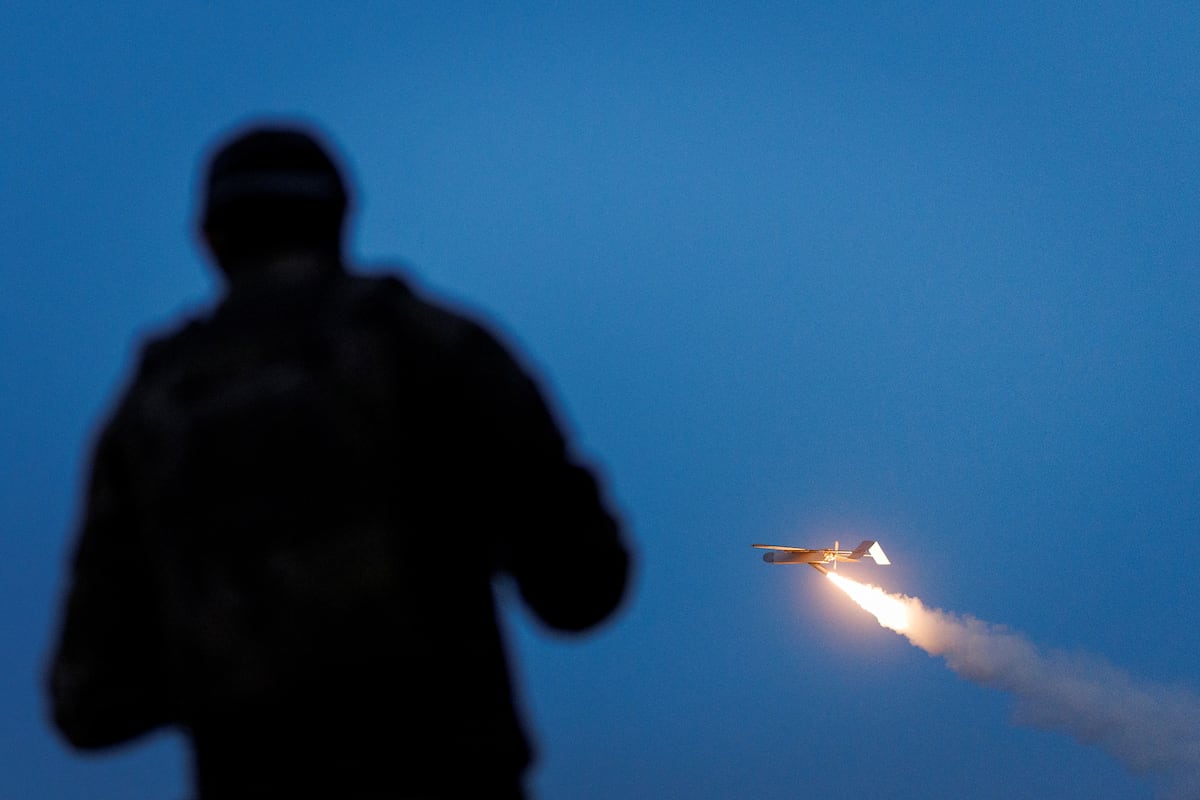

In a field in southern Ukraine, soldiers scrawled sardonic messages on a sleek grey attack drone that would soon be hunting Russian ships on the Black Sea — part of a widening Ukrainian campaign to isolate Crimea and weaken Moscow’s war effort.
Operating far behind the front line on Ukraine’s sweeping steppe, such units have hit more than 180 vessels and other sea-borne targets around the peninsula over the past three weeks, opening a new front in the war.
The attacks, first in the Sea of Azov and now expanding into the Black Sea that it opens into, are designed to raise the cost for Russia of occupying Crimea and to swing the initiative towards Kyiv in the fifth year of full-scale war in Ukraine.
“We work day and night, every day, without time off,” said battalion commander “Ray” of Magyar’s Birds, a brigade that is an important part of the effort. In line with Ukrainian military practice, he identified himself only by his call sign.
During a recent visit by Reuters, his team launched drones every couple of minutes. The unit said it struck a cargo vessel and floating crane in the Black Sea and a power substation in south Crimea. Reuters could not independently verify this.
The attacks are part of the growing duel in strategic waters in recent weeks, during which Russia has stepped up strikes on Ukrainian ports and international cargo ships.
Kyiv’s agriculture minister said on Thursday that shipowners had temporarily suspended vessel arrivals at Ukraine’s Black Sea ports for agricultural exports following the surge in attacks.
BATTLE OVER CRIMEA
Crimea, which serves as a transit and military hub for Moscow’s troops, has become a new focus for Ukraine’s drone forces as they scale up their strike capabilities.
In recent months, they have targeted road and rail links in a swath of occupied southern Ukraine that connects the peninsula to Russia — which seized and annexed it in 2014, long before Moscow’s full-scale invasion of Ukraine in 2022.
That has led to fuel shortages and a state of emergency in Crimea, with power and gas facilities also systematically hit.
Now, attacks on oil tankers, dry cargo ships and other vessels mark a widening of Kyiv’s effort to pressure Russian forces by starving them of resources.
Since the new phase of their campaign began in July, drone forces under commander Robert “Magyar” Brovdi have reported hitting about six vessels per day, detailed by Brovdi in mocking, emoji-riddled reports.
The attacks have choked Russian shipping through the Sea of Azov, which receives ships from Russia’s main southern grain-producing region via the Don River.
Brovdi’s forces said the Kerch ferry crossing between eastern Crimea and Russia’s Krasnodar region had lost around 75% of its capacity. Reuters could not verify this.
The commander told Reuters the attacks were aimed at “ruining the myth” of Russian domination and establishing total control over Ukraine’s territorial waters.
The new campaign is dubbed “Molochko”: a portmanteau that sounds like the word “milk” but denotes the phrase “Moscow will collapse because of Crimea.”
Sidharth Kaushal, a senior fellow at the Royal United Services Institute think tank in London, said Ukrainian attacks on Russian overland logistics had led to an increase in shipping through the Sea of Azov, thus providing more sea-borne targets.
The attacks, he said, are “a logical continuation” of Ukraine’s Crimea campaign.
RUSSIAN ATTACKS ON PORTS AND VESSELS
Ukraine’s strikes have been mirrored by intensifying Russian attacks on southern Ukraine, particularly the city of Odesa and ports that send much of the country’s grain through a maritime corridor to international markets.
On Sunday, 10 sailors were killed after Russian forces struck a Guinea-Bissau-flagged vessel carrying corn from the port of Odesa, Ukrainian officials said.
Last week, at least three people were killed in attacks on Odesa and Mykolaiv, another port city.
In the first two weeks of July alone, Russia struck Ukrainian ports 23 times and civilian vessels 17 times, Kyiv’s seaports authority said last Thursday, leaving traders struggling with logistics headaches.
Agricultural exports such as grains and vegetable oils remain Ukraine’s biggest source of foreign currency earnings, with more than 90% shipped from ports in the Odesa region through a maritime corridor.
Russia has said its attacks are aimed at infrastructure storing military cargo and fuel.
HUNTED BY RUSSIANS
The Ukrainian-made FP-1 and FP-2 drones used by battalion commander Ray’s team are a staple of Kyiv’s growing arsenal. They fly automatically to the operational zone, then pilots — often based far away — take over to land the final blow.
Minutes after catapulting their last propeller-powered drone using a small jet booster, the launch team packed up and prepared to move. No site is re-used and teams are often sent to new locations at a few hours’ notice.
Although technological advancements have allowed them to launch from over 100 km, or 62 miles, behind front lines, they are still a prized target for enemy drone teams.
“This is a constant war — a continuous struggle of measures and countermeasures,” said Ray, who commands his brigade’s ninth battalion, called Kairos.
Panama, a squadron commander, said he and fellow troops were motivated by the “tangible results” of their operations.
Beyond complicating Russian logistics, the campaign is boosting Ukrainian morale.
“It’s great that our tempo is so high,” he said, “but we still need to sustain it.”
Read the full article here
