



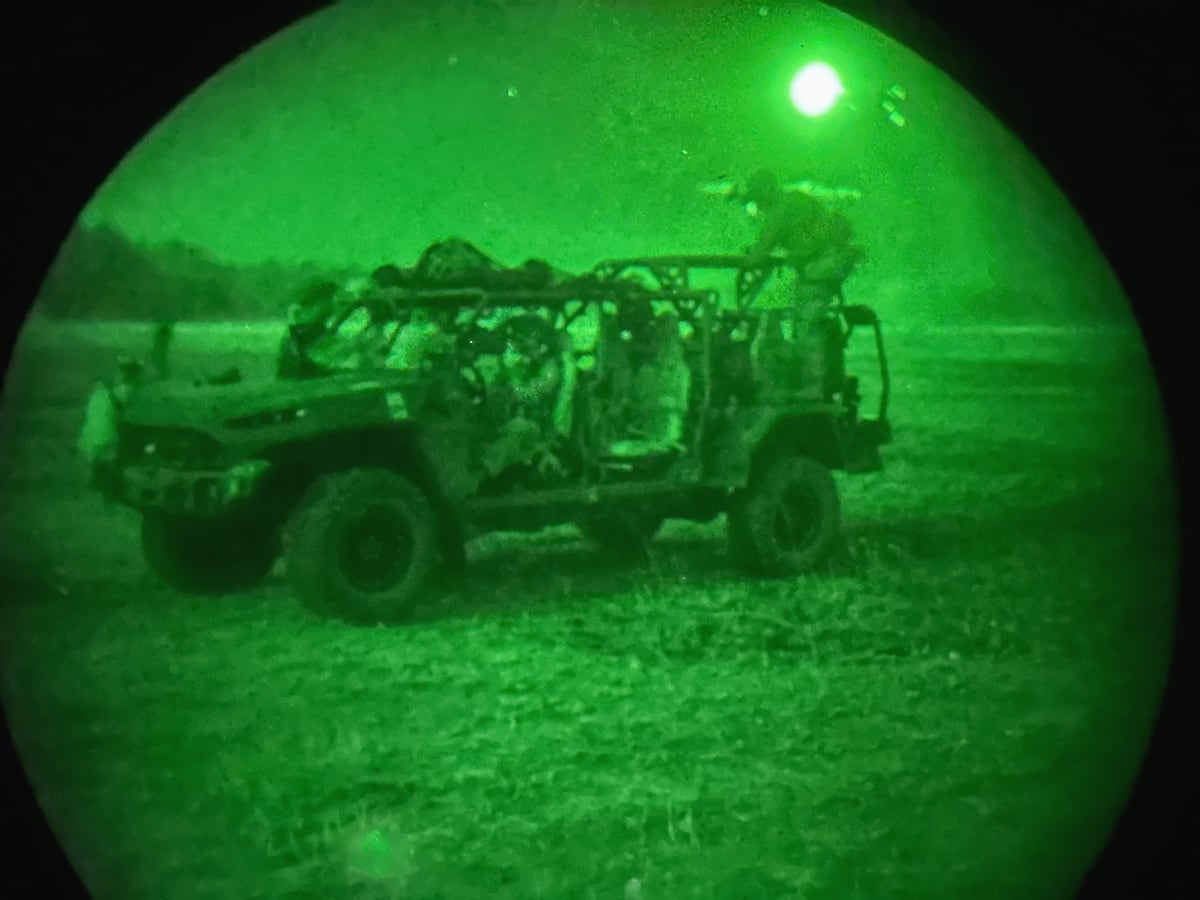

The U.S. Army has pitted three manufacturers against each other to build competing prototypes of its future infantry squad vehicle.
The service on June 30 awarded firm-fixed-price Other Transaction Agreements to Ford, GM Defense and BC Customs, the Army confirmed Tuesday. Each company will deliver three Infantry Squad Vehicle-Heavy, or ISV-H, models, with the first expected by March 30, 2027. The six-seat platforms will then be tested with the Army Test and Evaluation Command.
The Wall Street Journal first reported the awards on Monday.
Military Times requested the dollar amounts of the contracts, but the Army did not specify the cost.
In a Commercial Solutions Opening, or CSO, published in April, the Army posted that it was looking for vehicles capable of carrying a 4,000-pound payload, towing a 6,500-pound trailer and supporting large power requirements. The service wants its new ISV-H able to export 60 kW of continuous high-voltage DC power — an immense load — so soldiers can operate counter drone systems, electronic warfare, directed energy weapons and more.
The Army also wants the vehicle to be rechargeable — able to replenish its power to 90% within six hours — in conditions ranging from extreme cold that dips to -25 degrees Fahrenheit to intense heat climbing to 130 degrees.
The Army is preparing for autonomous operations, with desired specifications like architecture already in place for “drive-by-wire.” It also wants rotating rear seats and “ergonomic mobile workstations,” as well as rear seating that can be quickly configured — without tools — to hold a litter for evacuations.
The current Infantry Squad Vehicle, built by GM Defense, was designed to quickly move nine soldiers through landscapes that were dangerous or impractical to use other military vehicles.
The Army’s fiscal 2027 budget request, released in April, calls for purchasing an initial 34 ISV-H vehicles at an estimated cost of $463,000 per truck, with a long-term goal to buy 606 vehicles.
In a June Senate Armed Services Committee hearing, Jess Tolleson, principal deputy assistant secretary of the Army for Acquisition, Logistics, and Technology, said the ISV-H needs to fill a power-generation shortfall.
“One of the things that we do have a critical capability gap on right now is power generation at that mobile brigade combat team level,” he said.
GM Defense had not responded to a Military Times inquiry at the time of publication but previously said on social media that it was optimizing a Chevrolet Silverado 3500HD truck.
Ford, in a Tuesday statement regarding the contract, said its Super Duty trucks are well suited for military applications but did not provide further details on the specifications. Breaking Defense on Monday reported Ford would be using its F-Series pickup truck.
In a call on Tuesday, BC Customs chief operating officer, Dave Baringer, said the company was uniquely able to create an endlessly modify-able, “purpose-driven, ground-up vehicle.” He also said BC Customs was working in cooperation with Raglan, a company that will handle the electronic infrastructure of the prototypes. Baringer declined to discuss the timeline or contract amount.
The Army’s quest for a vehicle that can produce powerful amounts of energy comes amid its push to field more energy-directed weapons on lighter tactical vehicles.
The service has already operationally tested AeroVironment’s 20-kilowatt LOCUST laser aboard both the Infantry Squad Vehicle and Joint Light Tactical Vehicle through its Multi-Purpose High Energy Laser effort.
Eve Sampson is a reporter and former Army officer. She has covered conflict across the world, writing for The New York Times, The Washington Post and The Associated Press.
Read the full article here
