




The House rejected a move to send a controversial veterans benefits bill back to committee for reconsideration and postponed a vote on the legislation Thursday, with House Speaker Mike Johnson saying that the bill likely won’t be raised again “for weeks.”
In a surprising morning that followed more than an hour of heated debate over the Take Care of America’s Veterans Act on the House floor, Rep. Chris DeLuzio, D-Pa., offered a motion to return the bill to the House Veterans Affairs Committee for review.
The vote on DeLuzio’s proposal was to precede a final vote on the legislation, which has divided veterans groups, and the chamber rejected the effort in a 210-211 vote, with one of four Republicans who initially supported it, Rep. Victoria Spartz, R-Ind., changing her vote at the last minute.
But instead of proceeding with the final vote as planned, House leadership pulled the bill, with Johnson saying a decision on the measure now will be delayed for several weeks.
Punchbowl News reported that Johnson blamed “misinformation” over the bill for his reasons to hold the vote.
“Our Veterans Affairs Committee has done a great job engaging with veterans … There still remains, though, a lot of misinformation out there, so instead of putting the bill on the floor this afternoon, we’re gonna delay it just a bit. We’re gonna have several more weeks ahead of us before we get back here in September would be my guess when we process all this again,” Johnson told reporters.
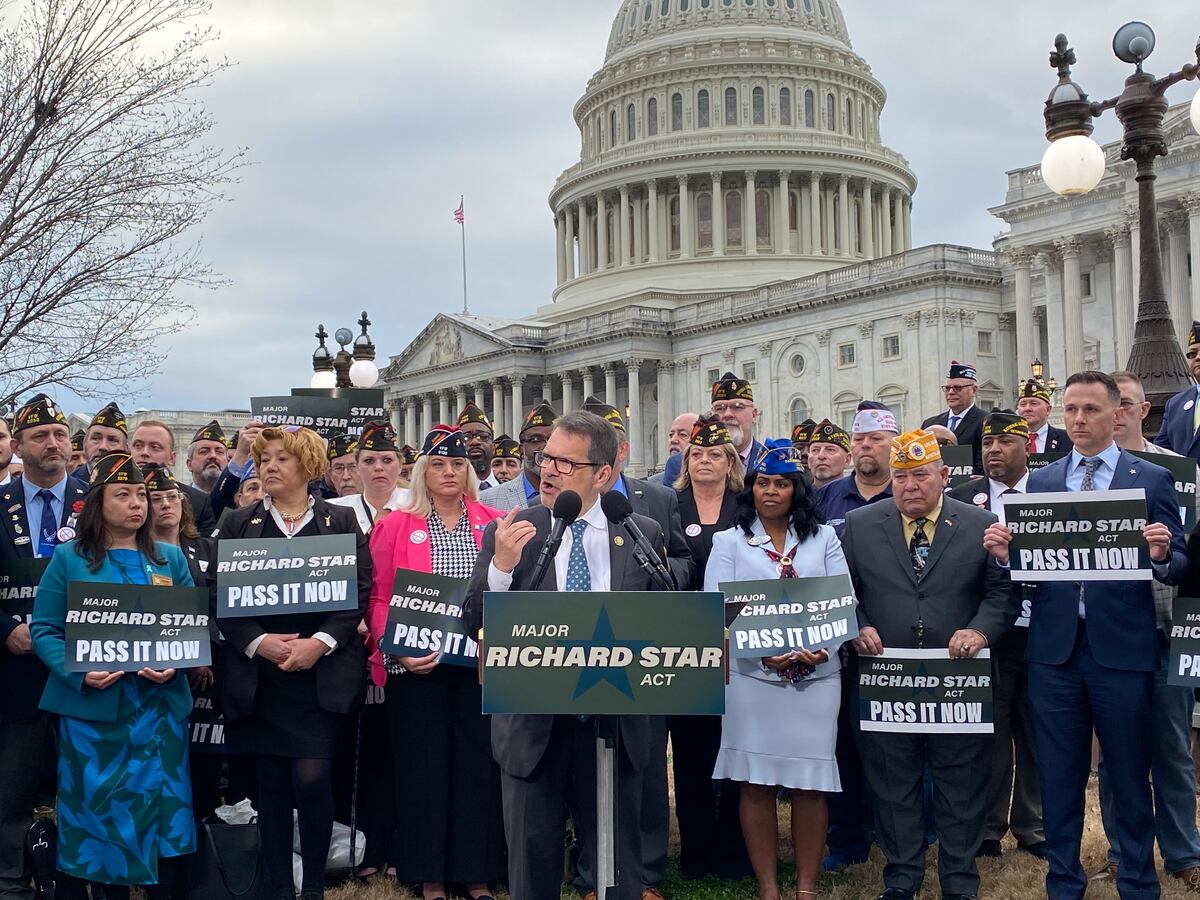
The Take Care of America’s Veterans Act, H.R. 9237, encompasses more than 60 pieces of legislation, many of which have widespread support among veterans and advocates, such as the Major Richard Star Act, which would give retired, combat-injured veterans their full Veterans Affairs disability compensation and military retirement, and the Love Lives On Act, which would continue benefits for surviving spouses of the fallen if they remarry before age 55.
But the proposal for covering the cost — enacting a planned rule that would change the requirements for disability compensation for two conditions that commonly affect veterans, sleep apnea and tinnitus, has split the veterans community and lawmakers.
Supporters say the payment proposal is vital to getting the legislation made into law while critics argue that future benefits for veterans should not be used to pay for current needs.
At least 22 veterans organizations support the bill. During a press conference Tuesday, Mario Marquez, the executive director of government affairs for the American Legion, said the proposal represents the best way forward for getting top priorities accomplished.
“Leadership is about carefully evaluating the facts making difficult decisions and accepting responsibility for those actions and those decisions,” Marquez said. “Progress only happens when leaders are willing to tackle difficult issues and keep veterans at the center of the conversation.”
But other groups vociferously oppose it, with the VFW and Disabled American Veterans leading the charge. Their representatives joined Democrat lawmakers in a press conference Wednesday to push lawmakers to vote against the bill.
VFW National Legislative Service Director Pat Murray said as an amputee who lost his leg in Iraq and medically retired, he would receive increased compensation as a result of the bill. But, he added, he didn’t want to “get those benefits at the expense of others.”
“We support the provisions of the Major Richard Star Act and we want the full act passed because that is what veterans deserve,” Murray said.
Prior to the planned vote Thursday, lawmaker engaged in heated debate that pitted the chairman and ranking member of the House Veterans Affairs Committee against one another. Chairman Rep. Mike Bost, R-Ill., said he had taken a lot of heat over the proposal but believed the bill helps “the greatest number of veterans.”
“This bill includes long-standing priorities for veterans, and importantly, it does so in a way that is paid for and capable of actually moving from here to the Senate and to the President’s desk,” Bost said. “At some point, we have to decide whether we’re going to keep talking about these promises or actually move a package that can become law.”
Rep. Mark Takano, D-Calif., the committee’s ranking member, has proposed pulling apart the legislation and voting separately on the provisions. Takano said that while he supports many of the legislation’s provisions, he disagrees with a proposal to raise VA home loan fees, several GI Bill initiatives, some health proposals and the payment structure.
“Let’s be crystal clear about what this bill does. It says to troops downrange right now who are in harm’s way that they have to have worse benefits than veterans have today to pay for benefits and care that other veterans have earned. That’s ridiculous,” Takano said.
VA officials confirmed to Military Times that they intend to follow through on the audiology portion of the proposed rule, which would mean that tinnitus, which currently receives a 10% disability rating, would be treated as a symptom of another condition, such as hearing loss or a traumatic brain injury, and would no longer get a standalone rating.
The officials did not address the sleep apnea portion of the rule, but a Politico reporter posted a message on X saying administration officials told her the VA has “made no move to withdraw the proposed sleep apnea rule and will be moving forward with the rule change that appeared on the regulatory agenda.”
Under the proposed rule, veterans with asymptomatic sleep apnea or a mild case controlled by treatment could receive a 0% disability rating.
Bost said that if the VA moves ahead with the 2022 proposed rule, without his legislation, the savings would return to the Treasury Department and not be allocated specifically to veterans.
The estimated savings of enacting the rule could be $57 billion over 10 years.
Patricia Kime is a senior writer covering military and veterans health care, medicine and personnel issues.
Read the full article here
