



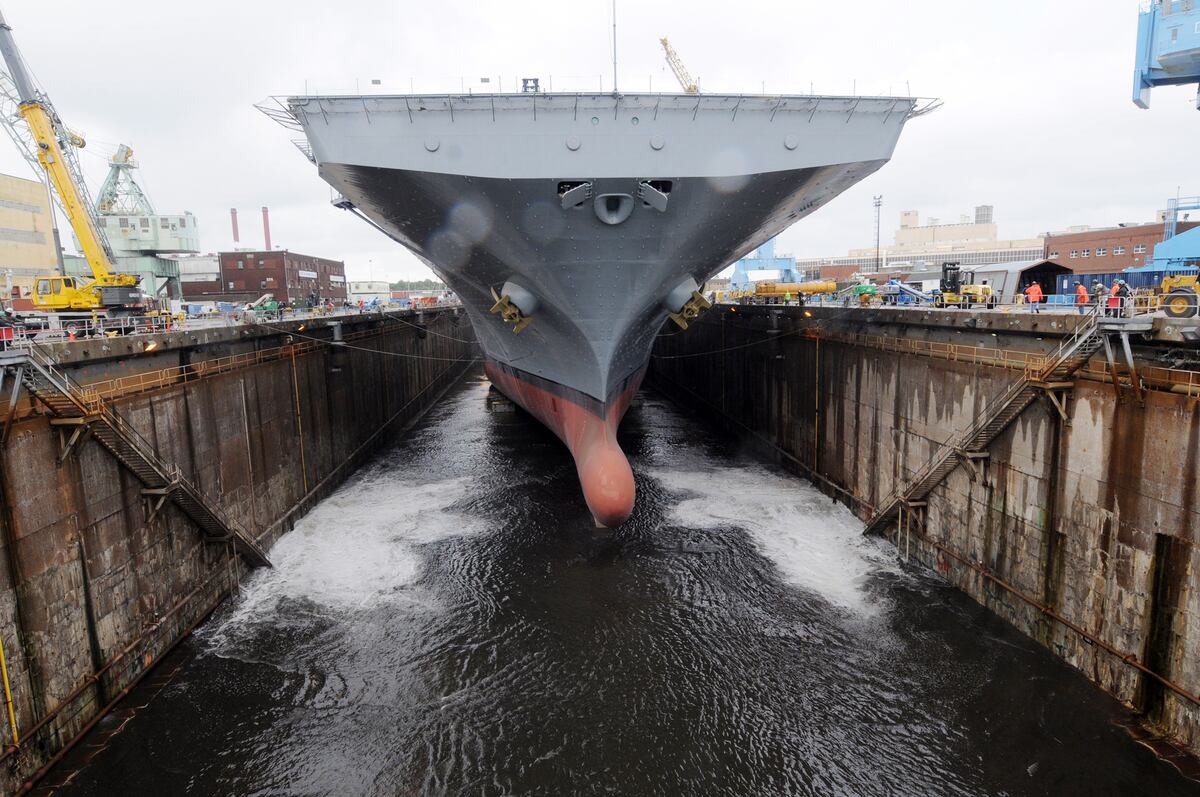

The Trump administration’s recent push to buy foreign-built warships is being waylaid by congressional defense committees who are seeking to limit the executive office’s ability to tap overseas construction yards to build out America’s naval fleet.
First reported on by the U.S. Naval Institute, the Senate Armed Services Committee’s markup of the Fiscal Year 2027 defense policy bill seeks to strip the presidential waiver authority granted to the commander-in-chief in Title 10 section 8679, which would allow the president to approve offshore ship construction under a vague description of “national security interest.”
Under the language of the markup, the defense secretary may arrange to “construct not more than two vessels for each class of covered vessels in a[n] [allied] foreign shipyard.”
“Covered vessels” listed within the bill’s language include only bulk fuel vessels and roll-on/roll-off ships.
Stipulations for such ships include the defense secretary determining — with evidence — that such a construction “is in the national security interests of the United States.”
Within 30 days of a construction deal with an Allied nation, the Pentagon must submit a report that aligns with the congressional stipulations, as well as the identification of the vessels to be built and “a description of the enforceable provisions that will govern the protection of classified information and controlled unclassified information” during the foreign construction process.
Additional requirements include “all critical mission systems, command and control equipment, and secure communications systems are installed in the United States or a secure allied facility; the vessels are projected to be constructed and delivered faster than if the vessels were constructed at a shipyard in the United States, or construction at a foreign shipyard otherwise provides a material benefit to readiness or force posture.”
The limitations put forth in the draft version of the National Defense Authorization Act were rolled out after the Trump administration revealed its designs to tap foreign shipyards to design and build U.S. Navy combatant ships.
Touting it as the “Finland model,” the expansion of auxiliary naval ships built from allied shipbuilders mirrors the push to expand the Coast Guard’s icebreaker fleet, solidified in the 2024 ICE Pact — a trilateral agreement between the United States, Canada and Finland to combine collective knowledge, resources and expertise to produce Arctic and polar icebreakers, according to the Department of Homeland Security.
“Those can follow the ICE Pact model where they’ll build up to two overseas, which would be concurrent with foreign direct investment into U.S. yards for subsequent ships to be brought, including their supply chain, and other guardrails,” a Senate Majority official told the U.S. Naval Institute last Thursday.
Overall, the service aims to increase its number of ships dramatically, according to President Donald Trump’s proposed $1.5 trillion fiscal 2027 defense budget.
There are currently over 290 battle force ships, though the number, according to Navy requirements by law, is 355, the document stated. The service intends to have 395 vessels in fiscal 2027 and 450 vessels by the end of fiscal 2031.
Currently, only 10% of shipbuilding is taking place at distributed sites. The service wants to increase that number to 50% to increase flexibility, reduce reliance on legacy shipyards and accelerate delivery.
Military Times reporter Riley Ceder contributed to this report.
Claire Barrett is an editor and military history correspondent for Military Times. She is also a World War II researcher with an unparalleled affinity for Sir Winston Churchill and Michigan football.
Read the full article here
