



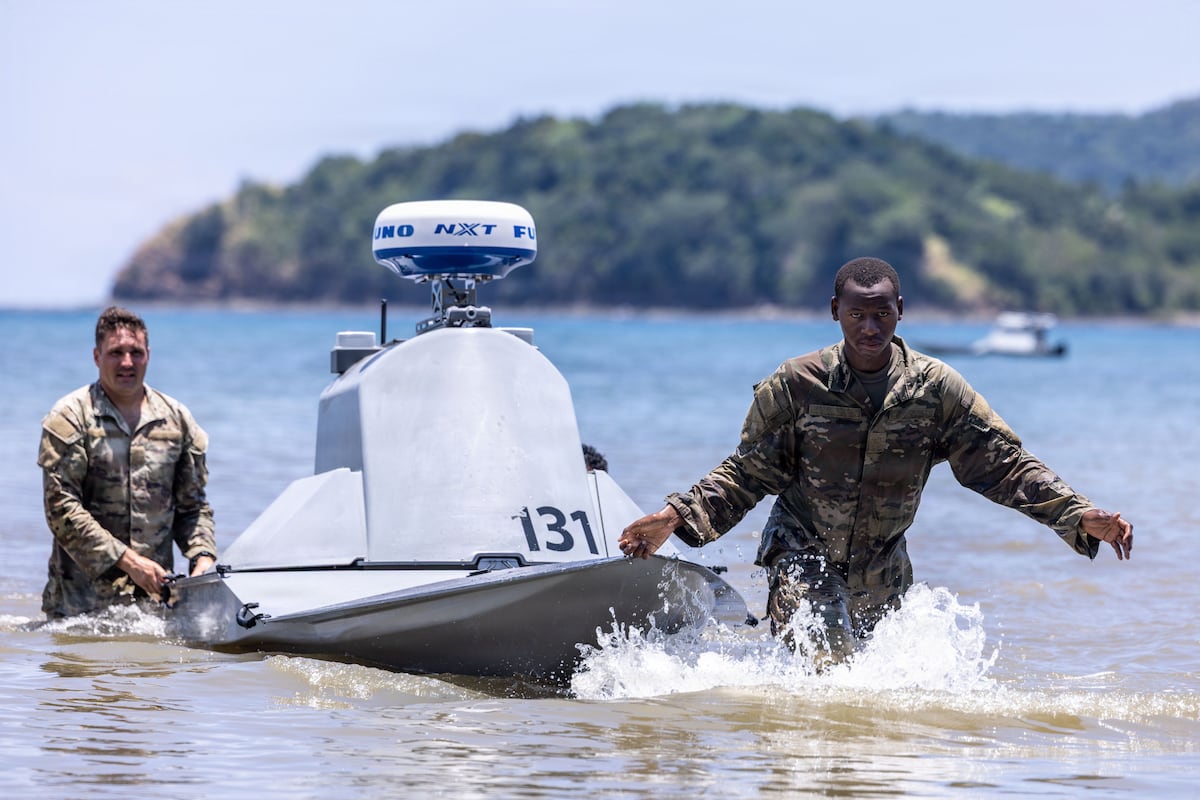

As the Army contends with a shortage of ships to carry troops and supplies in the Pacific, it’s pressing contract vessels into service – and looking to a future in which dozens of heavy-duty autonomous watercraft take on a significant portion of the task.
The Army’s little-known fleet of watercraft included about 70 Pacific-based vessels in 2024, down from 134 in 2018. According to a Government Accountability Office report published two years ago, the mission-capable rate of the remaining vessels has sharply declined, from more than 70% in 2020 to less than 40% in 2024.
In a roundtable with reporters this month, Maj. Gen. Gavin Gardner, commander of the Hawaii-based 8th Theater Sustainment Command, said the command had requested that industry deliver an autonomous vessel for testing as early as next summer, in hopes of rapidly building a fleet of 30 to 100 drone boats.
While the Army considered divesting its fleet around 2019, it has since reversed course, making key moves in recent years to build up both vessels and personnel to man them. In 2024, the service activated its first new composite watercraft company in years, the 5th Transportation Company out of Yokohama, Japan.
And just this year, 8th TSC’s lone Maneuver Support Vessel (Light) – the first of a small fleet of landing craft intended to replace the Vietnam-era Landing Craft Mechanized-8 – executed a first with a littoral high mobility artillery rocket system (HIMARS) launcher insertion on an austere beach.
“We can always use more watercraft,” Gen. Ronald Clark, head of U.S. Army Pacific, said earlier this year at the Land Forces Pacific symposium, according to a Stars and Stripes report. “Any commander that tells you he doesn’t need more is probably shooting beneath the target.”
Gardner and his senior enlisted adviser, Sgt. Maj. Montrell Kea, said they expected the future autonomous vessels to be heavy-duty, capable of carrying eight to 10 standard-size shipping containers.
“I could see those operating in the U.S. PACOM area of responsibility,” Gardner said. “I think that gives you a ton of operations, inventory in motion, easy to respond. And then because they’re autonomous, and we can work with our partner nations forward, you have those berthed up everywhere from Korea to Japan, the Philippines, Australia, Singapore, Thailand, etc.”
He added that the plan would be to control the autonomous vessels from 8th TSC headquarters, saving on mariner manpower and travel duty status costs.
“Clearly, [the autonomous vessels] would be forward in the theater, kind of moving supplies, because we have a constant demand for Army watercraft time now, to deliver equipment and supplies forward in the theater,” Gardner said.
Gardner didn’t name any companies he expected to be in the running to deliver these large autonomous vessels. Earlier this month, Army officials announced they had used much smaller autonomous boats in the Philippines to escort a logistics support vessel, in another demonstration of the capabilities of drone watercraft.
“Industry partners have come out and demonstrated some unmanned vessels within the Pacific as a part of U.S. Army Pacific’s experimentation,” Gardner said.
“I don’t want to get ahead of where we are from a contracting, but we have offered up through Army senior leaders, that if we could have the opportunity to test and evaluate a contracted vessel as early as this time next summer, and we think that opportunity looks to be there as industry partners are developing capability. So we’ve asked to try to get the first one of those out to Hawaii next summer, so that way it would be able to participate in our ability to move equipment and supplies around Hawaii from like Oahu, say over to the Big Island of Hawaii. And so that is what we’re pressing for right now.”
In the meantime, Gardner said, the Army is actively pulling stored watercraft out of prepositioned stocks to position them forward in the Pacific, and contracting with two U.S.-flagged crewed offshore support vessels, crewed by Army mariners. The Army’s ultimately expected to receive six more Maneuver Support Vessels (Light), all prepositioned forward in Japan.
Even with autonomous vessels in the mix, training more soldiers to operate and supervise boats remains a priority. Gardner said the Army’s next composite watercraft company was set to become active in October, with another one to follow next year that could encompass autonomous as well as manned watercraft.
“We’re recruiting and training and bringing those that may have been previously in staff positions to bring them back on ocean status as we bring up that force structure in the theater,” he said.
He stressed that no Army plan has autonomous vessels taking over all watercraft duties; instead, they’ll be used in concert with strategically employed manned vessels, even at full fleet strength.
“I use autonomous watercraft to do routine delivery, and then I see my manned Army watercraft systems to really give commanders operational maneuver to deliver at the time and place of our choosing, on the beach, that maybe an autonomous watercraft doesn’t have the capability to do, but current Army watercraft systems are designed to do,” he said. “So one does kind of port-to-port, and then Army watercraft systems would then do, you know, from the ocean to a beach of our choosing.”
Read the full article here
