




Editor’s note: This article first appeared on The War Horse, an award-winning nonprofit newsroom covering the human impact of military service, in partnership with The Sacramento Bee. It is republished here with permission. Subscribe to The War Horse’s newsletter here and The Sacramento Bee here.
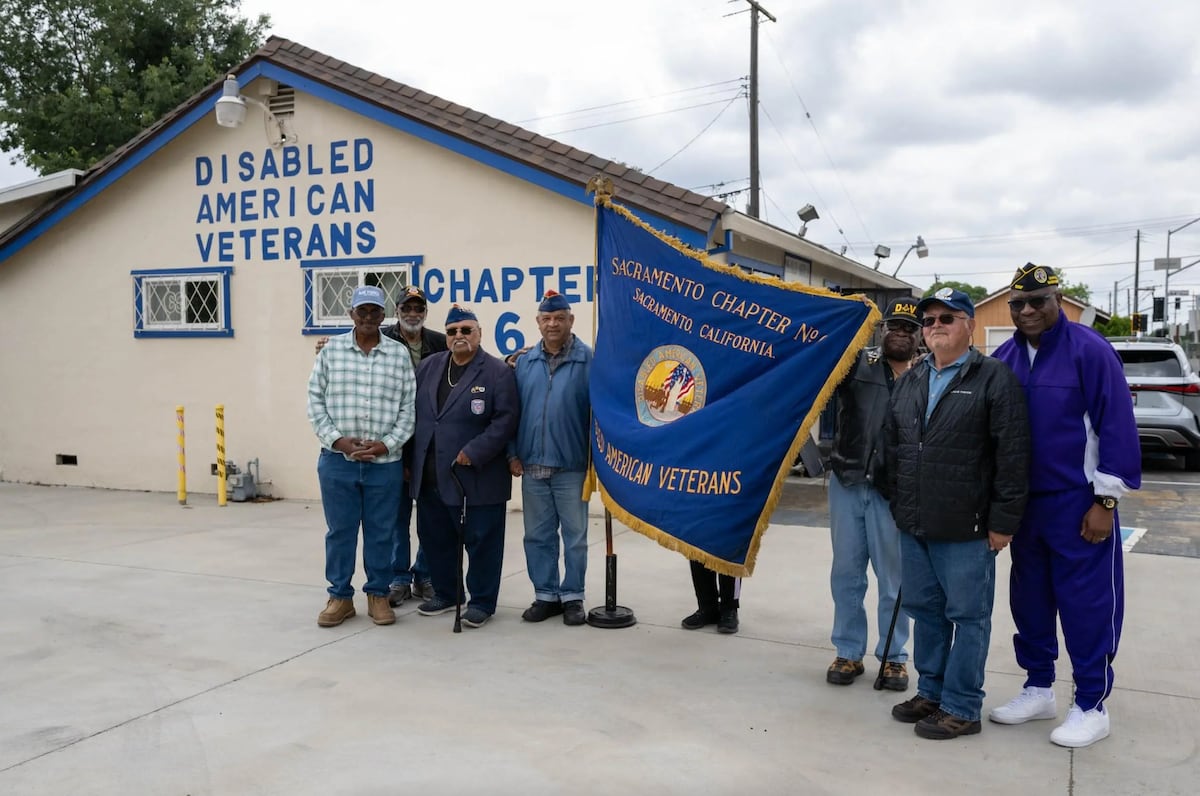
The Disabled American Veterans post in Sacramento, California, needed work. The small white building with blue trim and an American flag out front was built decades ago. Its heating and cooling system was ancient. The parking lot was riddled with potholes.
So when Chapter Treasurer Eldra Jackson Jr. learned they’d be getting a check for more than $39,000 from the estate of a California woman who had recently died, he was excited about tackling overdue repairs.
“It was a windfall,” said Jackson, who, like other officers at the Sacramento post, served as an unpaid volunteer.
But last fall, after Jackson reported the donation on the chapter’s annual financial report, he received a letter back from DAV national headquarters’ general counsel: The money didn’t belong to local veterans in Sacramento, it said. It belonged to the national organization, based thousands of miles away in Kentucky and backed by hundreds of millions of dollars in assets.
If the disabled veterans in Sacramento didn’t transfer the money to DAV’s national organization, the letter said, their chapter would be at risk.
“We’re doing the best we can to service veterans in our community,” said Chapter Commander Gilbert Tafoya, an Air Force veteran who was exposed to Agent Orange during the Vietnam War. “When all that is taken away, there’s something wrong.”
It may seem odd to see such a bitter dispute inside an organization built to serve disabled veterans. But the frustration that local vets in Sacramento feel toward their national organization isn’t unique. In interviews with DAV members from a dozen chapters in eight states, veterans told The War Horse that the national organization offered little financial support for their work with local veterans. But, they said, they felt DAV was quick to suspend or shut down small volunteer chapters over paperwork errors or requests for help with financial issues.
Local disabled veterans say that makes it harder to support veterans in their communities, whether by helping them navigate the notoriously complex Department of Veterans Affairs disability claims process, driving them to VA hospital appointments, or giving them a place to gather for Thanksgiving dinner with others who have served.
At the heart of this tension is a larger question facing America’s legacy veterans organizations: How do they serve veterans when the local post model that sustained them for generations is fading?
As the ranks of Korean and Vietnam War veterans thin, so do the member rolls of organizations such as DAV, the American Legion, and the Veterans of Foreign Wars. Younger veterans are less likely to join local posts, and groups like DAV are increasingly shifting toward national advocacy, online programming, and lobbying in Washington, D.C.
But in Sacramento and DAV chapters across the country, veterans say that sustaining local posts, where aging veterans can find community and purpose, should remain part of that mission.
“You’re supposed to be helping disabled veterans,” Jackson said. “All disabled veterans.”
Veteran Organization Membership Declines
Founded in 1920, Disabled American Veterans is a sprawling organization. More than 1,100 local chapters report to state departments, which in turn answer to the national branch.
“What DAV does at the national level, combined with what happens at the chapter level, that’s the life-changing impact,” said Dan Clare, DAV’s chief communications officer. “The chapters are feeding us veterans who need justice, who are not getting their benefits.”
DAV members typically pay dues to the national organization—topping out at $325 for a lifetime membership—and often join local chapters, where volunteers provide much of the hands-on support that veterans receive in their communities.
“We’re the grassroot. We do the work. We reach the veterans,” said Ace Taylor, a former commander of a local post near Salem, Virginia. His post was suspended by the Virginia state DAV in 2023 after, he said, he reported financial problems under the previous commander. The chapter, which was near a VA hospital, hosted veterans for meals and provided a space to relax between appointments.
The post “was a big part of the community,” Taylor said.
But DAV membership has been falling. In 2025, DAV had just over 900,000 members. In 2012, it had 1.2 million members, according to its earliest publicly available annual report. Clare, the DAV spokesperson, said the reduction in DAV’s membership was due to the organization cleaning up membership rolls to better reflect lifetime members. Meanwhile, larger veterans groups such as The American Legion and Veterans of Foreign Wars also struggle with membership. The American Legion, for instance, dropped from more than 2 million members in 2016 to 1.4 million last year.
American veterans are a shrinking population—VA estimates that the number of veterans will fall by about 30% over the next 20 years. Younger veterans, pulled by the demands of jobs and children, may have less free time to join volunteer groups. And, at least for some, veterans organizations like DAV seem like relics from another era.
“It’s part of a long decline of civic organizations in our country,” said Stephen Ortiz, a historian who studies veterans organizations at Binghamton University, The State University of New York.
“Since the Gulf War, you’ve had the internet, and since then social media, and that has for many Americans replaced the sense of connection from intensely local places to completely global places.”
Growing Coffers But Little Local Support
As membership in DAV has shrunk, however, the national organization’s coffers have grown. According to IRS filings, in 2024, DAV headquarters had net assets of more than $530 million. That’s up from about $289 million a decade earlier.
That’s not the entire financial picture, said Laurie Styron, the head of CharityWatch, a nonprofit watchdog that recently released an analysis of DAV financials.
DAV’s national structure also includes two affiliated organizations: DAV National Service Foundation and DAV Charitable Service Trust—which shares money and personnel among them, according to tax filings and audited financial statements. For instance, DAV charged the National Service Foundation and the Charitable Service Trust more than $100,000 each in 2024 for help with administering their business operations and fundraising. DAV’s top executive, National Adjutant Barry Jesinoski, is listed as vice president of both affiliated groups.
“They sort of give this illusion of separation,” Styron said. “But really, this organization is sharing all of these people. It’s sharing financial transactions.”
Styron said the overlapping structure makes it difficult for donors to know where their money goes.
The three organizations had a combined $750 million in adjusted net assets and about $171 million in cash expenses in 2024, according to CharityWatch’s analysis.
Asked about CharityWatch’s assertion that DAV’s structure makes donor transparency difficult, Clare called the watchdog group a “fringe evaluator.”
“CharityWatch likes to go after organizations like DAV because we have a good reputation and they can spark outrage,” the DAV spokesperson said. “This is their racket.”
Clare said DAV’s three different national organizations serve different purposes within the non-profit. And he pointed to the organization’s wide-ranging programs as evidence of its impact, both at the national and local level: helping to get veterans more than $33 billion in VA benefits last year, hosting job fairs and entrepreneur bootcamps, and successful legislative efforts. In 2022, for example, DAV helped push through the PACT Act, which expanded VA benefits to millions of vets who were exposed to toxic chemicals in the military.
But little of the organization’s money flows down to local chapters.
Even though members pay up to $325 for a lifetime DAV membership, local chapters only receive a small amount of that—currently no more than $3.50 per member annually, or just over 1% of lifetime dues, according to a recent DAV memo to chapter commanders. Chapters can also apply for grants from a national trust.
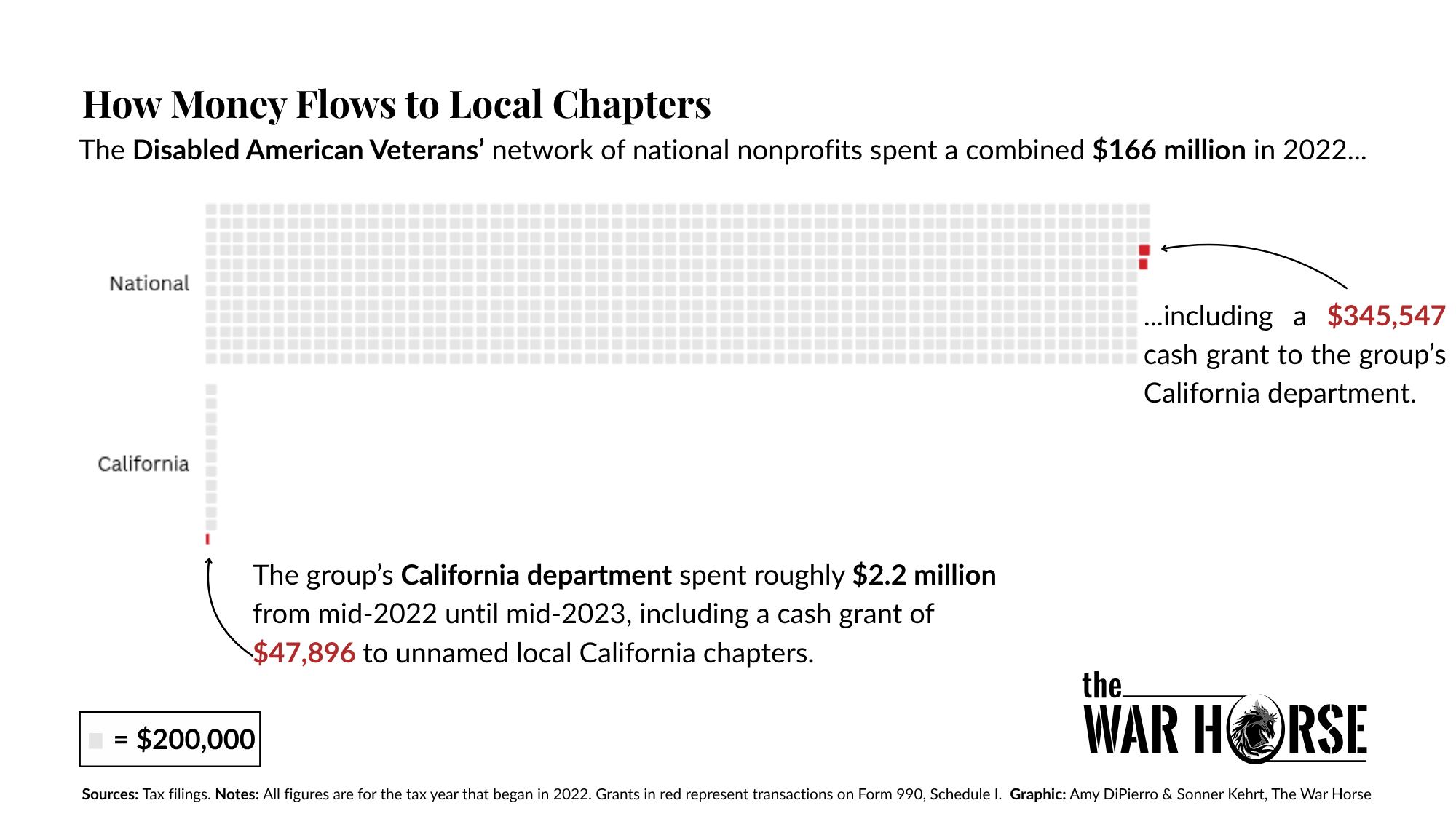
A War Horse analysis of tax filings found that, over the five tax years from 2019 through 2023, Disabled American Veterans’ national organizations gave nearly $1.9 million to DAV’s California department.
During that same period, the California department awarded $175,000 in grants to dozens of local chapters across the state.
“You’re raising this money on the behalf of disabled veterans,” said Rodney Deflumeri, a former chapter commander in Florida who resigned in February after examining DAV’s finances. “Why is there just [this] little tiny trickle?”
Packing Up History
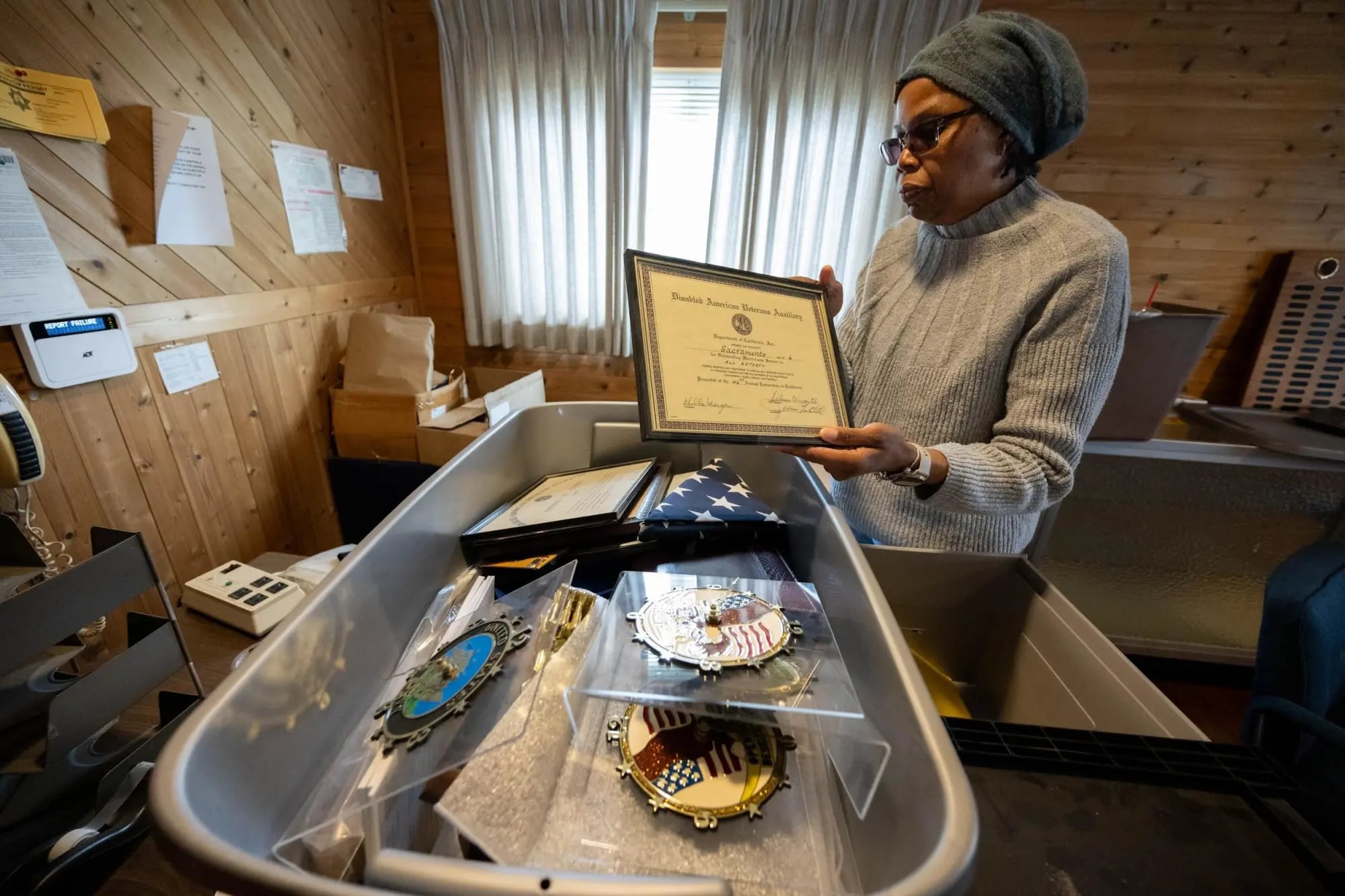
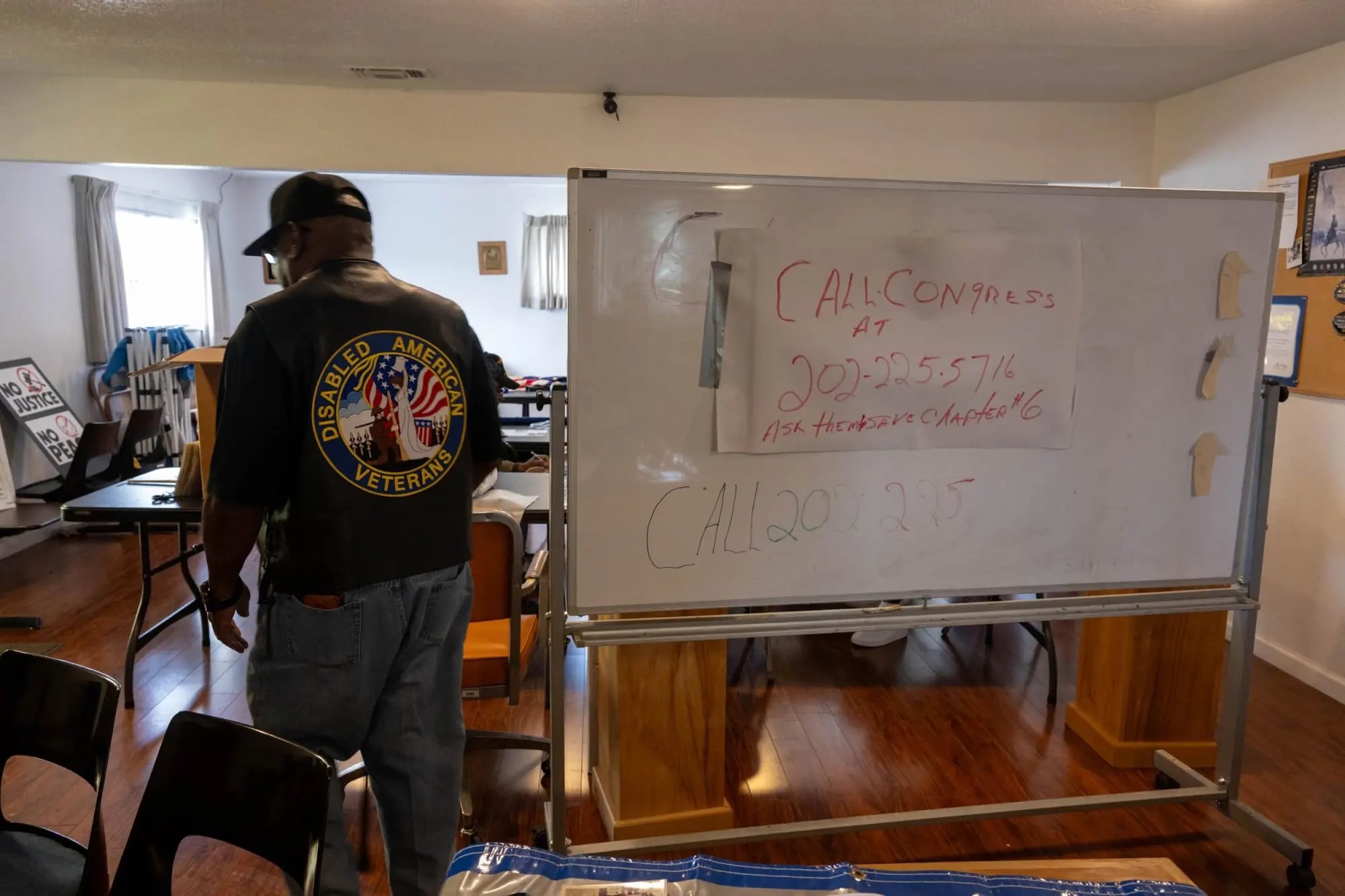
On a cloudy Tuesday in May, the DAV post in Sacramento was in disarray. Storage bins sat half-filled with old plaques. Black-and-white photographs littered the tables.
In December, the Sacramento chapter sued DAV National, asking a court to prevent the national organization from taking the donation. Days later, chapter leaders learned their bank account had been emptied and their DAV charter revoked, according to court documents.
“In light of your contentious actions,” Jesinoski, DAV National’s CEO, wrote in a letter to Tafoya, “you are not permitted to participate in DAV or Auxiliary activities in the future.”
Sacramento veterans also learned that people acting on behalf of DAV’s national organization were trying to begin the process of selling the small Sacramento building, according to court documents.
Tafoya and Jackson hope the lawsuit will stop the sale and protect the chapter. But they don’t want to risk losing the chapter’s history if the case doesn’t go their way. So they’re packing up more than a century’s worth of memorabilia and moving it out.
“It’s going into protective custody,” said Charles Anthony, a chapter member who served in both the Army and the Air Force as a military police officer.
In court documents, DAV said the Sacramento chapter violated a policy requiring all donations from wills be submitted to the national organization, which would then determine whether it would go to the local group or the national branch.
Tafoya said he first learned of the policy last summer, when DAV officially adopted it into its bylaws. That was nearly a year after the Sacramento chapter learned it was getting the nearly $40,000 donation, following a California probate court order.
In interviews with The War Horse, members of local chapters said DAV’s national organization was quick to suspend chapters that made financial or paperwork errors. After DAV enacted new requirements last year that chapters file their annual financial reports online, DAV headquarters suspended 399 of its chapters for failing to comply with the organization’s bylaws—more than a third of U.S. chapters.
“We have to comply with governance, whether that’s at the chapter level, the state level, or the national level,” Clare said. Most chapters have since been reinstated, he said.
But members said they are frustrated that the national organization moves quickly to punish paperwork errors while offering little financial support. Local chapters are barred from raising money online, a restriction national leaders say is intended to prevent chapters from competing with one another for donations.
“We end up at Walmart, giving out little flowers or something like that,” said Jim Ulinski, a Vietnam War veteran in Pennsylvania who survived the siege of Khe Sanh. “You have to just stand there, and hopefully they give you money.”
Serving Close to Home
In March, Sacramento members received letters informing them that their memberships had been transferred to a different branch in Carmichael, about 30 minutes east of their old post. Most have decided not to attend meetings there. They want to serve veterans closer to home.
Phil Rios was an art student organizing anti-war protests when he was drafted at the height of the Vietnam War. He went on to serve for 26 years. He found his way to the little white building in Sacramento while trying to file a disability claim with VA for post-traumatic stress disorder. He was denied three times over 14 years before he finally received benefits.
Rios said fellow veterans in Sacramento were the ones who pushed him to keep trying and helped him eventually win his claim. So he began volunteering with the chapter himself, helping other vets with PTSD file claims of their own.
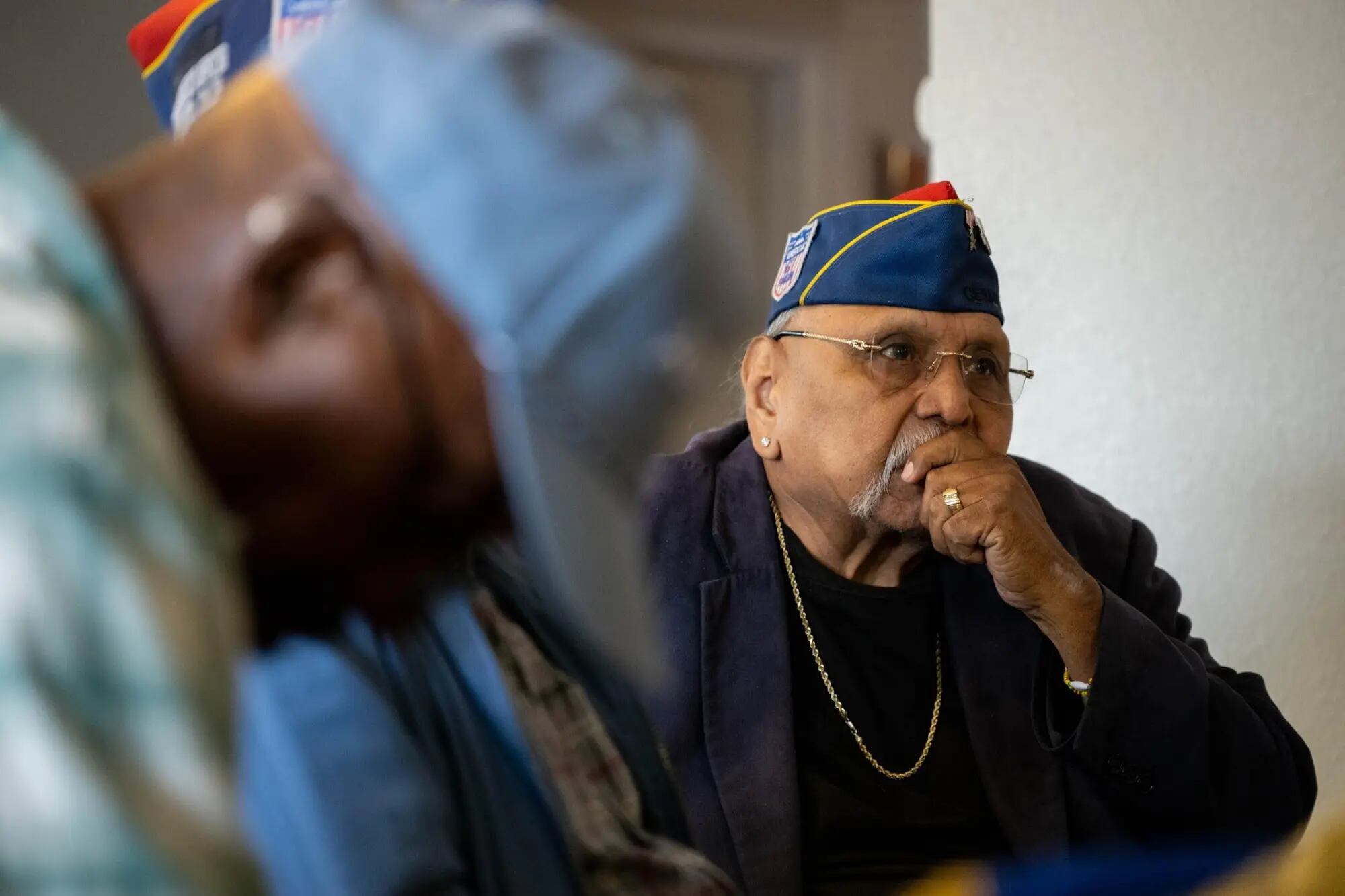
“I go to the guy’s house,” Rios said. “He knows I’ve been there—Vietnam, Desert Storm. I’ve seen what he’s seen. I can finish his sentence. And if he breaks down, he’s home, he’s not embarrassed. And then he opens up.”
Chapter members know younger veterans aren’t joining organizations like DAV the way earlier generations did. But they had been looking to the future all the same. They had recently invested in audio equipment to start a podcast, switched to membership applications that could be completed on a smartphone, and Tafoya said, were developing a plan to transfer leadership to a younger generation.
Instead, they were packing photos into boxes and feeling abandoned.
As disabled veterans, they had joined DAV to help support fellow veterans in their community.
“My care and concern has always been about my brothers and sisters. They wore the green uniform. They wore the boots,” said Vaughn Evans, who served in the Army for 24 years.
“It stinks to all ends that this is something that is being done to us by our own brothers and sisters.”
Read the full article here
