



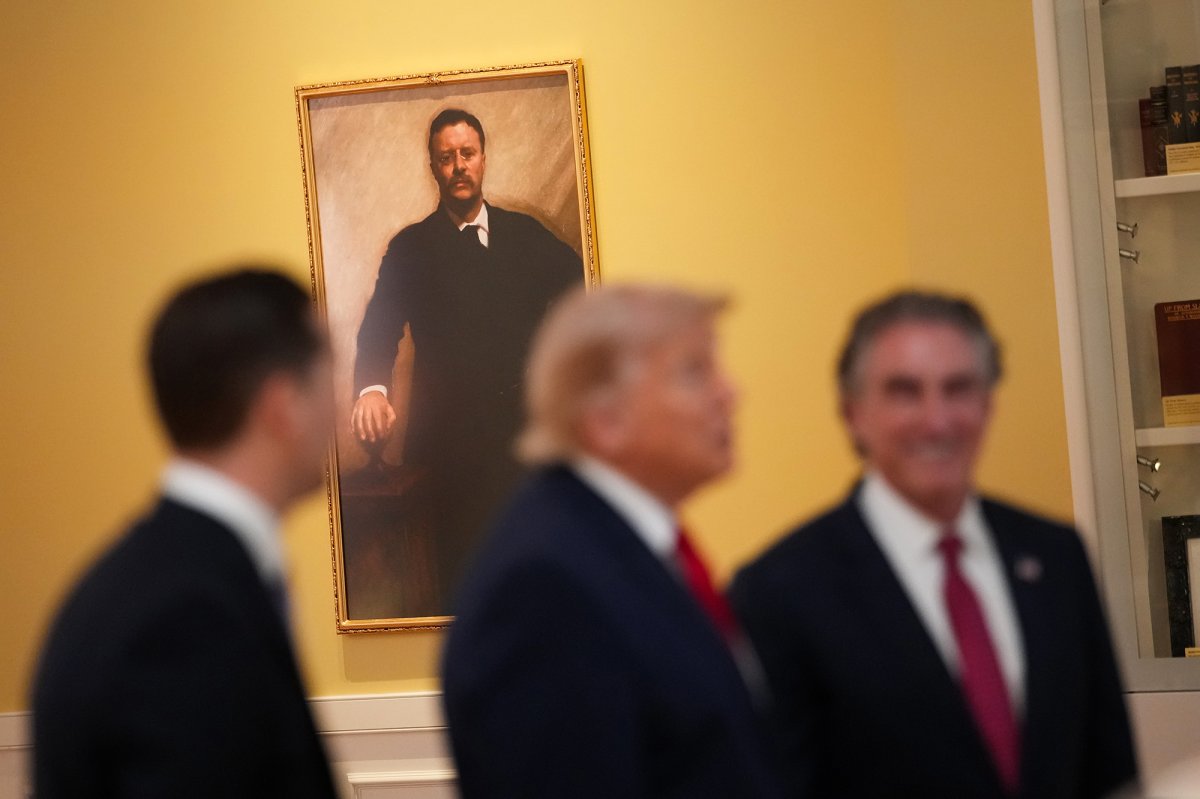

A massive $450 million, 93-acre facility carved out of western North Dakota’s badlands opens Saturday as a monument to America’s 26th president but also as a lens through which to consider Theodore Roosevelt’s lifelong commitment to conservation and the wise use of the nation’s natural resources.
The Theodore Roosevelt Presidential Library has been in the works almost since Roosevelt died in 1919 but gained momentum in 2020, when President Trump, in his first term, signed legislation that authorized the sale of 90.3 acres of U.S. Forest Service land to the presidential library.
Trump visited the library yesterday, and in meandering remarks that felt more like a political rally than a remembrance of America’s Gilded Age president, he noted that “it was a privilege to sign the bill that helped get this incredible project underway.”
“We took it [the 90 acres of public land] right out of the federal government,” Trump said, perhaps oblivious to enduring controversy over the sale of public land. “We ripped it away from the federal government. They don’t know it’s missing. They still haven’t figured out what the hell happened.”
Trump’s Secretory of the Interior, former North Dakota governor Doug Burgum, has accelerated energy development on public lands and has removed many regulatory barriers to resource development that have their origin in Theodore Roosevelt’s trust-busting legacy. Burgum was one of the early advocates for developing the Roosevelt Library.
Trump spoke for over an hour and cited Roosevelt’s attributes of intense passion, personal courage, commitment to causes, bravery in battle, and accomplishments as a hunter.
“He had a freakin’ wild life,” Trump observed, after allowing that Roosevelt was one of the few Americans he admired. “He didn’t want to be quiet. He wanted to be great.”
But Trump, who riffed on the Panama Canal, high-profile renovations of national monuments in Washington, D.C., and border security, didn’t dwell on Roosevelt’s conservation legacy. The closest he got was a nod to Roosevelt’s “incredible things with parks and everything else” before launching into Roosevelt’s muscular foreign policy.
Roosevelt protected some 230 million acres of public land, created the predecessors of the U.S. Forest Service and National Wildlife Refuge System, established five national parks, and designated 18 national monuments.
Place of Personal and Political Transformation
That conservation legacy is a vital part of the North Dakota center, says its chief executive officer Edward O’Keefe.
“Theodore Roosevelt looked a hundred years into the future of conservation,” says O’Keefe, a former media executive, North Dakota native, and Roosevelt scholar. “At the core of the library’s mission is to bring conservation into dialogue with the next generation of conservationists, welcome families into this discussion, get kids off their devices and into nature, and to really think about our relationship with the land and the great outdoors.”
The library overlooks Theodore Roosevelt National Park, the only national park named after an individual, in this case the president whose years as a rancher inside what’s now the park helped form his political identity and conservation ethic. Roosevelt’s Elkhorn Ranch, where the future president first sought refuge from personal loss and grief after his wife and mother died on the same day in 1884, became a crucible for Roosevelt’s self-described “strenuous life” that defined his personal and political brands. The Elkhorn Ranch is closely associated with Roosevelt’s reinvention as a big-game hunter, an identity and cause that led to the creation of the Boone and Crockett Club in 1887.
Roosevelt already has a property closely associated with his life, military career, and political legacy. It’s Sagamore Hill National Historic Site on New York’s Long Island. But although Congress authorized a presidential library to Roosevelt shortly after his death in 1919, there has never been a designated library for the president that many historians say guided the United States from a restive, rawboned backwater into a global superpower.
The North Dakota library features exhibits that expand on Roosevelt’s role as an Eastern elite, an unlikely war hero, New York governor, and influential president. But it leans hard into Roosevelt’s conservation ideas, influence, and legacy.
Related: President Teddy Roosevelt Conserved Millions of Acres of Federal Lands. It Was His Greatest Legacy
“Here, you will learn about TR, but more importantly you will learn from him,” says O’Keefe. “This place deserves to exist because Theodore Roosevelt changed the direction of our country, and made conservation a political and policy issue for the very first time. It’s extraordinary that when he proposed his first conservation bill, the Speaker of the House famously said, ‘There will not be one dime for scenery.’”
“It’s extraordinary that when he proposed his first conservation bill, the Speaker of the House famously said, ‘There will not be one dime for scenery.’”
—Edward o’keefe, ceo of the theodore roosevelt presidential library
Partly on the basis of Roosevelt’s relentless pursuit of the topic, conservation transitioned from a quaint idea held by a few intellectuals into a national priority as America’s once-abundant fish and game fell to rampant, unregulated growth. The North Dakota library, located near the national park gateway town of Medora, devotes a number of exhibits to Roosevelt’s commitment to protecting America’s vanishing wildlands and wild animals.
“When you immerse yourself in this landscape that, I’d argue, saved him, you understand why nature and wildlife and rivers and streams and mountains and all the wonders we have in America were so important to him,” says O’Keefe. “The outdoors saved TR’s life, and without it he would not have become the president he became. So to be able to place his presidential library in and within nature and invite people – especially families – to come experience what he experienced is not like anything else that exists.
“I’m glad Sagamore Hill has been conserved and preserved,” says O’Keefe. “You can enter Sagamore and feel like Roosevelt is going to bound down the stairs at any moment, but it’s not the immersive experience that shows the beauty and power of nature that inspired him not only to live but to make sure that many generations after him enjoy what he enjoyed.”
A Conservation Mecca
O’Keefe, whose job is to galvanize support and contributions for the library, notes that Roosevelt’s legacy is uniquely non-partisan.
“I’ve found that Theodore Roosevelt is the universal key to civil conversation,” he says. “Republicans, Democrats, Independents, they all love TR. If you want your conservation group to be successful, you would be smart to add Teddy Roosevelt’s name to it.”
At this particular moment, when many of Roosevelt’s conservation ideas and institutions are under pressure from resource extraction, industrialization of our public lands, and the tension between conservationists and preservationists intensifies, O’Keefe says the Medora facility is the perfect venue for discussions of Roosevelt’s legacy.
“There’s a vibrant debate about the conservation moment today, and what will it become in the future,” says O’Keefe. “I think the Theodore Roosevelt Library is well-timed to be a part of that discussion and to be a place of civic convening. If there’s one thing that TR did extremely well, it’s to listen – that’s surprising because he talked and wrote so much. But he gathered disparate voices that didn’t always agree with his perspective so he could learn and make informed decisions.”
O’Keefe imagines the North Dakota facility can be to conservation what Ronald Reagan’s presidential library is to public conversations about national defense.
“If you are in the defense community, you don’t miss the Reagan National Defense Forum,” says O’Keefe. “Whether you’re a defense contractor or a policy wonk or a government official connected to defense, it’s the place to talk about big issues related to national defense. You don’t have to debate whether Reagan’s policies were right or wrong, the issue of defense gives the [Reagan] library a convening purpose. We see the same possibility related to conservation. The authority and gravitas of Theodore Roosevelt gives us the ability to bring a lot of people from different organizations, private and public individuals, and government officials where we could be a galvanizing force in the field of conservation.
“Roosevelt’s Elkhorn Ranch is the cradle of American conservation,” O’Keefe says. “For conservationists, this is Mecca.”
Teddy Iconography
The North Dakota library is also the place to see iconic Teddy Roosevelt objects. One exhibit brings together the then-future president’s buckskin jacket and pants, his rifle, Tiffany knife, his spurs, and his branding irons.
“Objects are only objects until they tell a story, and these objects tell an extraordinary story about the history of our country and the birth of the conservation movement,” says O’Keefe. “You can come see the elk horns locked in battle for eternity that inspired the name of Roosevelt’s ranch. We have all these Roosevelt items that haven’t been together for a hundred years.”
O’Keefe says that, taken together, the exhibits push beyond Roosevelt’s biography and into his enduring mythology.
“For over a hundred years, there’s been an effort to memorialize Roosevelt in both the East and the West,” he says. “When you’re in the East, you feel the presence of Theodore Roosevelt’s ghost. When you’re in the West, you feel the presence of Theodore Roosevelt’s spirit.”
Saturday’s grand opening further cements Roosevelt’s life and legacy in the larger context of America’s national life.
“July 4 is a special date, not only for the obvious reasons,” says O’Keefe. “TR was president at America’s 125th birthday. He’s quite literally at the fulcrum of America’s history. He’s at the dividing point between America’s birth – the Declaration of Independence at Year Zero, and where we’ll be on July 4, 2026, at 250 years old. Roosevelt had the incredible foresight to look 100 years into the future. The actions he took in the early 1900s are responsible for the America we had in the 2000s. We picked this date [to open the library] because we hope the Roosevelt Library emphasizes that this place is not about the past. It’s about the future. If we don’t work together on important issues like the conservation community cares about, we won’t make it to America 500.
Related: I Interviewed Teddy Roosevelt After His Wilderness Mountain Lion Hunt. Here’s Why His Rifle Had Teeth Marks
“I’m sure a number of people can’t imagine America at 500,” he continues. “But that’s where TR was, right at the middle point between where we are and where we are going, and a lot of people in his world couldn’t imagine America at 250. But here we are, in large part thanks to Theodore Roosevelt.”
Read the full article here
