



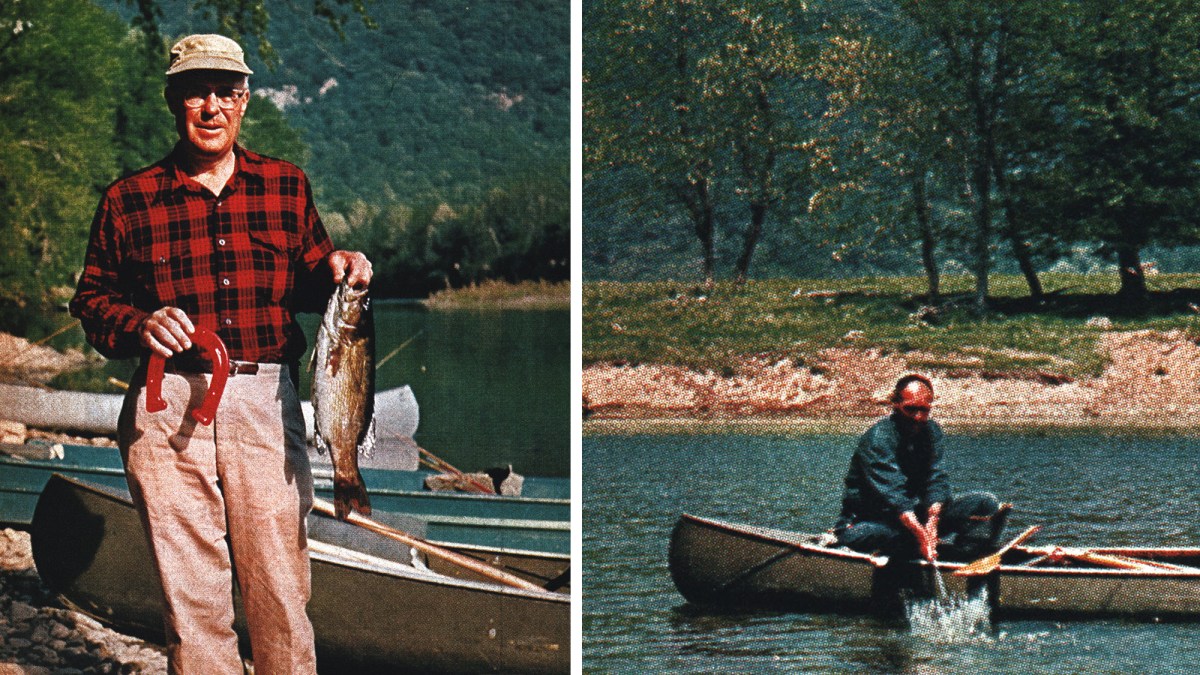

This story, “Horseshoe Bass,” appeared in the July 1965 issue of Outdoor Life.
Wade Clinedinst shoved our aluminum canoe away from the launching area and picked up his paddle. Bob Sumner followed close behind us in an aluminum boat. In the bow of the canoe, I arranged my gear to give me leg room and placed my fly rod along the gunwale. Then I relaxed, enjoying the peaceful scenery and waiting until we came to the first productive water.
Ten seconds later, Wade asked anxiously, “Is anything wrong?”
“Nothing I know of,” I said. “Why?”
“I wondered why you weren’t fishing,” he replied. “We’ve gone by two good spots already.”
“We have!” I yelped, grabbing my rod. “I thought the water was too shallow here.”
“The river’s low from lack of rain.” Wade explained, “but this is all good water. Cast to that log beside the bank.”
Out of the corner of my eye, I saw that Bob Sumner was already casting. Whipping out line, I tossed my deer-hair bug into the shadowy pocket Wade had indicated and twitched it once.
Before I could twitch it again, a smallmouth bass exploded under it and carried it a foot into the air in a shower of spray. As he shot under the log my rod bowed sharply and the reel gave an angry buzz. He went up again on the far side of the log and three times more in the flat water beside the canoe before I worked him within reach of Wade’s net. He wasn’t big, about 1 1/2 pounds, but he was hard-fleshed and full of fight from the cold, clear waters of the Potomac River’s South Branch.
Catching him in shallow water so near the launching site was my second surprise. The first was the river itself. This friendly stream, purling and chattering its way through shady woods and fertile farmlands flanked by green, rolling hills, seemed a far cry from the mighty Potomac that sweeps majestically past Washington. D.C. And it is indeed a far cry, for a distance of some 300 miles, as the river flows, separates Washington from Romney, West Virginia, where this bass-fishing trip took place.
The South Branch rises in a series of rivulets and cold springs in the rugged Allegheny Mountains and flows northeast for 140 miles to join the North Branch near Cumberland, Maryland. On its way, it tumbles through the wild Smoke Hole region of the Monongahela National Forest, through Petersburg Gap and the well-known “Trough” below Moorefield. From there to its junction with the North Branch it winds through a wide valley enclosed by wooded mountain ridges. It is this 50-mile stretch, from Moorefield to Green Spring, which provides some of the best smallmouth-bass fishing in the East and which I had come to West Virginia to investigate.
I did my investigating under the capable guidance of Wade Clinedinst who grew up in this Eastern Panhandle country. He is one of the top fishermen in the area. With John Ailes, editor and publisher
John Ailes. editor and a publisher of the Hampshire Review, Wade operates Hampshire Float Trips out of Romney from May through November.
Their service provides boats, guides, and transportation to and from any section of the South Branch. Either aluminum boats or canoes are available, equipped with coolers and ice. Box lunches are furnished and, at extra cost, bait for those who want to use it. They will also supply boats without guides, but it would be impractical, to say the least, for a nonresident to try to fish the river on his own. On our trip, besides Wade and myself, Bob Sumner, a biologist for the State Department of Natural Resources, was along in a separate boat as companion, observer, and general counselor.
As I unhooked my first bass and released it, I saw that Bob was fast to an acrobatic smallmouth only 100 yards from our launching place. While I watched, he reeled it in close, grabbed it by the lower jaw, and held it up for us to see – a bass almost a twin of mine. It was an auspicious beginning, two fish in about two minutes. I decided that this was one place that was going to live up to its advance billing. I was even more convinced when, minutes later, I had another vicious strike that threw my bug halfway back to the canoe.
But my optimism proved premature for about that time the sun rolled over a high, wooded ridge to the east and shined upon the water. Almost as if at a signal, the bass stopped hitting. It was a warm day for late May and this, combined with the bright sunshine slanting through the shadows, put the fish off their feed. We could see the bass silhouetted against the rocks, but they could see us, too, and they either lay motionless or swirled away at our approach.
However, Wade kept me on the edge of the canoe seat, casting enthusiastically, with his stories of fishing this stream. Each pool and riffle, each submerged stump and brush-pile, reminded him of monster bass which he or one of his fishermen had caught on some previous trip.
I believed him because in the low, clear water I could see fish finning beside the bank, but I couldn’t tease one into a strike. Finally, at Wade’s suggestion, I tried an underwater lure on my spinning rod. That didn’t work either. After a while, Wade picked up his rod and began pinpointing targets with a popper, but he went fishless too. If I hadn’t seen the bass, I would have thought there wasn’t a fish in the river.
But if I couldn’t catch smallmouths, I could enjoy the scenery. It is beautiful. We’d drift along a stretch of quiet water, then go dancing down a sweep of rapids around a bend into a wide, still pool. Cattle grazed in lush meadows, alternating with well-kept orchards and fields of corn. Grassy banks and leafy trees reflected in clear, green water.
Finally, Wade put me ashore on a gravel bar where the rapids quieted into a deep, dark pool. “Let’s stop and give this spot a going-over,” he said. “There are some good fish in this hole.”
Bob joined us and, being apprised of our plans, waded in shoes and all to a spot at the head of the rapids. Wade moved down the shore and I took up a position above him. We had the pool pretty well covered and for a time we were all busily engaged. Then I caught a fish. It hit my deep-running plug and streaked away in a run that put a good bend in my light spinning rod. But it wasn’t a smallmouth. It was a goggle-eye, a nine-incher that did its best to imitate the antics of one of its large cousins.
I had just released it when I heard a hail from Wade and turned to see his rod jerking up and down to the frenzied runs of a hooked fish which suddenly somersaulted into the air. I reeled in and ran to the canoe for the net, but before I got to Wade he had beached a nice two-pound smallmouth.
The only other excitement was when a really good fish followed Bob’s plug into fast water only to swirl away at the last second. But this pool gave us the tip-off, and from then on we cast the flats and then came ashore at the end of each rapids to pound the deep hole at its base. We managed to pick up four more bass and several goggle-eyes during the morning.
At noon we beached on a gravel bar for lunch. While we ate, Bob and Wade filled me in on some of the early history of this area. All of what is now West Virginia, they told me, was formerly a deserted wilderness used only as a common hunting ground by various Indian tribes. Three great paths traversed the region, one of which — the Seneca Trail — followed the South Branch from its mouth to Seneca Rocks, then westward to the present town of Elkins.
It wasn’t until long after seaboard Virginia had been settled that first explorers and fur traders penetrated into the rugged, mountainous interior. They were followed by German settlers from Pennsylvania and later by Englishmen who took up homesteads in the “Northern Neck” grant of Lord Fairfax between the Potomac and the Rappahannock rivers. Much of this area was surveyed by George Washington between 1748 and 1751. In 1753, with the growth of these South Branch settlements, it became evident that a local seat of government was needed. Hampshire County was formed in that year and the presiding justice, Thomas Martin, began his court at Romney, the first incorporated town in West Virginia. During the Seven Years’ War, this frontier valley became a bloody battleground in the struggle between France and England for the continent of North America.
That afternoon was a repetition of the morning, drifting lazily and casting flies, plugs, and popping bugs in an effort to rouse the sluggish bass. Here and there, mostly by going ashore at the head of the rapids, we teased fish into striking. When John Ailes met us at Joe Pancake’s farm in late afternoon, we had caught and released a dozen or so smallmouths and a like number of goggle-eyes, none of them large. Personally, I was satisfied for I’d had some action and a thoroughly enjoyable day, but the others were disappointed.
“I thought you’d do better than that,” John said. “You should have caught a dozen apiece, even on a day as poor as this one is.”
“It’s just too bright and hot, John,” Wade declared. “We saw plenty of fish, but we couldn’t make ’em hit in this low water.”
“What’s the weather supposed to be like tomorrow?” Bob asked.
“Hot and humid with a chance of scattered showers,” John reported gloomily.
That night at dinner and, later, back at the motel where I was staying, there was considerable discussion on what part of the river we should fish next day. John Ailes and Bob were anxious to have me see the Trough section, a wild, uninhabited stretch which runs through a seven-mile gorge noted for its scenery and its fishing. But Wade advised going farther downstream where the pools were larger and deeper.
“We aren’t out after scenery,” he declared bluntly. “We’re out after bass.” In the end his counsel prevailed, and I was glad it did.
Next morning dawned hot and humid, but again in the first few minutes of fishing I tied into a cartwheeling smallmouth. This was a larger fish, about a three-pounder, and I had him on for several minutes before he tore loose in an explosive leap. A few minutes later, I took a smaller fish beside a submerged ledge. Then, as the sun began to bore down into the pools, action tapered off as it had the day before.
We had put in several miles below Romney, planning to end our float at Green Spring near the junction of the North and South branches. Deepening and widening, this stretch of river winds between wooded hills and green fields in a series of long pools and swirling rapids. Around each bend new and picturesque vistas came into view. We may not have been out after scenery, but we were getting it and we weren’t getting bass, although we knew that they were there.
Wade told me more about the countryside through which we were passing. It’s a peaceful valley now, but, during the Civil War, bloody fighting took place in these fields. Owing to its proximity to the strategic Shenandoah Valley, this section bore the brunt of the struggle in West Virginia. Confederate cavalry criss-crossed the area in swift raids, destroying property, taking prisoners, and disrupting communication lines. Southern sentiment ran high, and in the vicious and bitter partisan warfare that swept over the valley, the town of Romney changed hands 56 times.
As the morning wore on it grew hotter, and I was thankful for the cooler packed with ice water and soda. We took six small bass and a few goggle-eyes, but by noon it looked as though this was going to be another shoulda-been-here-last-week trip.
“I wish you could see this river when it’s right,” Bob said as we sat in the shade, eating our sandwiches.
“I know the bass are here,” I told him. “You can’t help the weather.”
Just then Wade, who had been stretching his legs along the bank, bent and picked something up from the tangled grass. “Here,” he called. “This is going to change our luck.” He tossed a red plastic horseshoe down beside me. It was apparently one of a set of shoes from a youngster’s horseshoe-pitching game and how it had got here would be hard to say, but I went along with the gag and placed it in the bow of the canoe when we set out again after lunch. Its magic properties were slow in manifesting themselves. The first thing I did was snag a bankside tree. When we paddled in to retrieve the lure, the biggest bass I had seen yet swam lazily away from shore. A few minutes later, though, I foul-hooked a small bass by the tail, so I figured the shoe hadn’t lost all its power.
About an hour later, a solid bank of clouds came over the hills and a breeze sprang up. Out of the west we could see a misty gray curtain of rain bearing down upon us, and when it settled around us the bass began to hit. Not all at once, but a definite change of pace began to take place in the fishing. The small bass appeared first, slashing out of the shallows to belt flies and plugs.
Then Wade hooked into a really good fish, a rampaging smallmouth that leaped and plunged and skittered across the water on its tail. “This is more like it,” he said with a grin as he drew the fish in for me to net. When I fastened my scales in its jaw, the pointer slid to 3½ pounds. Minutes later, he snagged another good bass beside a half-submerged tree.
“Try an underwater plug,” he suggested. “I think you’ll get bigger fish. The small bass are beating the big ones to your topwater bug.”
I switched to a diving plug and caught a bass not much longer than the lure, but a few casts later I hung a deep-bellied fish that leaped right over a log to take the plug. By now things were getting hot, and it seemed as though every time I looked up Wade or Bob was playing a fish. Once, Wade and I both had bass on at the same time. I’ve been in bass hotspots before — Maine’s St. Croix River, Vermillion Lake in Ontario, and Maryland’s Northeast River, to name a few — and this fishing was comparable.
We caught a lot of small bass, eight to 10-inchers, which is a good sign, especially in unstocked waters such as this, for it shows a healthy natural reproduction. And every once in a while we snagged into good fish running from two to three pounds, but none of the real lunkers which Wade assured me lived in these pools.
After the shower passed, the fishing slackened but it didn’t end. The rain, cooling and stirring up the water, had roused the lethargic bass and put them into a feeding mood. Now we could cast to drowned brush heaps and sunken logs with some assurance of getting a strike. We didn’t bother to fish the pools below the rapids from shore for we were now having action as we floated through them.
I’d lost count of the number of fish Wade and I had caught and put back, but Bob, being a good scientist, kept track of his catch. When we went ashore for a late afternoon stretch, he reported that he had taken 19 bass. Of these, he had saved half a dozen of various sizes to take back to the laboratory for experimental purposes. When we set out again, Wade told me that there were only a couple of miles of water left before the South and North branches joined. “John will meet us about a quarter of a mile this side,” he said. “That’ll give us about an hour more to fish and there’s some good water coming up.”
For this final two miles, the river winds in a series of bends between towering green hills. Runs and eddies alternate with deep, brimming pools shaded by leafy trees.
Near the tail of one of these pools I was flipping my plug up to the bank when, suddenly, there came a resounding splash behind me. I whirled and saw little wavelets spreading outward from a patch of foam close to the bank beside an overhanging tree.
“What was that?” I asked Wade.
“I don’t know,” he replied, “but it sure made a powerful ruckus.”
“Probably a muskrat,” I said, but I was already feverishly reeling in my line.
“Probably,” Wade agreed, but he was already turning the canoe in a wide circle.
Neither of us spoke as we swung back to drift quietly toward the spot. Thirty feet away, Wade backed water and I let go a looping cast. The plug arched and plopped under the tree. As it hit, its tiny splash was engulfed in a geyser of water and a dark bulk cartwheeled into the air. I caught a glimpse of wide, flaring gills and thrashing tail, then the fish disappeared in a crash of spray.
“Don’t lose that one!” Wade barked, digging in with his paddle.
I was telling myself the same thing as line whirred from the spool. Wade maneuvered the canoe to midstream while I clung to the bucking rod and tried vainly to pressure the bass away from the debris-lined shore. It was like trying to haul a bulldog away from a cat. I was using three-pound-test monofilament line and I wished I’d taken time that morning to exchange it for my spare spool of six-pound nylon.
But I didn’t have much time for regrets. The bass kept boring doggedly toward shore, lunging and vaulting into the air in ponderous leaps. For a time, all I could do was hang on and hope the straining line wouldn’t break. Then, suddenly abandoning these tactics, the fish turned in a lightning dash for deep water. He came straight toward the canoe, dived under it, and leaped again on the far side. By then, though, Wade had spun the canoe around and I was able to crank in line, holding the rod tip high.
Feeling the pressure again, the fish swept around us in a wide circle, and my taut line cut the water with an audible hiss. He came to the surface 20 feet away and tried to jump again, but his leap was a heavy roll. Straining the tackle, I reeled him in and Wade thrust his net into the water. The old battler had enough guts left to shy off twice at the sight of the meshes, but on the third swipe Wade scooped him up. It was only then that I saw that Bob had come up during the fight and had beached his boat to watch the proceedings. We joined him on shore for the weighing-in ceremonies. The scales showed 5¾ pounds, which is a good smallmouth from any water.
Read Next: This Traditional Bait Still Slays Summertime Bluegills
I’d seen a beautiful river, I’d caught a lot of fish, and now I’d connected with a lunker which, as Bob said, was a fitting way to wind up a trip. We were almost at the take-out place, anyway, for around the next bend we saw John Ailes waiting for us on shore.
As we glided toward him, Wade grinned. “I told you that horseshoe was going to change our luck,” he declared.
“I think the shower helped,” I suggested.
“I don’t know,” Wade said, “but it’s sure a funny coincidence. You know that stretch where you caught the big bass?”
“Sure,” I nodded. “What about it?”
“Well,” he replied, “they call it Horseshoe Bend.”
Read the full article here
