



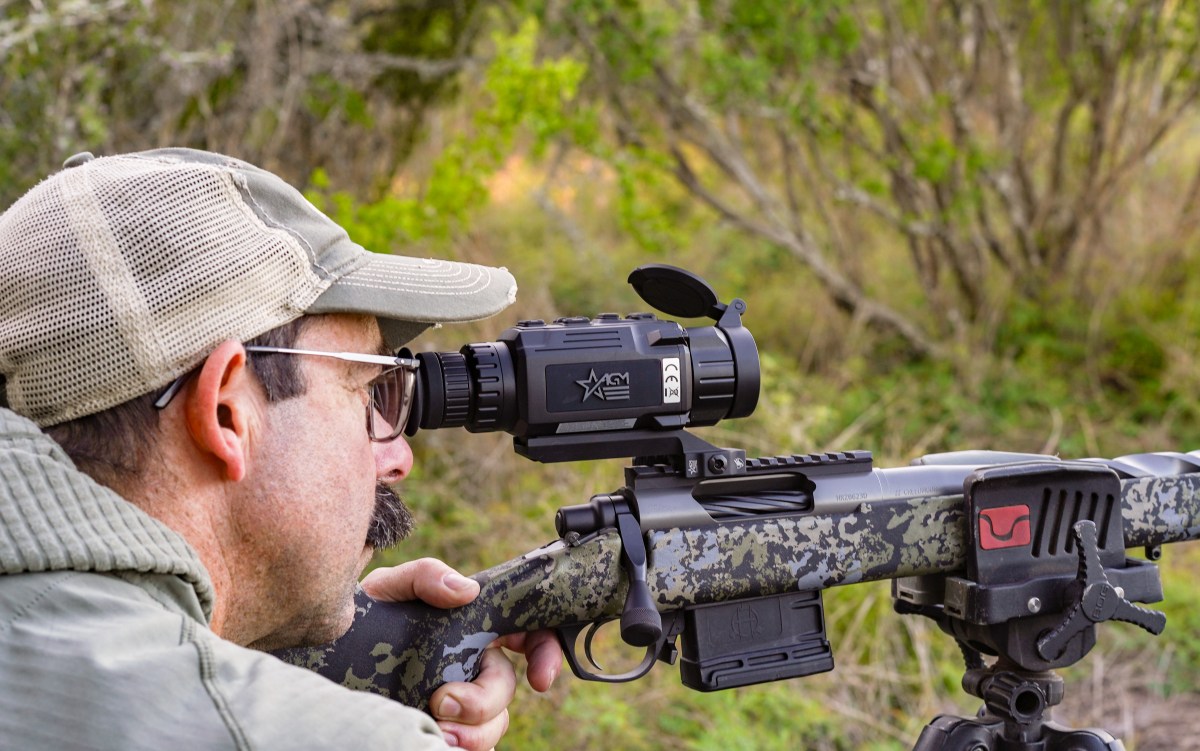

No matter where I travel in America and no matter the crew I hunt with, the topic of thermals eventually comes up, and the conversation inevitably boils down to a simple, predictable question: Can I get into the thermal game without busting my budget?
It’s a natural question, given that high-performing thermals cost over $8,000. Who among us has that coin laying around for hunting gear we might use only a dozen times a year? Middling thermals average right around $4,000. So… what can you get for $2,000?
That was the question we set out to answer in our first-ever Budget Thermals test. We set the ceiling at $2,000, which seems to be the intersection of what the thermal-curious are willing to pay and decent products that are worth the money. We asked manufacturers to submit a range of weapon sights, monoculars, and clip-ons for testing alongside the higher-end thermals we took to Texas for a week of night hunting last month.
The response was disappointing. Turns out there are vanishingly few worthwhile thermals at that entry-level price point. Some brands might have these gateway thermals in their catalogs, but they’re not actively selling them as they promote their higher-end products. Others recognize that their entry-level thermals are inadequate for serious hunting, and they declined to participate in our invitational lest their brand reputation take a hit. Still other brands didn’t have any to lend us for our test, because they’re routinely sold out of their budget product lines.
All that confirms our hunch: if you can find a decent thermal for under $2,000, snatch it up, because it’s a rare thing, indeed.
Here are the best budget thermals we tested this year. Yes, I understand there are holes in this collection, but it’s what we received from manufacturers, along with a couple others that we recommend because they have attributes that make them top considerations for entry-level thermal shoppers.
Budget Thermal Scopes
Budget Thermal Monoculars
7 Things You Need to Know About Buying a Budget Thermal
How to Hunt at Night: Experts Share Their Secrets
Our testing revealed another series of truisms, which I’ve condensed into this seven-point punch list:
- Invest In 384-Class Sensors. There’s a direct correlation between thermal sensor resolution and a unit’s ability to positively identify targets at night. This is the daylight optic equivalent of light transmission or twilight factor. The higher the number, the better the image. You’re going to see a lot of 256-pixel thermals in on-line close-out sales. Leave them there. Thermal technology is improving so fast that last year’s good-enough 256 simply isn’t keeping up. If you can’t afford a 384-pixel or better unit now, wait a year. Prices will come down.
- Consider Battery Styles. Lower-end thermals often have proprietary rechargeable lithium-ion cells that don’t fit other brands or even other models within the same brand. That’s so 2025. The industry is moving toward interchangeable – and rechargeable –18650 cells. It’s a cost-savings in the long run, as proprietary batteries and their chargers can often cost $200 or more if you need to replace them.
- Stick With Name Brands. The thermal industry is in a state of flux, with new brands materializing out of the ether, selling white-box units for a year or two at cut-rate prices, and then vanishing. Buy into an established brand, not only for service after the sale but for sustained resale value on the aftermarket. Just as the daylight optics industry has moved toward customer-friendly warranties, the thermal market is following. Search out companies that have liberal 5-year warranty terms.
- Buy the Best Thermal You Can Afford, Then Trade It. This is the successful strategy of many night hunters. They are able to recoup their initial investment as long as they buy high and don’t hold the unit for long. The thermal market is growing so fast that it’s smart to buy a $4,000 thermal now, use it for a year, and then sell it for $3,000 and use the return to invest in your next $5,000 thermal. By that math, you’re getting a lot of utility out of a unit for around $1,000 a year.
- Detection Range Is Bogus. You’ll see some pretty audacious yardage claims for thermal units’ detection range, and they’re probably technically accurate. But they shouldn’t be considered adequate for hunting. The “detection range” is the distance that a warm-blooded animal shows up as an indistinct blob on a thermal. It’s a mush of pixels that could be either a hog or a heifer. A much better measure of target identity is a thermal’s “identification range” which is often a third of detection range, but is a much better measure of a thermal’s hunting chops.
- LRF is Cheap. The addition of a true laser rangefinder makes a thermal a much more useful device. On a sight, the LRF is generally tied to a ballistic calculator, so you can make distance-informed shots way out there. It’s also an ethical advantage. Knowing your target’s range will tell you its size, so you can determine if that cat way out there is a tabby or a tiger. The number of sub-$2k units on the market with LRF is encouraging that the feature, once relegated to high-end thermals, is becoming an industry standard.
- Consider All-In-One Units. There are a number of thermals on the market — AGM’s Rattler, DNT’s Hydra, Nocpix’s SLIM — that serve as capable hand-held viewers, but which have reticles and quick-attach mounts. Use them off the gun to view the world at night, but then when you detect a target, you can clip them to a gun and deploy them as sights. They’re not quite as good as dedicated monoculars, just as they’re not quite as good as dedicated riflescopes, but their ability to do both pretty well makes them raging bargains.
The Best Budget Thermal Scopes
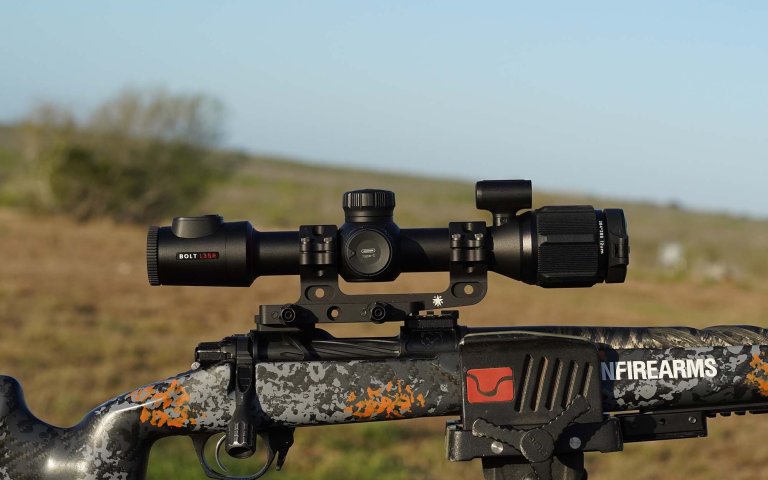
Editor’s Choice – Top Budget Weapon Sight: NOCPIX BOLT L35R 384×288 LRF – $1,999
Buy From Midway USA
Buy From EuroOptic

Nocpix Bolt Footage
This weapon sight, built around a durable aluminum tube and which mounts on standard 30mm rings, is a smart pick for hunters who want to get into thermals but who also want a rifle scope’s familiar form factor, simple navigation, and a built-in laser rangefinder.
With a 3.5x base magnification, this scope is optimized for predator hunters. Its 384×288 thermal sensor is resolved enough that users can double the magnification to 7x and still see their target, though we quibble with Nocpix’s claim of 1,800 yard detection distance. Much beyond that 7x magnification, and you’re going to be frustrated with a muddy and pixilated image. We reckon the BOLT has a real-world range of about 500 yards, which should be satisfying for most users. The BOLT L35R has the added benefit, rare at this price point, of a built-in rangefinder and ballistic calculator that makes shots at the edge of its image resolution both accurate and ethical.
The BOLT has plenty of other appealing attributes, from smart and intuitive 3-button operation, the ability to connect to a mobile app to easily share photo and video recording, and a standard 18650 battery with good-enough 6.5 hours of run time. Those are all features most users expect on thermal sights costing $4,000 to $5,000. That they’re standard on a workaday scope costing half that amount is a major coup for Nocpix.
The BOLT L35R’s image resolution will disappoint hunters who have shifted to 640- and even 1,280-class thermals, but for an honest digital scope that costs about the same as a premium daylight scope, this Nocpix offers a ton of value in a familiar and useful style.
Nocpix Bolt K35R 384 Specs and Features
Features: 7 thermal palettes, 8 reticles, picture-in-picture, recoil-activated recording, onboard Wi-Fi, wireless connectivity to mobile app
| Sensor Resolution | 384×288 |
| Display Resolution | 1024×768 AMOLED |
| Pixel Size | 12um |
| NETD | |
| Objective Lens | 35mm |
| Magnification | 3.5x base, 14x digital |
| Detection Range | 1,950 yards |
| Rangefinder Range | 1,000 yards |
| Battery Type | 18650 rechargeable cell |
| Warranty | 5 years, with 5-day repair |
Innovation Award: INFITAC IOL 25 – $1,899
See It
-
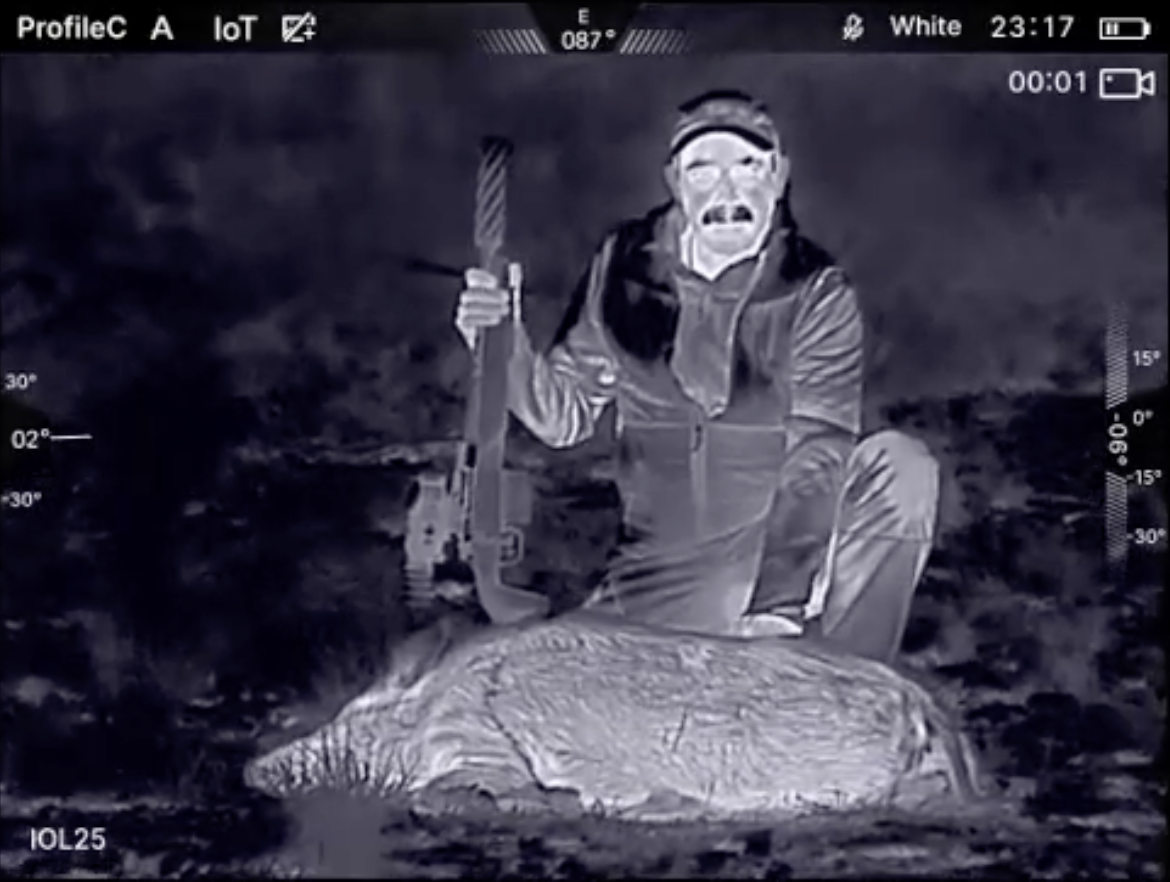
The IOL 25 being used as a handheld to aid in game recovery. -
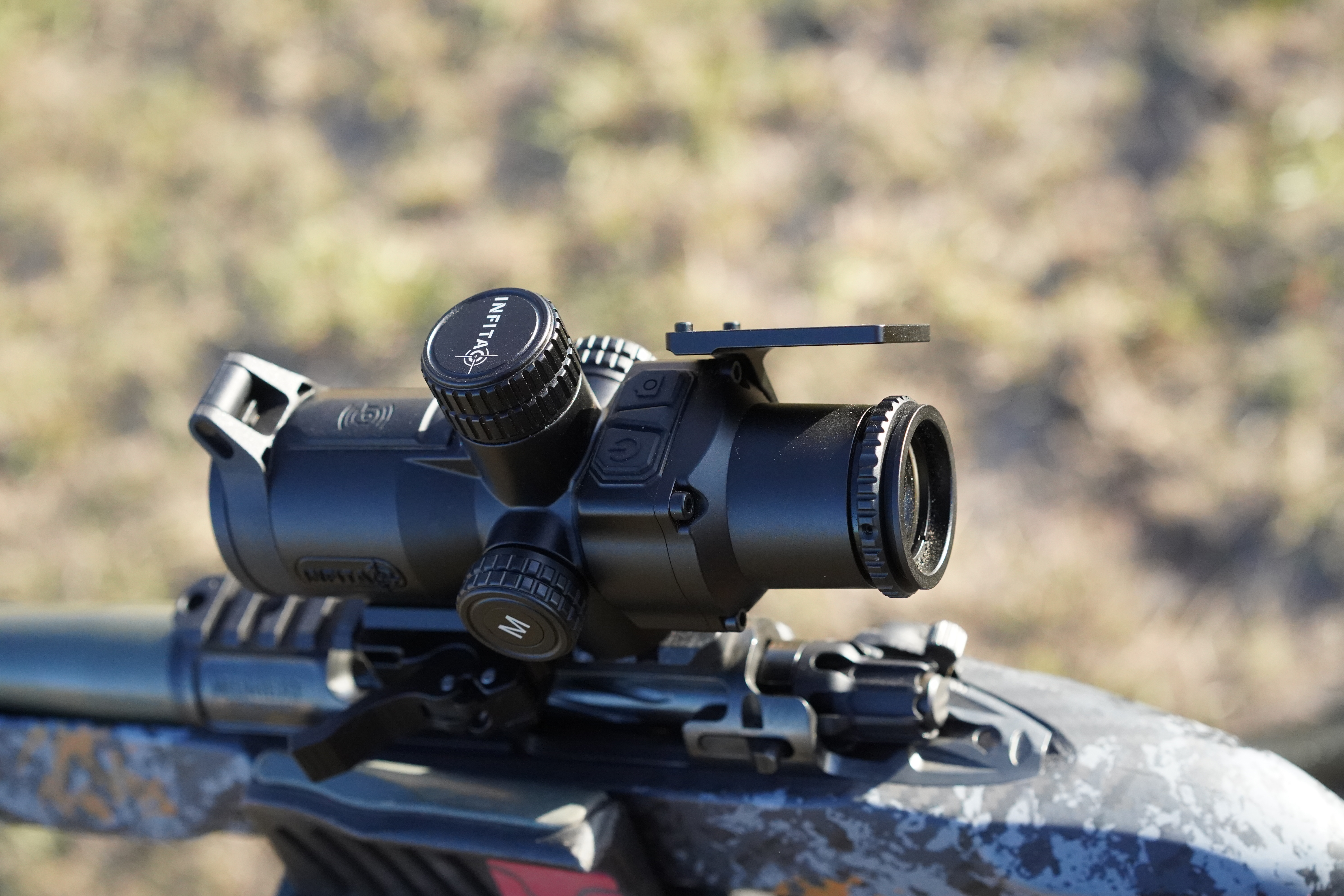
The IOL 25s controls
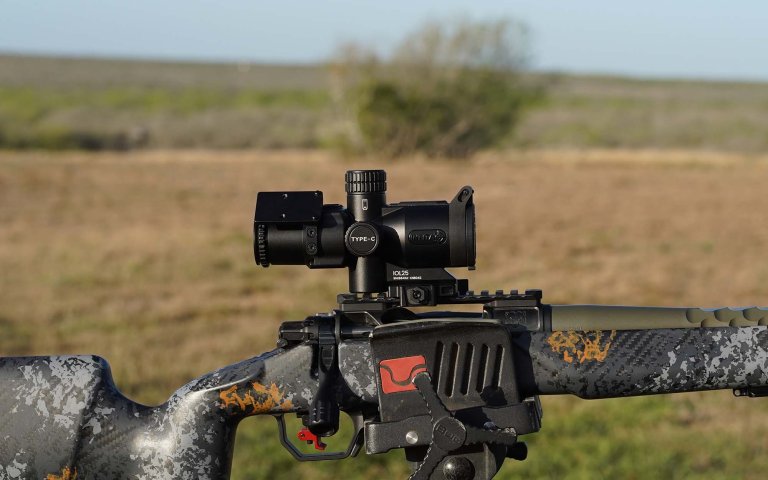
This versatile device from INFITAC features three different uses: handheld viewer, stand-alone weapon sight, and clip-on companion that transforms a daylight scope into a thermal sight.
This super-short stubby — it measures a ridiculously short 5.6-inches long — scope ships with an excellent Picatinny rail mount, making it a great choice as a dedicated thermal for rifles, pistol-caliber carbines, ARs, or even shotguns. The 384×288 sensor makes it an adequate stand-alone thermal scope, but its high-def 1024×768 AMOLED display makes images pop and gives the bantam scope a larger and more vibrant picture than you’d expect.
The scope is at its best at its base 2x magnification. Once you start ramping up the digital magnification, the image falls apart fairly quickly. But that 2x magnification paired with a LPVO makes the INFITAC IOL 25 a very good clip-on thermal.
In stands overlooking feeders in Texas this spring, we experimented with detaching the INFITAC from our guns, using it as a wide-scan viewer, and then clipping it back onto rifles. Additionally, Outdoor Life’s gear editor, Scott Einsmann, mounted the IOL 25 ahead of a Primary Arms PLXC 1-8x LPVO and assessed the unit’s talents as a clip-on. “The IOL 25 has a dedicated clip on zeroing setting, which makes the process of aligning the clip-on and day scope very easy,” he says. “You can also save multiple profiles for moving the optic between rifles.”
In all, we were impressed with the little unit’s versatility, but its real value proposition is when paired with the DNVS-14 Pro INFITAC’s digital night vision monocular. That helmet-mounted unit allows users to wirelessly tether to the IOL weapon sight so that two people can co-witness the same sight picture through the scope. That’s a fairly routine capability for military thermal users, but to have it available for civilians elevates the INFITAC into something entirely novel for most hog and predator hunters.
It also has an offset mount for a red-dot sight, if you want to add yet another layer of capability to this do-everything thermal.
Infitac IOL 25 Specs and Features
Features: Flash-killer objective lens filter, QD rail mount, multiple palettes and reticles, onboard Wi-Fi, wireless connectivity to mobile app
| Sensor Resolution | 384×288 |
| Display Resolution | 1024×768 AMOLED |
| Pixel Size | 12um |
| NETD | |
| Objective Lens | 25mm |
| Magnification | 2x base, 16x digital |
| Detection Range | 800 yards |
| Battery Type | 18650 rechargeable cell |
| Warranty | 3 years |
AGM RATTLER V2 35-384 – $1,975
See It
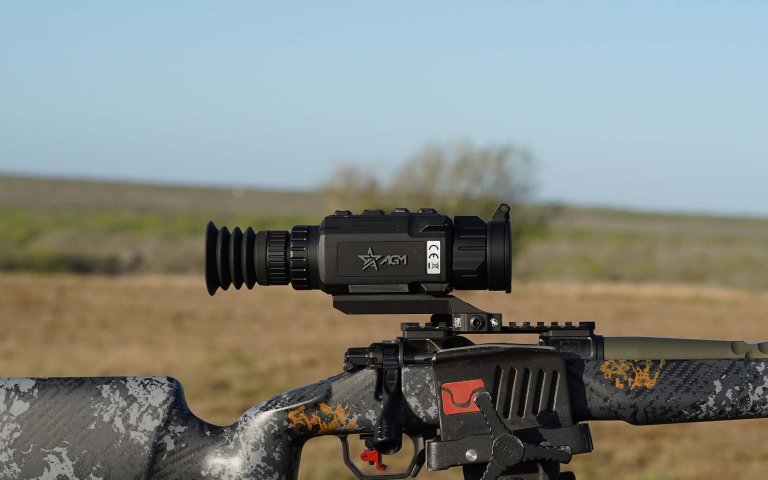
If you’re shopping thermal sights, you’re going to see a couple different styles, the standard 30mm tube scopes like the Nocpix BOLT, and this AR-optimized Rattler from AGM. The sight has a built-in QD mount that quickly mates to Picatinny rails and a short stature that fits neatly on carbine-sized rifles. But its design holds another feature; it can be quickly removed from the gun and used as a hand-held viewer, then when snapped back on the rail it’s a capable sight with a selectable reticle.
We tested this capability, and its point of zero didn’t shift noticeably with multiple removals and remounts. That dual use really boosts the value proposition of the AGM Rattler model, which comes in so many versions and combinations of lens size and sensor resolution it’s easy to get confused. AGM has five Rattler V2s, ranging from its 19-256 that costs $895, two 25mm versions in 320 (see above) and 385 resolutions, and this 35mm 385 version, which is the best combination of performance and appealing price.
AGM can keep this viewer/sight under $2,000 because it doesn’t have a built-in laser rangefinder. Instead, it has what’s called a “stadiametric” rangefinder, which uses standard size targets to determine distance. It’s a clunky and inexact system that’s vastly inferior to a laser rangefinder, but it does give users a rudimentary way to measure either target size at known distances or determine the yardage of standard-size targets.
The 25-384 model ($1,795) comes with 2x base magnification, which is optimized for hog hunters who trade power for wider field of view and quick target acquisition. The 35-384 model has 3x base mag, making it a better choice for predator hunters who might engage animals out to 300 yards. Both Rattler V2 models have outrageous 11-hour battery life, excellent
That navigation caught the attention of Outdoor Life thermal tester Derrick Ratcliff, who reckoned the V2 25-384 the best value in the category.
“Very impressive for the price,” Ratcliff noted. “The buttons are easy to navigate, though the menu is maddeningly detailed for on-the-fly changes, and I struggled with the zeroing screens.”
AGM Rattler V2 35-384 Specs and Features
Features: Custom QD mount, 4 thermal palettes, 10 reticles, picture-in-picture, recoil-activated recording, onboard Wi-Fi, wireless connectivity to AGM mobile app
| Sensor Resolution | 384×288 |
| Display Resolution | 1024×768 OLED |
| Pixel Size | 12um |
| NETD | |
| Objective Lens | 35mm |
| Magnification | 3x base, 24x digital |
| Detection Range | 1,800 yards |
| Battery Type | 18650 rechargeable cell |
| Warranty | 5 years |
SIGHTMARK SHADE 3.5-28×30 – $999
See It
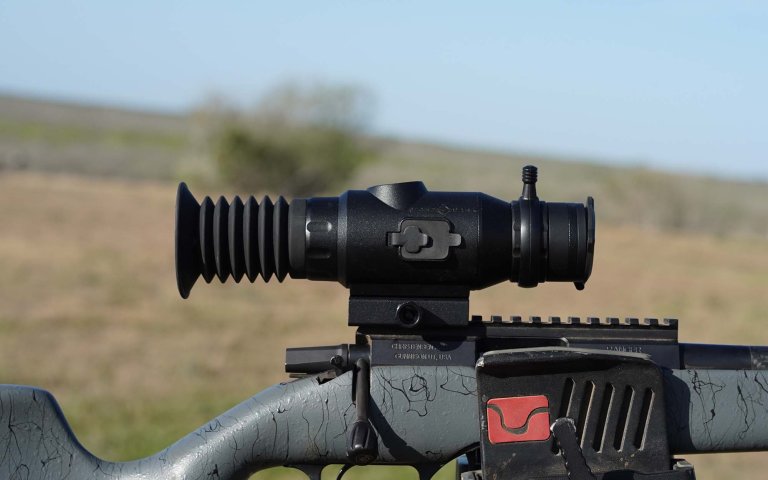
You’ve seen this before. The new Shade is nearly identical to the Sightmark Wraith released two years ago. It’s a $1,000 thermal that will get folks into the night-hunting game with barnyard-level optics in a fairly durable package.
Here’s what you won’t get in the Shade. You won’t get wireless transmission of photo and video – you’ll have to download content from an on-board micro SD card. You won’t get a rangefinder or any ballistic calculators. You won’t get much battery life. And you won’t get much performance out past about 200 yards.
But that’s not the intention of this entry-level thermal that Sightmark is positioning for farmers, homeowners who want to see into the night, and hunters on a budget who simply want to get into the thermal game.
These customers get an honest, short-range device that clips onto weapon rails with a QD mount, and that can be used to detect and engage nighttime varmints, peer into livestock pastures, and possibly be deployed for personal defense.
Our testers complained about the lack of tactility in the Shade’s buttons, its disappointing range and battery run time, and its lack of Wi-Fi or Bluetooth. Its display screen also appears to be located deep inside the unit, far from the viewer’s eye, But testers praised its rugged aluminum chassis, its overall capability at its 3.5x base magnification, and its price.
“This is a good choice for a rimfire thermal,” noted tester David Stroud. “Keep it in your truck or on your porch for dispatching vermin.”
Sightmark sells a 2-16×15 version of the Shade, with the same 256 sensor, for $799. Testers’ recommendation is to spring for the 3.5x model for an extra $200, because at its base magnification it will give you a bit more reach.
Sightmark Shade 3.5-28×30 Specs and Features
Features: QD rail mount, multiple palettes and reticles, onboard video and photo recording, 10 reticles, 5 color palettes
| Sensor Resolution | 256×192 |
| Display Resolution | 1280×720 LCD |
| Pixel Size | 12um |
| NETD | |
| Objective Lens | 30mm |
| Magnification | 3.5x base, 28x digital |
| Detection Range | Undisclosed |
| Battery Type | CR123 cell |
| Warranty | 3 years |
GOYOJO GRS225RF LRF SCOPE – $749
See It
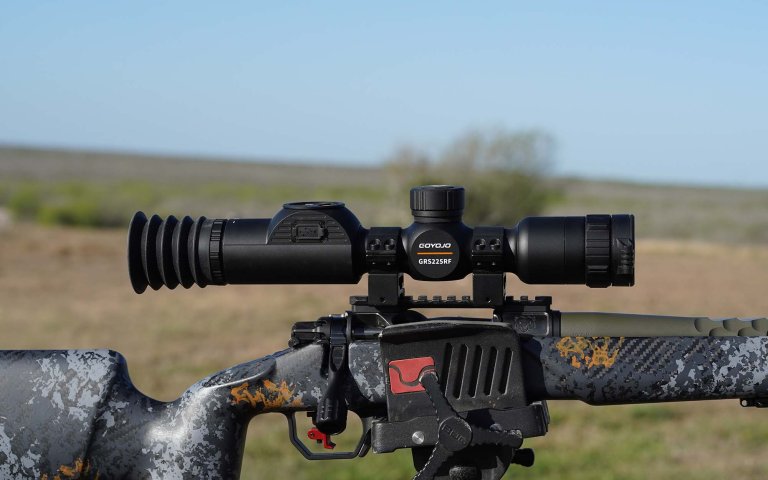
This full-featured thermal scope charmed the test team, right up until the moment when we tried to zero it. Its reticle danced around more than an immigration attorney at a deportation hearing. It turned out that its electronics kept defaulting to a baseline rifle profile, and once we figured out that bug, we got along okay with this full-size 30mm thermal rifle scope.
That is, we managed to hit our target at 50 yards. Out to 100 yards and beyond, the world through this entry-level thermal looks like an impressionist painting, without the fun colors. It’s limited by its 256×192 sensor, which is at the very bottom of target detection performance. We also quibbled about the scope’s extremely limited mounting dimensions.
It would be easy to dismiss this sold-on-Amazon brand as unserious, but the GRS225 has some very appealing features, including its 1,100-yard laser rangefinder, its very good 30mm mounting rings, and its simple and responsive controls. How a company can deliver a full-sized thermal optic complete with rangefinding, wireless photo and video transfer, mounting rings, and intuitive menu navigation for well under $1,000 is a mystery for AI to solve. The conclusion our testers drew is that all those fancy features are limited by its lousy resolution.
In short, this is an inside-200-yard thermal, and realistically it consistently performs inside 100 yards. That’s not nothing, and it would make a clutch rimfire thermal for varmint control. But given its smart design and easy navigation, a more sensitive 384 or 640 sensor Goyojo would deliver more than twice the scope at double the price.
Goyojo GRS225RF LRF – Specs
Features: 4 thermal palettes, picture-in-picture, recoil-activated recording, onboard Wi-Fi, wireless connectivity to mobile app
| Sensor Resolution | 256×192 |
| Display Resolution | 1440×1080 OLED |
| Pixel Size | 12um |
| NETD | |
| Objective Lens | 25mm |
| Magnification | 3.5x base, 10x digital |
| Detection Range | 1,100 yards |
| Rangefinder Range | 1,000 yards |
| Battery Type | 18650 rechargeable cell |
| Warranty | 1 year |
Athlon Cronus ATS Pro 25P-250 – $800
See It
Let’s start with what this entry-level thermal isn’t. It isn’t very clear or very sharp. It isn’t going to allow you to shoot out to 500 yards, or even past 250 yards. It isn’t going to win any hunting competitions or design awards. It feels a little flimsy.
But it is one of the best bargains in the thermal market, and is fully capable of getting you on coyotes and pigs out to near 200 yards. It will easily capture video and photos and transmit them to your phone. It comes with a solid rail mount. It’s easy to operate. And it gives hunters an opportunity to dip their toe in the thermal category without taking out a second mortgage.
Given the astonishing capabilities – and prices – of its competition, we had low expectations of the Athlon. The ATS Pro’s 256-microbolometer sensor is among the lowest-resolution cores in our test. To put that in context, the 1280-microbolometer sensor of AGM’s Adder, which won last year’s thermal scope test, has five times more resolution. It’s also 12 times more expensive.
If you want a bit more resolution, consider Athlon’s Cronus ATS Pro 35P-400, with a 400×300-pixel core. That unit will cost you about $1,800; in our view the increased performance doesn’t quite justify the upcharge.
The 25P-250 Cronus isn’t racing for the bottom. Its one-button and rotary selector operating system is fast and intuitive. Double-tap the power button to reveal the menu, use a rotary collar inside the eyepiece to navigate its options, then hit the power button to make selections. The scope has 10 selectable reticles, five based on MOA and five based on MIL dimensions adjustments, and seven color palettes. While the Athlon doesn’t exactly have a ballistic calculator, it does have the ability to customize reticles to various holdover values at specific distances.
Athlon’s mobile app is a little clunky — among its other shortcomings, it only works in horizontal mode — but the photo and video transfer is easy. And we had problems with batteries refusing to take a charge after a while.
The single-point rail mount is decent, and makes for fast mounting, but it’s not a precision attachment. And we worried that the plasticky build might not be up to the sort of bump-and-grind abuse thermal hunters routinely demonstrate.
But those are speculative fears. What we determined in testing is that this is a thermal that’s absolutely worth the money.
Athlon Cronus ATS PRO 25P-250 – Specs
Features: Stadiametric rangefinder, 7 color palettes, selectable reticles, easy rotary-collar menu navigation
| Sensor Resolution | 256×192 |
| Display Resolution | 1024×768 |
| Pixel Size | 12um |
| NETD | |
| Objective Lens | 25mm |
| Magnification | 3.6 base, 14.4x digital |
| Detection Range | 1,400 yards |
| Battery Type | 18650 rechargeable cell |
| Warranty | 5 years with registration |
Holosun DRS-TH – $1,882
See It
Holosun has married its excellent red-dot technology with a miniaturized thermal unit in the DRS-TH, which enables users to capably deploy handguns or self-defense shotguns in nighttime scenarios. Our testing was geared to tease out the talents of mid- and long-range thermal scopes, so we weren’t able to get a full work-up on the Holosun.
But we strapped the unit on our 22 Creedmoor ARs and had a ball with short-range plinking in quick target-acquisition scenarios. We operated the DRS-TH in separate red-dot and thermal modes, but the unit can run in dual-use mode where users can dim down the red dot to a barely visible aiming point and use the thermal for low-light target detection and recognition. It’s a fast and effective combination.
The unit has a 2 MOA red dot with eight brightness settings as well as four night-vision settings. Users can choose between a 65 MOA circle for fast target acquisition or 32 MOA for tighter handgun aiming. Or deactivate the circle and use just the red dot for precision work. DRS-TH has a 1x base mag but magnification steps to 3x and 5x. Display options include white hot, black hot, outline, and highlight modes.
The small size of the Holosun does have some drawbacks. It doesn’t have a Bluetooth transmitter, so it doesn’t connect to a mobile app. Users can record video and then transfer it via USB cable. And the small controls and separate lens covers take some practice to quickly deploy the sight in the field.
But the display, at 1.25x.98 inches, is surprisingly large for such a micro sight, giving users a fairly wide view of the world. Given those dimensions, plus all the technology packed into this sight, the unit is a chunk. It weighs over a pound and can throw off the balance of a smaller-frame handgun. But it’s just about perfect for an AR, pistol-caliber carbine, or home-defense shotgun.
Holosun DRS-TH Specs and Features
Features: Dual red-dot/thermal reflex sight, Shake-Awake battery saving feature, 2 MOA red dot and 32/65 MOA aiming circles, 10 hours run time in thermal mode, 50,000 hours run time in red-dot mode, integrated rail mount
| Sensor Resolution | 256×192 |
| Display Resolution | 1024×768 |
| Pixel Size | 12um |
| NETD | |
| Objective Lens | N/A |
| Magnification | 1x, 3x, 5x |
| Detection Range | N/A |
| Battery Type | 18650 rechargeable cell |
| Warranty | 3 year |
The Best Budget Thermal Monoculars
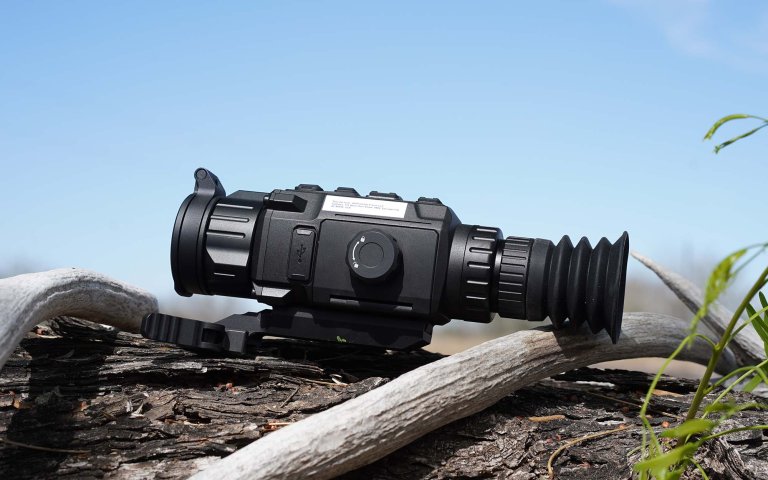
Editor’s Pick – Top Budget Thermal Viewer: AGM RATTLER V2 25-320 – $1,195
See It
The best-selling thermal at big-box sporting goods stores, this AGM is actually $300 cheaper than last year and outcompetes 256-resolution models with a better sensor, 5-year warranty, and plenty of features found on more expensive sights.
Its 320×256 sensor is a bit of an oddball, situated between the 256 and 384 standards. But with its 3.5x base magnification, it’s a good choice for both predator and hog hunters who keep shots inside 200 yards but want better resolution than that delivered by 256-pixel sensors. The Rattler V2 25-320 has a stadiametric rangefinder instead of a laser rangefinder, and it has a limited selection of four color palettes, but it has a high-resolution 1024×768 OLED display,
The Rattler V2 25-320 is a good choice for the thermal-curious looking for a decent unit from a premium brand that can give them experience with many of the features found on higher-end thermals. It’s going to disappoint hunters looking to engage targets outside about 200 yards, but at under $1,200 it’s a tremendous value in a gateway thermal.
AGM Rattler V2 25-320 Specs and Features
Features: 4 thermal palettes, 10 reticles, picture-in-picture, recoil-activated recording, onboard Wi-Fi, wireless connectivity to mobile app
| Sensor Resolution | 320×256 |
| Display Resolution | 1024×768 OLED |
| Pixel Size | 12um |
| NETD | |
| Objective Lens | 25mm |
| Magnification | 3.5x base, 24.5x digital |
| Detection Range | 1,200 yards |
| Battery Type | Rechargeable NE-4400 Li-ion cell |
| Warranty | 5 years |
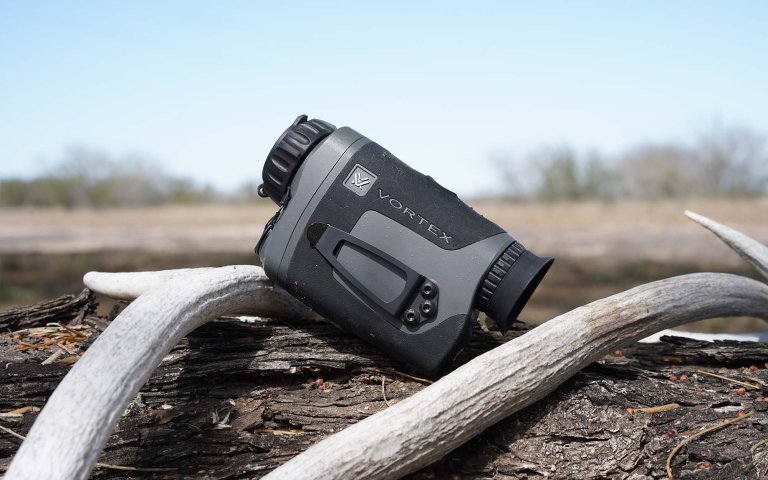
VORTEX VEIL 400 – $1,499
See It
Vortex’s long-awaited entry in the thermal market is this very capable, simple, and durable monocular. We’ve included it in the budget category even though the MSRP for the Veil 400, released earlier this week, is $2,299 because you can expect to see it in the marketplace for about $1,499. That price not only qualifies the Veil 400 for our category but makes this an exceptional bargain, besides.
The Veil 400 is built around a 400×300-pixel thermal sensor. It’s a strange size, since most units jump in resolution from 384 pixels to 640. But it works well in this platform, which looks and handles a lot like a conventional laser rangefinder. This isn’t going to be a 600-yard monocular, but it’s very handy inside about 250 yards. And it’s a worthy introduction to night hunting for Vortex brand loyalists who have been waiting for the daylight optics company to step into the thermal market.
With a base magnification of 2.3x and digital zoom to 4.6 and 9.2x, the monocular is well-suited for scanning large landscapes with its 57.8-feet-at-100-yards field of view. But once you start zooming, the resolution deteriorates fairly quickly. Vortex claims a detection range of 1,100 yards, and while users may technically be able to detect a hot cow at that range, its more realistic identification range is inside 200 yards.
The Veil doesn’t connect to a mobile app, so while the unit records photo and video, users have to connect their computer to the monocular with a USB cable to retrieve the on-board images. Our testers were split on the utility of its video recorder; the record button must continually be pushed in order to record. The Veil doesn’t have a laser rangefinder, and its 4-palette library is fairly limited. But it has three distinct modes — Balanced, Contrast, and Brush — to optimize viewing in different conditions. We’re also happy to see that it has a ¼-20 threaded socket to accept tripod plates.
In the field, the Veil 400 is easy to operate with its intuitive three-button navigation – if you can run a laser rangefinding monocular, you can run this. The monocular ships with standard 18650 rechargeable cells that each provide about 4.5 hours of run time, which is a little low compared to its peers.
If newcomers to thermal hunting will find the Vortex adequate, the experienced night hunters on our test team were more critical.
“Vortex is behind the curve, which is disappointing since it’s a company I admire and whose products I use,” said tester John Barth. “The price is too high for what already exists in the market, and its ergonomics didn’t fit me.”
But tester Scott Einsmann took a longer view.
“It’s the best viewer for anyone who is ‘thermal curious,’” he notes. “It works well inside 100 yards, so for hunters who are set up on feeders or for blood trailing, it’s fun and useful. The main reason to buy it is because Vortex isn’t a fly-by-night budget thermal company. You can invest in it and not worry about any issues with getting warranty repairs.”
Every tester called out Vortex’s warranty as a value-add to the Veil 400. Just as we have with Sig’s equally liberal warranty, we wonder how Vortex will manage to both satisfy customers and compete in a category of high-priced, easily breakable devices. Meanwhile, we’ll hope the next thermal release from Vortex will have the Veil’s wide utility and thoughtful ergonomics.
Vortex Veil 400: Specs and Features
Features: Familiar form factor, easy one-hand operation, tripod adapter, 4 color palettes, 3 viewing modes, on-board photo/video storage, covered by Vortex’s exceptional unlimited, unconditional lifetime warranty
| Sensor Resolution | 400×300 |
| Display Resolution | 1024×768 OLED |
| Pixel Size | 12um |
| NETD | Not provided |
| Objective Lens | 25mm |
| Magnification | 2.3x base, 9.2x digital |
| Detection Range | 1,100 yards |
| Battery Type | 18650 cells |
| Warranty | Lifetime |
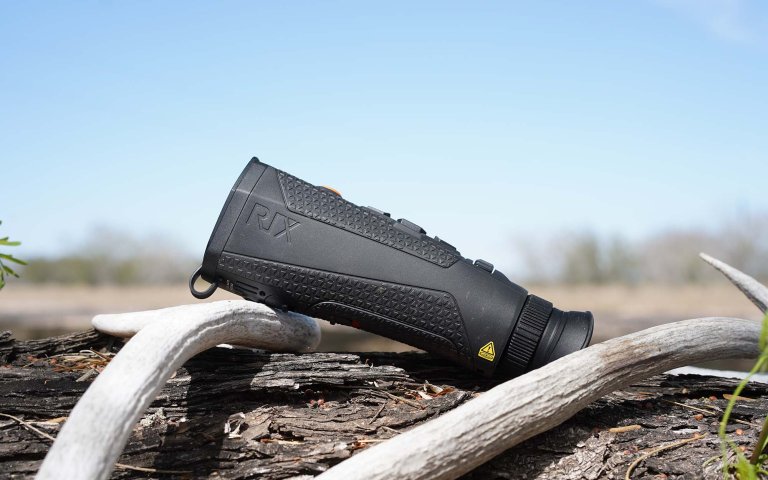
RIX TITAN T3 – $1,799
See It
This honest do-everything viewer could be considered the platonic ideal of the budget monocular. Its 384 sensor is fine enough to identify animals out to 250 yards. It can record and relay video and photo content to a mobile app, and it has smart, easy-to-navigate buttons and menu screens.
And, at under $1,800, it gets hunters into the thermal game in a unit that will retain its resale value.
Like the AGM and Nocpix brands, RIX has a number of models with only slight variations and similar naming conventions. That can make it hard to know which sensor resolution, objective lens size, and performance standard is right for you. In the Titan family of handheld monoculars, RIX sells a pair of models: the T3 we tested and the 35mm 640×480 T6 that sells for $2,599. Both feature the same button arrangement and overall operation. The T3 has a base magnification of 2.6x while the T6 has a 2.2x base mag.
The T6 would be our choice of the two, but its $700 price hike moves it out of budget consideration. If the T3 lacks some resolution, it has plenty of other attributes. The built-in laser rangefinder with a 1,300-yard detection range is a rarity at this price point, and the ballistic calculator enables long, precise shots. We love the one-hand operation and the fingertip focus control, and its 8-inch length makes it easy to stow in a jacket pocket.
The auto-shutoff feature saves batteries, which is good since the 5-hour run time on its 18650 cells is on the lower end of performance expectations. RIX has recognized the button panic that some users experience and addressed it with a smart next-function feature on its menu. In the display is a small map of the button arrangement, which advises users of the consequences of each control. If users take their time to consult the map, riffing between functions is quick and flawless.
In all, this is a great monocular for a beginner to thermal hunting, but it’s such a sophisticated unit that even seasoned users will find it extremely useful.
RIX Titan T3: Specs and Features
Features: Built-in laser rangefinder, ballistic calculator, power-saving stand-by mode, wireless photo and video transfer to RIX+ app, next-function button navigation, fingertip focus control, image stabilization
| Sensor Resolution | 384×288 |
| Display Resolution | 1920×1080 OLED |
| Pixel Size | 12um |
| NETD | |
| Objective Lens | 25mm |
| Magnification | 2.6x base, 10.4x digital |
| Detection Range | 1,421 yards |
| Rangefinder Range | 1,312 yards |
| Battery Type | 18650 cells |
| Warranty | 5 years |
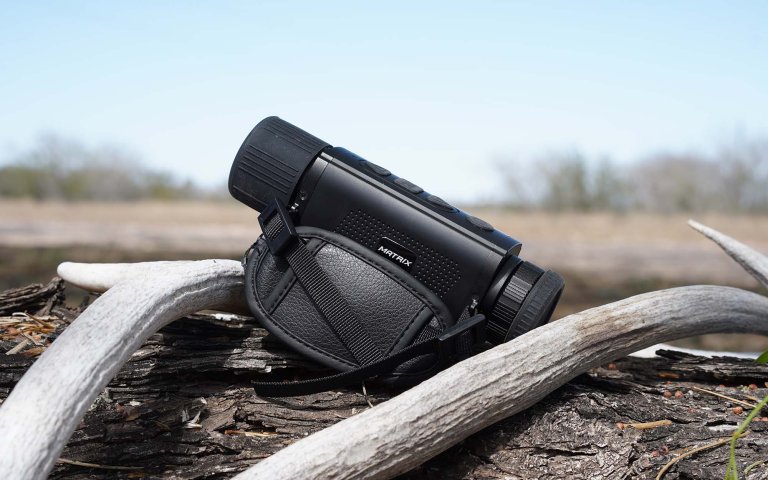
PREDATOR THERMAL OPTICS MATRIX 15-384 – $1,119
See It
Predator sells a version of the Matrix with a laser rangefinder, along with other models that feature larger objective lens diameters and higher thermal sensors. Those cost more, of course, but they may help overcome one of the limitations of this 15mm, 384 version: it’s just not very useful beyond about 100 yards.
In part, that’s because of the anemic performance of its underpowered sensor. But it’s also because the puny 15mm lens doesn’t provide much optical talents. We found the Matrix to be an adequate observation tool at its 1.5x base magnification, but if you add even one increment of digital magnification, image resolution deteriorates, turning targets into squirmy blobs of temperature variation.
Test team members provided mixed feedback on its refresh rate, with half the crew thinking the refresh rate was acceptable, the other half noting that it was distractingly frequent. Testers found consensus on the buttons, which were mushy and indistinct with unclear operation. And, try as we might, we could not find Predator’s mobile app to pair to the device.
Tester David Stroud noted that the buttons “are small and hard to find in the dark, and I had difficulty finding the video mode.”
Predator Thermal Optics Matrix 15-384: Specs and Features:
Features: Durable aluminum chassis, photo and video recording capability, wide-angle 1.5x base magnification
| Sensor Resolution | 384×288 |
| Display Resolution | 1024×768 |
| Pixel Size | 12um |
| NETD | |
| Objective Lens | 15mm |
| Magnification | 1.5x base, 12x digital |
| Detection Range | 1,500 yards |
| Battery Type | 18650 cells |
| Warranty | 5 years |
Guide TE 421 – $1,099
See It
This may not be the thermal that serious night hunters reach for, but it’s a thermal for just about everyone else. Compact enough to fit in a pocket, stupid-simple to use, and versatile enough for close-in surveillance and mid-range target ID, it has many of the features of units costing three to four times its price.
Those features include seven color palettes, Wi-Fi connectivity to a very good mobile app for image sharing and live-streaming, and smart attributes like a battery-saver mode, refresh countdown clock, picture-in-picture and hot-track modes, and a claimed 1,400-yard detection range. Not bad for a handy thermal that costs just over $1,000 and features an impressive 10-year warranty.
Its single-button operation is among its best features. The menu is accessed through a rotating color just ahead of the eyepiece focus. It’s a system for thermal virgins or tech-challenged users who struggle with the long- and short-push of multiple function buttons. Simply turn the collar to the function you want, then select with a push of the top button. What could be easier?
There are some limitations to the TE 421. We couldn’t get close to the stated 6-hour run time. While the Guide has a tripod adapter, it’s too shallow to be much use with most standard tripod plate studs. The display sits so far inside the housing that viewing can seem like looking down a tube. Its utility is limited to inside 150 yards. Also, we found the navigation collar a little tight, to the degree that it was hard to hold the unit still while riffing between functions.
But, considering those limitations, the Guide TE 421 is a charming, useful, and frankly fun thermal that would be a great entry-level viewer or an extra thermal to have around your house, vehicle, or in a purse or briefcase.
Guide TE 421 : Specs and Features
Features: Wi-Fi connection to mobile app, one-button navigation, at 5.2 inches and 10.4 ounces, very compact and light
| Sensor Resolution | 400×300 |
| Display Resolution | 800×600 AOMLED |
| Pixel Size | 12um |
| NETD | |
| Objective Lens | 25mm |
| Magnification | 1.9x base, 7.6x digital |
| Detection Range | 1,400 yards |
| Battery Type | Internal Li-Ion |
| Warranty | 10 years |
ATN BlazeTrek 325 – $1,495
See It
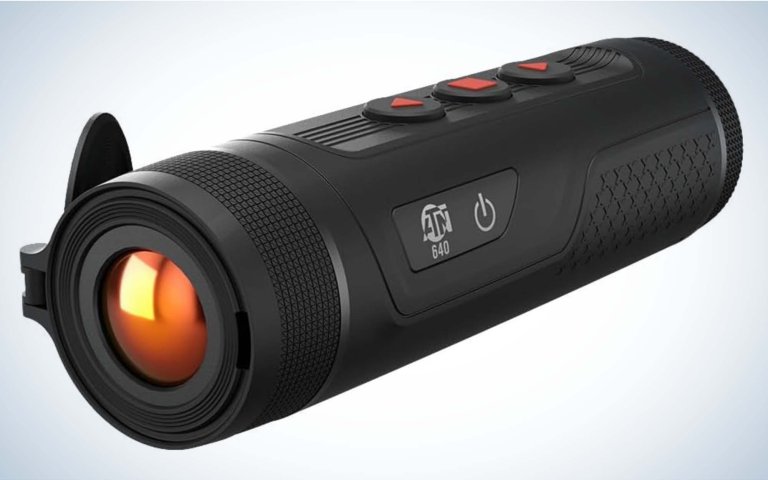
One of the genius features of ATN’s thermals is that most models are available in a wide range of configurations. Prospective buyers can match the resolution, performance, and price of units to their budget. We tested the lower-end BlazeTrek, but a higher-performing 640×512 micron unit is available for about $2,200, or about double the price of the 384×288 unit.
That price differential tells you all you need to know about thermal resolution, in general. You can expect to pay approximately double for every doubling of the thermal core resolution.
But ATN has another benefit for would-be buyers. They can try out the units themselves, hold them in hand, and compare and contrast their capabilities at one of the company’s stores in major Texas cities, Atlanta, and Chicago. That’s a helluva benefit, since most thermal customers buy online and have to go on specs, YouTube videos, and the (sometimes compromised) impressions of social media influencers to make buying decisions.
This little monocular has so much packed into its 9-ounce, 6.2-inch frame. It has a stadiametric rangefinder, hot-point tracking, Wi-Fi, video and still image capture, and a sensitive core. Too many features, noted the test team. It doesn’t really need the rangefinder, and the 1,300-yard detection range is just too ambitious for a tiny viewer. Our conclusion: operate this at whitetail ranges, inside about 400 yards, and you’ll be happier with its abundant talents. Beyond that range images get flimsy and ghosty and users get frustrated with its shortcomings.
ATN BlazeTrek 325- Specs and Features
Features: At 9 ounces and 6.2 inches long, very compact; tripod-mountable, 5 color palettes, simple 3-button navigation
| Sensor Resolution | 384×288 |
| Display Resolution | 800×600 OLED |
| Pixel Size | 12um |
| NETD | |
| Objective Lens | 25mm |
| Magnification | 2.7x base, 21x digital |
| Detection Range | 1,300 yards |
| Battery Type | Internal Li-Ion |
| Warranty | 3 years |
Read the full article here
