




This story, “Trapped in Devil’s Hole,” appeared in the Sept. 1963 issue of Outdoor Life.
From the trail along the rim of the gorge, the Middle Fork of the San Joaquin River, whiplashing down its canyon 1,000 feet below, looked like a twisting silver snake. It was water that neither John McClary nor I had ever been on, and just the sight of it, even though it was still hours away, was enough to make a fisherman’s heart skip.
We were in the rugged, high country of the Sierra Nevada’s, in west-central California just southeast of Yosemite National Park. Downstream we could see the granite top of Squaw Dome soaring almost 8,000 feet. Across the gorge were two peaks even higher, Saddle Mountain and Silver Peak, and a few miles upstream was Devil’s Postpile National Monument.
At our feet lay a massive canyon, still in deep, midmorning shadow. The walls were mostly smooth and bare, dropping in steep slides from one ledge to another, with manzanita, mountain mahogany, and sparse grass occasionally growing out of the crevices. It would be a tough climb for two inexperienced mountaineers, but we were sure we could make it. Nor was there any doubt that once we got to the bottom we’d find fishing that would make the hard climb worthwhile. John had fished other reaches of the San Joaquin but, so far as he knew, nobody had ever wet a line in this beautiful stretch.
This was a dream trip we’d planned for six months. John, my neighbor in Newark, California, had dropped in one evening in February, 1962, as I was tying a big dry fly we call the Sofa Pillow, or Haystack. (See “Haystack Fly,” OUTDOOR LIFE, April, 1959).
“Man, I know a place where you could have a ball with that,” he said.
“Where ?” I asked.
“The gorge of the San Joaquin,” John replied. “A spot I call the Devil’s Hole. You can fish below it and above it, but there’s about half a mile of deep gorge that nobody gets into. It’s virgin water, and from what I’ve caught downstream it’s got to be crawling with good trout.”
And that was how this whole adventure got started.
I’m a teaching principal in Hayward, Calif., 42, married, and have two children, David, 14, Kim, 6. John is 30, also married, has one youngster, and is a draftsman for Armco Steel Products at Livermore. We moved into neighboring houses a couple of years ago and formed a firm friendship, mostly because of our mutual love of trout fishing.
I’ve been at it since I can remember, have tied my own flies for 30 years, and have tested them in most of the famous rivers of the West. John is as cracked about trout fishing as I am, but up to the time we made this trip he was not a fly man.
Related: Trout Flies We Love to Hate
Before that evening was over we agreed to tackle the Devil’s Hole at the end of summer, and in late August our plans took final shape.
Knowing we were going into remote country, we chose our outfits with great care. In addition to food and utensils (limited to a frying pan, mess kits, and canteens), we packed snake and first-aid kits, knives, waterproof matchsafes, a light ax, mending kit and tape, string, survival kit, and 30 feet of stout nylon parachute cord. We had light down sleeping bags and air mattresses but no tent. Our packs weighed about 35 pounds apiece.
We left home late on the Friday afternoon before Labor Day, driving to the town of Bass Lake. We reached the Clover Meadow ranger station, at the end of a dirt road about 30 miles farther on, at 1 a.m. We’d leave our car there.
We unrolled our bags and slept until sunrise. Then, while I made breakfast, John went to talk with ranger Virgil Bishop. John came back with a map, a fire permit, and a warning to watch out for snakes. Rattlers were out in numbers, Bishop said.
This was Saturday. We planned to be out of the canyon by Monday noon, Labor Day, and the ranger asked that we check in at the station before leaving so he could be sure we’d got out safely.
We made the three-mile hike to the canyon’s rim in about an hour. There we took a 10-minute breather, then started down.
The first few hundred feet, on decomposed granite that felt like coarse sand, were fairly easy. Then we came to scrub pines, manzanita, and loose rock, and the going got tougher. The sun was high, and it was hot, hard work. I have an old knee injury, and it’s far harder for me to climb down than up. But we scrambled and fought our way to the first ledges, watching closely for rattlers.
From there it was impossible to pick a route. Only by climbing down to the top of each cliff could we determine how to go on. Often we made bad guesses and had to claw our way back up and try another route. Sliding, crawling, stopping frequently to sip water, we zigzagged slowly down the canyon wall.
Before we lighted our fire, we took our boots off again. My partner was in real trouble. His feet were so swollen he couldn’t get his boots back on.
We were halfway down when the first hint of trouble came. Our feet began to hurt. In half and hour my toes were burning like fire, and John was suffer-ing even more. We both had bad blisters, and John’s were broken and raw. He’d had his boots repaired, and they’d been sewed too tightly across the toes and had rough seams on the inside. We applied salve and bandages and resumed our descent.
The canyon wall changed now, the broken ledges and sparse brush giving way to bare, smooth granite with a few cracks running almost straight up and down. We lowered our packs over the worst places with chute cord, then let ourselves down, feeling for toe and finger holds, straining, sweating, a little scared. Six hours after we’d left the rim, we reached the river. Our feet were on fire, but we thought it had been worth it.
At that time of year, the San Joaquin is a medium-size stream, clear, and has slow-currented pockets and deep, black pools alternating with rocks, rap-ids, and frothing torrents. I’d never seen more tempting water, but before we could fish, our feet had to be taken care of. We lugged our packs to a sand bar and pulled our boots off. The bandages we had put on had rubbed off, and our blisters were bleeding sores. We dressed them and put our rods together.
Trout were dimpling the pool below the sand bar, and now and then they drifted out from their hiding places to snatch bits of food. I started with a No. 12 Humpback Nymph, one of my own patterns, and a 10-inch cutthroat took it on the first cast. I released him and cast for another. Every fish in the pool was feeding, and I tried pattern after pattern with the same results. John was using his spinning rod with a small spinner and doing just as well as I on the eight to 10-inch natives.
As the shadows began to deepen in the canyon, I changed to a big, gray Sofa Pillow, and a two-pound brown slammed into it. John switched to a fly rod and took one almost as big on a Haystack. We strung enough for supper, then quit.
Before we lighted our fire, we took our boots off again. My partner was in real trouble. His feet were so swollen he couldn’t get his boots back on. Luckily, I had a pair of sneakers. They were far too big for him, but they’d have to do.
We were starting to get a little worried. We discussed the climb up and finally admitted it would be suicide to tackle that granite face, the shape our feet were in. Upstream, around a sharp bend in the river, the canyon opened up; we had seen a fisherman in a pool there while climbing down. But between us and that pool, vertical cliffs 200 feet high fell straight to the water. We were blocked in that direction.
Downstream half a mile or so, there was a camp at Granite Creek Falls, with a steep trail angling down to the river. John had been there before. If we could reach that trail we’d have no trouble climbing out. But we didn’t know what obstacles lay in the gorge, and we couldn’t see around the first bend.
We finally put our worries aside until morning, and, after eating a good supper of trout, bread and jam, cheese and coffee, we crawled into our bags. Looking up out of the gorge was like looking out of a gigantic well. There was inky black all around, with just a strip of sky overhead ablaze with stars.
Dawn was creeping down the canyon walls when we awoke, and the only sound was the rush of the river. It was an eerie place at that hour. At break-fast, we talked things over. I grew up with rod and rifle in Utah ranch country where self-reliance is taken for granted. John is a cool, level-headed thinker. We were in a tight spot, but we thought we could get out. However, we agreed it would be best to start at once. We cooked our five remaining eggs along with our trout and fried a can of potatoes. We’d start with full bellies.
We began by scouting upstream, but it was no dice that way. Having run fast water in rubber rafts, I came up with a plan. I proposed that we make a makeshift raft of our air mattresses to float our packs, swim the pools downstream, and climb over any intervening rocks.
There’d be some risk, of course. I’ve been carried over falls once or twice, and I know the terrible power of water. Though McClary is a good swimmer, he had never tackled fast current. But he was game to try. With luck, we thought we could reach the Granite Creek Falls camp by night. That would give us all day Monday to climb and hike to the car and get home on schedule.
To reduce weight, we discarded all gear but the bare essentials. We kept our mess kits, canteens, ax, fry pan, bags, and fishing gear. If we got out as quickly as we expected, food would be no problem, so we took only four slices of bacon, half a loaf of bread, a small wedge of cheese, one can of stew, a box of cookies, enough coffee for four cups, and some lemon juice.
We found three pieces of driftwood long enough to go under both air mattresses and lashed our raft together with string. It was frail but the best we could manage. We attached the parachute cord, loaded our packs, and let the raft down through the first pool, walking along shore and wading where we had to. The water wasn’t deep, but it was icy cold.
Related: In Alaska, Even a Seemingly Unremarkable River Can Offer the Adventure of a Lifetime
At the lower end of the pool, the river forked around big rocks, plunging through white-water chutes barely wide enough for the raft. We carried the packs up over a ledge, but John elected to ride the raft through and keep it from hanging up. I’d check it with the cord. He made it almost to the bottom, lying across the two mattresses, when he bounced against a rock and hung in the raging current, threatening to capsize. I couldn’t slack off on the line because of the turmoil of water below him. He hung on, with water pouring over the raft, until he could find footing and stand up, chest deep, hanging to the line for balance. I tugged, and he scrambled out. We’d had a taste of the awful force of the river.
I climbed down to the next pool and waded out, he let the raft go, and I caught it as it came tossing down. We had been in and out of the water two hours now, and we’d come no more than 100 yards.
We found a piece of plank, used it to stiffen our raft, and floated down the next pool sitting on either end with our legs dangling. That pool ended in a jumble of rocks that looked impassable, but we found a crack where a huge slab of granite 200 feet tall had broken away from the wall, leaving a tunnel-like opening at the bottom just wide enough for us to carry everything through.
At the foot of the next pool, we came to a big U-shaped bend where the river ran deep and slick against an overhanging cliff. It was the most dangerous spot we’d seen, and it was also a point of no return. But we had nothing to lose, so we loaded up and shoved off, hanging to the raft.
The pool was so deep it was jet black. The river swept us under the overhang, and suddenly I felt current tugging my legs toward the rock wall and drawing me down. I could see nothing in the inky water, but the river must have poured through a cleft or into a submerged cave. Desperately I kicked my body back to the surface, got a foot against the wall, and shoved. I still wonder what was down there and shudder when I think of it.
Just below that bend we landed on a sand bar, gathered some driftwood, heated our stew, and ate some cheese.
At 6 o’clock that Sunday afternoon, exhausted from 11 hours of wading, swimming, climbing, and carrying, we found a series of narrow ledges just above the water. Following them around a bend, we looked straight down the gorge for 500 yards. At the far end, the camp at Granite Creek Falls was in plain sight.
“We’ve got it made,” I told John jubilantly.
But almost before I said it, we realized I’d spoken too soon. We could hear a waterfall downstream and see the river disappear at that point, and the canyon walls dropped vertically to the brink on both sides.
We had two hours of daylight left, and we used them struggling to reach a flat rock at the top of the falls, hoping to get a look over. We didn’t make it, but we got close enough to see that the river swirled into its plunge in a wicked whirlpool, then narrowed and knifed through a deep slot. Spray was bouncing up, and from the way the water ran and thundered, it was plain that no swimmer could hope to go over and live.
Here, within sight of our goal, we were hopelessly trapped. We couldn’t get past the waterfall, and there was no way to go back upstream even if we had wanted to.
We spent that night on three big boulders wedged together in midstream. We scrounged enough driftwood for a tiny fire, went without supper, and huddled in our bags for warmth. John’s feet were beginning to look ugly. The raw centers of the blisters were ringed with blue, and the skin around them was white. We dressed them as best we could and tried to make light of our troubles, but neither of us slept much.
Except for being short of food, we were in no immediate peril, but our predicament was serious.
We didn’t think a helicopter could get low enough to rescue us because of the air currents and the narrowness of the gorge. If climbers reached us, we doubted they could lead us back up the walls, half disabled as we were. It didn’t help any to know that our families would be worried sick.
This was Monday morning. We wouldn’t be missed for 24 hours. We had told our wives we’d be home that night, but my Jo Ann had waited my late return from too many fishing trips to feel concern over a few hours of delay, and she’d reassure Virginia McClary. When there was no word from us by Tuesday morning, however, they’d sound the alarm.
For breakfast, we had a small piece of cheese, two cookies apiece, and a cup of weak coffee. After we ate, we used the parachute cord to rope together like mountain climbers and clawed and waded back upstream to the last little sand bar we had seen. There was a break in the cliff there and a tongue of cedar climbing up 100 feet. That meant firewood and material for smoke signals. We decided to camp on the bar.
We climbed and tested the wall, looking vainly for a route up. We went without lunch, and supper was no better than breakfast. At dark, because it looked like rain, we cached the remaining bacon and cheese in a small cave. In the morning it was gone, lugged off by a squirrel or pack rat.
Bishop had told us to make smoke signals if we needed help, so we tried that Tuesday morning, piling green cedar branches on a driftwood fire. In a canyon like that one, the wind blows upstream during the day, dies as the evening cools, then freshens and blows downstream through the night, until the sun warms the air. There’s another lull before it turns upstream again. We lighted our fire when that lull came, and it sent up a column of dense, white smoke. But before the smoke reached the rim, it dissipated in the air. Our signals were never seen.
That morning we fished. The pool was alive with 10 to 12-inch cutthroats, and a dozen casts got us enough for breakfast. John even got one that weighed two pounds.
We had no fat, so we tried grilling the fish in our mess kits, but they scorched on one side and stayed raw on the other. Broiling them on green sticks wasn’t much better. Finally we put a little water in the kits and steamed them, and they were fine.
We spent that night on three big boulders wedged together in midstream. We scrounged enough driftwood for a tiny fire, went without supper, and huddled in our bags for warmth. John’s feet were beginning to look ugly.
There was nothing to do but wait. Our feet made any activity an ordeal, but in spite of the pain we fished a lot. I tested just about every fly I had with me and they all took trout, but the Sofa Pillow fished underwater produced best. We kept enough for our meals and released good fish until we lost count.
We were eating a late lunch Wednesday afternoon when three shots rapped out, up on the rim. We dropped our kits and raced for a lookout rock in the river. At the top of the canyon, looking about the size of a doll, was a man silhouetted against the sky. We waved frantically, and after a minute the tiny figure waved back. We were seen!
We learned later that the man who found us was John Broughton. Arlan Austin, a buddy of his, was with him. Both were friends of McClary’s. Virginia and Jo Ann had triggered a desperate search when we didn’t show up Tuesday morning, and Broughton and Austin were two of many friends and members of our families who dropped everything to look for us. John’s dad, Paul McClary, spent every minute with the rangers in the search party until we were found.
Half an hour after we were sighted, a big Air Force helicopter skidded into sight downstream. A man standing in the door tossed out a message wrapped around a stick. “Stay put,” it read. “Help on the way.”
There was no further sign of rescue until Thursday afternoon, when men on foot appeared at the Granite Creek Falls camp. Two of them, in swimming trunks, worked their way up the river close enough to wave but couldn’t get past the waterfall. After an hour or so they went back.
Late that afternoon, with a strong wind sweeping the canyon, we heard the helicopter again. The pilot, we learned sometime later, was Lt. Richard Whiteside from Hamilton Air Force Base, and he was really pouring on coal. I’ve never seen anything grittier than the way he bucked his big whirly-bird through the gorge’s air currents.
We had spelled out FOOD with green branches on the sand bar, and in three passes the chopper tossed out supplies. We had all the food we needed at last, and that night we ate the first real meal we’d had since Sunday morning.
We didn’t know it, of course, but by that time we were front-page news across the country. “How they got there is unknown,” said the Associated Press. “How or when they will be rescued is uncertain.”
When it was all over we received newspaper clippings about ourselves from almost every state in the country, and even from Germany and Japan. And while we were sweating out our ordeal in the canyon, our wives were sweating out theirs at home, keeping vigil beside their radio sets, going without sleep, answering endless phone calls, praying, frantic with anxiety.
The pilot was really pouring on coal. I’ve never seen anything grittier than the way he bucked his big whirly-bird through the gorge’s air currents.
Our rescuers were doing everything possible but were finding it as difficult to reach us as we had feared, and nothing happened on Friday until about 3:30 p.m. Then we got the biggest surprise of the whole experience.
We were hunched beside our fire when a voice said “Hello!” We looked up and saw Virgil Bishop, the Clover Meadow ranger, and his assistant, Murray Taylor, walking out of the cedars 30 feet away. They had been fighting their way down the canyon wall since 6:30 that morning. Bishop had been off duty because of family illness and had not learned we were missing until the day before. Experienced climbers, he and Taylor had started for us right after daylight. Bishop agreed, after looking at our feet, that they could not take us back up the wall. An Air Force rescue team was on the way, he said, and we’d best wait for them. Then, leaving Taylor to help with our rescue, he started for the rim. It was with a terrible feeling of frustration that we watched him climb without being able to follow.
Taylor slept that night in a little cave, using a sheet that had been dropped with a box of food to retard its fall. We warned him he might have rattlers for bedfellows, but he was too tired to care.
That Friday the Air Force at Hamilton Base sent its ace rescue and survival man into action. He was M/Sgt. Anthony Martino, a veteran paramedic who headed the water-survival course at the base, one of the best in the business, an icy-nerved climber and jumper who had made a specialty of dangerous rescues.
The sergeant and another expert in mountain rescue, Lt. Tom Finan, were about halfway down the wall at dark, unknown to us. They spent the night on a ledge and reached us at 9 o’clock Saturday morning. Their packs included two one-man rubber rafts, life preservers, throw-away paper sleeping bags, a two-way radio, climbing gear, and 1,200 feet of half-inch nylon rope.
Trying to find a route over which he could lead two half-crippled men, Martino went up on the sheer granite face and tried to drive pitons, but there were no cracks to take them. About 40 feet above the river he came to a narrow ledge, only a foot or so wide and sloping down away from the cliff at a bad angle. Martino inched along on that precarious, tilted shelf for 100 feet until he reached a rock wedged in a crevice and directly over the falls. There he anchored a rope and came back, anchoring it at our end as well. He’d take McClary, Taylor, and me along the rope to the end and then belay us down to the flat rock at the top of the falls, he said.
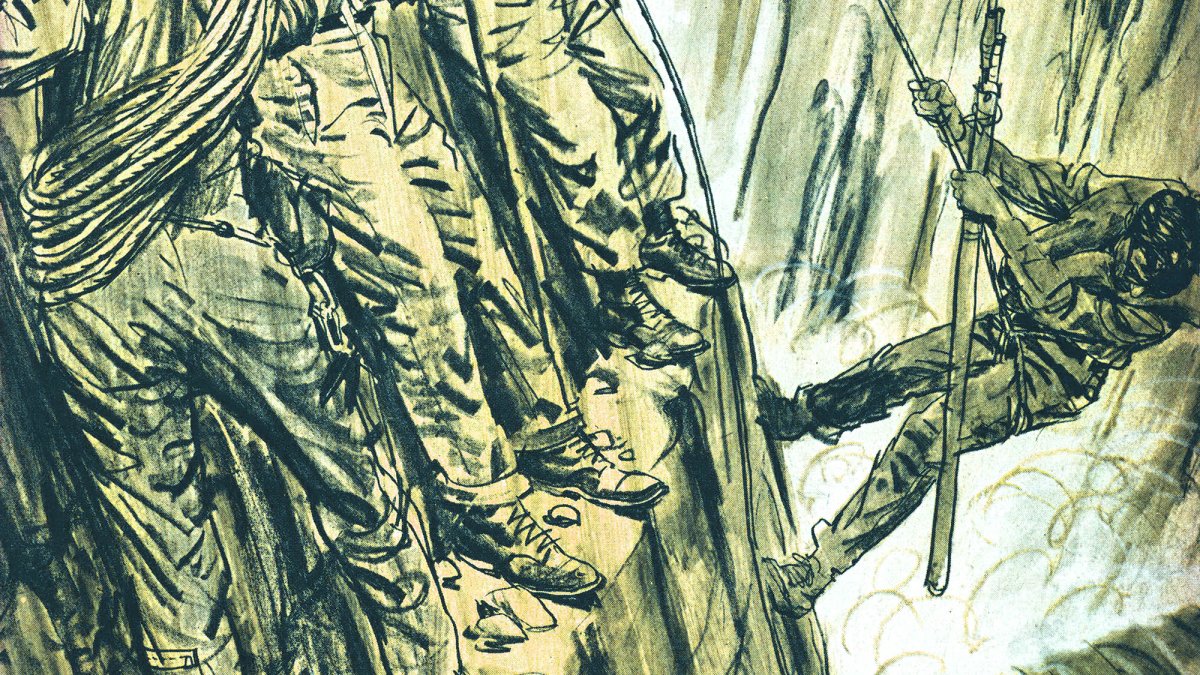
He and Finan rigged sling seats for us and fastened them to the rope with snap links. We went one at a time, hanging to the rope, shuffling along on that treacherous, sloping ledge with nothing below it but the vertical drop to the raging river, pressing ourselves in against the cliff like flies. In a couple of places the ledge petered out, and we had to swing across hand-over-hand on the rope. There weren’t even finger holds in the smooth granite. We were safe enough as long as the rope held, but the whole business gave me an awful, empty feeling in my stomach.
I took all the slack out and jumped — and my feet went out from under me on a wet and slippery shelf.
From the rock at the top of the falls, John and I got our first look at the plunge we’d have taken had we risked going over. A man would have had no chance of surviving it.
The next move was even more dangerous. Martino decided the way to get over the falls and through the surging pool below was to let one man down on a rope and lower an inflated raft to him. He’d anchor 200 feet of rope at the foot of the falls, swim the raft down to the rocks at the tail of the pool, and attach the other end there. Then the rest of us would be lowered and the packs passed down, and we’d either swim the length of the pool or ferry in the second raft, hanging onto the rope. Lt. Finan volunteered to go over first.
He attached his rope, standing knee-deep in crashing, tumbling water, almost under the falls, and we blew up the raft and passed it down to him. He let himself down to the foot of the pool, but just as he stepped out on a rock, a whirlpool caught the raft, tore it from the rope, and took it down out of sight, all so fast we hardly knew what had happened. It was a terrifying thing, but I guess we were too busy or too numbed to be really scared.
We went over the falls on the rope, one at a time, John and I, and then Taylor. Sgt. Martino was the last man down. He looped his rope around a rock, lowered himself, and pulled the rope off.
We had one more falls to go over, about 15 feet high. I went down first, climbing over the rocks, and found our lost raft bobbing and pounding under the falls. I managed to retrieve it and dump it.
I paddled the length of the next pool, stowed the raft in a crevice, and looked around for a rock to anchor one of our ropes to so the others could follow it down, but every rock in sight was as big as a house. I was clambering around when I came to a place where a good chunk of the river went straight down between three boulders. I had to get across. I was hanging onto the rope, tied at the other end 100 feet upstream. I took all the slack out and jumped — and my feet went out from under me on a wet and slippery shelf.
I brought up with a jerk that all but tore my arms out, and found myself dangling on the rope in a hole up to my waist, with tons of water sucking me down. I tried to lift my feet, but it was as if they were held by a giant magnet. I was out of sight of the rest of the party, and they had no idea anything had gone wrong. I gripped the rope desperately, kicked and fought, and at last got a knee on dry rock. I braced myself and heaved, and I was out, shaking like a leaf.
I never did succeed in fastening the rope at that place. We doubled it to make a loop and I served as a human pulley to tow the men and packs down on the second raft. The rest was easy. Below those rocks, we swam and rafted down a long, half-moon pool that ended on an open beach. We were out of the Devil’s Hole at last. It was 4 o’clock on Saturday afternoon, almost exactly seven days from the time we first reached the river and began to realize we were in trouble. It had taken the five of us six hours to cover that last 500 yards.
An Army jet helicopter from Fort Ord was standing by on a sand bar a quarter of a mile downstream. John and I climbed aboard for the flight to Fresno, the nearest field where it could refuel. That take-off at the bottom of the gorge was one to remember. Capt. John S. McLeod lifted the big chopper from the bar, made a turn, and flew straight at the wall. At the last second he tilted it around and headed for the other side.
We zigzagged back and forth like a giant dragonfly all the way to the top.
I’ve flown hundreds of hours, but I heaved a very deep sigh of relief and gratitude when we finally cleared the rim. We were pleased to learn, some months later, that Captain McLeod was cited by an executive order from the President of the United States and awarded the Air Medal for the daring part he played in our rescue. When we landed at Fresno, a small private plane came in behind us. It was my brother Gene.
He had left his teaching job to join the air search for us when we were reported missing and was coming now to fly us back to Newark. On the way, we stopped at Madera long enough to check with the office of Sheriff Merlin Young, who had coordinated the search, and to phone our wives. We were home before dark.
Read Next: We Tracked a Cougar into a Box Canyon Maze. The Cliffs Almost Killed Us and Our Horses
We had lost 12 pounds apiece, and our feet were in bad shape, especially John’s, but luckily there was no infection and they healed fast, although both of us lost most of our toenails. It was eight months before I finally shed the last damaged one and my feet felt normal again.
John and I still talk about the fishing in the Devil’s Hole and all the beautiful trout we caught and put back. They are still there, in those foam-flecked pools, and they can stay there as far as we’re concerned. It’s a sure bet neither of us will ever try to go back after them.
Read the full article here
