



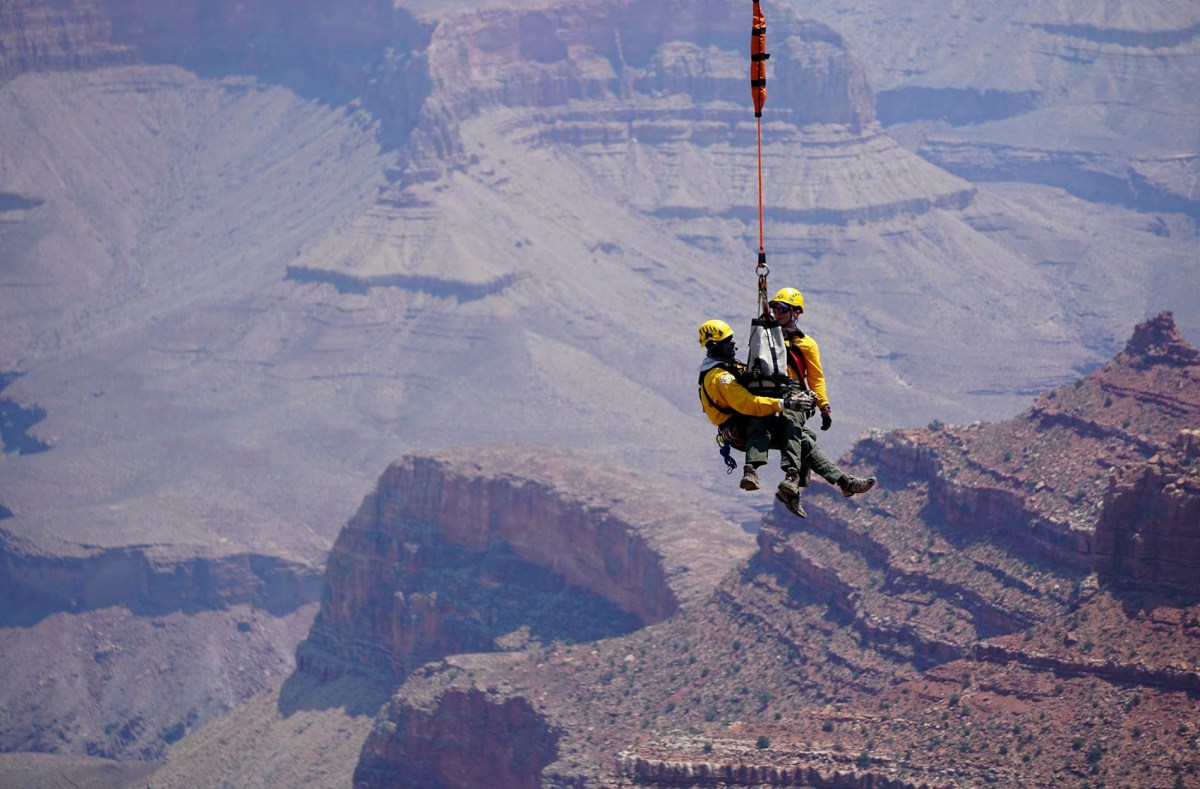

The search-and-rescue team at Grand Canyon National Park completed a hair-raising rescue mission on March 20, using a helicopter and a fixed line to extract a hiker who’d broken his back at Mooney Falls. Video footage captured by an onlooker and shared to social media shows a rescuer and the injured hiker dangling on the line beneath the helicopter as they’re flown up and away from the falls to safety.
The hiker is expected to make a full recovery, according to his daughter Domenica Celstina Roe, who posted on Facebook about the accident and the ensuing rescue. In a series of posts, Roe explained what happened leading up to the helivac, when “a moment of clumsiness became a survival situation.” She also thanked the SAR crew and other bystanders, including a hiker who was also a paramedic, for helping extricate her 62-year-old father from the base of the falls.
“We were extremely lucky the NPS responded to the call quickly and were able to figure out how to get to us down there,” Roe wrote in one post. “For context, we were probably an hour from needing to spend the night down there, and if this accident had happened further down the trail toward beaver falls, a helicopter would not have been able to get him.”
Grand Canyon National Park public affairs officer Joelle Baird says the high-adrenaline rescue operation was also a rare one for the team, since it occurred outside the park on the Havasupai Indian Reservation. Baird says they were called in to assist because of the unique rope skills required in such a steep and remote location. She explains that the SAR team specializes in short-haul rescues, where the rescuer and evacuee are suspended on a fixed line beneath the helicopter and flown a short distance to a safe landing zone.
“It’s not used in every national park service site, but we have a high need for it here just because of how remote the terrain is,” Baird tells Outdoor Life. “So it’s definitely a tool that has huge advantages when it comes to accessing these remote areas.”
Baird says the last time the GCNP SAR team was called in to assist on the Havasupai Reservation was in 2024, when Havasu Canyon flash-flooded and someone was swept downstream toward the Colorado River.
Mooney Falls is one of several iconic waterfalls along Havasu Creek — the most well-known being Havasu Falls. It’s the largest set of falls, dropping around 200 feet. It’s also the most dangerous waterfall to access, requiring hikers to descend a slippery, near-vertical cliff using a series of fixed ladders and metal chains. The falls are named after a miner, James Mooney, who fell to his death while attempting to climb down them in 1882.
Roe explained in her Facebook post that her dad was in great shape and had no trouble descending the falls. But then he slipped and fell at the bottom, fracturing his spine on a rock. Roe said that while they were prepared to spend the night at the base of the falls, they were extremely lucky that the NPS was able to reach them there. She also warned others that the climb down was “objectively sketchy,” and that a similar accident could happen to anyone.
Read Next: It Took Rescuers Days to Find Us in a Remote Canyon. It Took Even Longer to Figure Out How to Get Us Out
“I’m decently experienced in the outdoors with climbing, camping and backpacking, and I don’t think I’d come back here or recommend this trip to very many people,” Roe wrote. “This is not a beginners backpacking trip and I realize how much worse it easily could have been.
“This is a hauntingly beautiful place,” Roe added in another post, “but I think Instagram has made it seem way less remote than it really is.”
Read the full article here
