



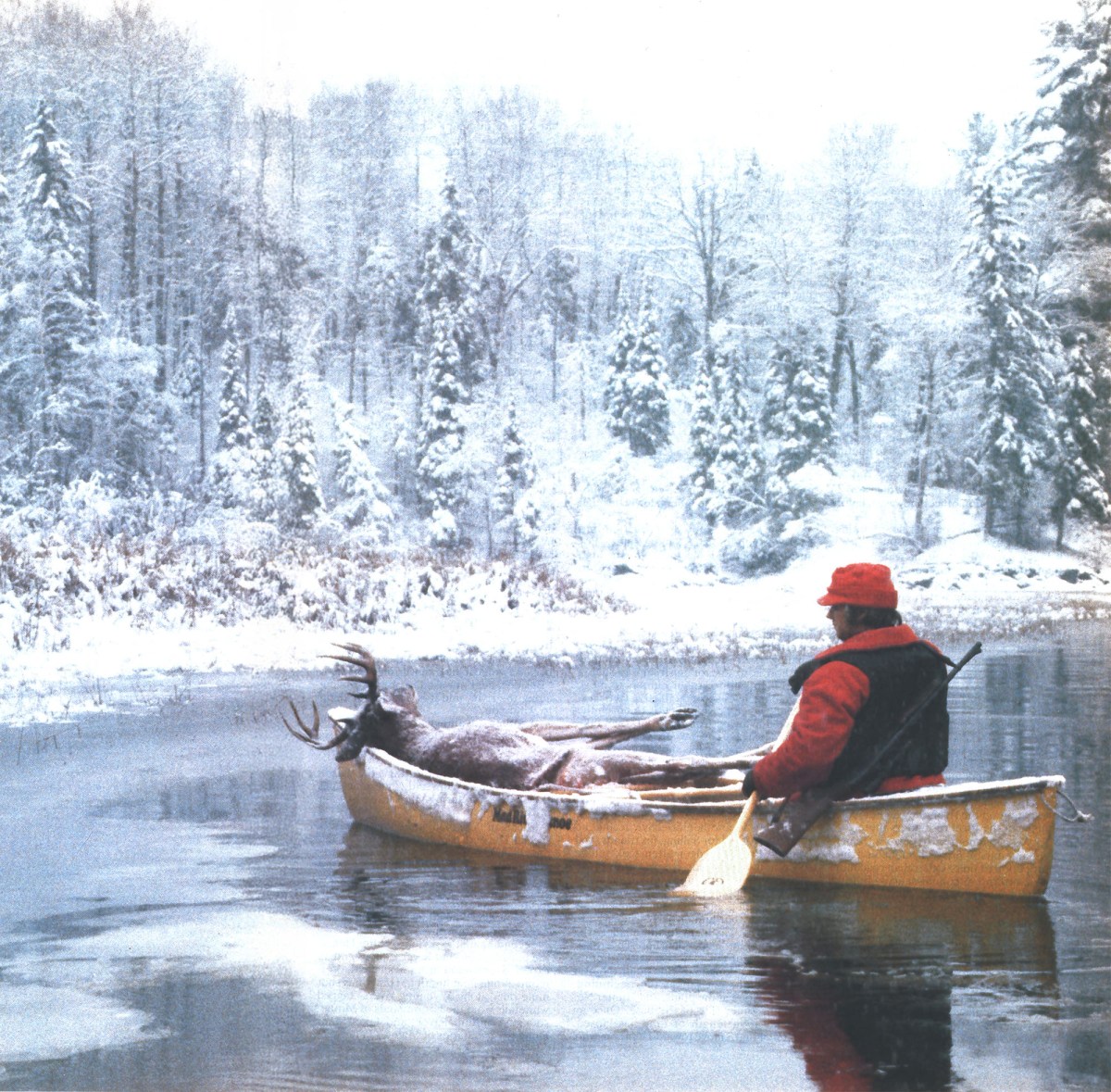

This story, “Float a River, Tag a Buck,” appeared in the Sept. 1985 issue of Outdoor Life.
Morning fog curled above the river like campfire smoke as Al Davis, in the stern of his 16-foot canoe, kept us on course with deft flicks of the paddle. From my bow-end advantage, I drank in the early-October beauty along the southern-Michigan river. Changing leaves offered a panorama of autumn colors. We were only 15 minutes downstream from our launch site, and I had already seen a great blue heron, beavers, muskrats, and several fox squirrels.
My partner silently negotiated a pretzel bend. There in the brush, not 20 feet away, stood a fat fork-horn whitetail. The buck watched us for a long moment with ever-widening eyes, then swapped ends and melted into the woods.
“Too bad we’re hunting ducks and not bucks,” said Davis, a veteran waterfowl float hunter. “I always see deer on these rivers.”
Three weeks later, on another float, he proved that point. The firearms deer season was open, and I had exchanged my over/under for a slug-barrel shotgun.
Had I possessed a doe permit that day, I could have filled it in the first half mile of our drift. Those trips motivated me to think about how deadly effective float hunting for deer could be.
The practice is probably as old as North American hunting. For hundreds — maybe thousands — of years, Indians canoed the continent’s waterways in quest of game, including deer. Beginning with Lewis and Clark, early white hunters also relied on float hunts to keep fresh meat in camp. Floating was highly popular with New York state hunters who drifted Adirondack Mountain streams in specialized guide boats. An 1892 Winslow Homer painting, “Hound and Hunter,” shows a young man in such a boat, reaching for a huge buck that his dog had driven to him.
Floating is an excellent deer hunting tactic, yet — with the exception of moose hunters — few sportsmen try it. Nowhere is this more evident than in my native state of Michigan where, if hunters do turn to rivers, they invariably are after ducks or squirrels — rarely are they after deer. On a Sunday afternoon last November, during the statewide firearms deer season,I took a little survey from an l-75 bridge overpass near Flint. Of the first 100 vehicles containing what I figured were hunters, 37 also carried whitetails tied to hoods, roofs, or trunks. Only one vehicle toted a canoe, though, and one other pulled a boat.
Float-hunting opportunities exist across the country. All of the Lower 48 states have huntable populations of deer, and many host intricate river systems ideally suited to this sport. Michigan, for instance, contains more than 36,000 miles of streams and more than 9 million acres of public land open to hunting. Is float hunting legal, you ask? Well, according to the game law regulations of 15 states that I spot-checked, shooting deer from watercraft not under power is generally allowed. One state, Kansas, technically prohibits the killing of game from any vehicle, (including unpowered boats). According to Mike Cox, the fish and game commission information and education supervisor, however, that regulation might well have been relaxed by the time you read this. Even if it is not, there is no law prohibiting Kansas hunters from using boats as a means of access to hunting areas, nor does it stop them from transporting game in the same manner. Be sure to check your state game law digest or to ask a conservation officer, however, before you go afloat.
Why should you consider float hunting? I know of five important reasons:
- Deer naturally frequent waterways in their travels, using these protective covers en route to crossing spots, winter yards, sources of drinking water, and food.
- Hunting pressure drives the biggest, smartest bucks to riverbottom cover. Here, they hide out along brush-choked banks, in mature lowland hardwoods that are often strangled with grapevines, throughout conifer swamps; and on dry pods in cattail marshes. Heavy snowfall also tends to concentrate deer in thick cover. This is especially true in the cover that I call green stuff — lowland conifers usually interlaced with water pockets.
- Rivers permit float hunters the opportunity to get close to unsuspecting deer. My hunting partners and I have jumped bedded whitetails from as close as 20 feet. Perhaps because most deer are used to movement on the river, they do not expect danger in the form of hunters there.
- Rivers allow hunters to cover a tremendous amount of prime deer habitat in a short period of time. Other than road hunting or aircraft reconnaissance — both of which are illegal in many states — there is no better way to scout territory nor to hunt it effectively.
- Waterways greatly increase accessibility to remote areas that are low in hunter pressure and, in some states, to public land that is landlocked by areas that are privately owned. Further, in addition to stalking deer by watercraft, rivers also open the door to other successful tactics such as still-hunting, trail watching, rattling, hunting over scents or baits, and driving.
So how come more deer hunters don’t do it? Chances are many never gave float hunting a second thought. Then again, some may not be willing to do the homework involved. This includes scouting a river for floatability, deer habitat, put-in and take-out access, and who owns the land en route. It also involves using two vehicles or making pickup arrangements with another party, and it could mean knocking on a door or two if the stand of oaks that you wish to hunt is privately owned.
Carl Salling, a professional guide who is president of In Season Adventures Inc. of Mesick, Michigan, began float hunting for deer when he was a college student 20 years ago. To date, Salling has killed 108 bucks in four states and British Columbia. Fifteen or 20 of these deer came via float-hunting tactics. He has guided others to river hunting success, too, including three clients who each tagged a buck in a single day. Salling picks rivers such as Michigan’s Big Manistee, which has large tracts of public ownership and meanders slowly through good deer habitat.
“You have to know local terrain and pressure conditions,” Salling said. “For instance, opening-day pressure on high ground, such as ridges often drives deer to lowland cover. A hunter sitting in a canoe can connect if he is in the right place at the right time.”
Salling said that deer have regular river-crossing spots, which are typically found in brushy or wooded areas abutting straight, shallow river sections. A proven hunting method is to anchor upstream of such a trail, then wait for other hunters to move deer along it. A second effective tactic, especially when bowhunting, is to beach the canoe downwind from the trail, then take a stand in heavy cover where you can watch the runway. Salling has shot a buck each of the past seven years during Michigan’s gun season by posting the same trail from his blind. On two occasions, he shot deer moving down the trail toward him after he had seen them cross the river.
Driving is another effective technique that has worked for Salling, his friends, and clients. Pressured·deer often seek refuge on points and islands covered with brush or thick timber. Sailing’s driving method involves dropping one or two drivers off at an upstream point. The remaining hunters (a three or four-hunter party is ideal) quietly drift downstream to. the head of the island or point. Depending upon cover size, a variation of this plan also works.
“There were days when we saw more deer than waterfowl. So five years ago, we switched our deer hunting methods to floating. Now that’s all we do.”
For instance, on a long and wide point, Hunter No. 1 might get out at the beginning, Hunter No. 2 at the point, and Hunter No. 3 at the other side of the base. Once an agreed-upon length of time has lapsed hunters 1 and 3 move toward Hunter 2, who acts as a poster. The best location to post is one that gives a clear view of both sides of the cover. Sometimes deer will break out on top of a waiting hunter; on other occasions, they will spurt from cover halfway along the drive. Extra hunters could act as blockers to intercept these deer. Drivers, incidentally, should move quietly and zig-zag slowly to discourage bucks from side-stepping the drive.
Forested ridges can also provide ideal drive conditions. A poster or posters are dropped off far upstream, then skirt lowland cover on their way to hilltop stands. Drivers get out at strategic spots along the lowland cover and, at a prescribed time, zigzag their way up the slope. All driving/ posting tactics require an intimate knowledge of the terrain. Topographic maps are extremely helpful. If the land is state or federal property, hunters can check with area foresters or game biologists to see if cover-type maps are available. A county plat book will aid in identifying landowners. These books are usually available for about $10 at most courthouses and from many chambers of commerce. Hunters seeking permission to enter private lands then know who to call or visit.
Brothers Jim and Jeff Redmon of Higgins Lake, Michigan, have used plat books to find suitable stretches of public land on a dozen northern state streams. Like several others I interviewed, the Redmons, who also guide deer hunters, got into this sport through floating rivers for ducks.
“But there were days when we saw more deer than waterfowl,” Jim told me. “So five years ago, we switched our deer hunting methods to floating. Now that’s all we do.”
During those five years, Jim Redmon, who’s 29, and his brother Jeff, 32, have tagged eight deer between them. Interestingly, the Redmons are bowhunters and their average shots are only about 20 yards from canoe to deer.
“You can get so close to deer in a canoe because you can be quiet,” Jim explained. “Besides, deer are used to objects moving along the river, and it is difficult for them to wind you.”
“You can get so close to deer in a canoe because you can be quiet. Besides, deer are used to objects moving along the river, and it is difficult for them to wind you.”
Another advantage is that Michigan’s bow season begins October 1 and runs six weeks until the firearms opener in mid-November.
“The rivers we run during bow season are always open,” Jim said, “but sometimes they freeze up during gun season or later in the year.”
Michigan, like many other states, offers special December-only muzzleloader and bow deer seasons.
Redmon cites lack of hunting pressure in the early season, particularly along rivers, as another reason for his and Jeff’s ability to get close to deer.
“Sometimes, they’ll just stand there and look at you,” Jim said.
Seconding that experience is Jim Henry, the president of Mad River Canoes and an expert deer hunter from Waitsfield, Vermont. While float hunting, Henry has shot mule deer along Wyoming rivers, tagged whitetails from the bottomlands of Minnesota’s Vermilion River, and taken deer along the tributaries of Maine’s Penobscot River. Most of these experiences were wilderness hunting expeditions in unpressured areas that are inaccessible by car or truck. In Maine, during the past two Novembers, Henry and his friends used a 21-foot freighter canoe to transport their wall tent, stove, and other gear; then they buddied up in 16 or 17-foot Explorer canoes to drift streams flowing into Chesuncook Lake. Their method involves relying upon paddle power to cover large areas of prime deer habitat. and they keep an eye out for crossing areas.
Mornings and evenings are best because deer are moving along waterway edges, looking for food and mating partners. Two falls ago, the Henry party of four hunters tagged an eight-point. a four-point, and two does. All were shot from canoes.
Getting close to deer and away from other hunters are two key advantages to float hunting. Access to prime habitat and the ability to cover it in a short period of time are other pluses. Although I know of no one who does it. rattling from a canoe at 10-minute intervals every mile or so could be a dynamite hunting tactic. A good-size canoe or inflatable also allows hunters to carry plenty of gear. including bait where legal, and affords a means of transporting game.
Depending upon stream type and flow rate, johnboats, rowboats, canoes, and inflatable rafts can be ideal for float hunting deer. Canoes, though, are the most popular choice. Those constructed of aluminum are light and easy to transport, plus they handle easily and can be propelled quite rapidly by muscle power. Aluminum, how; ever, is noisy. To deaden sound, some hunters line canoe bottoms with carpeting and place slit flexible hose over the gunnels. Others opt for wood or fiberglass boats but then lose the lightweight advantage. On the other hand, the space age offers durable, lightweight synthetics such as Kevlar, polypropylene, and hypalon, all of which are now popular materials in new boat construction.
The Achilles Inflatable Corporation, for instance, produces several inflatable rafts, each made with a four-layer fabric of heavy-duty nylon reinforced with hypalon and neoprene, both man-made elastomers. The result is a tough, snag-free fabric that is also surprisingly light. An SPD-4DX Sport Dinghy model that I used to float down a Michigan river weighed just 93 pounds. With its 990-pound capacity, however. it can transport two hunters and a whitetail buck. The raft can also handle a 10-hp motor.
Related: The Best Packrafts, River-Tested
Kevlar is the new rage in canoe construction. The Sawyer Company is building 17-foot long canoes made of closed-cell. foam-core Kevlar for a total weight of less than 50 pounds. Mad River’s Explorer, a 16-foot six-inch-long canoe, is also made of Kevlar. It weighs 57 pounds. A 12-foot Porta-Bote, constructed of polypropylene and featuring a cargo capacity of 600 pounds, weighs only 59 pounds. The Porta-Bote is actually a rowboat that folds into surfboard shape only four inches high and. it comes with oars. Your choice of boat for float hunting deer is purely personal. You should know, though, that there are excellent products to choose from.
Actually you don’t even have to own a boat. Many canoe liveries are open late into the fall. Kevin Hughes, a friend of mine. rents canoes to drift Michigan’s Betsie and Chippewa rivers for deer during the firearms season. I have also heard about a small handful of innovative hunters who drift brush-choked streams in float tubes that are normally used for pond bass fishing. I can believe the stories that tell of these hunters being able to approach deer almost within touching distance. A Madison, Wisconsin, hunter I know of stillhunts by wading trout streams that wander through tag alder swamps skirted by hardwood ridges.
This hunter has shot bucks by posting logging roads and fence lines—natural travel routes for deer-that he encounters in his stream travels. He claims that firm-sand stream bottoms aid in walking and that his low vantage point is a big help in picking out deer in heavy cover.
If floating rivers for deer is a new sport for you, start with friendly streams that you can easily negotiate. They are often the best waterways for deer anyway, because they meander through lowland cover, allowing hunters plenty of time to check banks for deer activity and sign.
From a boat, you can hunt alone or with a partner. If you’re hunting with a friend. only the hunter at the boat’s front end should be armed for safety reasons. Hunters can swap positions halfway through the float. Another safety precaution is to add sponsons to the canoe if the stream you plan to drift is wide and slick running. Another idea is to wear a life preserver, especially the vest type. They are comfortable. don’t impede shooting, and actually help to keep you warm. Pack matches, tinder, and a dry change of clothes in a waterproof bag and tie it to a boat seat or thwart. Tipping over in an ice-cold stream is not my idea of fun. Neither is flirting with hypothermia, the No. 1 outdoor killer.
If floating rivers for deer is a new sport for you, start with friendly streams that you can easily negotiate. They are often the best waterways for deer anyway, because they meander through lowland cover, allowing hunters plenty of time to check banks for deer activity and sign. One or two practice drifts will help you to become familiar with both the river and its habitat. It will also give you an idea as to the travel time.
Read Next: ‘I Laughed, I Cried.’ After 36 Years, North Woods Hunter Finally Tags His First Deer
This fall, I’m hoping to float a river and tag a buck in heavily hunted northern Michigan, as well as in wilderness Maine. In both places, I don’t expect competition from another float hunter.
Read the full article here
