



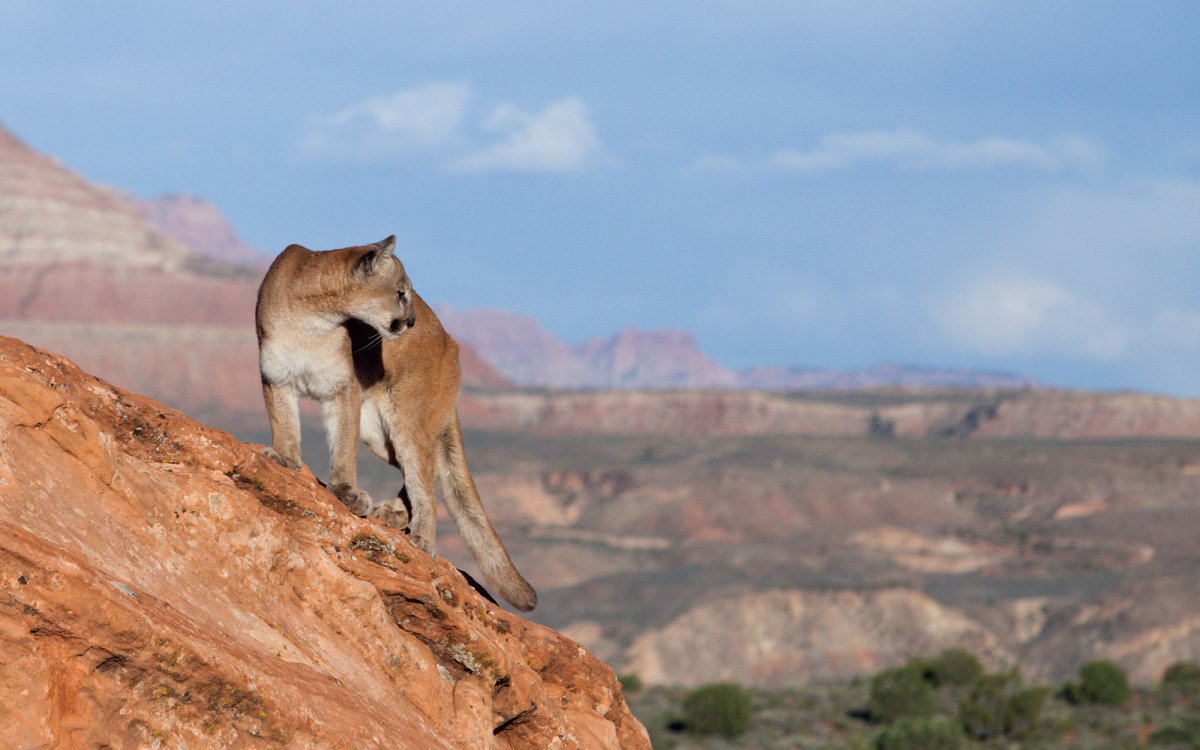

Wildlife managers in Utah have begun culling mountain lions in six of the state’s game management units as part of a new study. The objective of the three-year study is to gauge the impacts these targeted removals may have on deer populations. They are trying to determine whether killing more mountain lions results in more mule deer.
“We’ve seen predation as a potential limiting factor in many units,” Kent Hersey, Utah Division of Wildlife Resources big game projects coordinator told the state wildlife commission during a board meeting on Thursday. “When lion predation exceeds seven percent or so, deer survival is very difficult. If we can’t achieve population survival, the population goes down. That creates additive mortality, and we want to see what happens when we remove additive mortality.”
This “additive mortality” is cougars, which rely on deer for around 80 percent of their diet. The DWR says the six hunting units in the study area have higher than eight percent predation, with some units seeing double-digit percentages in recent years.
The practice of killing mountain lions (and other predators) to benefit ungulate populations remains a controversial subject among wildlife managers. And although Utah is not the first state to undertake such an experiment, the response from hunters and trappers there has been mixed. Some groups are already speaking out against the study, while others are supporting it or taking a wait-and-see approach.
“The Utah Houndsmen Association does not support this study,” UHA’s outgoing president Cory Huntsman said during the commission’s public testimony session in January.
Houndsmen, of course, play an important role in keeping Utah’s cougar populations in check and studying the species. As do trappers, who also harvest them. And while bounties on big cats were removed back in the 1960s, when the species achieved regulatory status, Utah made it easier for hunters and trappers to control cougar populations in 2023 by legalizing lion hunting year-round. The DWR’s new multi-year effort ups the ante by adding state agency trappers to each of the six game management units under study: Boulder, Monroe, Stansbury, Pine Valley, Wasatch East, and Zion.
It’s all this extra pressure that doesn’t sit right with Huntsman and other houndsmen, who are now asking the DWR to release maps of where the state’s traps and snares are located.
“We’ve had hounds killed by snares,” Hunstman said. “Outfitters are scared so they’re not hunting the lions. They’re relying on state trappers. With a heat map, you might get the outfitters in there as well. You’ll give us a little peace of mind to where we can turn our dogs loose.”
Read Next: Wyoming Lawmakers Tried to Declare Open Season on Mountain Lions. Local Houndsmen Shut It Down
Other hunting groups have come out in support of the study, which started with the DWR collaring mule deer in the six units during late 2025. The Utah Wild Sheep Foundation is providing $150,000 in funding, while Sportsmen for Fish and Wildlife is contributing another $150,000. The Mule Deer Foundation helped with collaring in December and is now waiting to see the results of the study before taking a stance on it. MDF president Greg Sheehan says he was part of that collaring effort, and that despite a mild winter so far, he noticed the body fat on many of the does was incredibly low.
“We recognize cougars can have a population effect in some instances, but in other instances they don’t,” Sheehan tells Outdoor Life. He looks forward to learning the results of the study and how managers “will go about implementing changes based on those results.”
Not surprisingly, some of the same wildlife groups who pushed back on the 2023 law to expand mountain lion hunting have spoken out strongly against the new study. Predator advocacy groups like the Mountain Lion Foundation argue that cougar populations are already in decline, and that other factors play a bigger role than predators in suppressing Utah’s mule deer populations.
“Habitat quality, winter severity and human pressure ultimately determine deer recovery not predator eradication,” MLF social media coordinator Anna Wright told the commission earlier this month. “What these removals reliably do cause is instability.”
Riley Peck, the incoming director of the DWR, acknowledged in that same meeting, however, that the state agency is required to do something about the downturn in mule deer populations that researchers in Utah and other Western states have seen in recent decades.
“We have a mandate from the state legislature that tells us we’re going to look at cougar management and take specific action when predators might have a top-down effect on some of our big game species,” Peck told those in attendance. “That puts us in an interesting spot as we are trying to manage for abundance and existence of cats for those who want them and manage for a big game species that is primarily their prey.”
Peck noted during his testimony that mule deer declines are a top-up problem in roughly 70 percent of the state — meaning populations are suffering due to a loss of habitat, vegetation, and other environmental factors. He said the DWR considers the other 30 percent of the state to be a top-down problem, which means predation is the limiting factor.
These science-based considerations, however, don’t take public opinion into account. And at a time when some Western states have considered outright bans on cougar hunting, lion hunters are finding themselves in the middle of a larger debate.
Read: Officials Confirm a Mountain Lion Killed the Colorado Hiker Found Dead on New Year’s Day
“The optics are horrible,” Huntsman warned in his testimony. “A study like this, with the optics it brings on Utah, I just don’t think we need to bring this fight to Utah any faster than it’s already coming.”
Read the full article here
