



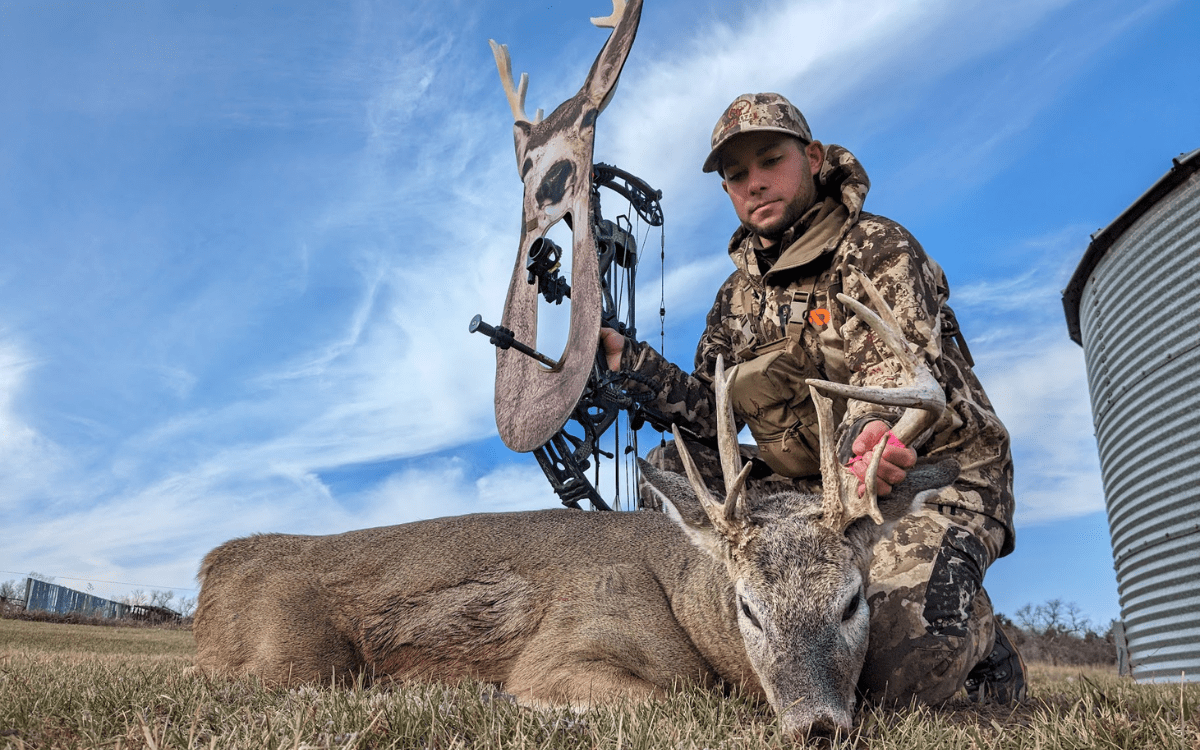

Four long years were spent eating tag soup during my annual archery trip to the prairie in search of whitetail and mule deer. In the vast flatland, stalking with nothing more than ankle-high grass as cover proved to be more of a fool’s errand than a difficult hunting strategy. Getting to 100 yards was easy, but closing the final 50 to 60 yards was nearly impossible. Eventually, I had reached a point where enough was enough, and I began searching for a tool to help me close the distance.
That’s when I came across the Ultimate Predator Stalker Decoy. This bow-mounted decoy attaches easily and is just realistic enough to trick a rutted-up buck in the middle of November. Since I began using the decoy on my annual trip, I’ve tagged out every year.
While that sounds fine and dandy as a brief overview, I’d be lying if I said it’s been easy to fill those tags. On rare occasions, the decoy helps finish the stalk for me and puts an unwary whitetail right in my lap. Most of the time, however, my stalks end the same way they did before I had the decoy, with the deer spooking and running into the next county.
On those adrenaline-pumping occasions that it works, it’s worth the countless heartbreaks leading up to that moment. Over the years, I’ve learned a few rules that can’t be broken if you want to be successful. Below are the five rules for reaping whitetail deer that you need to know.
You Can’t Beat Their Nose
Just like stalking in deep ravines or picking out a treestand location, factoring in the wind and thermals is a necessity when reaping whitetail deer. In my experience, there’s not a single product on the market that you can apply or wear that will beat a deer’s sense of smell when they’re directly downwind. Since you’re reaping from the ground, there’s nothing you can do other than to approach from an angle where your wind and thermals won’t be a factor.
When reaping deer, they’ll usually try to circle downwind. This is a natural movement pattern that is hardwired and unbreakable. Knowing this, you have to use the terrain and landmark features, like a thick treeline or fence row, to your advantage.
Once a buck locks on to you, it’s not going to want to lose sight of you when approaching. If you can get near a fence row that is perpendicular to the wind direction and in range, you’re increasing your odds of getting a shot off.
Look for Lockdown
Aside from the wind, which applies to all forms of deer hunting, this rule is the most important rule of them all. If you’re trying to reap a deer in the big woods of the Northeast, or the prairie out West, a buck in lockdown is going to be the most willing to march your way.
When a buck is in lockdown with a doe in estrus, he’s arguably at the peak of his aggression towards other bucks. In the multiple days of lockdown, it’s likely that he will fend off multiple different bucks trying to gain access to the doe. This natural instinct works in your favor when reaping.
If you’re able to approach a lockdown buck with the wind in your favor, he’ll likely be willing to close the distance for you. That’s not always a guarantee, as factors like the doe running off or the buck not feeling aggressive in that moment may come into play, but lockdown is the scenario I crave when reaping whitetail deer.
You Have to Pop the Bubble
If you’ve reaped spring gobblers, you’ve likely heard of popping the bubble. In essence, the bubble is an imaginary line in the landscape that you need to cross with your decoy to invade the bucks’ privacy. If you pop up 500 yards away on the skyline, he’s likely to pay you no mind, or simply retreat over the next ridge and play it safe.
But if you use the terrain to your advantage and close the gap to 80 yards and then appear with the wind in your favor, your odds of triggering an aggressive reaction go up in a hurry. This is even more important in a lockdown scenario. Getting in close to the buck and doe prior to being seen and then popping out almost in bow range can force a rutting buck to pick a fight over flight just based on his instincts kicking in.
Approach the Buck, Not the Doe
In a lockdown scenario, your biggest threat of getting busted while reaping is always the doe. Unlike her male counterpart, she doesn’t have insanely high doses of testosterone that make her more susceptible to letting her guard down. Typically, she’s always on high alert.
That means your approach with the decoy has to be very well thought out. Rather than just bullrushing in and trying to pop the bubble by any means necessary, a more subtle approach is to pop the bubble in a way where only the buck can see you. In most cases, the buck will bed within 15 to 20 yards of the doe. In the best-case scenario, this leaves you with a tight window to approach with the wind in your favor and pop the bubble without being visible to the doe. It’s not always possible, but I’m referring to the ideal setup here.
By approaching the buck and leaving the doe oblivious to your presence, you’re much more likely to elicit an aggressive reaction from the buck without the doe spooking and taking him with her. In the end, you must remember that no matter how realistic your decoy looks, the buck cares more about the doe than you and will skip out on a fight to stick with his doe without a moment’s notice.
Look and Sound Like a Buck
This final rule has been the difference maker for me on three of my four successful reapings. Whether you’re using a grunt tube to create low tending or loud challenging grunts, snort wheezing to elicit a reaction, or even just stomping the ground once you’ve popped the bubble, it’s pivotal that you act like a buck when reaping.
A challenging buck doesn’t just meander in a straight line and walk right up to a lockdown buck and doe. They stomp, they grunt, and they slowly circle in preparation for a fight. Watch any video of bucks fighting, and pay close attention to the moments before the fight. Their body posture and positioning can cue you in on minute details to replicate when reaping.
I’ve found most success in a stomp and snort wheeze combination. This typically convinces the buck that I’m there to challenge him for his doe, and that’s when he bristles up, pins his ears back, and begins marching in my direction. Once I see those telltale signs, my focus switches to my rangefinder and release.
Final Thoughts on Reaping Whitetail Deer
This tactic isn’t very popular or mainstream. That’s for good reason. The success rate is admittedly low. For every successful reaping, there are 20 to 30 unsuccessful approaches in the rearview mirror. You have to be willing to fail time and time again in order to have one successful hunt.
I would also be remiss to not mention that safety is paramount when reaping. Do not, under any circumstances, reap on public land during a firearms season. Even in archery, deploying hunter’s orange on the decoy and your person would be a strong recommendation of mine. No deer is worth dying over.
With that said, reaping whitetail deer is something I look forward to attempting every year. It’s a wonderful way to break up the monotony of sitting in a treestand for hours on end. It’s physically and mentally challenging, and has led to some of the most exciting moments in my hunting career. There’s nothing better than tricking a mature buck into pinning his ears back and approaching you, ready for a fight.
Read the full article here
