



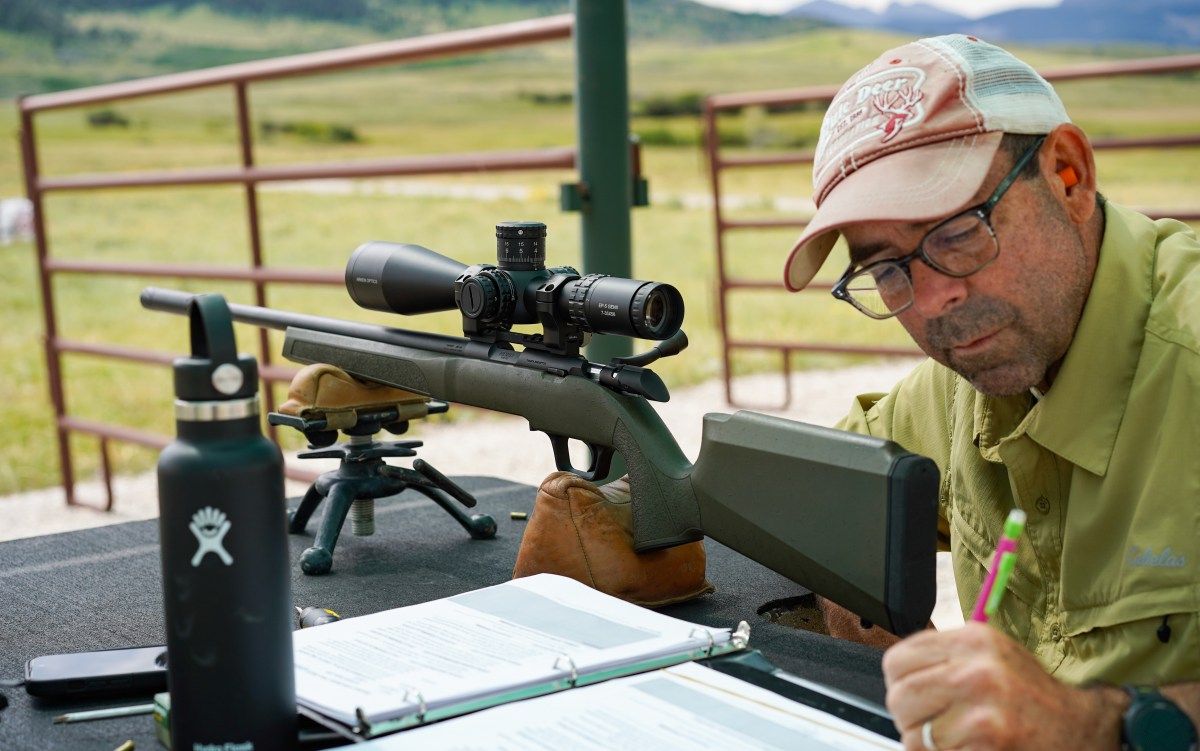

Long-range target scopes have one job: to place bullets with repeatable precision at distance. But there’s plenty of room for variation within that performance envelope, and this year’s crop of precision scopes has it all: cheap and expensive, MOA and MIL reticles, digital and analog, and illuminated or not.
But one attribute caught our test team’s eye: the increase in these scopes’ magnification. We have 30-power, 32-power, 35-power, and even a 36-power scope in this year’s field. Meanwhile, the bottom of the magnification range is also creeping upward. The standard of the class – the 5-25×56 precision scope – now starts at 8x for some and 7x for others. Because these are almost all first-plane reticles that increase in size in proportion to magnification, the reticle references are super-sized at the top end of magnification, so large that some of them limit target visibility.
Obviously, brands are making these high-mag scopes for shooters who demand it, but our test team spent a good deal of time, both on our rimfire range and at the long-range steel course, assessing reticle visibility at both the low and high magnifications of each scope. One of our take-aways is that fine-lined reticles aren’t especially useful at lower powers, and reticle utility is fairly limited at the highest powers, begging the question: how useful is this high-magnification trend?
While you answer that question for yourself, consider the wide range of prices in this year’s field. We have some insurgent precision scopes for under $400, while the top-end scopes will set you back $2,500. We have a pair of very interesting digital scopes from Burris and Steiner, and a satisfying crop of very good scopes in the $750 range. All are capable steel-ringers, whether you’re a MOA or MIL shooter, a turret dialer, or prefer holdovers.
Best New Precision Scopes of 2025
Can’t get enough of precision scope reviews? Read our shooting editor’s review of his top long range rifle scopes. Some notable picks include the Leica PRS 5-30x56i, Nightforce ATACR 7-35×56, Swarovski Z8i 3.5-28×50, Kahles 540i 5-40×56, and Vortex Razor HD Gen III 6-36×56.
Best Precision Rifle Scopes of 2025, Reviews & Recommendations
Editor’s Choice Traditional Precision Scope: Leupold Mark 4HD 8x32x56
See It
Pros
- At 30 ounces, light for the class
- Fast and readable PR-2 MIL-based reticle
- Low-profile ZeroLock turret controls
- Liberal mounting dimensions
- Three-turn elevation dial
- At $1,600, fairly priced
- Lifetime warranty
Key Features
-
34mm tube -
25-yard-to-infinity side focus -
Elevation turret compatible with custom dials -
Turret button serves as revolution indicator -
Extreme 32x magnification
With this slimmer, more stripped-down Mark 4HD than its high-magnification predecessors, Leupold has introduced a racehorse of a precision scope that’s nearly a pound lighter than its peers. And, for those shooters who struggled to find 35mm rings for previous versions of the Mark precision scopes, I’m happy to announce the 8-32×56 version is built on a standard 34mm tube.
I’m equally happy to congratulate Leupold for packing so much performance in a scope that retails for $1,600. Yes, that’s still a pile of money, but it’s about a grand less than many of its high-end competitors. For its combination of value, performance, and features, the Mark 4HD 8x32x56 M5C3 Side Focus FFP PR2-MIL (say that three times real fast) wins our Editor’s Choice for the top traditional precision scope in this year’s field.
The addition of electronic scopes from Steiner and Burris (to include the excellent Eliminator 6 features in our Best Hunting Scopes review) forced us to consider a second Editor’s Choice, for scopes that use integrated rangefinders and ballistic software to determine a shooter’s aiming point. These electronic scopes are so different in function and performance that we felt it was correct to consider them on their own merits, and not as head-to-head peers of traditional scopes, with analog reticles and turrets.
The Leupold clawed its way to the top of a stacked field of precision scopes by doing a number of things right. That starts with a very serviceable first-plane reticle (that’s the PR2-MIL part of the scope’s designation). The MIL-based reticle features elevation references every .5 MILs, with windage references that span out in halved proportion to distance. So at 2 MILs of elevation, shooters also have 1 MILs of windage references on either side of the vertical stadia. At 6 MILs of distance, shooters have 3 MILs of windage. The reticle has a crazy 30 MILs of elevation references, though the corresponding windage references stop at 10 MILs.
The reticle radiates out from a .05 MIL floating center dot, which is fine enough that targets aren’t obscured but also distinct enough to enable precision shooting, whether at way-out-there steel or close-in rimfire targets. It’s important to note that the Mark 4HD’s reticle is not illuminated. We lost the reticle against some cluttered backgrounds, but overall the reticle is visible even without being lighted up, and by leaving illumination behind, Leupold is able to offer this scope at a lower price.
The most distinctive element of the Mark 4HD’s controls is the turret dials. Both the elevation and windage wheels are low-profile exposed dials activated with a push-button lock that also functions as a revolution indicator. The ZeroLock dials define most Leupold product lines, and while they’re handy on a precision scope, they also frustrate shooters who want a traditional zero stop that functions independently of the turret travel. The Mark 4HD three-revolution ZeroLock dials basically establish the zero at the beginning of the turret travel.
It’s important to note that, while the scope has three revolutions of travel, the scope’s internal adjustment range accommodates only two revolutions of travel. The difference can be explained by floating the reticle, that is, zeroing it near the top of the first revolution and then having nearly two additional revolutions to dial for distance. Happily, the dials are re-zeroable, enabling shooters to establish their zero at whatever place in the erector system makes sense to them.
The locking turrets caught the fancy of OL optics tester Todd Netto. “I love the set-it-and-forget-it turrets,” says Netto, who noted that the PR-2 reticle was his favorite of this year’s entries. “This scope gives shooters a hard but fair choice of dialing or holding” for aiming points.
The controls, versatile reticle, lightweight build, solid value, plus excellent low-light performance combined to push the Leupold Mark 4HD to the top of this year’s precision field and gave it our consensus vote as the top optic in the category.
| Leupold Mark 4HD 8-32×56 Specs | |
| Magnification: | 8-32-power |
| Objective Lens: | 56mm |
| Tube Diameter: | 34mm |
| Exit Pupil Diameter: | 7-1.75mm |
| Twilight Factor: | 21-42.3 |
| Field of View: | 13.1-3.4 feet at 100 yards |
| Eye Relief: | 4.2-3.9 inches |
| Reticle Plane: | First |
| Reticle Plane: | First |
| Reticle Type: | Non-illuminated FFP PR-2 MIL |
| Turret Click Values: | .1 MIL |
| Adjustment Per Revolution: | 10 MIL |
| Total Internal Adjustment – Elevation: | 20 MIL |
| Total Internal Adjustment – Windage: | 13 MIL |
| Weight: | 30 ounces |
| Length: | 15.6 inches |
Editor’s Choice Electronic Precision Scope: Burris XTR PS 5.5-30×56
See It
Pros
- Digital elevation turret
- Distance-adjusted heads-up display
- Swappable capped or uncapped windage dial
- Customizable ballistics programs
- Excellent controls
- Range-dial-hold-shoot simplicity
- Anti-cant indicator
Cons
- Reticle references not clear until @8x
- Tedious set-up process
- Value proposition depends on battery
- No zero stop
- At $2,500, a pricey scope
Key Features
-
Digital heads-up display -
Clickless elevation turret -
34mm tube -
Runs on single CR123 battery -
Bluetooth connectivity to BurrisConnect app -
SCR 2 first-plane reticle -
Angle-compensating aiming -
Heads-up display includes match timer and altitude table
My buddy Derrick Ratliff, founder of Horizon Firearms, is immersing himself in next-level precision-shooting gear as he trains for the Mammoth Sniper Challenge next spring. With Sig’s KILO10K laser rangefinding binocular, refined custom ballistics, and a capable scope atop his 25 Creedmoor, Ratliff claims ringing steel well beyond the mirage zone is “almost too easy.”
This revolutionary XTR PS optic from Burris makes hitting distant targets even easier.
We saw a version of this scope (the Burris Veracity PH) configured for hunters in last year’s Outdoor Life optics test, but this year’s PS (Precision Shooting) model more capably harnesses the power of precise ranging and turret manipulation. The heart of the Burris XTR PS is a “smart” elevation turret that users turn to match the distance of the target. The distance is displayed in an LED digital heads-up display inside the scope. When paired with the BurrisConnect mobile app that aligns the scope’s references to shooters’ specific bullet and load, hitting targets is as easy as ranging, then dialing to the precise yard (or meter), holding for wind, and engaging the trigger.
It’s basically like having a custom ballistic turret, but instead of being engraved with load-specific clicks, the turret travel is tied to the BurrisConnect mobile app.
Of course, the real world introduces all sorts of reasons to miss, including incorrect wind calls, small deviations in ballistic inputs, and the human/gun connection. But the scope solves most of the elevation problems simply and elegantly.
It achieves that first with its clickless turret. This smooth-turning dial freaked out some OL testers who are accustomed to the audible and tactile clicks of a precision turret. But the infinitely adjustable dial allows for much more precise solutions, to within 1/30 MIL compared with the standard .1 MIL click values of traditional turrets. Want to hold for a half-yard instead of a full value? No problem. Just turn the dial until the specific yardage appears in the display. The turret’s movement adjusts the reticle to the specific elevation hold.
Other precision talents include a very good first-plane SCR 2 MIL-based reticle with a floating .1 MIL center cross and 20 MILs of holdover references, with hashes every .2 MILs on the vertical (elevation) stadia and 10 MILs of windage on either side of the aiming cross. The reticle is fully useful even if the CR123 battery goes out.
But to get the full utility of this system, take time to build a ballistic profile in the BurrisConnect app. I can’t emphasize enough that the precision of the scope is only as good as the inputs. Testers had a bit of trouble with those inputs, as some aspects of the app aren’t intuitive, but for digital natives the system is fairly straightforward. Then pair the app with the scope, transfer the ballistic data, zero your elevation turret, and dial to your target.
The app also allows shooters to set wind direction and speed, a key feature that takes only a little of the magic out of windage calls. In order to get the best of the system, though, shooters must zero their windage dial. The capped windage dial that comes with the scope can be traded out for an exposed dial.
The Burris XTR PS 5.5-30×56 is a pricey scope, but at around $2,500, most testers felt the performance justified the price.
“Yes, it’s expensive, but compared to other scopes in the price range, it has more and better features and a quality build,” notes tester Nate Ward.
Fellow tester Todd Netto, who struggled to get the mechanical turret zeroed, appreciated the scope’s adjustability and user-friendly add-ons.
“The extra windage turret is amazing, and the attention to detail on things like turret indexing and reference lines that point to the turret screws is simple but thoughtful. I’m surprised more companies don’t follow Burris’s example.”
In our review of the Burris Veracity PH last year, we noted that some of the digital attributes blur ethical lines by encouraging long-range hunting or using technology as a shortcut to traditional hunting skills. Those ethical qualms are largely irrelevant in a target-shooting situation. Whether the XTR PS makes it “too easy” to engage long-range steel is a debatable point, but when deployed correctly, the Burris makes precision shooting fast, fun, and effective.
| Burris XTR PS 5.5-30×56 Specs | |
| Magnification: | 5.5-30-power |
| Objective Lens: | 56mm |
| Tube Diameter: | 34mm |
| Exit Pupil Diameter: | 8-1.7mm |
| Twilight Factor: | 17.5-41 |
| Field of View: | 21.5-4.2 feet at 100 yards |
| Eye Relief: | 3.3-3.7 inches |
| Reticle Plane: | First |
| Reticle Type: | SCR 2 |
| Illumination: | Yes, red and green |
| Turret Adjustment Values: | .1 MIL |
| Adjustment Per Revolution: | 20 MIL |
| Total Internal Adjustment – Elevation: | 26 MIL |
| Total Internal Adjustment – Windage: | 15 MIL |
| Weight: | 37.5 ounces |
| Length: | 15.4 inches |
Great Buy: Nutrek Coppertag 3-18×50
See It
Pros
- Hunting scope with abundant precision features
- At $429, an insane value
- Versatile first-plane reticle
- 6-times power ratio
- Includes a functional zero-stop
Cons
- Not quite powerful enough for true long-range precision work
- Tree-style reticle is a little dense for hunting work
- Reticle not especially visible below 7x
Key Features
-
10-yards-to-infinity side focus -
30mm tube -
6-step illumination -
Exposed elevation, capped windage turrets -
Includes sun shade
This isn’t a classically configured precision scope. But the Chinese-made 3-18×50 Coppertag, from a new brand in the sports-optic market, has just enough precision talents and just enough long-range hunting chops, that it effectively bridges the boundary between shooters and hunters. The fact that the Coppertag retails for under $500, along with its abundant versatility and tasty controls, cemented the Nutrek scope’s status as the Great Buy winner of this year’s Outdoor Life precision scope category.
A few anatomical details created confusion for the OL test team. That starts with the 3-18’s very capable tree-style first-plane reticle, a design we’re more accustomed to seeing in 5-25×56 precision target scopes. The fact that Nutrek has equipped this light, compact scope with such a capable reticle, and added center-cross illumination to the package, confirms its crossover appeal. Testers noted the reticle is nearly identical to those in the Athlon and Arken scopes in the category.
“It’s like the Arken had a big baby with the Athlon,” noted tester Todd Netto. “The Nutrek brings the best of both for less money. It’s a cheap Chinese scope that’s actually very good.”
The Nutrek features a zero stop, a rare attribute for a scope at this price, as well as an exposed tactical-style elevation turret. It has better glass than we expected, and a side parallax control that brings targets into focus as close as 10 yards, making it an excellent choice for precision rimfire competition. Adding to its features, the center-cross illumination lights up the aiming point, making it a capable scope for quick shooting at lower magnifications, and for precision shooting at higher powers.
The reticle’s center dot and cross float in the image plane, giving shooters plenty of target visibility. Elevation hashes are at .5 MIL increments, with windage dots every .25 MILs. The relatively sparse references give the reticle a lighter look than those first-plane reticles with references every .1 MILs. The lack of granular aiming points may frustrate some precision shooters who like to have holds that conform to the .1 MIL click values of the turrets.
In terms of demerits, the turrets of the Nutrek move a little too smoothly and imprecisely for our liking. We found that we’d have to go back to our zero and slowly count clicks. The turret indexing is good but not great, though we do like the revolution indicator on the elevation turret. Our biggest quibble is that the reticle isn’t especially visible below about 8x, and in a scope that tops out at 18x, that’s not a lot of usable magnification.
We also wonder about the Coppertag’s warranty. Nutrek notes in the product manual that the scope “might be covered with different warranty policies at varied sales channels and regions.” We encourage readers to research the warranty thoroughly before purchase.
But the Coppertag is a very capable crossover hunting and target scope, with decent performance at a seriously affordable price. We’re happy to see a new brand in the precision-optics market, and assuming the scope is as durable as it appears, it is a remarkable bargain and worthy of our Great Buy award for the precision-scope category.
| Nutrek Coppertag 3-18×50 Specs | |
| Magnification: | 3-18-power |
| Objective Lens: | 50mm |
| Tube Diameter: | 30mm |
| Exit Pupil Diameter: | 16.7-2.8mm |
| Twilight Factor: | 12.2-30 |
| Field of View: | 38.3-6.3 feet at 100 yards |
| Eye Relief: | 3.8-3.7 inches |
| Reticle Plane: | First |
| Reticle Type: | IR BDC Tree reticle |
| Illumination: | Yes |
| Turret Click Values: | .1 MIL |
| Adjustment Per Revolution: | 10 MIL |
| Total Internal Adjustment – Elevation: | 35 MIL |
| Total Internal Adjustment – Windage: | 35 MIL |
| Weight: | 28.7 oz. |
| Length: | 13.7 inches |
More of the Best Precision Scopes
Tract Toric UHD Eagleman LRH 4-25×50
See It
See It
Pros
- Available in both MRAD and MOA versions
- Push-button illumination module
- Pull-to-turn exposed elevation turret
- Versatile target and hunting build
- RevStop Zero Stop
- At $1,399, a fair price for a versatile scope
Cons
- Fairly shallow eye relief
- Relatively limited internal adjustment range
-
30mm tube -
Push-button illumination module with 10 intensity levels -
Tree-style MRAD reticle -
Lifetime warranty -
Weight: 25 ounces -
Length: 15.2 inches
-
A look at the reticle. -
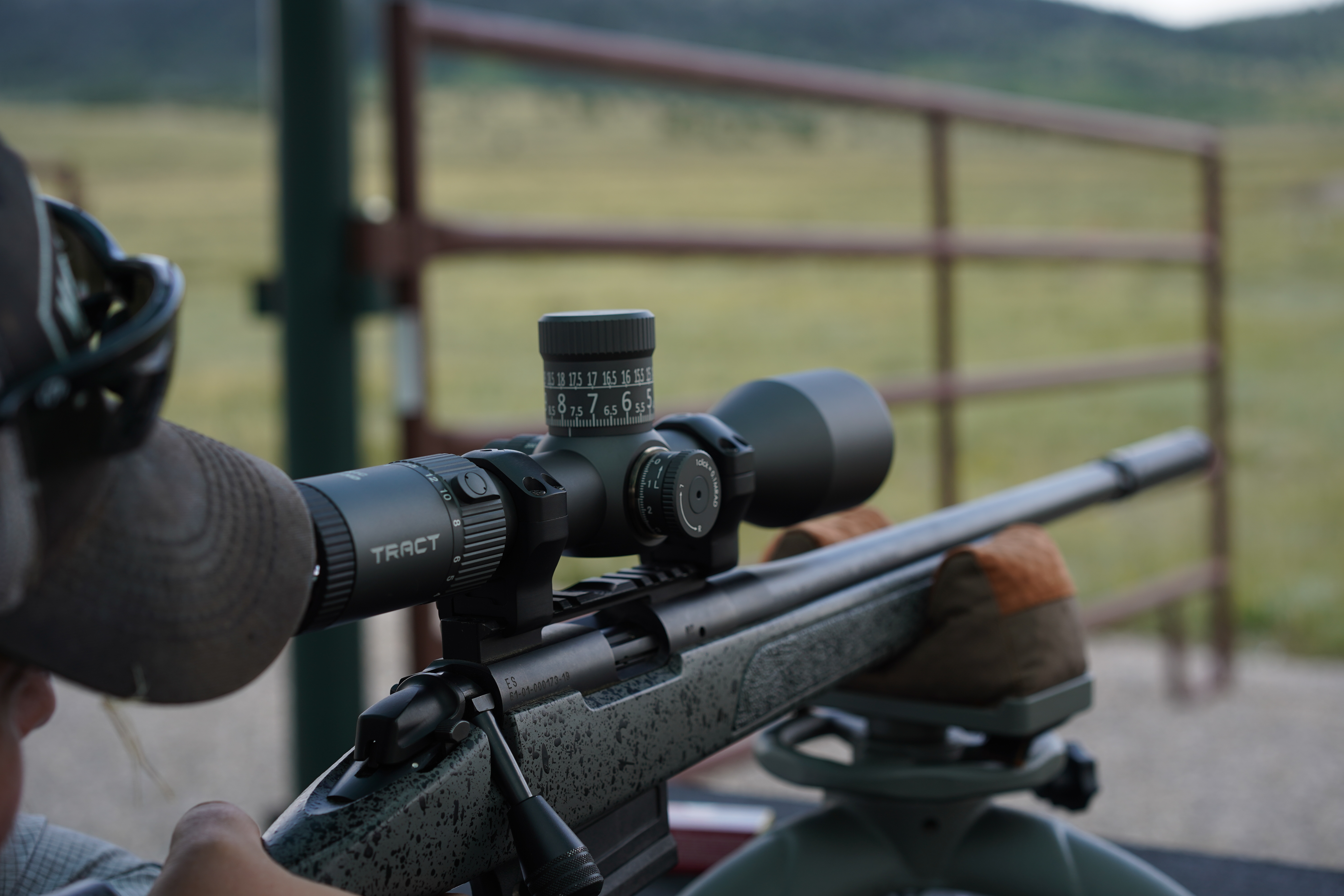
We nearly entered this excellent optic in our Hunting Riflescope category, but OL’s test team reckoned that this first-plane scope, with a very good and intuitive reticle and velvety controls nominally has more going for it as a precision scope than a hunting optic.
But the fact that it splits the difference so elegantly says a lot about the versatility of the Tract Toric UHD with the Eagleman LRH reticle tuned to MRAD values.
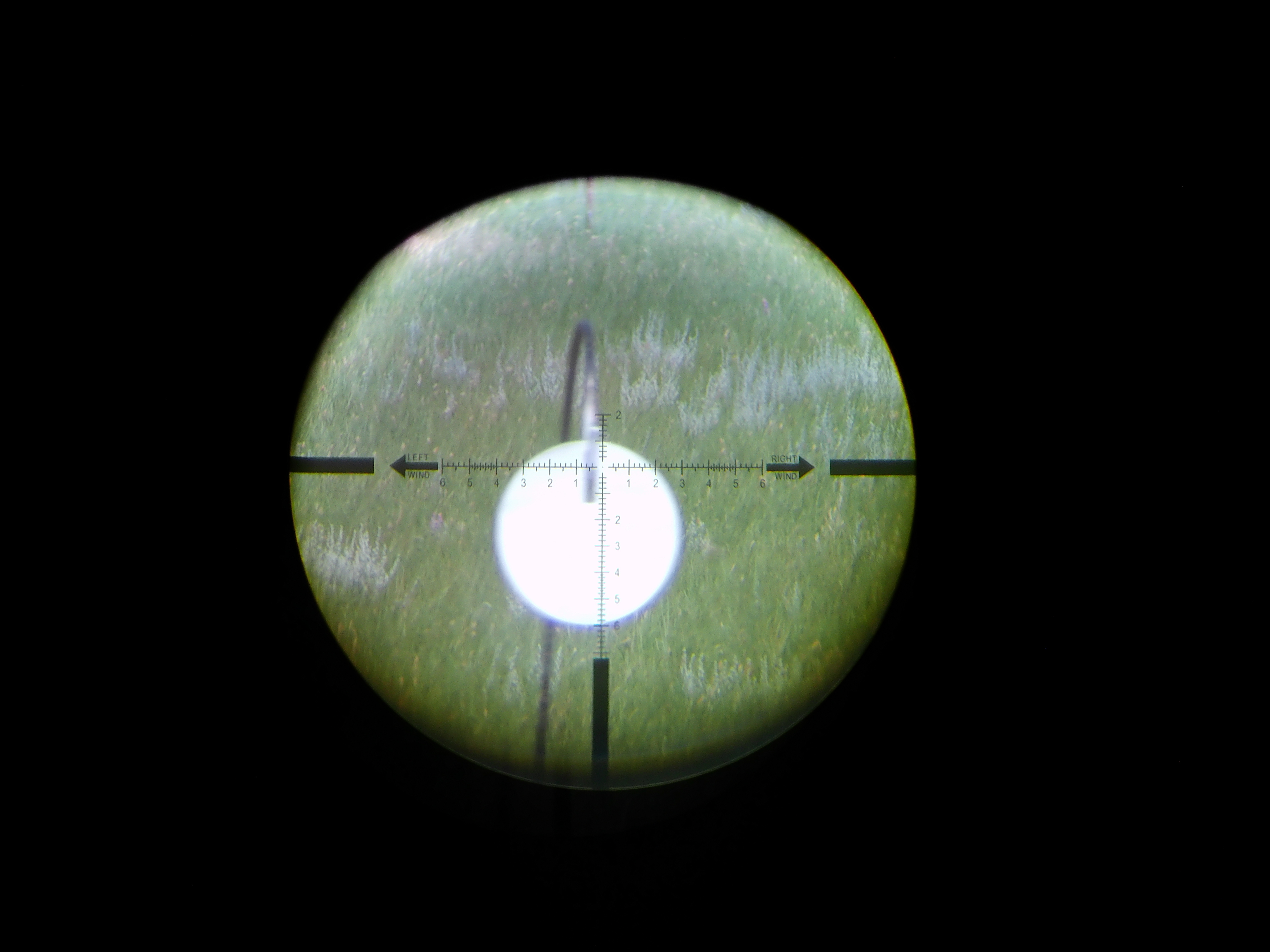
The namesake reticle is designed by James Eagleman of Barbour Creek Long-Range Shooting School, and Tract came out with an MOA version of the scope last year. This year’s MRAD version features a floating center dot and .2 MRAD elevation steps along with .2 and .5 MRAD windage ticks and 7 MRAD of elevation holds. The reticle has a truncated upper vertical stadia in order to keep targets visible in holdover situations. The design further includes ranging and mover hashes well away from the center aiming point.
It’s a fast and elegant system, but what really distinguishes the Eagleman design is the wind direction cues on the outer ends of the horizontal stadia. The visual reminder to hold into the wind is simple — maybe too simple for experienced shooters — and further enhances the speed of the spare reticle.
It’s this simplified first-plane reticle that makes the Tract a versatile crossover scope. The design provides just enough references to make precise aiming points in a variety of situations, but it’s not so distractingly busy that it inhibits quick holds for fleeting shots.
For those shooters and hunters who prefer to dial than hold, the Tract has some of the best turrets in the field. The extra-high elevation turret has indexing so bold you could see the numeric references from space, and clicks are positive and tactile. The windage dial is capped. The test team quibbled over the height of the pull-to-turn elevation dial. A portion of the team felt it was too high by half, and that it could impede hunting in heavy cover or when extracting the rifle from a scabbard or case. The other half of the team liked the easy access to the turret.
“Love the size. Love the look. Love the turrets. Overall a very solid scope and my vote for best crossover,” noted tester Todd Netto.
“Turret indexing for days,” wrote another tester, who offered a metaphysical take on the windage references. “Lovely controls and great glass. I’m not so sure about the windage-for-dummies. If you don’t really need it, you don’t really see it, but if you need it, you see it.”
The 4-25-power magnification range is well-suited to hunting and shooting situations, and the excellent glass – the 50mm Tract nearly won our low-light test – make the reticle especially visible. At about $1,600 from the direct-to-consumer brand, we felt the performance merits the price. The Tract with Eagleman LRH (it stands for Long Range Hunter) reticle is a great fit for a shooter who wants to hunt with the same scope they use to ring steel.
Bushnell Match Pro ED 5-30×56
See It
Pros
- At under $900, an excellent value
- Excellent rimfire competition scope
- Close-in 15-yard parallax setting
- Re-zeroable turrets
- Same G5I reticle as in Bushnell’s Elite Tactical scopes
Cons
- Grainy image at higher mags
- Reticle not visible at lower magnifications
Key Features
-
34mm tube -
Easy-Set zero stop -
Pop-up revolution indicator on elevation turret -
3-position power-changing lever -
Sunshade has internal and external threading -
Parallax Adjustment: 15 yards to infinity -
Weight: 32 ounces -
Length: 15 inches
With its Goldilocks approach, Bushnell has a rifle scope for just about every shooters’ proficiency level and budget. For entry-level shooters, the R5 6-18×50 with second-plane DOA-LRH800 reticle is a good choice for long-range hunting and target shooting. That’s the Baby Bear scope. For serious competition shooters, the Papa Bear is the Elite Tactical XRS3 that we review elsewhere in this piece. But the Mama Bear is just right for serious shooters on a budget. That’s the Match Pro that retails for well under $1,000 and has many of the attributes as the $2,500 XRS3.
The main commonality is the G5I MRAD reticle in the first focal plane. This is a competition reticle designed by rifle maker George Gardner that features smart references and numeric designations without cluttering up the image plane. Just as in the Elite Tactical version, the reticle is fully illuminated.
The biggest difference, besides the underwhelming grade of glass in the Match Pro, is the turret design and handling. The turrets in the Match Pro are lower in profile, less tactile, and have adequate – but not great – indexing. The locking exposed elevation turret has three revolutions of travel, and the Match Pro has a smart and simple revolution indicator, a button that pops up on the cap. It’s flush for the first revolution, shows red for the second, and a silver steel base shows for the third revolution.
The Match Pro has a decent zero stop. It’s not as robust as the RevLimiter of the Elite series, but the Easy Set is simple and does its job of getting shooters back to their zero fast and without fuss.
Bushnell is making the case for this Mama Bear of a scope as a rimfire competition optic with its 15-yards-to-infinity side parallax. The scope’s ability to focus on very small and close targets makes it a smart choice for NRL22 and PRS Rimfire competitions. It’s the middle child of Bushnell’s precision-optic product line, but just right for shooters of just about any skill level and budget.
Arken EP-5 Gen 2 7-35×56
See It
Pros
- First-plane mil-based reticle
- Rezeroable tactical-style turrets
- Excellent ED Japanese glass
- Solid AZS zero stop
- Positive turret feedback
- At around $600, appealing price for full-featured scope
Cons
- Post-on-base zero stop is primitive
- Too much magnification at high end
-
34mm tube -
Turrets tuned to .1 MRAD click values -
Re-zeroable turrets -
25-yards-to-infinity side parallax -
Lifetime warranty -
Weight: 42 ounces -
Length: 15.5 inches
In the fierce battle for market share for the sub-$1,000 precision scope, this heavy hitter (and heavy) model from Arken deserves a second or even a third look. It delivers a ton of value in a tight and smart package that retails for around $700, and significantly less if you catch one of Arken’s frequent rebates.
The EP-5 Gen 2 is designed for ringing distant steel. That singular purpose helps explain some of its singular features, like the exposed and non-locking turrets and fairly unsophisticated but effective zero stop. The first-plane reticle is built around an illuminated center aiming cross with a .04 MIL floating dot that offers plenty of target visibility and a fine aiming point. The tree-style reticle features 12 MILs of elevation and 8 MILs of windage holds with elevation hashes every .5 MILs and windage dots every .2 MILs.
It’s a familiar MIL-based reticle for most precision shooters (Arken also has an MOA-based VPR reticle in this scope model), and includes key features like .1 MIL increments at the ends of each stadia for ranging and bracketing moving targets. If we have a quibble with the reticle, it’s the relative fineness of each reference. The numeric elevation marks could be a little larger and more distinct and the windage dots could use a little more differentiation.
But while the crazy-high 30x magnification is a little much at the top end, the 7x magnification at the lower end is really nice for both reticle visibility and field of view. We found the sweet spot to be about 16x, with excellent reticle and target visibility. We expected the limited illumination — only about .75 MILs are illuminated in any direction from the center dot — to limit utility of the scope, but instead it nicely centers the eye on the middle of the crosshair, a feature that shooters who dial rather than hold for aiming solutions will find pleasing.
Dialers will also appreciate the tactile and precise turret movements. Turret indexing is clear and simple, and a revolution indicator on the base of the elevation turret effectively communicates turns. We have a minor quibble with the fairly unsophisticated zero stop, which is basically a threaded screw, the head of which is in the top of the elevation turret, that engages a raised portion of the turret. It’s quick and simple, but we found that with repeated hard use, especially if we didn’t fully engage the screw, the post scraped over the stop instead of seating against it.
But those are frankly minor demerits. Overall, this is a powerful scope, with better glass than we expected for the price and responsive controls. Arken has done a masterful job of adding value to its optics by offering very good titanium scope rings ($112), a bubble level ($73), and power-change lever ($43) on a sold-separately basis. The EP-5 Gen 2 ships with a sunshade.
For a hard-working scope with serviceable reticle and controls, a lifetime warranty, and features we don’t expect to see on an optic at this price point, Arken gets a huge nod for not only producing an entry-level precision scope but one with enough chops to compete against optics that cost three and four times as much.
Athlon Ares ETR Gen2 UHD 4.5-30×56
See It
Pros
- Solid construction
- Very good “high-definition” glass
- Ships with premium lens covers and sunshade
- Stout zero stop
- Simplified tree-style reticle
Cons
- Vanishingly fine reticle
- Reticle not especially visible below 8x
Key Features
-
34mm tube -
Available in both MIL and MOA versions -
25-yard-to-infinity side parallax -
6-step red illumination -
Elevation turret revolution indicator -
Lifetime warranty -
Weight: 36.8 ounces -
Length: 15.3 inches
This very good and precise target scope from Athlon is proof that you can get a top-notch competition optic without mortgaging your house or selling your plasma monthly for the next decade. The Ares ETR Gen2 UHD (whew, that’s a lot of meaningless designations) is built for long-range competitions but may be at its best in the growing field of rimfire precision shooting.
Because it’s an Outdoor Life review, before we dive into its merits, you know we’re going to detail some shortcomings. The first is its whopper 30x magnification. There’s no legitimate reason, besides to differentiate itself, to boost power beyond the standard 25x. At 30x, the image gets dark and grainy. Yes, the first-plane reticle is especially large, but it doesn’t really serve shooters because so little of the reticle is visible at that power.
On the lower end of the magnification range, the fine reticle isn’t especially visible until about 8x. If I was the King of Athlon, I might suggest a Gen3 version of this excellent scope in an 8-25x version that captures the best of both ends of the magnification range.
Operationally, this is a sweetheart. The exposed turrets (the windage dial locks) move with positivity and very audible clicks. We wish the indexing was a little more bold (nods to Arken, Tract, and Bushnell for their exceptional indexing), but there’s a serviceable revolution indicator. The 6-intensity red illumination fires up the working parts of the reticle, or the part that has windage and elevation references.
Athlon calls this its APRS12 IR MIL reticle (there’s also an MOA version). If you struggle with this mash-up of letters and numbers in the reticle designation, you’re not alone. It basically stands for All-Purpose Reticle, but the S is lost on me, just as the 12 is. The MIL-based reticle in the Ares ETR Gen2 has 10 MILs of elevation references and 10 MILs of windage references on either side of a floating .05 MIL center dot.
It’s a clear and fairly simple reticle, with elevation hashes at every .1 MIL increment and floating windage dots at every .2 MIL step. On the horizontal stadia, the windage hashes at every .2 MIL give enough hold off without cluttering up the view. Out past 6 MILs on the windage stadia, references switch to hashes every .1 MIL for ranging purposes.
Athlon calls this a dual-purpose reticle that’s appropriate for hunting as well as precision target work, but there’s just too much going on in the tree-style design to be useful for many hunting scenarios, but just enough references to be useful for precision rimfire and center-fire work without getting lost in a confusion of dots and dashes.
The zero stop is well-designed and easy to use, especially for shooters accustomed to the brass Nightforce ZeroStop that’s been adapted by Bushnell, Vortex, and other brands.
Optically, the Athlon is good but not great, with shortcomings in its “ultra-high-definition” glass showing up above about 20x. But mainly we noted its very stingy eyebox. Shooters have to be perfectly aligned with the axis of the scope to get the full field of view. If you move much, you’ll lose the image.
But assuming you mount this big scope at the correct height, and settle in squarely behind the eyepiece, you shouldn’t have problems with the image, and should be able to deploy the very good and clean reticle out to whatever yardage your gun will shoot. This scope, which retails for about $1,200, is a bargain for its considerable talents.
MONSTRUM CHALLENGER 5-25×56
See It
Pros
- Ships with excellent cantilever mount
- At $229, an insane value
- Zero stop
- Reticle visible across magnification range
- Reticle available in MOA or MIL references
Cons
- 30mm tube limits adjustability
- Spongy turrets
- Sticky power-changing dial
Key Features
-
Power-changing lever -
25-to-infinity side focus -
Pull-to-turn windage turret -
Lifetime warranty -
Weight: 37 ounces -
Length: 14 inches
Consider this: for well under $250, you can buy a competent precision target scope that doubles as a fair hunting optic. It comes with a pretty good mount. It has a MIL-based first-plane reticle that is at least as capable as the target reticles inside name-brand scopes. And this optic has a lifetime warranty and good-enough glass.
We’ll quibble about some of the “precision” of the Monstrum Commander in a few paragraphs, but that’s an astonishing amount of value, considering that many of its peers cost 10 times as much and don’t deliver anywhere near 10 times the performance.
We’re not quite sure how Monstrum – which is available on Amazon and other online retailers – can deliver this sort of output. Forgettable glass, mushy controls, and probably a very narrow profit margin help the Challenger achieve its price, but while it’s tempting to call this a starter scope for a beginning PRS competition shooter, it has attributes that will appeal to seasoned shooters.
The scope’s best features is its MM4 reticle (the MOA version is called the CM4). We’re pretty sure the entire reticle lights up with red in six intensities. Our indecision is based on a two-tier intensity. The center-cross aiming point is significantly brighter than the rest of the reticle, but the outer portions of the design are also dimly illuminated, possibly because messy reticle etching accidentally reflects the illumination. In either case, the center cross measures 1 MIL both in width and height and the crosshair itself is .1 MIL in thickness.
The reticle has elevation references every .5 MIL down to 6 MILs and .08 MIL windage dots out to 4 MILs. Put together, the windage and elevation references form a sort of minimalist tree-style reticle. It’s not quite enough hold-over or hold-off for hard-core precision shooters, but the spare references make this a useful hunting scope, since there are just enough holds to enable quick and precise-enough shooting.
The Challenger’s 30mm tube further cuts weight (the scope weighs 37 ounces, so it’s not svelte but it’s also not as chunky as some of its 40-ounce peers).
Shooters who like to dial turrets to their aiming prescription are likely to be disappointed in the Monstrum’s mushy turrets, which tend to bind slightly at either end of their travel. The windage turret pulls to turn, while the elevation turret turns freely. The Challenger has a very capable zero stop, a feature that’s rare to non-existent at this price point.
The scope has a very close focus of 25 yards to infinity, making it a decent rimfire competition scope.
Outdoor Life’s test team debated whether the Monstrum, at $229, was a more worthy recipient of our Great Buy award, which we gave to the Nutrek Coppertag at twice the price. But the consensus opinion was that the Challenger, while delivering a ton of performance for the price, felt and operated like a cheap scope, while the Nutrek handles with more precision and tactility.
“It has tight, loose, odd, smart parts,” notes tester Todd Netto. “It works great, but it feels just as cheap as it is.”
Still, for its abundant value, excellent warranty, and pretty good operation, the Monstrum Challenger is a lot of scope for shockingly little money.
See It
Pros
- Best turret indexing in the field
- Locking diopter
- Excellent
- Japanese glass
- Updated reticle with finer references
- Sunshade has both internal and external threads
- Multi-position ThrowHammer magnification lever
Cons
- At over 2 pounds, a heavy scope
- At 36x, very limited reticle visibility
Key Features
-
34mm tube -
Push-button illumination -
Full-reticle illumination -
50-yard-to-infinity parallax -
RevLimiter zero stop -
Rezeroable turrets -
Fully transferable lifetime warranty -
Weight: 39 ounces -
Length: 15 inches
While most Bushnell optics have become mid-market products optimized for big-box retailers, the company’s Elite Tactical line of scopes and spotters are used by top shooters to win prestigious competitions. They’re that good.
The latest iteration of Bushnell’s robust Elite Tactical XRS3 precision scopes maintains the reputation of the product line with even more magnification and a more useful first-plane reticle. The battle-tough scope is built around George Gardner’s – of GAP – reticle design that uses a modified tree characterized by highly visible elevation hashes and less visible windage dots. The new G5I design adds .25 MRAD intervals between steps, additional holdover windage dots, and numerical references on either side of the vertical stadia. The cumulative effect is both a more precise and more readable reticle.
The new iteration of the XRS3 adds push-button illumination. The elegant module – tucked inside a battery compartment with a cover the size of a compact car’s hubcap – allows users to ramp from just-visible illumination in low-light situations to daylight-bright blazing.
We questioned whether the entirety of the massive 6- to 36-power magnification would be useable in the first-plane reticle, but were delighted to have all the field of view at lower mags combined with full reticle visibility. At the highest magnifications, the reticle becomes a tool to make fly-speck adjustments at either extreme distances or at tiny targets in rimfire range. The ED glass is among the best we’ve seen in this year’s field, and the scope’s optical quality make the reticle even more visible.
We also love the bold and clear turret indexing. The re-zeroable dials feature bold whole-number markings, smaller half-value marks, and readable .1 MRAD references between them. Bushnell’s zero stop – called the RevLimiter – is among the best in the industry for its simplicity to set and dead-stop robustness, allowing users to slam their turrets back to zero after dialing up for distant shots. The elevation turret has three revolutions of adjustment, and very readable revolution indexing.
Additional attributes include a locking diopter, an old-school style that allows users to lock the eyepiece to their specific prescription. It’s an added value to an already very forgiving eyebox.
If we have quibbles with the scope, it’s its heft, both physically and financially. At significantly over two pounds, it’s a commitment to carry around. And at about $2,500, it’s an investment. But for serious competition shooters, whether on a long-range centerfire or a precision rimfire, this is a bright, tight, and precise scope with a reticle that eases some of the frustration of counting dots and hashes in the haste of a competition. The reticle is fast, precise, and readable at all magnifications, all qualities that make the Bushnell Elite Tactical XRS3 a rarity in the precision-scope category.
Vortex Viper HD 5-25×50
See It
Pros
- Available in both MRAD and MOA versions
- Push-button illumination module
- Pull-to-turn exposed elevation turret
- Versatile target and hunting build
- RevStop Zero Stop
- At $1,399, a fair price for a versatile scope
Cons
- Fairly shallow eye relief
- Relatively limited internal adjustment range
Key Features
-
30mm tube -
Push-button illumination module with 10 intensity levels -
Tree-style MRAD reticle -
Lifetime warranty -
Weight: 25 ounces -
Length: 15.2 inches
With this front-plane reticle version of its venerable Viper HD scope, Vortex is giving Western hunters a tough choice. Do they transition from summertime steel-ringing with this scope to deer, antelope, and elk seasons? Or do they make this bright, precise, and lightweight scope their main hunting rig and transition to targets in the off-season?
The very factors that make this a capable hunting scope — 25 ounces, 30mm tube, low-profile objective lens — disqualify it slightly as a precision target scope, if only because the industry is moving toward ultra-magnified scopes with gargantuan 34mm tubes and massive objective lenses to make high-mag viewing possible.
But it’s such a fine and versatile scope that we included it in our precision scope field rather than our hunting scope test, because it has a few more attributes for steel-ringers than for big-game hunters.
That starts with its first-plane reticle that’s built around a floating .04 MRAD dot with .5 MRAD hashes all the way out to 10 mils of elevation. The scope has very fine wind holds, with .06 MRAD dots every .1 mil that spreads away from the vertical stadia as the distance increases. At 1 MRAD of elevation, shooters have 1 MRAD of wind holds. At 10 MRADs of elevation, shooters have 3 MRAD of wind holds.
It’s a simple, easy-to-use reticle with just enough numeric references that shooters shouldn’t get too lost in the maze of dots and dashes. The reticle also has ranging references and brackets for movers.
The scope has excellent controls, starting with its pull-to-turn exposed elevation dial that has positive clicks and nice indexing. The windage dial is capped. The 20-yards-to-infinity side parallax makes this a good rimfire precision scope for engaging tiny up-close targets. The push-button illumination module fires 10 the reticle with 10 intensity levels.
While we’re talking about the Viper HD line, hunters who want all these attributes but with a more sparse and fast hash-style reticle in the second focal plane should consider the Viper HD with the VMR-3 reticle. It has all the excellent glass, center-dot illumination, mannerly controls, and external dimensions of the first-plane model but with the option of adding a custom dial based on a shooters’ specific load and bullet.
Both 5-25×50 scopes are durable, bright, and priced right given their performance, attributes, and Vortex’s legendary lifetime transferable warranty.
Read the full article here
