



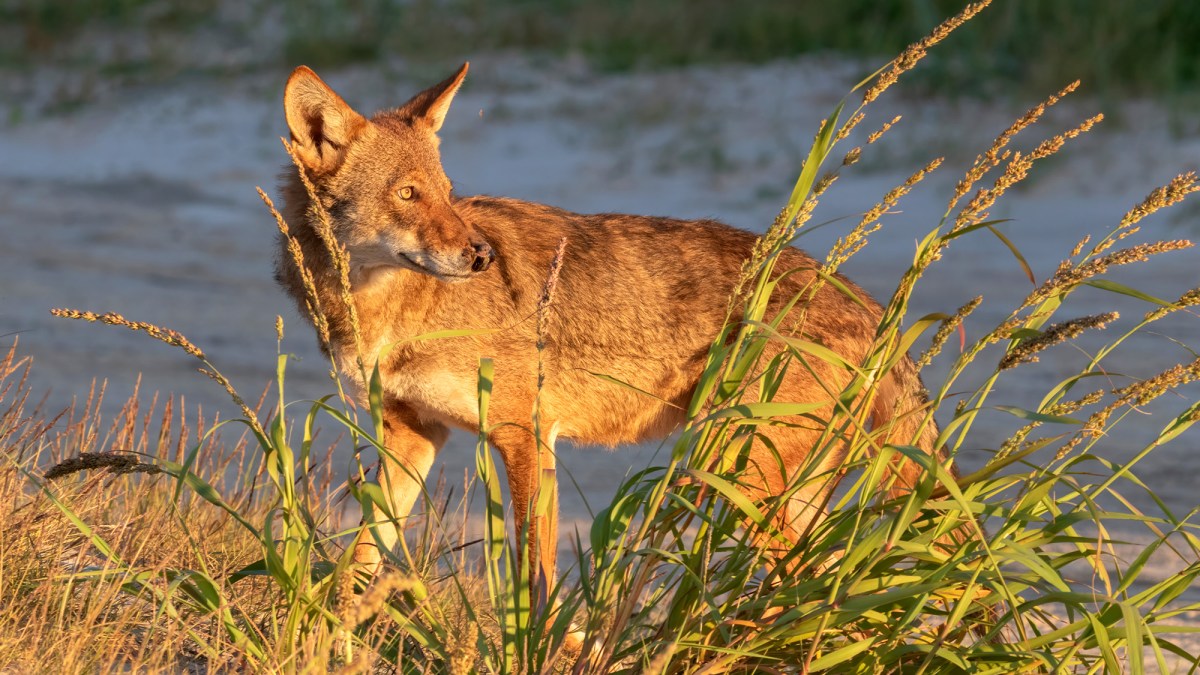

The Texas Department of Transportation is now working with state wildlife officials to help protect the “ghost wolves” that live along the Gulf Coast. TDOT announced Thursday that it had finished installing wildlife crossing signs along a highway on Galveston Island where the animals are known to travel.
According to the state agency, at least 75 of these little-known canids were struck by vehicles along this stretch of road between 2020 and 2025. TDOT says it hopes the crossing signs will also raise public awareness around “ghost wolves,” a relatively newly discovered hybrid species that is part coyote and part endangered red wolf.
Today, wild red wolves are found only in a small corner of North Carolina. This population is made up of descendants from the last known red wolves that inhabited coastal Texas and Louisiana in the 1970’s. The U.S. Fish and Wildlife Service captured 17 of those wolves during the late 70’s, and used 14 of them to establish the captive breeding program that is ongoing. The USFWS then declared red wolves extinct in the wild in 1980.
Although Galveston’s strange-looking coyotes were long thought to be just that, wildlife researchers learned in 2018 that many of them have surprisingly high amounts of red wolf DNA — a byproduct of interbreeding that occurred before red wolves were extirpated from the Gulf Coast regions of Texas and Louisiana. These pre-extinction genetics are the reason for the “ghost” moniker, and conservationists now believe that Canis spiritus can play a role in the recovery of the world’s most endangered wolf species. In some ways, they already have.
“These animals carry both an incredible history in their DNA but also could be a life-saver for the critically endangered red wolf,” say researchers at the Gulf Coast Canine Project.
Although the research group officially formed in 2020, GCCP’s origin story began two years prior, when a Galveston Island resident named Ron Wooten sent in DNA samples from two dead coyotes he’d found on the road. Wooten had always been curious about the local ‘yotes, which are larger and lankier than typical coyotes with bigger ears, redder coats, and white markings on their muzzles. But he and others were still shocked by the DNA results, which showed that both canines were half red wolf and half coyote, according to Texas Parks and Wildlife Magazine.
Coyote-wolf hybrids are not a new phenomenon. In fact, hybridization is part of the coyote’s natural history in North America. As gray wolves and their smaller cousins, red wolves, were killed off by settlers during the early 20th century and pushed out of their historic ranges, Western coyotes expanded across the U.S. to take their place. This led to rampant interbreeding between wolves and coyotes, and even among coyotes and dogs. Researchers have found that a typical coyote living in the Northeastern U.S. contains genetics from western coyotes, wolves, and, to a lesser extent, dogs.
In most modern coyote populations, these “coywolf” genetics have been watered down over time. But the ghost wolves found today on Galveston Island and in parts of southwestern Louisiana still have a high percentage (35 percent or more in some cases) of red wolf DNA.
Along with a team of other researchers, GCCP founders Dr. Kristin Brzeski and Dr. Bridget VonHoldt published this groundbreaking “rediscovery” in a scientific journal in 2018. As the authors pointed out in the study, this was around 38 years after the U.S. Fish and Wildlife Service had declared red wolves extinct in Texas. And with fewer than 30 red wolves now living in the wild along the North Carolina coast, these “ghost” genetics could potentially play a role in the USFWS’ ongoing Red Wolf Recovery Program.
Read Next: Could Red Wolves Actually Improve Deer Populations and Hunting in the Southeast?
“Through interbreeding with coyotes, this endangered genetic variation has persisted and could represent a reservoir of previously lost red wolf ancestry,” the authors wrote in 2018. “This unprecedented discovery opens new avenues for innovative conservation efforts, including the reintroduction of red wolf ghost alleles in the current captive and experimental populations.”
What might those new avenues look like? Enter the Colossal Foundation, a pioneering — and controversial — biotechnology company that aims to “de-extinct” species like the wooly mammoth and Tasmanian tiger.
How the Red ‘Ghost’ Wolf Became the Totem Animal of the Karankawa
Although Colossal got plenty of press for bringing back the dire wolf in 2025, it also successfully completed a red wolf cloning project in 2024. Using genetic material from two Gulf Coast ghost wolves, scientists produced two litters of pups. The firstborn female red wolf, who turned one last September, is named Neka Kayda, which translates to “ghost daughter” in the native Karankawan language.
Read Next: More Than Half of Colorado’s Reintroduced Wolves Are Dead. Can the Program Survive Another Year?
“The Karankawa People and the Red Wolf do have much in common,” said a spokesperson for the Karankawa Tribe of Texas Five Rivers Council, which collaborated with Colossal on the project. “Both being called extinct. Both being forcefully moved off their homelands through violence and loss of natural habitat. Both going through a crucial conservation stage. Both changing history and, despite all odds, pushing forward on their path.”
Read the full article here
