



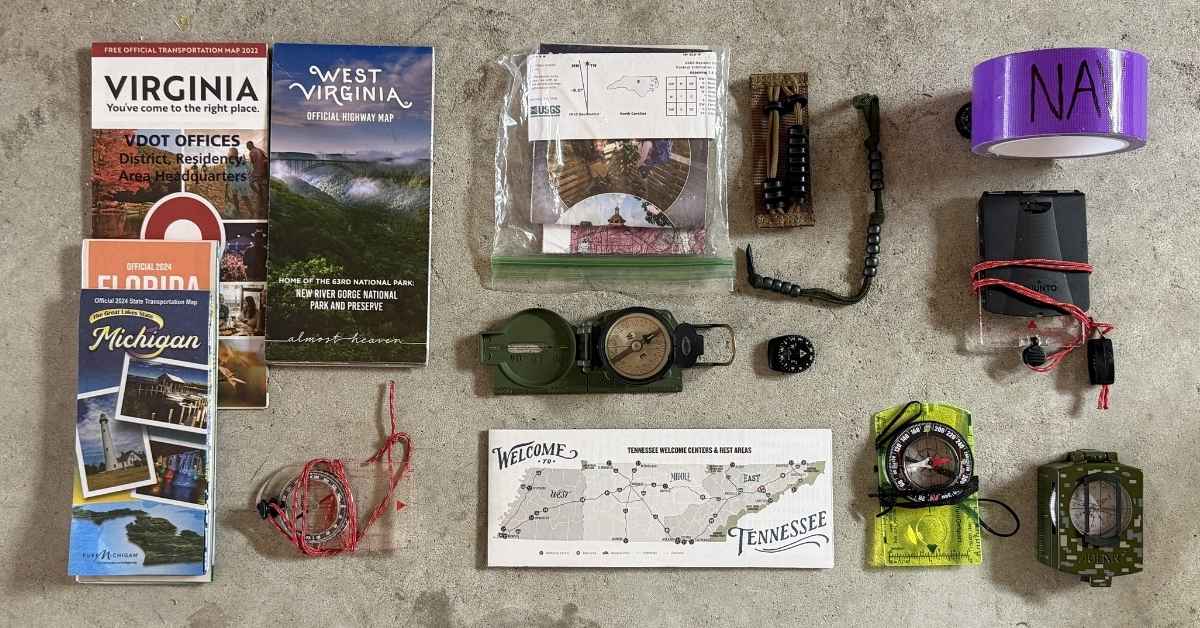

Many survival kits and emergency plans rely on travel to escape threats. Having technology to guide you is always nice, but it’s not necessarily reliable during a disaster. This is why navigation gear and map-reading skills are important focuses for your preparedness.
GPS is everywhere- in your vehicle, on your phone, and even in your watch (for some models). It’s great for convenience, but paper maps, compasses, and low-tech gear are more reliable if you know how to use them. Map reading can be simple with a bit of practice, and all low-tech navigation gear is relatively inexpensive.
I’ve taught land navigation courses in the military and to Boy Scouts, so I’ll share the gear you’ll need and a few skills to practice to help you get the basics.
Contents (Jump to a Section)
We’ve decided to splinter our navigation guide into a separate guide from our communication guide so that we can take a deeper look at the gear and skills needed. When you buy through our links, we may earn a commission. Disclosure»
Survival Navigation
Using the maps app on your phone or already knowing your route like the back of your hand is best, but it’s not ideal to solely rely on those in survival situations. You always want a backup plan, and navigating without your phone or from an unfamiliar location should be possible.
Navigation Gear
There are plenty of supplies to consider for navigation, and here are the essentials:
Less essential gear includes:
- GPS – A standalone GPS is less important due to redundant technology with your cell phone, smartwatch, or other GPS-capable gear.
- Protractor – A military protractor can help you plot courses on maps to avoid obstacles and estimate distances more easily.
- Ranger Beads – We tested the best ranger beads, so grab some so you can pace count accurately and know how far you’ve traveled.
Maps
The hardest part about maps is knowing what size and type you need- but I can help there. If your survival plan involves walking, you’ll want the USGS Quadrangles of your evacuation route, printed and organized in route-order. Add labels and markings as you see fit. Those are all free- just head over to one of the sites we list in our free map guide.
If your plan involves a vehicle, you’ll want state road and highway maps, which can be mailed to you for free for most states. Again, check our free map guide to see if your state and any states you plan to travel through ship maps through the mail completely free.
You can buy folding maps online, but I don’t really see any reason to go that route, since state DOTs keep them relatively updated. I also own a road atlas, though, since my wife prefers that to individual maps.
Reading road maps is relatively easy, as long as you understand where you are located on the map, which direction you are heading, and have signs and landmarks around you for reference.
Navigating a USGS Quadrangle map by foot requires more equipment, however.
Compasses
Compasses can be very effective navigation tools when paired with maps. On their own, they can help you go in a general direction- but azimuths by themselves are tough when it comes to accuracy. If you are using just a compass, you’ll want to sight a distant landmark and walk to it rather than stare at a compass while walking.
This can be difficult, if not impossible, in the woods, so that’s where pace-counting beads can really come in handy. When you first get beads, you should find the distance of your stride on different terrain so that you can determine the distance that you travel using the beads. This immensely helps, since traveling by foot rarely happens in a straight line- you’ll need to turn and adjust around obstacles. Knowing distance and direction helps approximate this.
It’s important to know that there are limitations with compasses and external factors to account for. Compasses are affected by metal, electricity, and magnetism. (This includes knives, phones, watches, and other compasses). They also don’t point true north- they point to magnetic north, so you’ll need to set the compass using the declination diagram on a map.
Organizing Navigation Supplies
Navigation gear is most often paired with communication supplies- both are informational tools that can help during movement. Because they are informational, we assigned the nav/comm gear the color purple in our prepping organization categories. Purple is historically associated with wisdom, which makes sense for the category.
Keeping nav/comm equipment together makes sense- when traveling, it is much safer to let trusted people know your location, destination, and to check in every so often. If you have a GPS or powered technology, you’ll also want gear that can provide power to that. Lastly, you’ll want protective cases, especially for more fragile map compasses.
The Final Word
Navigation supplies are essential components for most survival and emergency kits. Navigating without a GPS voice in your ear is harder, but doable with a minor investment of supplies and time.
Practice reading maps occasionally, and get out your compasses and use them to understand your model’s features and specific limitations. Even I need practice, and I’ve spent my life using them while orienteering, in military exercises, and as a land nav teacher overseas.
If you haven’t looked at communication gear yet, you should head to that category. Otherwise, it’s time to move on to a dirty but important topic: sanitation in survival situations.
See more of our expert-written guides, resources, and reviews in your search results – add TruePrepper as a preferred source.
Prepping Your Way
No judgement and no imperatives. Prepare the way you want to with the trusted source millions of modern preppers have relied on.
Our newsletter fires out every Monday where you can expect:
- Practical prepping guides and tips
- Thorough survival gear reviews
- Noticeably absent spam and popups
Thanks for subscribing, supporting our cause, and improving your own resilience.
Read the full article here
