



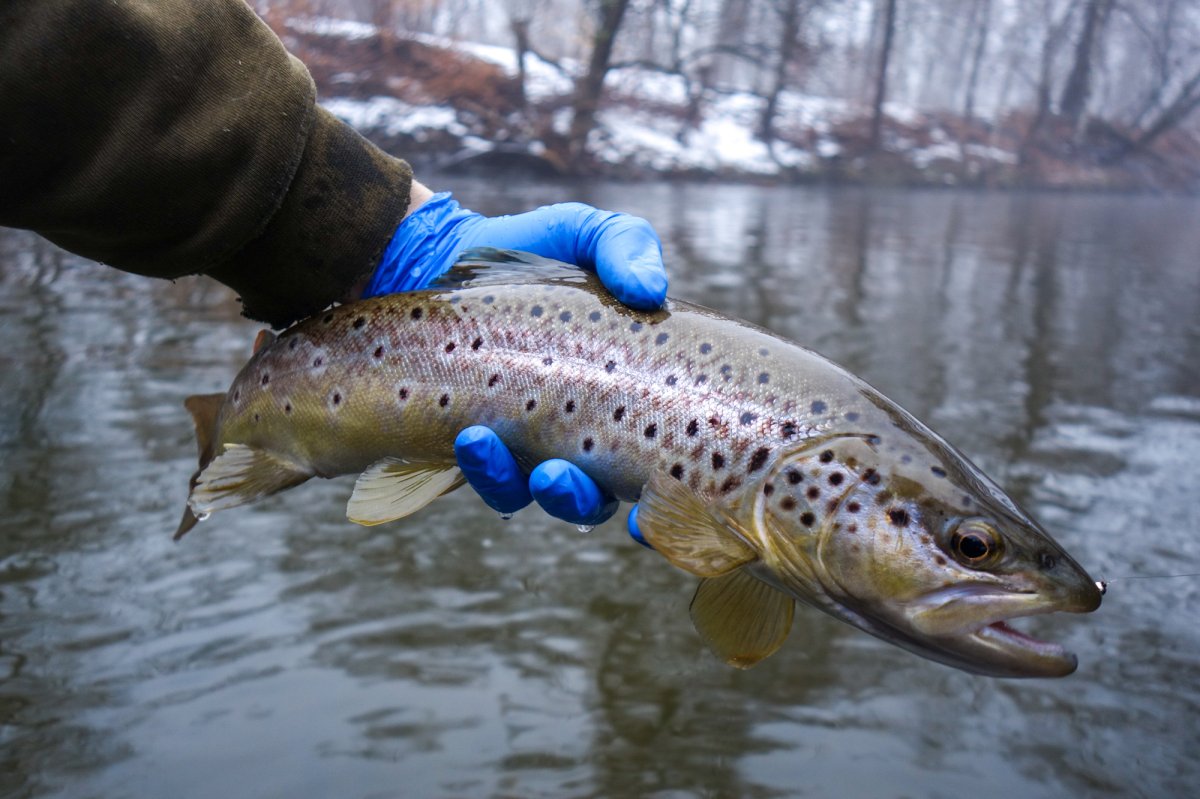

If you live within close range of a spring creek or tailwater river that supports trout, consider yourself lucky. It means when the temperatures drop off in winter, you’ve still got game that rivals spring action. But most of us aren’t that fortunate. We’re stuck with freestone rivers and streams, and when the mercury falls, this presents challenges.
My friend and Connecticut-based fly guide Rowan Lytle knows a thing or two about the struggles of finding freestone success in winter. The problem is that these waters rely solely on precipitation for their flow, which means the air temperature affects them far more than spring-fed waters or those fed by dam releases which inject warmer water year-round. But if you’re stuck with freestones, don’t fret. Lytle has some tips for first deciding if you should be fishing at all, and if the answer is yes, he’s got some tricks up his sleeve for making the most of those bitter winter days.
Listen to this week’s episode of the Quick Strike Podcast on Apple, Spotify, or wherever you get your podcasts.
Freezer Burn
Trout are cold-water fish. That’s common knowledge. It’s easy to assume, then, that the colder the water the happier the fish, but that’s not the reality. There is such a thing as too cold for trout, which means the first step to successful winter fishing on a freestone stream is recognizing when simply catching a trout could be detrimental to its health. Left alone, the fish will survive bitter cold water with no issue, but the air temperature and water temperature matter more once you stick a fly in its lips.
“People have to remember that freestone streams don’t have springs or dam releases to provide a reliable source of warmer water,” says Lytle. “That means if you have a really cold winter, the water can actually cool to temperatures below freezing. That water might not be frozen because it’s moving, but it’s dangerously cold.”
Let’s assume that, to keep the water that cold, the air is also below freezing. Super-cooled water is only liquid when it’s flowing. So, if you were to stick a trout in these conditions, all the water in its gills and on its eye will no longer be moving if you take it out of the stream. This will result in near-instant freezing. Likewise, water inside its body can begin to crystalize very quickly. The negative effects of this would be no different that you or I trying to climb Mount Everest in shorts and a T-shirt. The bottom line is that before you embark on a freestone trout mission in the dead of winter, be sure the conditions won’t be deadly for the fish.
Cold Calling
If you do have favorable winter conditions, the next critical thing to understand is that the trout won’t be where you left them in the spring or fall on a freestone stream. Location is everything in winter, and sometimes the game is won more consistently through patience and repetition than trying to cover miles and miles of water.
“In most places, the fish will get very slow and lethargic as the water temperature drops,” Lytle says. “Generally speaking, trout are most aggressive in water ranging from 50 degrees to about 62 degrees. Even during milder winters here on the East Coast, freestone streams are likely to be running well below those temperatures.”
Once the water drops below 50 degrees, Lytle no longer anticipates steady action in riffles or fast-moving pocket water, simply because holding in these areas forces trout to expend too much energy. Despite their comfort level in chilly streams, trout are going to seek out deeper, slower lies this time of year. On one hand, this makes them easier to locate. On the other, it presents challenges that those who only flyfish during warmer months may not have faced.
Long Shots
Small eggs, scuds, pheasant tail nymphs, and tiny black stoneflies are all top-producing patterns for Lytle in winter. Fly selection, however, is the easy part. The challenge is learning how to present those flies to fish holding in 6 to 10 feet of water, which is the common depth range where he finds them stacked up. If you’re looking to aggressively strip a streamer pattern, now is not the time. You must slow down as much as the fish.
“I hate to say it, but some of the most productive methods for fooling winter freestone trout are kind of boring,” says Lytle. “I use very small strike indicators that will detect the slightest hit and very long leaders. Then, you’re taking long, slow, tedious drifts to keep the flies in the zone for as much time as possible.”
By “long” Lytle is referring to leaders in the 10- to 12-foot range, and one of the biggest mistakes he says he sees people make with a rig like this is trying to fish upstream. Though that’s the norm in flyfishing most of the time, in winter he has more success casting across and downstream, and then feeding line to achieve a long drift. With practice, Lytle says you’ll get a feel for how far you can let that indicator go and still be able to get a solid hook set if it dips under.
Read the full article here
