



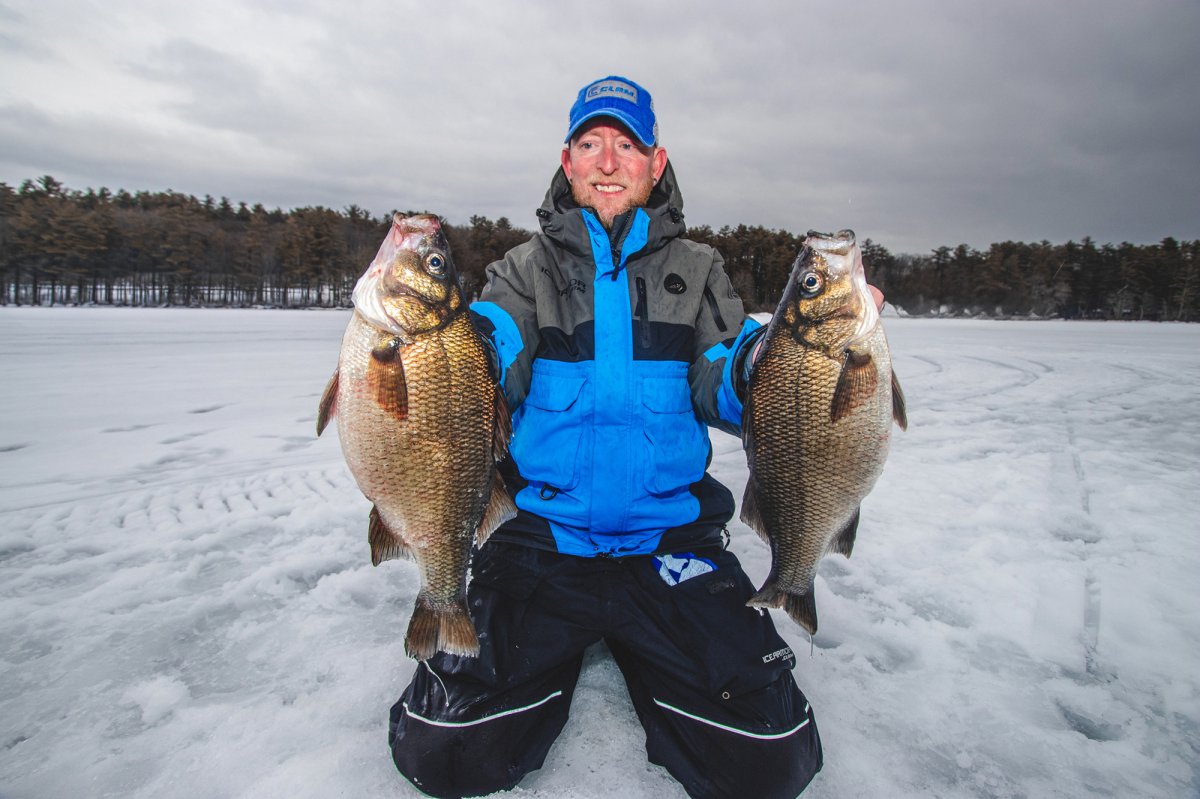

White perch are a bit odd. They exist in strong numbers in many regions of the country, yet few anglers make them a primary target. Much of this has to do with size. For the most part, white perch are small, rarely cracking about 10 inches in length. But there are also pockets of fish scattered throughout their range that grow big. In many cases, these are brackish water environments — but Lake Winnipesaukee in New Hampshire is not. Here in New England, landlocked white perch routinely break the 2-pound mark, and one of the fastest ways to catch a pile of these giants in on the ice.
My friend and veteran guide Tim Moore has been getting after these marauding schools for decades. They’re relatives of the striped bass, and behave similarly under the ice, roving around chasing balls of smelt. Because they’re often on the move, anglers often must be, too, staying mobile and getting ahead of the fish. It’s a fast-paced style of ice fishing. When you get on the perch it’s usually the motherlode and the action is fierce. If these fish exist on hardwater near you, Moore’s insight will help you pin them down. And if they don’t, just learning about the game might get you fired up for a road trip to “Winni” this winter.
Listen to this week’s episode of the Quick Strike Podcast on Apple, Spotify, or wherever you get your podcasts.
Basin Instinct
As it goes with many fisheries: If you find the bait, you find the predators. It applies to white perch, which is why Moore mostly fishes in protected basins off the main lake. Baitfish often seek sheltered water. What’s important is having a milk run of basins or coves, because one can be on fire while the others are dead. This is especially important on larger bodies of water.
“Winnipesaukee is a different animal compared to a lot of fisheries for white perch because it’s so big,” says Moore. “The fish can behave much like they would if they were in the ocean. They’re nomadic. They’re either there or they’re not, but they can also just show up in an instant. You put a flasher in and there’s nothing on the screen. Then you drop a jig down and suddenly the red lines just start stacking up because they were just lying on the bottom.”
In the ideal scenario, a big school of feeding white perch will hang in a small area for a while. And though electronics are crucial for locating them, a little “bent-rod sonar” comes in handy, too. Moore isn’t looking at other anglers to steal spots, but rather to figure out if the fish are stationary or moving around. If anglers are frequently leap frogging each other and drilling new holes, Moore knows to do the same and expand the perimeter where he’s fishing sooner rather than later.
Nail the Timing
On many days, it’s not a matter of if you’ll get into drop-and-reel action, just when. Much like white bass and stripers, white perch often feed hardest during low light periods regardless of how much snowpack is on the ice. Midday can be tough, especially if the sun is shining. But that doesn’t mean there’s no opportunity between raging feeds.
“You can catch perch on tip ups and even worms,” Moore says. “If they’re not actively chasing bait schools, they’ll root around in the mud within the basins for worms or aquatic insects. It’s not the most fun way to target them, but it can be effective. In that scenario, though, you’re picking a fish here and there, so I’d rather keep moving and find an active school.”
Moore’s strategy once he locates a pile of perch with his electronics is focusing on the top of the school. Rather than dropping a jig into the mix, he likes to stay just above them as it increases competition. Once one fish is willing to peel away and attack a jig, the rest of the fish will start looking up. This is when you can experience periods of non-stop action.
Drop Zone
Like many species under the ice, lure selection isn’t a mystery. It’s finding the fish that matters, and once you do, a standard smattering of offerings will make the play. The same applies to white perch, with simple jigs being the ringers, though Moore does advise having lures in a variety of sizes.
“I have two lures that are absolutely my go-tos,” Moore says. “I like the Clam Epoxy Drop and the Blade Spoon. They Epoxy Drop is probably the most effective lure because it’s so small, but it also takes more time to reach depth, and these fish can be as deep as 30 feet. The Blade Spoon gets down much faster and if the fish are picky, it’s more versatile because you can finesse it or work it really quickly.”
Speed to the zone matters, because a hungry school and disappear in a flash, so you need to make hay while the sun’s shining. Moore also points out that inactive fish — the ones lying in the mud picking off bugs — will also take a shot at the same spoons you’d use during blitz time if you work them really slowly on the bottom, creating a slight disturbance to get their attention. If you get after perch on the ice this winter you hopefully won’t have to do that, though, because your screen will be red top to bottom all day.
Read the full article here
